
Microsoft AZ-120 Practice Exams
Last updated on Nov 16,2026- Exam Code: AZ-120
- Exam Name: Planning and Administering Microsoft Azure for SAP Workloads
- Certification Provider: Microsoft
- Latest update: Nov 16,2026
You plan to migrate an SAP environment to Azure.
You need to recommend a solution to migrate the SAP application servers to Azure. The solution must
minimize downtime and changes to the environments.
What should you include in the recommendation?
- A . Azure Storage Explorer
- B . Azure Import/Export service
- C . AzCopy
- D . Azure Site Recovery
D
Explanation:
Site Recovery is used to manage and orchestrate disaster recovery of on-premises machines and Azure VMs. However, it can also be used for migration. Migration uses the same steps as disaster recovery with one exception. In a migration, failing machines over from your on-premises site is the final step. Unlike disaster recovery, you can’t fail back to on-premises in a migration scenario.
Reference:
https://docs.microsoft.com/en-us/azure/site-recovery/migrate-tutorial-on-premises-azure
https://www.microsoft.com/en-us/itshowcase/strategies-for-migrating-sap-systems-to-microsoft-azure
Your on-premises network contains the following:
• A 1-Gbps internet connection
• An SAP HANA 1.0 instance that has a 4-TB database
• An SAP landscape that uses SUSE Linux Enterprise (SLES) 12
You have an Azure subscription that contains a virtual machine. The virtual machine is of the M64s SKU and runs SLES 15 and HANA 2.0.
You need to migrate the database to the virtual machine and upgrade the database to HANA 2.0.
The solution must meet the following requirements:
• The migration must be performed during a weekend.
• The database can be offline during the migration.
Which migration method should you use?
- A . Azure Data Box
- B . HANA database backup and log shipping
- C . Azure Migrate
- D . HANA database export and import
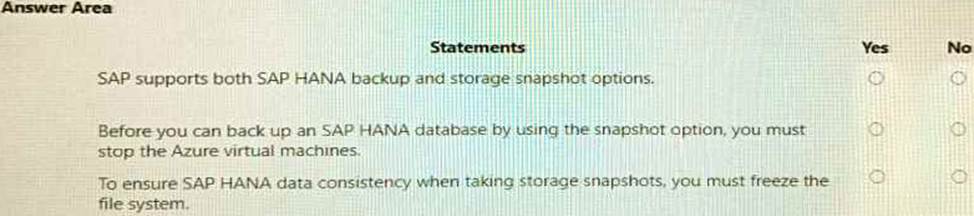
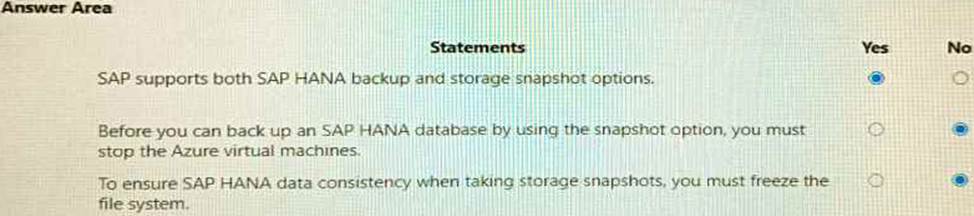
HOTSPOT
For each of the following statements, select Yes if the statement is true. Otherwise, select No. NOTE Each correct selection is worth one point.
You have an SAP landscape on Azure that contains the virtual machines shown in the following table.

You need to ensure that the Application Server role is available if a single Azure datacenter fails.
What should you include in the solution?
- A . Azure Private Link
- B . Azure Load Balancer Standard
- C . a local network gateway
- D . Azure Application Gateway v1
You are planning the Azure network infrastructure to support the disaster recovery requirements.
What is the minimum number of virtual networks required for the SAP deployed?
- A . 1
- B . 2
- C . 3
- D . 4
B
Explanation:
Scenario: Ensure that all the production databases can withstand the failure of an Azure region.
Note: Use Azure Site Recovery to replicate applications across regions. Azure Site Recovery replicates workloads running on physical and virtual machines from a primary site (either on-premises or in Azure) to a secondary location (in Azure). When an outage occurs at the customer’s primary site, a failover can be triggered to quickly return the customer to an operational state. After the primary location is restored, customers can then fail back.
Reference: https://docs.microsoft.com/en-us/azure/architecture/resiliency/recovery-loss-azure-region
You are evaluating which migration method Litware can implement based on the current environment and the business goals.
Which migration method will cause the least amount of downtime?
- A . Use the Database migration Option (DMO) to migrate to SAP HANA and Azure During the same maintenance window.
- B . Use Near-Zero Downtime (NZDT) to migrate to SAP HANA and Azure during the same maintenance window.
- C . Migrate SAP to Azure, and then migrate SAP ECC to SAP Business Suite on HANA.
- D . Migrate SAP ECC to SAP Business Suite on HANA an the migrate SAP to Azure.
A
Explanation:
The SAP Database Migration Option (DMO) with System Move option of SUM, used as part of the migration allows customer the options to perform the migration in a single step, from source system on-premises, or to the target system residing in Microsoft Azure, minimizing overall downtime.
Reference: https://blogs.sap.com/2017/10/05/your-sap-on-azure-part-2-dmo-with-system-move/
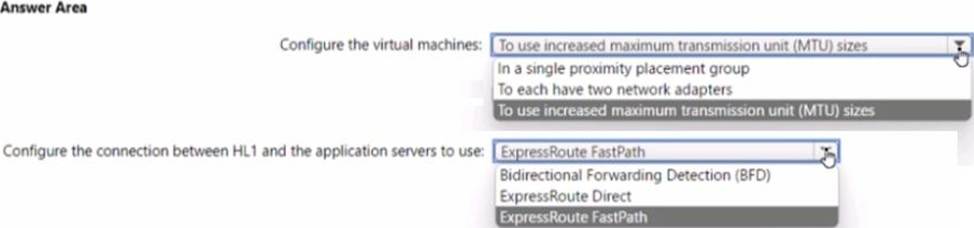
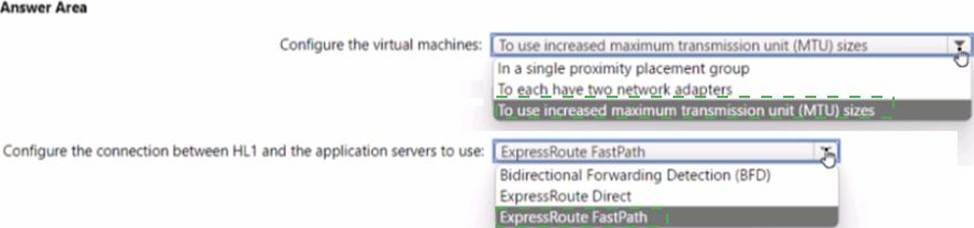
HOTSPOT
You have an instance of SAP NANA on Azure (Large Instances) named HIM.
You plan to deploy Azure virtual machines. The virtual machines will host application servers that will access the database on HLI1.
You need to minimize latency between the application servers and HLH
What should you do? To answer, select the appropriate options m the answer area NOTE: Each correct selection is worth one point.
HOTSPOT
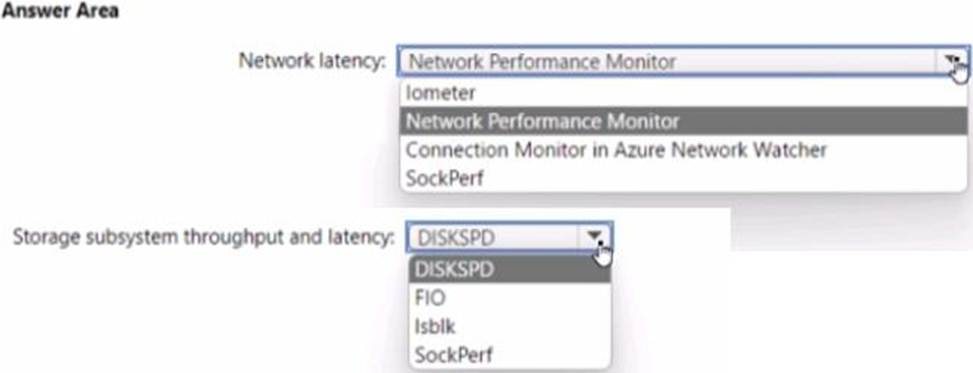
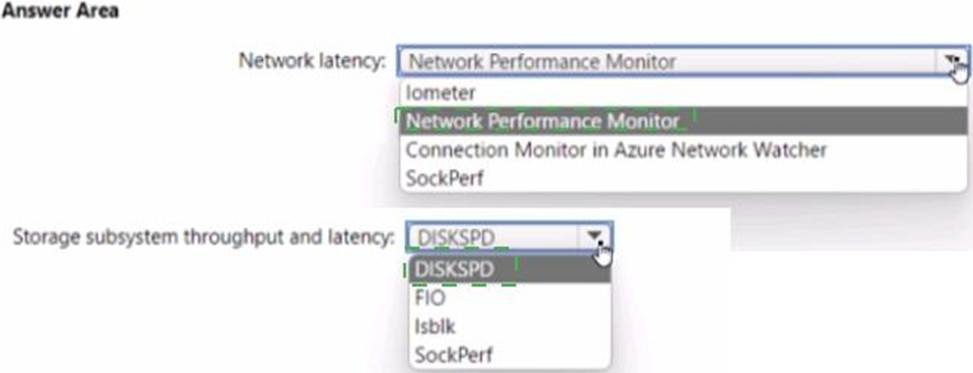
You have an SAP on Azure landscape.
You need to gather the following metrics:
• The network latency between an SAP NetWeaver server and an SAP HANA server.
• The throughput and latency of the storage subsystem on Windows Server and Linux platforms
What should you use for each metric? To answer, select the appropriate options in the answer area. NOTE: Each correct selection is worth one point.
You have an SAP ERP Central Component (SAP ECQ) environment on Azure.
You need to add an additional SAP application server to meet the following requirements:
• Provide the highest availability.
• Provide the fastest speed between the new server and the database.
What should you do?
- A . Place the new server in a different Azure Availability Zone than the database.
- B . Place the new server in the same Azure Availability Set a? the database and the other application servers.
- C . Place the new server in the same Azure Availability Zone as the database and the other application servers.
You have an on-premises SAP NetWeaver landscape that contains an IBM DB2 database.
You need to migrate the database to a Microsoft SQL Server instance on an Azure virtual machine.
Which tool should you use?
- A . Data Migration Assistant
- B . SQL Server Migration Assistant (SSMA)
- C . Azure Migrate
- D . Azure Database Migration Service