
Microsoft AZ-120 Practice Exams
Last updated on Nov 16,2026- Exam Code: AZ-120
- Exam Name: Planning and Administering Microsoft Azure for SAP Workloads
- Certification Provider: Microsoft
- Latest update: Nov 16,2026
You are deploying an SAP environment on Azure that will use an SAP HANA database server. You provision an Azure virtual machine for SAP HANA by using the M64s virtual machine SKU. You need to set the swap space by using the Microsoft Azure Linux Agent (waagent) configuration file.
Which two settings should you configure? Each correct answer presents part of the solution. NOTE: Each correct selection is worth one point.
- A . ResourceDisk.EnableSwapEncryption=n
- B . AutoUpdate.Enabled=n
- C . ResourceDisk.SwapSizeMB=229376
- D . ResourceDisk.EnableSwap=y
CD
Explanation:
To create a swap file in the directory that’s defined by the ResourceDisk.MountPoint parameter, you can update the /etc/waagent.conf file by setting the following three parameters:
ResourceDisk.Format=y
ResourceDisk.EnableSwap=y
ResourceDisk.SwapSizeMB=xx
Reference: https://support.microsoft.com/en-us/help/4010058/how-to-add-a-swap-file-in-linux-azure-virtual-machines
Note: This question is part of a series of questions that present the same scenario. Each question in the series contains a unique solution that might meet the stated goals. Some question sets might have more than one correct solution, while others might not have a correct solution.
After you answer a question in this section, you will NOT be able to return to it. As a result, these questions will not appear in the review screen.
You deploy SAP HANA on Azure (Large Instances).
You need to back up the SAP HANA database to Azure.
Solution: Back up directly to disk, copy the backups to an Azure virtual machine, and then copy the backup to an Azure Storage account
Does this meet the goal?
- A . Yes
- B . No
B
Explanation:
Instead you should create a Recovery Services vault and a backup policy.
Reference:
https://docs.microsoft.com/en-us/azure/backup/sap-hana-db-about
https://docs.microsoft.com/en-us/azure/backup/backup-azure-sap-hana-database#configure-backup
DRAG DROP
You have an SAP landscape on Azure that contains the virtual machines shown in the following table.

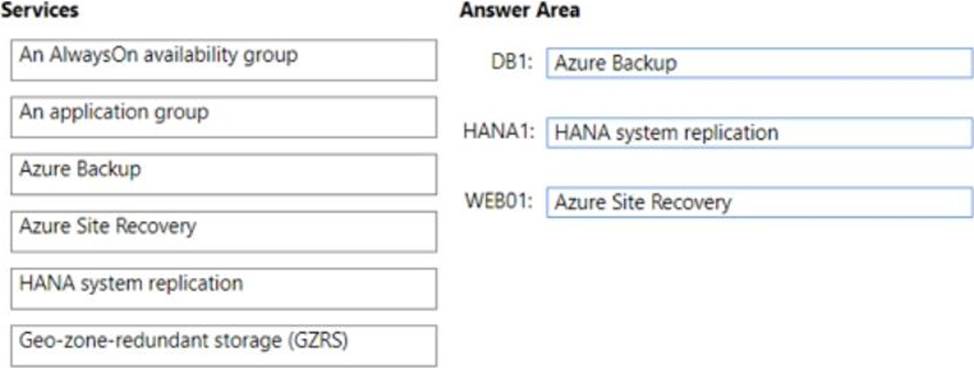
You need to recommend a recovery solution in the event of an Azure regional outage.
The solution must meet the following requirements:
• Minimize costs.
• Minimize data loss.
• Minimize administrative effort.
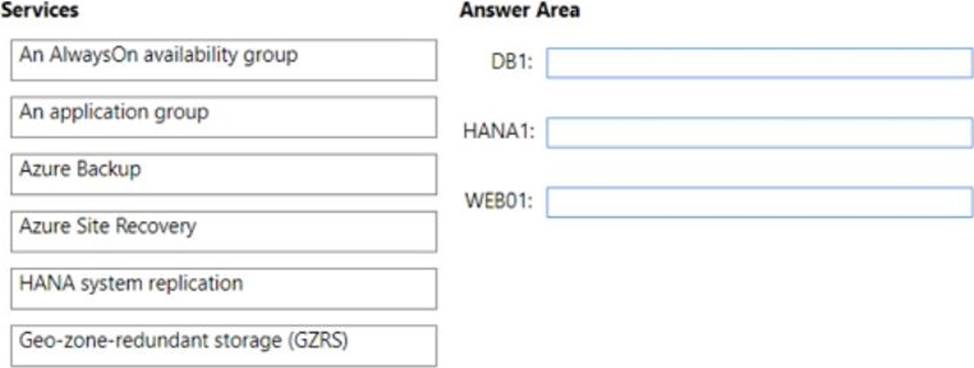
What should you recommend for each virtual machine? To answer, drag the appropriate services to the correct virtual machines. Each service may be used once, more than once, or not at all. You may need to drag the split bar between panes or scroll to view content. NOTE: Each correct selection is worth one point.
HOTSPOT
You have an SAP environment that contains the following components:
* Enhancement Package 6 for SAP ERP Central Component 6.0 (SAP ECC 6.0)
* Servers that runs SUSE Linux Enterprise Server 12 (SIES 12)
* Databases on IBM D82 10.5
* SAP Solution Manager 7.1
You plan to migrate the SAP environment to Azure.
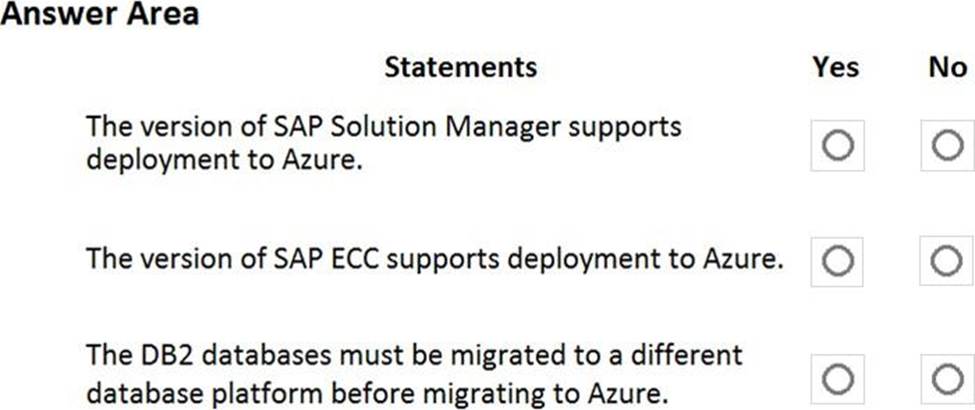
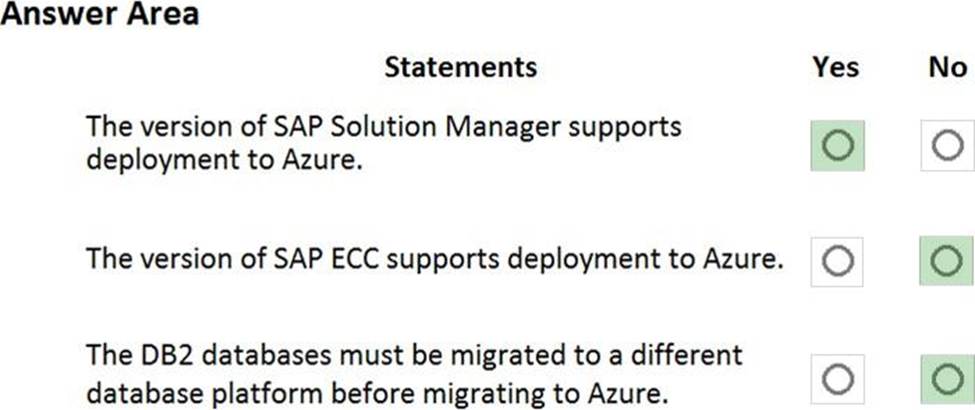
For each of the following statements, select Yes if the statement is true. Otherwise, select No. NOTE: Each correct selection is worth one point.
Explanation:
Box 1: Yes
Box 2: NO
Box 3: No
With Microsoft Azure, you can migrate your existing SAP application running on IBM Db2 for Linux, UNIX, and Windows (LUW) to Azure virtual machines. With SAP on IBM Db2 for LUW, administrators and developers can still use the same development and administration tools, which are available on-premises.
Reference:
https://docs.microsoft.com/en-us/azure/data-factory/connector-sap-table
https://docs.microsoft.com/en-us/azure/virtual-machines/workloads/sap/dbms_guide_ibm
HOTSPOT
You have an SAP environment that contains the following components:
* Enhancement Package 6 for SAP ERP Central Component 6.0 (SAP ECC 6.0)
* Servers that runs SUSE Linux Enterprise Server 12 (SIES 12)
* Databases on IBM D82 10.5
* SAP Solution Manager 7.1
You plan to migrate the SAP environment to Azure.
For each of the following statements, select Yes if the statement is true. Otherwise, select No. NOTE: Each correct selection is worth one point.
Explanation:
Box 1: Yes
Box 2: NO
Box 3: No
With Microsoft Azure, you can migrate your existing SAP application running on IBM Db2 for Linux, UNIX, and Windows (LUW) to Azure virtual machines. With SAP on IBM Db2 for LUW, administrators and developers can still use the same development and administration tools, which are available on-premises.
Reference:
https://docs.microsoft.com/en-us/azure/data-factory/connector-sap-table
https://docs.microsoft.com/en-us/azure/virtual-machines/workloads/sap/dbms_guide_ibm
You have an Azure subscription.
You deploy Active Directory domain controllers to Azure virtual machines.
You plan to deploy Azure for SAP workloads.
You plan to segregate the domain controllers from the SAP systems by using different virtual networks.
You need to recommend a solution to connect the virtual networks. The solution must minimize costs.
What should you recommend?
- A . a site-to-site VPN
- B . virtual network peering
- C . user-defined routing
- D . ExpressRoute
B
Explanation:
https://github.com/MicrosoftDocs/azure-docs/issues/32537
https://azure.microsoft.com/en-us/blog/vnet-peering-and-vpn-gateways/
HOTSPOT
You plan to deploy two Azure virtual machines that will host an SAP HANA database for an SAP landscape. The virtual machines will be deployed to the same availability set.
You need to meet the following requirements:
• Ensure that the virtual machines support disk snapshots.
• Ensure that the virtual machine disks provide submillisecond latency for writes.
• Ensure that each virtual machine can be allocated disks from a different storage cluster.
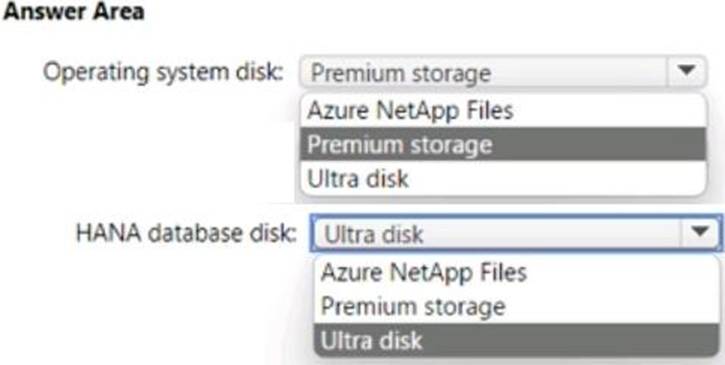
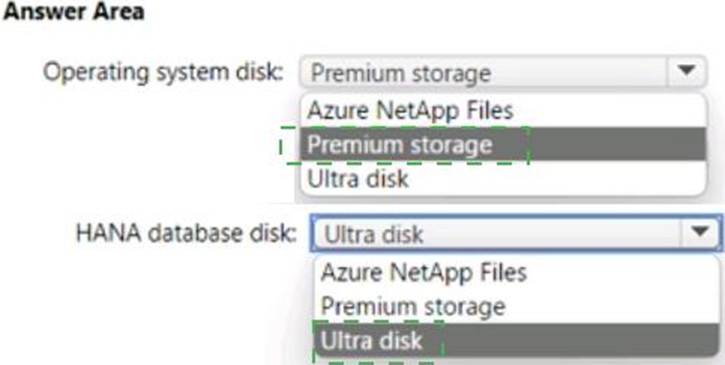
Which type of operating system disk and HANA database disk should you use? To answer, select the appropriate options in the answer area. NOTE Each correct selection is worth one point.
You have an Azure virtual machine that runs SUSE Linux Enterprise Server (SlES). The virtual machine hosts a highly available deployment of SAP HANA.
You need to validate whether Accelerated Networking is operational for the virtual machine.
What should you use?
- A . fio
- B . iometer
- C . netsh
- D . ethtool
D
Explanation:
Check for activity on the VF (virtual function) with the ethtool -S eth0 | grep vf_ command. If you receive output similar to the following sample output, accelerated networking is enabled and working.
vf_rx_packets: 992956
vf_rx_bytes: 2749784180
vf_tx_packets: 2656684
vf_tx_bytes: 1099443970
vf_tx_dropped: 0
Accelerated Networking is now enabled for your VM.
Reference: https://docs.microsoft.com/en-us/azure/virtual-network/create-vm-accelerated-networking-cli
You are planning a highly available SAP HANA deployment on Azure virtual machines.
You need to recommend a solution for monitoring TCP latency between the SAP application and the database tiers on the TCP socket layer.
What should you include in the recommendation?
- A . the Azure Network Watcher reachability report
- B . Azure Extension for SAP
- C . the NIPING command
- D . the PING command
DRAG DROP
You have a large and complex SAP environment on Azure.
You are designing a training landscape that will be used 10 times a year.
You need to recommend a solution to create the training landscape.
The solution must meet the following requirements:
✑ Minimize the effort to build the training landscape.
✑ Minimize costs.
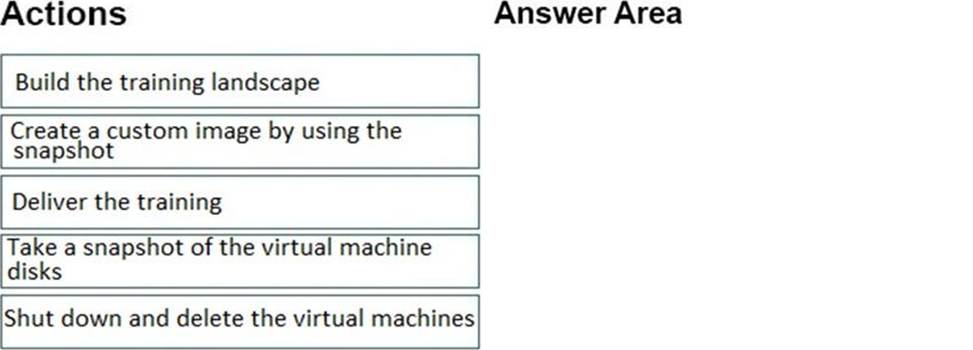
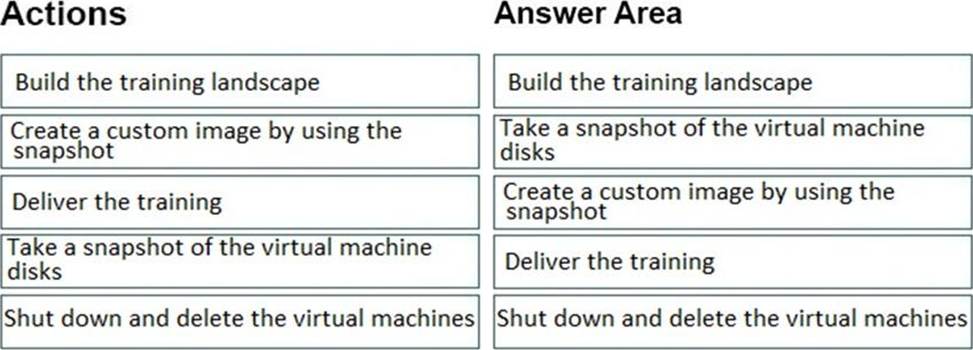
In which order should you recommend the actions be performed for the first training session? To answer, move all actions from the list of actions to the answer area and arrange them in the correct order.
Explanation:
Build
Snapshot
Custom Image
Deliver Training
Shutdown
Reference: https://docs.microsoft.com/en-us/azure/virtual-machines/workloads/sap/planning-guide