
Microsoft AZ-120 Practice Exams
Last updated on Nov 16,2026- Exam Code: AZ-120
- Exam Name: Planning and Administering Microsoft Azure for SAP Workloads
- Certification Provider: Microsoft
- Latest update: Nov 16,2026
You have an SAP landscape on Azure that uses SAP HANA
You perform a daily backup of HANA to Azure Blob Storage and retain copies of each backup for one year
You need to reduce the backup storage costs.
What should you implement?
- A . a stored access policy
- B . a Recovery Services Vault backup policy
- C . a storage access tier
HOTSPOT
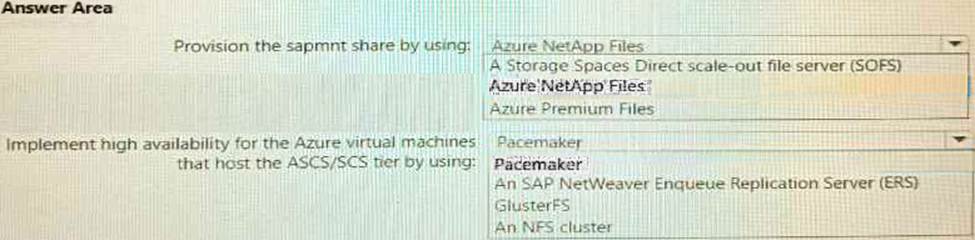
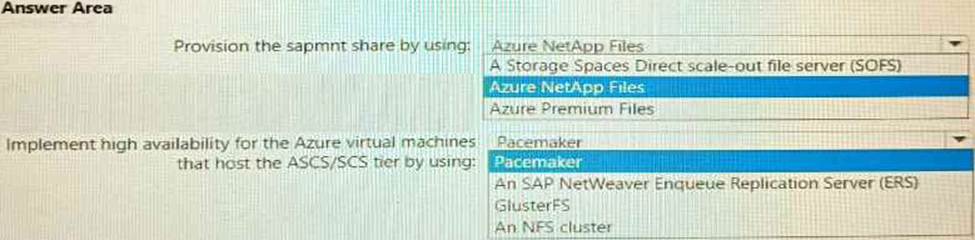
You plan to implement a highly available, three-tier deployment of an SAP NetWeaver landscape on Azure. The landscape will use SUSE Linux Enterprise Server (SLES).
You need to implement the SAP NetWeaver central services (ASCS/SCS) tier.
What should you do? To answer, select the appropriate options in the answer area. NOTE Each correct selection is worth one point.
You are designing an SAP production landscape on Azure.
The landscape must ensure service availability in the event of an Azure datacenter failure
What should you include in the design?
- A . an availability zone
- B . an availability set
- C . a fusion group
- D . a proximity placement group
HOTSPOT
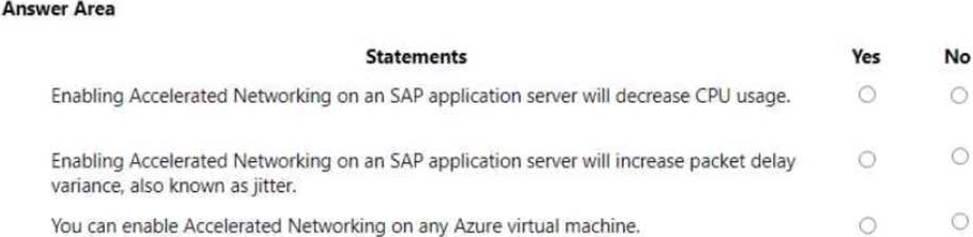
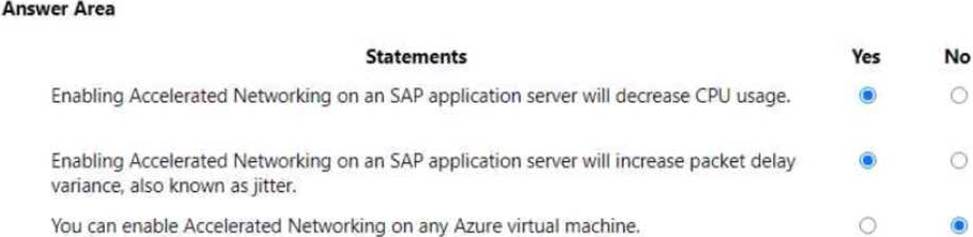
For each of the following statements, select Yes if the statement is true. Otherwise, select No. NOTE: Each correct selection is worth one point.
HOTSPOT
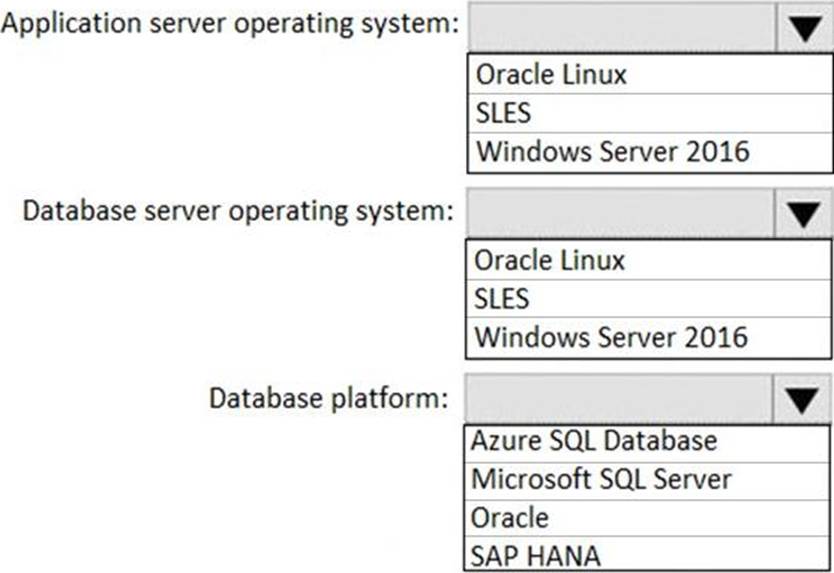
You have an on-premises SAP environment. Application servers run on SUSE Linux Enterprise Server (SLES) servers. Databases run on SLES servers that have Oracle installed.
You need to recommend a solution to migrate the environment to Azure. The solution must use currently deployed technologies whenever possible and support high availability.
What should you include in the recommendation? To answer, select the appropriate options in the answer area. NOTE: Each correct selection is worth one point.
HOTSPOT
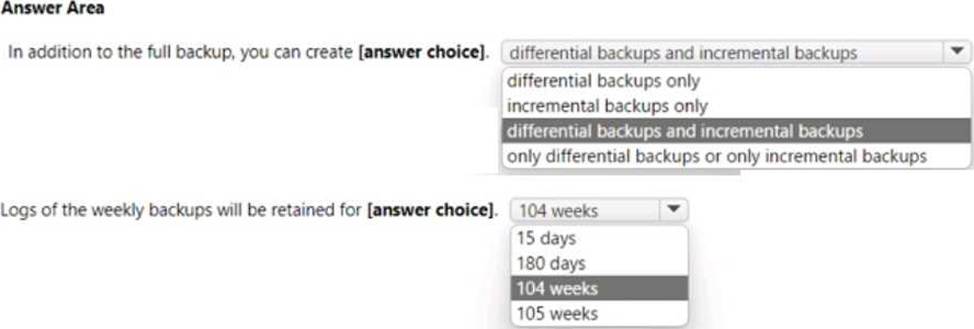
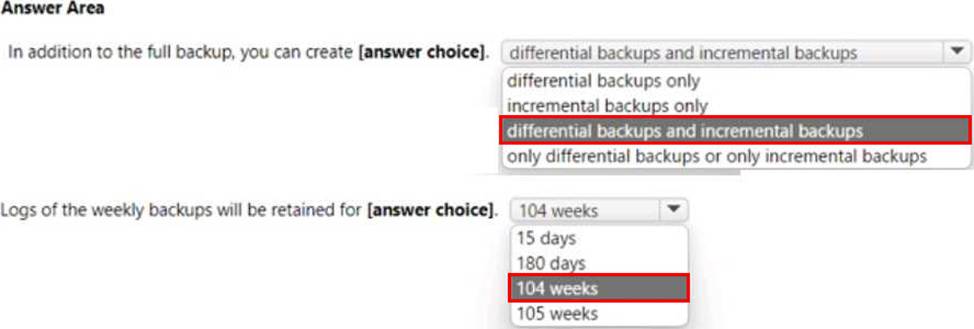
You have an SAP on Azure production landscape that contains an SAP HANA database.
You create a backup policy as shown in the following exhibit.
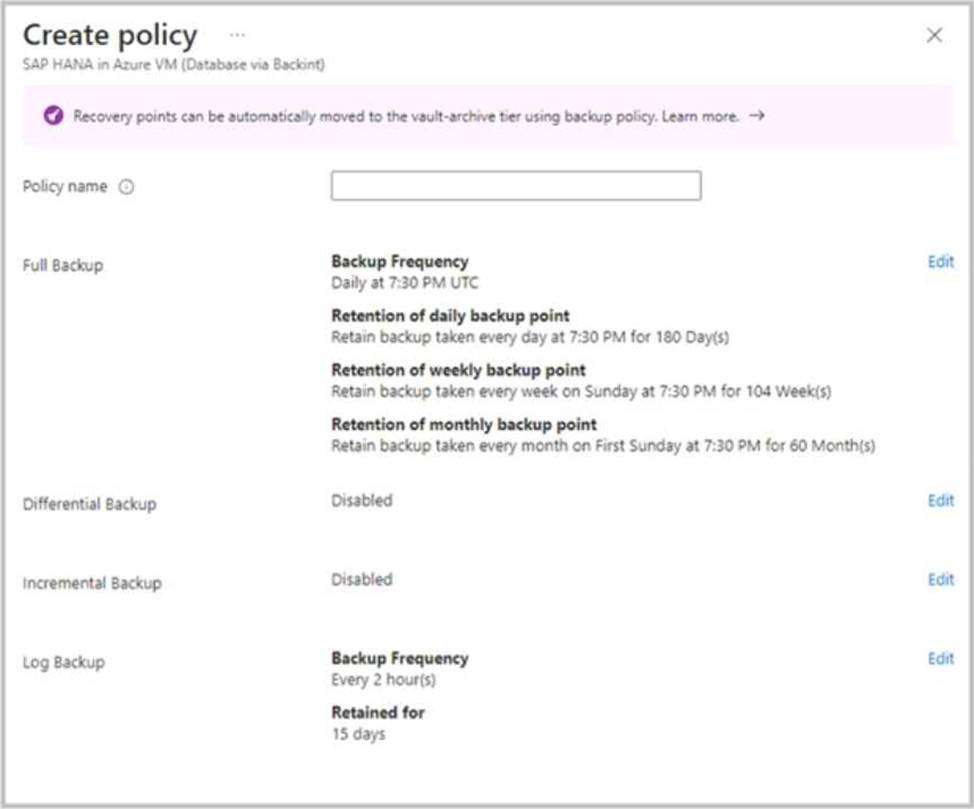
Use the drop-down menus to select the answer choice that completes each statement based on the information presented in the graphic. NOTE: Each correct selection is worth one point.
You have an SAP environment on Azure that uses multiple subscriptions.
To meet GDPR requirements, you need to ensure that virtual machines are deployed only to the West Europe and North Europe Azure regions.
Which Azure components should you use?
- A . Azure resource locks and the Compliance admin center
- B . Azure resource groups and role-based access control (RBAC)
- C . Azure management groups and Azure Policy
- D . Azure Security Center and Azure Active Directory (Azure AD) groups
C
Explanation:
Azure Policy enables you to set policies to conform to the GDPR. Azure Policy is generally available today at no additional cost to Azure customers. You can use Azure Policy to define and enforce policies that help your cloud environment become compliant with internal policies as well as external regulations.
Azure Policy is deeply integrated into Azure Resource Manager and applies across all resources in Azure. Individual policies can be grouped into initiatives to quickly implement multiple rules. You can also use Azure Policy in a wide range of compliance scenarios, such as ensuring that your data is encrypted or remains in a specific region as part of GDPR compliance. Microsoft is the only hyperscale cloud provider to offer this level of policy integration built in to the platform for no additional charge.
Reference: https://azure.microsoft.com/de-de/blog/new-capabilities-to-enable-robust-gdpr-compliance/
You are deploying an SAP production landscape to Azure.
Your company’s chief information security officer (CISO) requires that the SAP deployment complies with ISO 27001.
You need to generate a compliance report for ISO 27001.
What should you use?
- A . Azure Security Center
- B . Azure Log Analytics
- C . Azure Active Directory (Azure AD)
- D . Azure Monitor
A
Explanation:
In the Azure Security Center regulatory compliance blade, you can get an overview of key portions of your compliance posture with respect to a set of supported standards. Currently supported standards are Azure CIS, PCI DSS 3.2, ISO 27001, and SOC TSP.
Reference: https://azure.microsoft.com/en-us/blog/regulatory-compliance-dashboard-in-azure-security-center-
now-available/
You are deploying an SAP environment on Azure that will use an SAP HANA database server. You provision an Azure virtual machine for SAP HANA by using the M64s virtual machine SKU. You need to set the swap space by using the Microsoft Azure Linux Agent (waagent) configuration file.
Which two settings should you configure? Each correct answer presents part of the solution. NOTE: Each correct selection is worth one point.
- A . ResourceDisk.EnableSwapEncryption=n
- B . AutoUpdate.Enabled=n
- C . ResourceDisk.SwapSizeMB=229376
- D . ResourceDisk.EnableSwap=y
CD
Explanation:
To create a swap file in the directory that’s defined by the ResourceDisk.MountPoint parameter, you can update the /etc/waagent.conf file by setting the following three parameters:
ResourceDisk.Format=y
ResourceDisk.EnableSwap=y
ResourceDisk.SwapSizeMB=xx
Reference: https://support.microsoft.com/en-us/help/4010058/how-to-add-a-swap-file-in-linux-azure-virtual-machines