
Microsoft AZ-120 Practice Exams
Last updated on Nov 16,2026- Exam Code: AZ-120
- Exam Name: Planning and Administering Microsoft Azure for SAP Workloads
- Certification Provider: Microsoft
- Latest update: Nov 16,2026
HOTSPOT
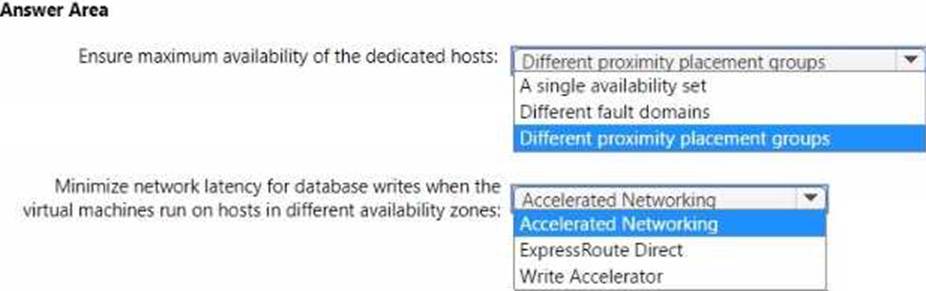
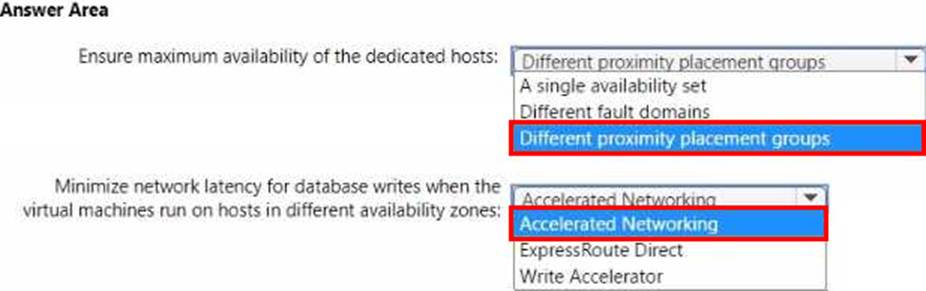
You need to implement a deployment of SAP NetWeaver on Azure. The deployment will be hosted on Esv3 virtual machines that run on dedicated hosts. The hosts will be deployed to different availability zones in a single Azure region.
The solution must meet the following requirements:
• Ensure maximum availability of the dedicated hosts.
• Minimize network latency for database writes when the virtual machines run on hosts in different availability zones.
What should you use for each requirement? To answer, select the appropriate options in the answer area. NOTE: Each correct selection is worth one point.
HOTSPOT
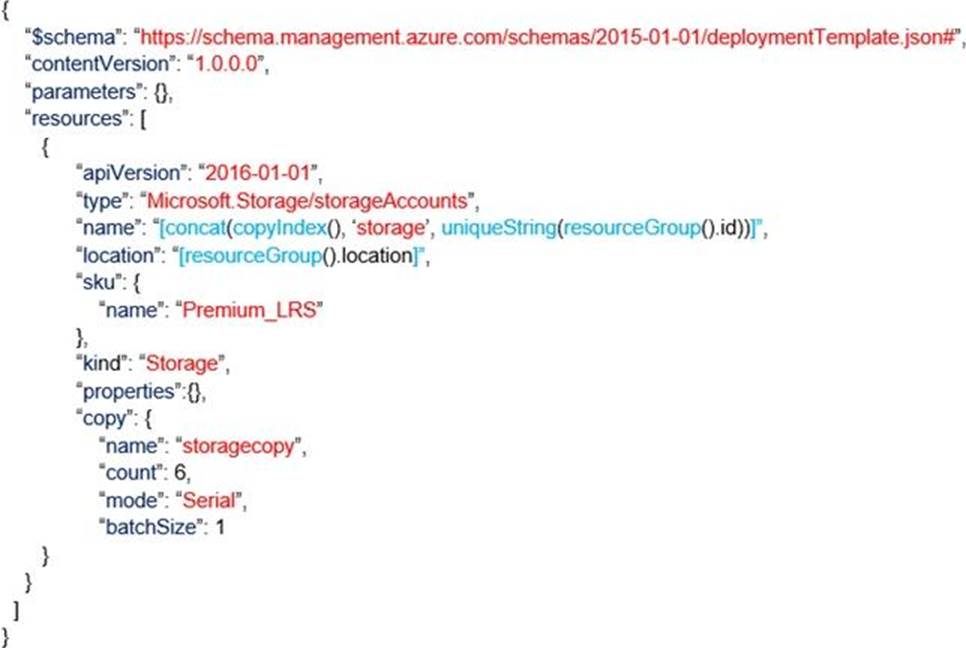
You have the following Azure Resource Manager template.
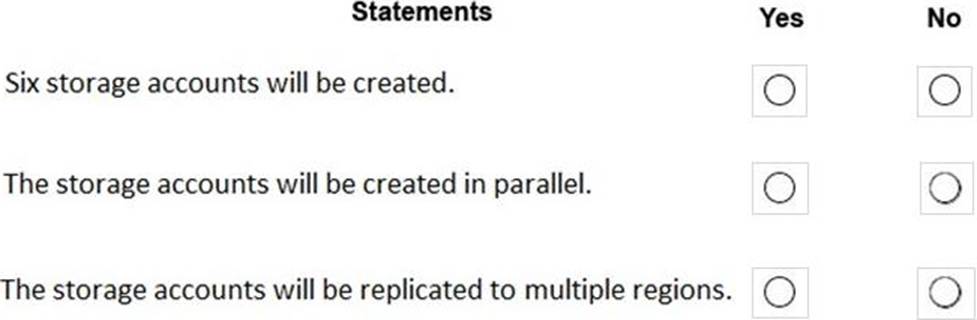
For each of the following statements, select Yes if the statement is true. Otherwise, select No. NOTE: Each correct selection is worth one point.
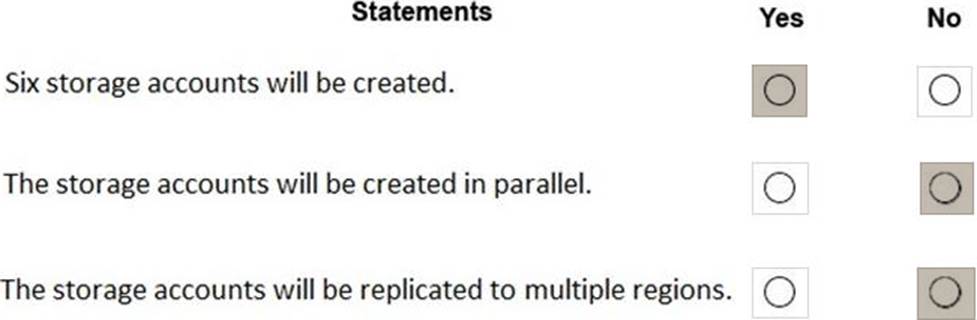
Explanation:
Box 1: Yes
Count is 6.
Box 2: No
Mode is serial.
Box 3: NO
Reference: https://docs.microsoft.com/en-us/azure/azure-resource-manager/templates/copy-resources
You have an on-premises deployment of SAP on DB2.
You plan to migrate the deployment to Azure and Microsoft SQL Server 2017.
What should you use to migrate the deployment?
- A . SQL Server Migration Assistant (SSMA)
- B . Azure SQL Data Sync
- C . db2haicu
- D . DSN1COPY
HOTSPOT
You have an SAP production landscape that uses SAP HANA databases.
You configure a metric alert for the primary HANA server as shown in the following exhibit.

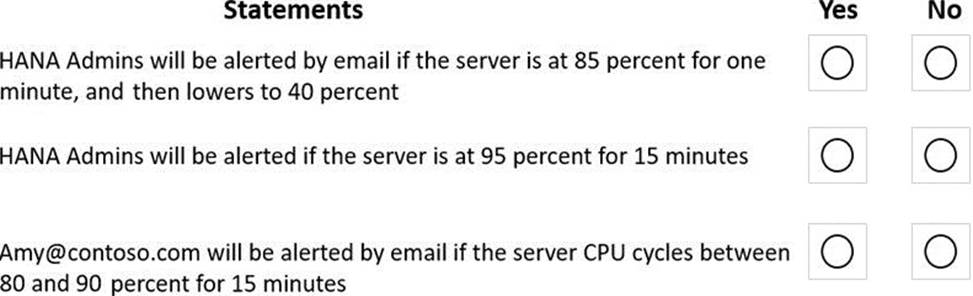
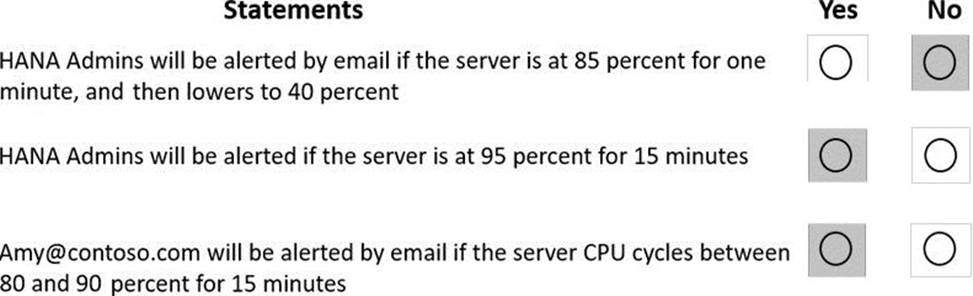
Explanation:
Box 1: No
The period is 15 minutes. Only alerts or emails will be sent.
Box 2: Yes
Box 3: Yes
HOTSPOT
You have SAP ERP on Azure.
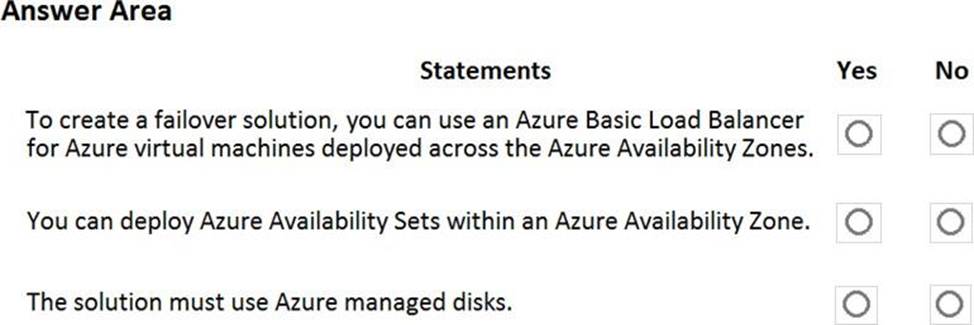
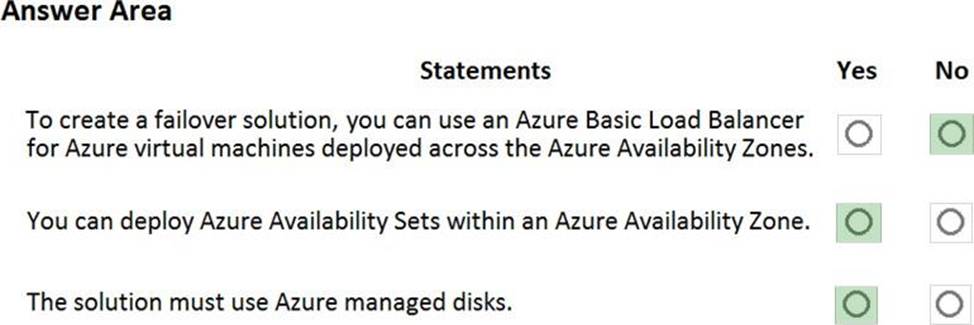
For SAP high availability, you plan to deploy ASCS/ERS instances across Azure Availability Zones and to use failover clusters.
For each of the following statements, select Yes if the statement is true. Otherwise, select No. NOTE: Each correct selection is worth one point.
Explanation:
Box 1: No
You can’t use an Azure Basic Load Balancer to create failover cluster solutions based on Windows Server Failover Clustering or Linux Pacemaker. Instead, you need to use the Azure Standard Load Balancer SKU.
Box 2: Yes
Azure Availability Zones is one of the high-availability features that Azure provides. Using Availability Zones improves the overall availability of SAP workloads on Azure.
The SAP application layer is deployed across one Azure availability set. For high availability of SAP Central Services, you can deploy two VMs in a separate availability set.
Box 3: Yes
You must use Azure Managed Disks when you deploy to Azure Availability Zones.
Reference: https://docs.microsoft.com/en-us/azure/virtual-machines/workloads/sap/sap-ha-availability-zones
https://docs.microsoft.com/en-us/azure/virtual-machines/workloads/sap/sap-proximity-placement-scenarios#combine-availability-sets-and-availability-zones-with-proximity-placement-groups
https://docs.microsoft.com/en-us/azure/architecture/reference-architectures/sap/sap-netweaver
You plan to migrate an SAP environment to Azure.
You need to design an Azure network infrastructure to meet the following requirements:
* Prevent end users from accessing the database servers.
* Isolate the application servers from the database servers.
* Ensure that end users can access the SAP systems over the internet
Minimize the costs associated to the communications between the application servers and database servers
Which two actions should you include in the solution? Each correct answer presents pan of the solution. NOTE: Each correct selection is worth one point.
- A . Configure Azure Traffic Manager to route incoming connections.
- B . Configure an infernal Azure Standard Load Balancer for incoming connections.
- C . Segregate the SAP application servers and database servers by using different Azure virtual networks.
- D . In the same Azure virtual network, segregate the SAP application service and database servers by using different subnets and network security groups.
- E . Create a site-to-site VPN between the on premises network and Azure.
You have an Azure subscription. The subscription contains a virtual machine named VM1 that runs SUSE Linux Enterprise Server (SLES) and was created by using an Azure Marketplace image.
You plan to deploy four virtual machines based on VM1 that will have the SAP Web Dispatcher role.
You need to create a generalized image of VM1.
What should you do first?
- A . Install the Custom Script Extension.
- B . Run sysprep.
- C . Install the Azure Linux VM agent.
- D . Run waagent,
DRAG DROP
You have an SAP environment on Azure.
You use Azure Recovery Services to back up an SAP application server.
You need to test the restoration process of a file on the server.
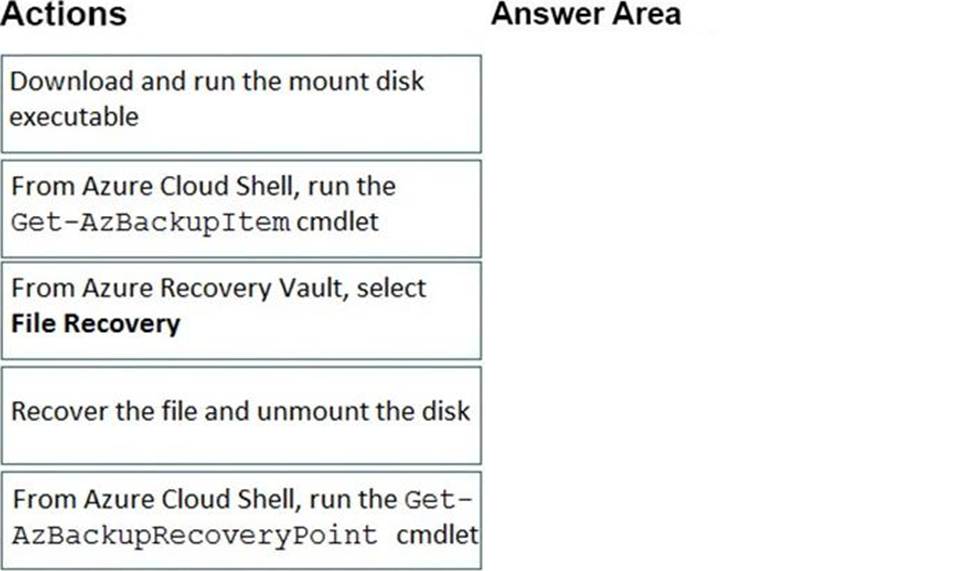
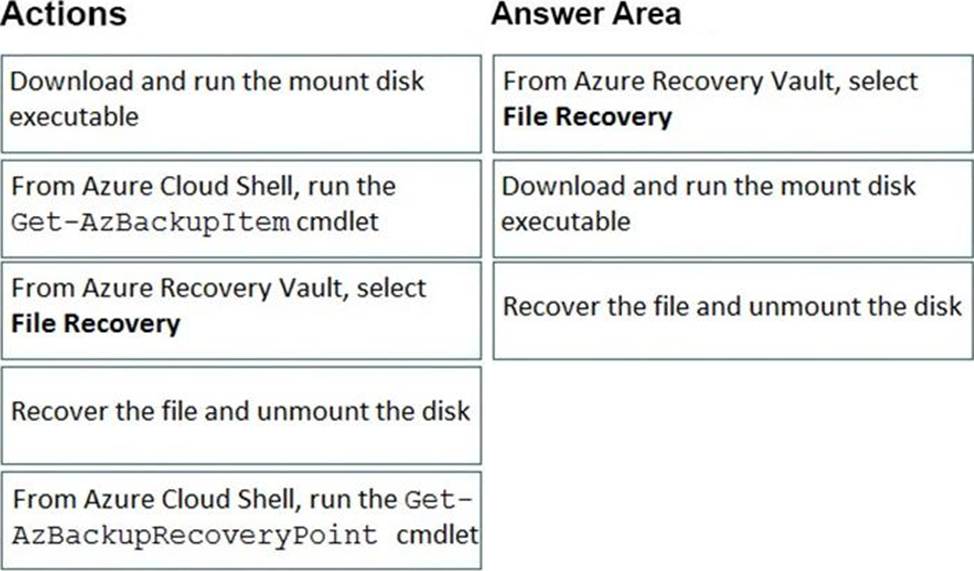
Which three actions should you perform in sequence? To answer, move the appropriate actions from the list of actions to the answer area and arrange them in the correct order.
Explanation:
Step 1: From Azure Recover Vault, select File Recovery
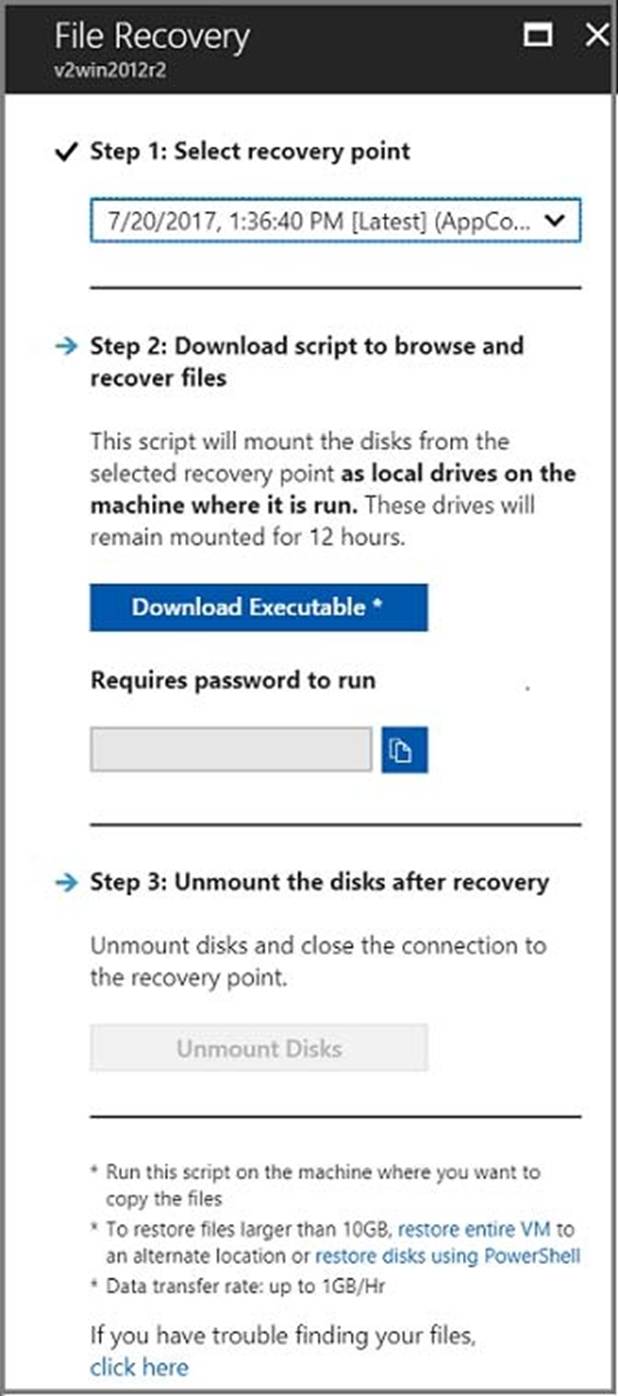
To restore files or folders from the recovery point, go to the virtual machine and choose the desired recovery point.
Step 2: Download and run the mount disk executable
Step 3: recover the file and unmount the disk
You have an Azure subscription that contains a virtual network named VNET1, an SAP production landscape on Azure, and an SAP non-production landscape on Azure. Both landscapes connect to VNET1.
Each landscape contains virtual machines that run the following:
• SAPHANA
• SAP NetWeaver
• Microsoft SQL Server
You need to monitor the landscapes. The solution must minimize costs.
What is the minimum number of required Azure Monitor for SAP Solutions instances?
- A . 1
- B . 2
- C . 3
- D . 6
DRAG DROP
Your on-premises network contains an Active Directory domain.
You have an SAP environment on Azure that runs on SUSE Linux Enterprise Server (SLES) servers.
You configure the SLES servers to use domain controllers as their NTP servers and their DNS servers.
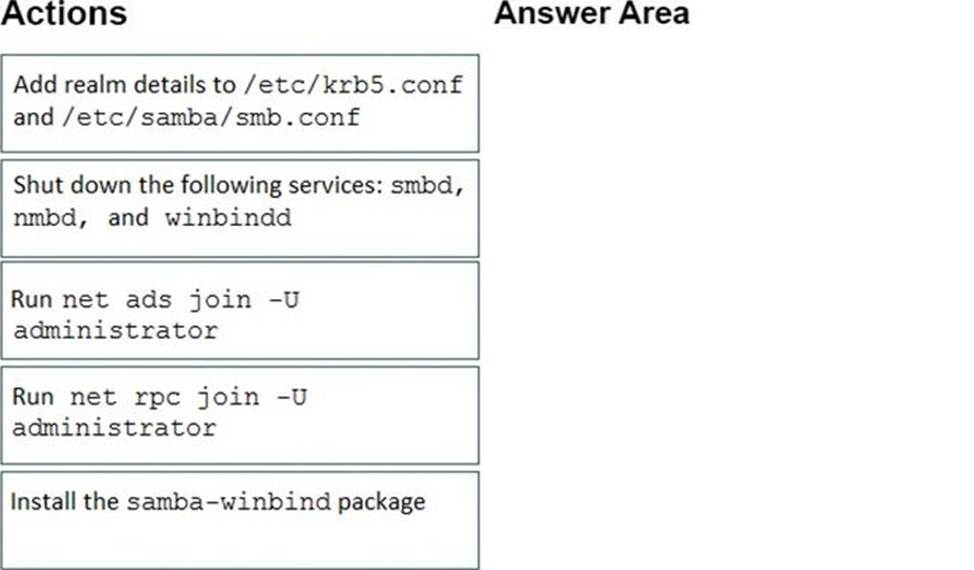
You need to join the SLES servers to the Active Directory domain.
Which three actions should you perform in sequence? To answer, move the appropriate actions from the list of actions to the answer area and arrange them in the correct order.
Explanation:
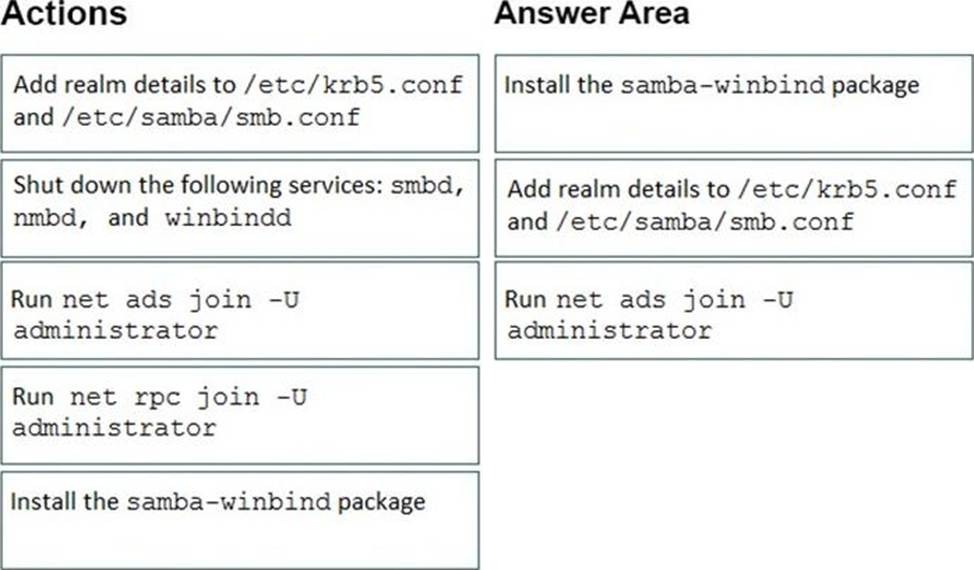
Step 1: Install the samba-winbind package
Install samba-winbind
Step 2: Add realm details to /etc/krb5.conf and /etc/samba/smb.conf
Edit files – best way to do this is to use yast on test machine and copy files from it
In following examples you need to replace EXAMPLE/EXAMPLE.COM/.example.com with your values/settings
/etc/samba/smb.conf
[global]
workgroup = EXAMPLE
usershare allow guests = NO #disallow guests from sharing
idmap gid = 10000-20000
idmap uid = 10000-20000
kerberos method = secrets and keytab
realm = EXAMPLE.COM
security = ADS
template homedir = /home/%D/%U
template shell = /bin/bash
winbind offline logon = yes
winbind refresh tickets = yes
/etc/krb5.conf
[libdefaults]
default_realm = EXAMPLE.COM
clockskew = 300
[realms]
EXAMPLE.COM = {
kdc = PDC.EXAMPLE.COM
default_domain = EXAMPLE.COM
admin_server = PDC.EXAMPLE.COM
}
Step 3: Run net ads join -U administrator
Join the SLES 12 Server to the AD domain
References: https://www.suse.com/support/kb/doc/?id=7018461