
Microsoft AZ-120 Practice Exams
Last updated on Nov 16,2026- Exam Code: AZ-120
- Exam Name: Planning and Administering Microsoft Azure for SAP Workloads
- Certification Provider: Microsoft
- Latest update: Nov 16,2026
You plan to migrate an SAP HANA instance to Azure.
You need to gather CPU metrics from the last 24 hours from the instance.
Solution: You use Monitoring from the SAP HANA Cockpit.
Does this meet the goal?
- A . Yes
- B . No
A
Explanation:
The SAP HANA cockpit provides a single point of access to a range of SAP HANA administration and monitoring tasks. It is used to monitor and ensure the overall health of the system.
The HANA Monitoring dashboard also visualizes key HANA Metrics of SAP HANA system.
Reference:
https://developers.sap.com/tutorials/dt-monitoring-hana-part1.html
https://help.sap.com/viewer/afa922439b204e9caf22c78b6b69e4f2/2.10.0.0/en-US
https://www.hanatutorials.com/p/hana-monitoring-dashboard.html
You have an on-premises SAP NetWeaver deployment that uses Windows Server 2016 and Microsoft SQL Server 2016.
You need to migrate the deployment to an Azure virtual machine that runs Windows Server 2016 and
has Microsoft SQL Server 2019 installed.
Which migration method should you use?
- A . heterogeneous SAP classical migration
- B . classical SAP Database Migration Option (DMO)
- C . lift-and-shift
- D . Azure Migrate
You have an Azure subscription that contains an SAP HANA on Azure (Large Instances) deployment.
The deployment is forecasted to require an additional 256 GB of storage.
What is the minimum
amount of additional storage you can allocate?
- A . 256 GB
- B . 512 GB
- C . 1TB
- D . 2 TB
HOTSPOT
You have an Azure subscription that contains the virtual machines shown in the following table.
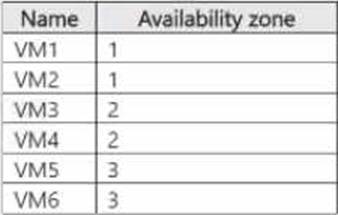
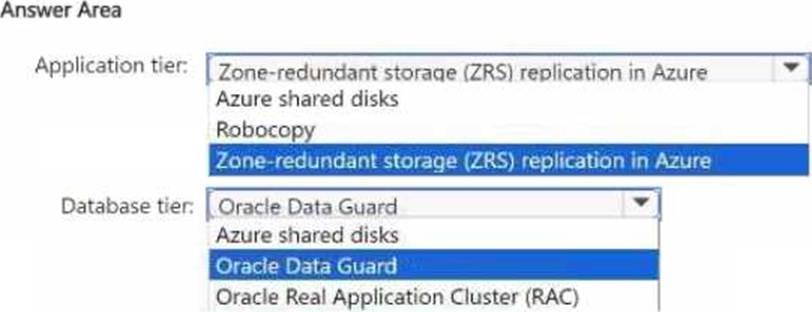
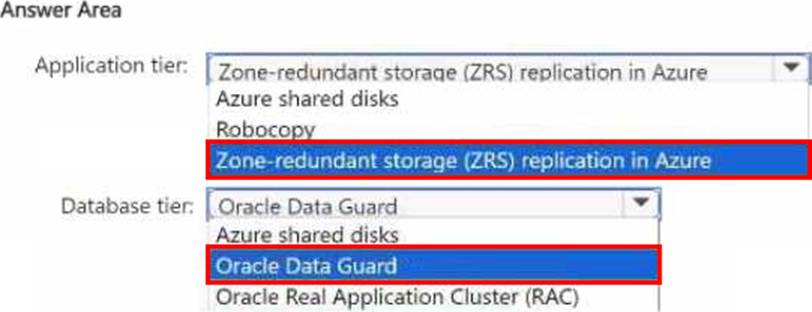
You need to deploy a highly available, three-tier SAP NetWeaver landscape that will use an Oracle database.
What should you use to ensure redundancy for the application tier and the database tier? To answer, select the appropriate options in the answer area. NOTE: Each correct selection is worth one point.
HOTSPOT
You have an Azure subscription.
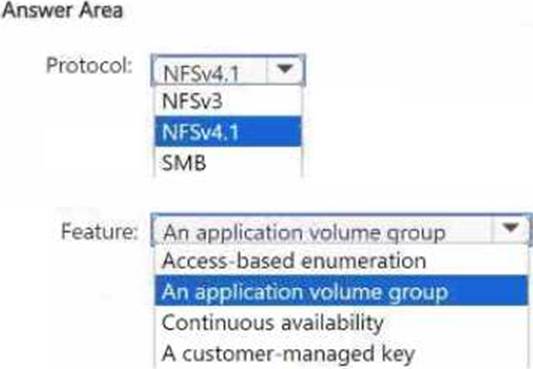
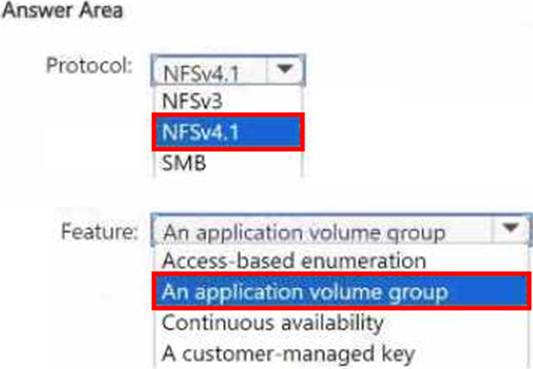
You need to deploy an instance of SAP HANA that will use Azure NetApp Files to host data. The solution must use proximity placement groups.
Which protocol and feature should you configure for the deployment? To answer, select the appropriate options in the answer area. NOTE: Each correct selection is worth one point.
You are migrating SAP to Azure. The ASCS application servers are in one Azure zone, and the SAP database server in in a different Azure zone. ASCS/ERS is configured for high availability.
During performance testing, you discover increased response times in Azure, even though the Azure environment has better computer and memory configurations than the on-premises environment. During the initial analysis, you discover an increased wait time for Enqueue.
What are three possible causes of the increased wait time? Each correct answer presents a complete solution. NOTE: Each correct selection is worth one point.
- A . a missing Enqueue profile
- B . disk I/O during Enqueue backup operations
- C . misconfigured load balancer rules and health check probes for Enqueue and ASCS
- D . active Enqueue replication
- E . network latency between the database server and the SAP application servers
CDE
Explanation:
E: The network latency across Availability Zones is not the same in all Azure regions. In some cases, you can deploy and run the SAP application layer across different zones because the network latency from one zone to the active DBMS VM is acceptable. But in some Azure regions, the latency between the active DBMS VM and the SAP application instance, when deployed in different zones, might not be acceptable for SAP business processes.
Reference: https://docs.microsoft.com/en-us/azure/virtual-machines/workloads/sap/sap-ha-availability-zones
You have an SAP landscape on Azure that contains the virtual machines shown in the following table.

You need to ensure that the Application Server role is available if a single Azure datacenter fails.
What should you include in the solution?
- A . a local network gateway
- B . Azure Virtual WAN
- C . Azure Load Balancer Standard
- D . Azure Private Link
C
Explanation:
For the load balancers of the failover clusters of SAP Central Services and the DBMS layer, you need to use the Standard SKU Azure Load Balancer. The Basic Load Balancer won’t work across zones.
Reference: https://docs.microsoft.com/en-us/azure/virtual-machines/workloads/sap/sap-high-availability-architecture-scenarios
Note: This question is part of a series of questions that present the same scenario. Each question in the series contains a unique solution that might meet the stated goals. Some question sets might have more than one correct solution, while others might not have a correct solution.
After you answer a question in this section, you will NOT be able to return to it. As a result, these questions will not appear in the review screen.
You deploy SAP HANA on Azure (Large Instances).
You need to back up the SAP HANA database to Azure.
Solution: You create a Recovery Services vault and a backup policy.
Does this meet the goal?
- A . Yes
- B . No
B
Explanation:
https://docs.microsoft.com/en-us/azure/virtual-machines/workloads/sap/hana-backup-restore
You have an SAP NetWeaver deployment hosted on Azure virtual machines that run SUSE Linux Enterprise Server (SLES) and are configured as a Pacemaker cluster.
You need to monitor the deployment by using Azure Monitor for SAP Solutions.
What should you install first on the cluster nodes?
- A . ha_duster_provider
- B . Performance Co-Pilot
- C . PMProxy
- D . pcp-pmda-hacluster
You plan to deploy an SAP production landscape on Azure.
You need to estimate how many SAP operations will be processed by the landscape per hour. The
solution must minimize administrative effort.
What should you use?
- A . SAP Quick Sizer
- B . SAP HANA hardware and cloud measurement tools
- C . SAP S/4HANA Migration Cockpit
- D . SAP GUI