
Microsoft AZ-120 Practice Exams
Last updated on Nov 16,2026- Exam Code: AZ-120
- Exam Name: Planning and Administering Microsoft Azure for SAP Workloads
- Certification Provider: Microsoft
- Latest update: Nov 16,2026
HOTSPOT
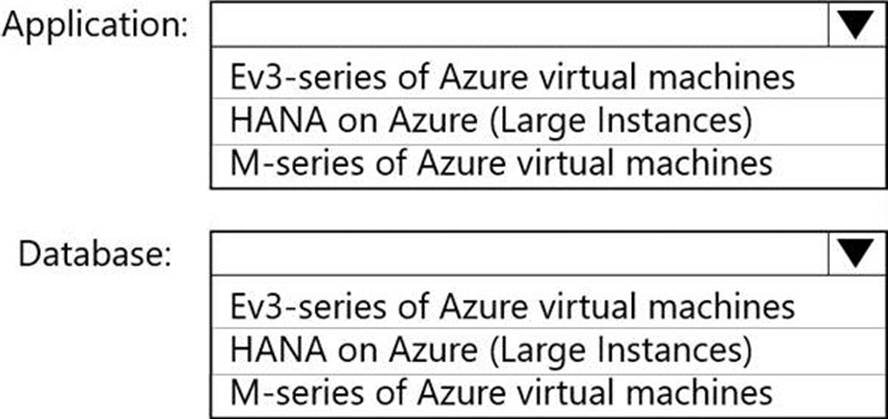
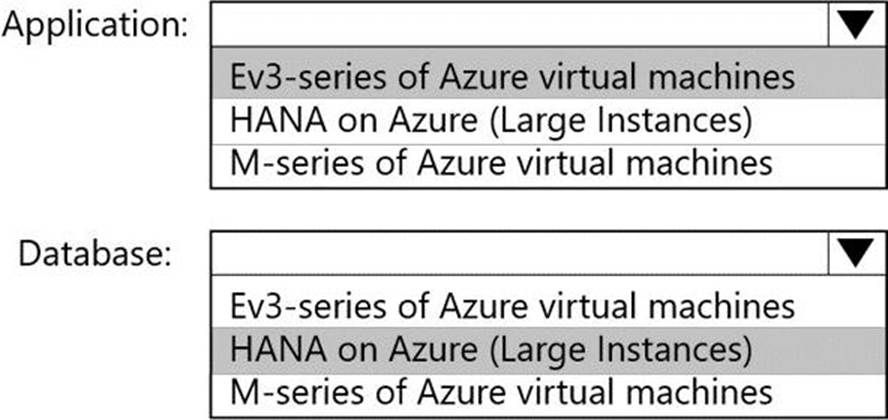
You have an on-premises deployment of SAP Business Suite on HANA that includes a CPU-intensive application tier and a 20-TB database tier.
You plan to migrate to SAP HANA on Azure.
You need to recommend a compute option to host the application and database tiers. The solution must minimize cost.
What should you recommend for each tier? To answer, select the appropriate options in the answer area. NOTE: Each correct selection is worth one point.
Explanation:
Box 1: Ev3 series M Azure virtual machines
The Ev3 series pricing is starting from $58.40 /per month.
The E-series Azure VMs are optimized for heavy in-memory applications such as SAP HANA. These VMs are configured with high memory-to-core ratios, which makes them well-suited for memory-intensive enterprise applications, large relational database servers, in-memory analytics workloads etc.
The Ev3-series VMs range from 2 to 64 vCPUs and 16-432 GiB of RAM, respectively.
Example workloads include SAP HANA (e.g., E64s v3, E20ds v4, E32ds v4, E48ds v4, E64ds v4), SAP S/4 HANA application layer, SAP NetWeaver application layer, and more broadly memory-intensive enterprise applications, large relational database servers, data warehousing workloads, business intelligence applications, in-memory analytics workloads, and additional business-critical applications, including systems that process financial transactions of various nature…
Note: The M-series family of Azure virtual machines are memory optimized and are ideal for heavy in-memory workloads such as SAP HANA. The M-Series offer up to 4 TB of RAM on a single VM. In addition, these VMs offer a virtual CPU count of up to 128 vCPUs on a single VM to enable high performance parallel processing.
Example workloads include SAP HANA, SAP S/4 HANA, SQL Hekaton and other large in-memory business critical workloads requiring massive parallel compute power.
Box 2: Hana on Azure (Large Instances)
The storage used in HANA Large Instances has a file size limitation. The size limitation is 16 TB per file.
Reference:
https://docs.microsoft.com/en-us/azure/virtual-machines/workloads/sap/hana-storage-architecture
https://azure.microsoft.com/en-us/pricing/details/virtual-machines/series/
HOTSPOT
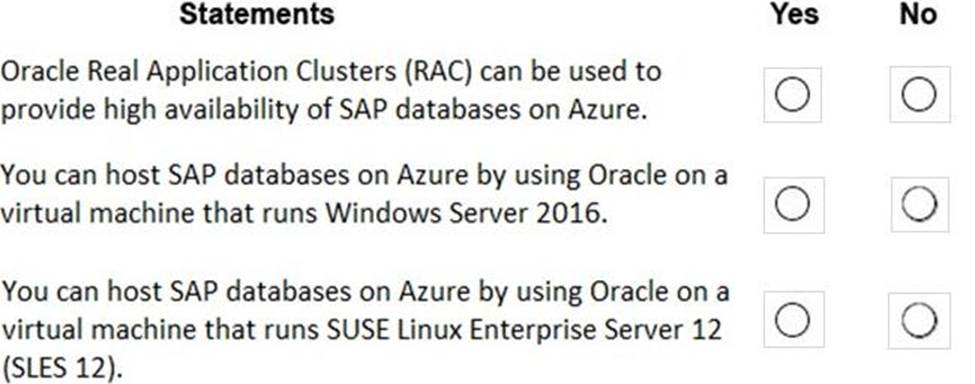
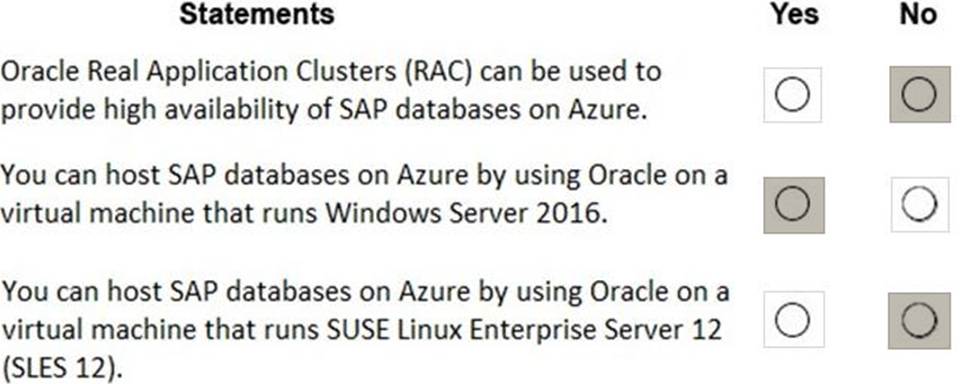
For each of the following statements, select Yes if the statement is true. Otherwise, select No. NOTE: Each correct selection is worth one point.
Explanation:
DRAG DROP
You migrate SAP ERP Central Component (SAP ECC) production and non-production landscapes to Azure.
You are licensed for SAP Landscape Management (LaMa).
You need to refresh from the production landscape to the non-production landscape.
Which four actions should you perform in sequence? To answer, move the appropriate actions from the list of actions to the answer area and arrange them in the correct order.
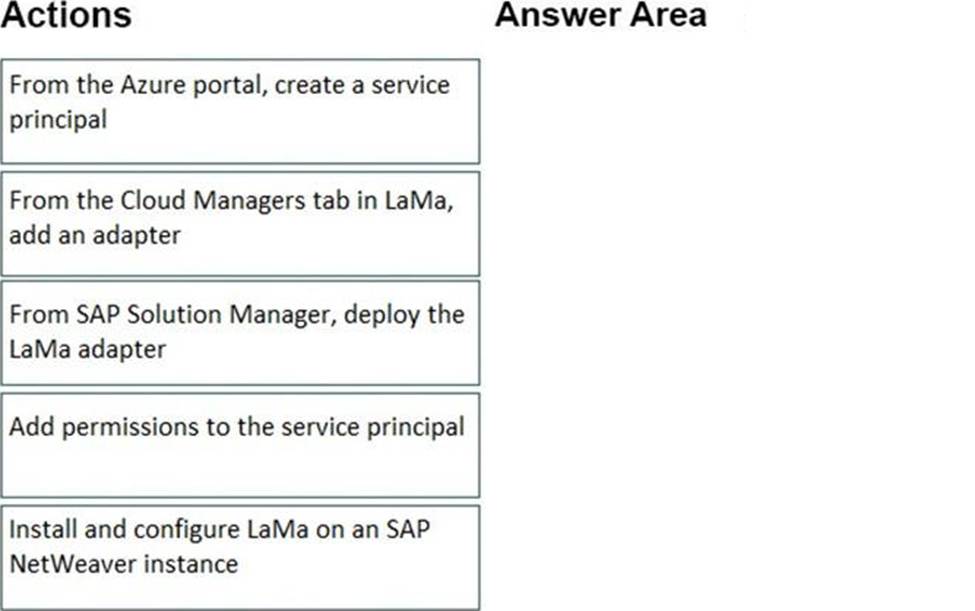
Explanation:
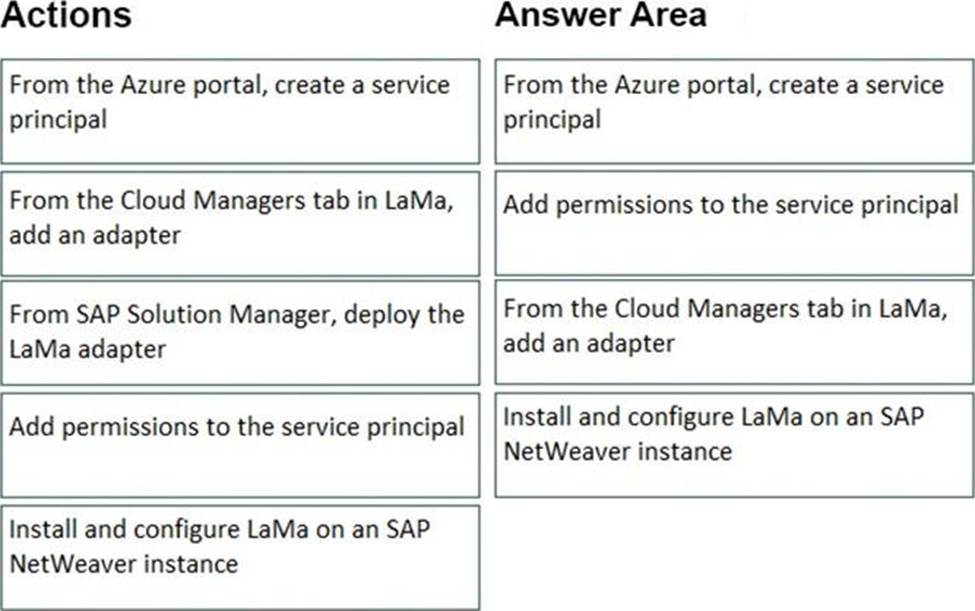
Step 1: From the Azure portal, create a service principal
The Azure connector can use a Service Principal to authorize against Microsoft Azure. Follow these steps to create a Service Principal for SAP Landscape Management (LaMa).
Step 2: Add permissions to the service principal
The Service Principal does not have permissions to access your Azure resources by default. You need to give the Service Principal permissions to access them.
Step 3: From the Cloud Managers tab in LaMa, add an adapter Create a new connector in SAP LaMa
Open the SAP LaMa website and navigate to Infrastructure. Go to tab Cloud Managers and click on Add. Select the Microsoft Azure Cloud Adapter
Step 4: Install and configure LaMA on an SAP NetWeater instance Provision a new adaptive SAP system
You can manually deploy a new virtual machine or use one of the Azure templates in the quickstart repository. It contains templates for SAP NetWeaver ASCS, SAP NetWeaver application servers, and the database. You can also use these templates to provision new hosts as part of a system copy/clone etc.
Note: To support customers on their journey into a cloud model (hybrid or entirely public cloud), SAP and Microsoft partnered to create an adapter that integrates the SAP management capabilities of LaMa with the IaaS advantages of Microsoft Azure.
Reference:
https://docs.microsoft.com/en-us/azure/virtual-machines/workloads/sap/lama-installation
https://docs.microsoft.com/en-us/learn/modules/maintain-azure-sap-workloads/2-set-up-remote-management
This question requires that you evaluate the underlined BOLD text to determine if it is correct.
You have an Azure resource group that contains the virtual machines for an SAP environment.
You must be assigned the Contributor role to grant permissions to the resource group. Instructions: Review the underlined text. If it makes the statement correct, select “No change is needed”. If the statement is incorrect, select the answer choice that makes the statement correct.
- A . No change is needed
- B . User Access Administrator
- C . Managed Identity Contributor
- D . Security Admin
B
Explanation:
Contributor – Can create and manage all types of Azure resources but can’t grant access to others.
User Access Administrator – Lets you manage user access to Azure resources.
Reference: https://docs.microsoft.com/en-us/azure/role-based-access-control/overview
You plan to deploy an SAP production landscape that uses SAP HANA databases on Azure.
You need to configure the storage infrastructure to support the SAP HANA deployment The solution must meet the SAP issued requirements for data throughput and I/O.
How should you configure the storage?
- A . RAID1
- B . RAID5
- C . RAID0
- D . RAID6
HOTSPOT
You have an Azure subscription. The subscription contains two virtual machines named SQL1 and SQL2 that host a Microsoft SQL Server 2019 Always On availability group named AOG1.
You plan to deploy an SAP NetWeaver system that will have a database tier hosted on AOG1.
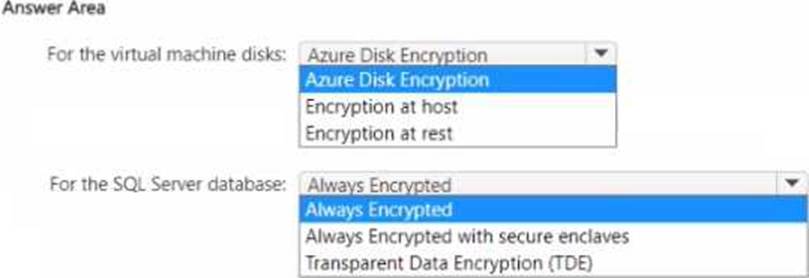
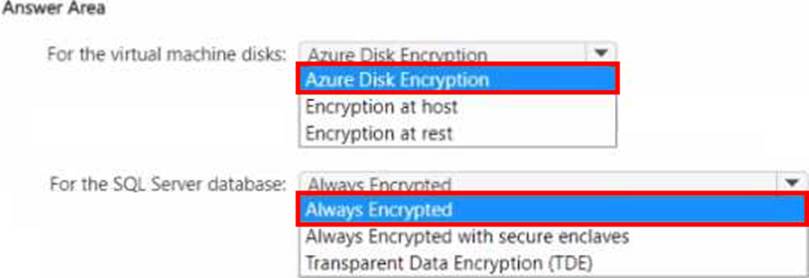
You need to encrypt the Azure virtual machine disks and the SQL Server database.
The solution must meet the following requirements:
• The operating system disk, data disk, and the temporary disk of the virtual machines must be encrypted.
• SQL Server encryption keys must be stored on-premises.
Which type of encryption should you use? To answer, select the appropriate options in the answer area. NOTE: Each correct selection is worth one point.
You have an Azure subscription named Sub1 that contains a Microsoft Sentinel workspace named Workspace1.
You have an SAP RISE managed workload that is integrated with Sub1.
You implement the Microsoft Sentinel solution for SAP applications in Workspace1.
You need to deploy the Microsoft Sentinel for SAP connector for Workspace1 by using the Azure portal.
What should you provision first?
- A . an Azure virtual machine that runs Windows
- B . an Azure Kubernetes Service (AKS) cluster
- C . an Azure logic app
- D . an Azure virtual machine that runs Linux
DRAG DROP
You have an SAP production landscape in Azure.
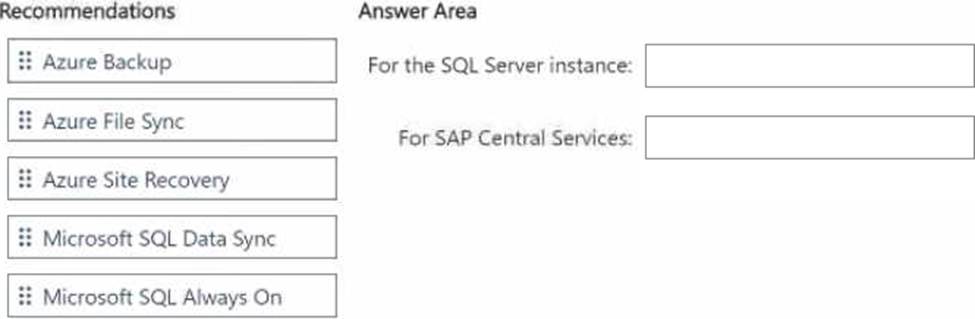
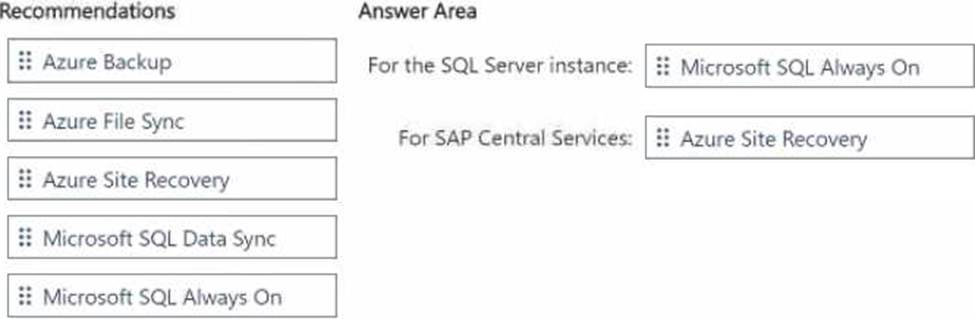
You need to recommend a disaster recovery solution that will enable failover between two Azure regions. The solution must provide the lowest recovery time objective (RTO) for a Microsoft SQL Server instance and SAP Central Services (SCS).
What should you include in the recommendation? To answer, drag the appropriate recommendations to the correct workloads. Each recommendation may be used once, more than once, or not at all. You may need to drag the split bar between panes or scroll to view content. NOTE: Each correct selection is worth one point.
You deploy an SAP landscape on Azure.
You plan to use an Azure Automation account to stop the SAP virtual machines outside of business hours.
You need to ensure that you can use Azure Automation runbook a for the virtual machines.
What does the Azure Automation account require?
- A . an Azure Storage account
- B . an Azure App Service WebJob
- C . a Recovery Services vault
- D . a Run As account
You have an on-premises network and an Azure subscription.
You plan to migrate on premises SAP workloads to Azure virtual machines. You will use an NFS account in Azure NetApp Files as the storage platform.
You need to ensure that data transferred between the NFS account on the virtual machines and the
Azure NetApp Files shares is encrypted.
What should you create first?
- A . an Active Directory connection for the NFS account
- B . a system-assigned managed identity in the NFS account
- C . a user-assigned managed identity in the Azure subscription
- D . an Azure key vault in the Azure subscription