
Microsoft AZ-120 Practice Exams
Last updated on Nov 16,2026- Exam Code: AZ-120
- Exam Name: Planning and Administering Microsoft Azure for SAP Workloads
- Certification Provider: Microsoft
- Latest update: Nov 16,2026
HOTSPOT
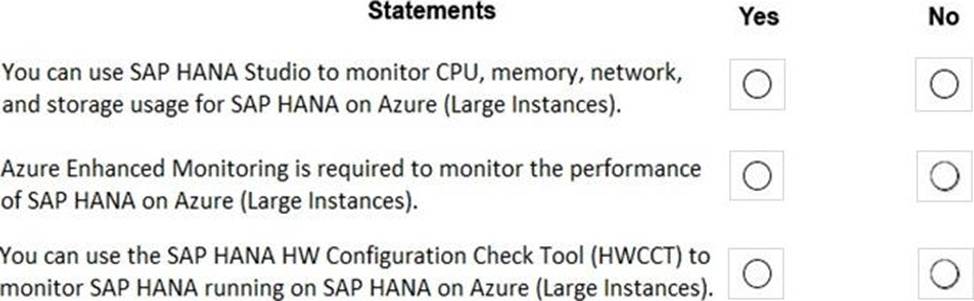
You deploy SAP HANA by using SAP HANA on Azure (Large Instances).
For each of the following statements, select Yes if the statement is true. Otherwise, select No. NOTE: Each correct selection is worth one point.
Explanation:
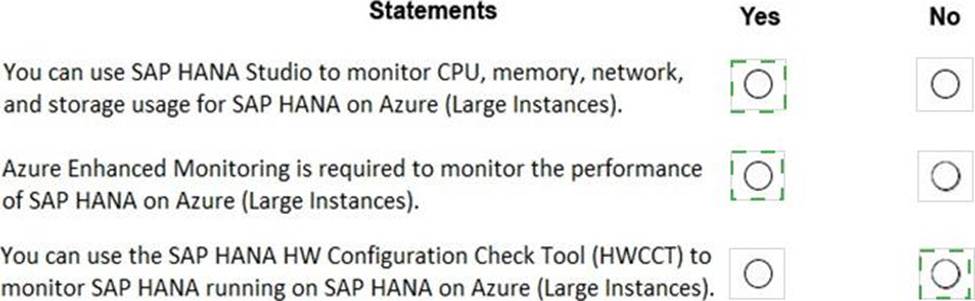
Box 1: Yes
Box 2: Yes
The SAP Azure Enhanced Monitoring Extension allows for collecting diagnostic data including OS and Application performance counters from Azure VMs running SAP workloads.
Box 3: No
Reference: http://www.deployazure.com/compute/virtual-machines/sap-azure-enhanced-monitoring-extension/
https://docs.microsoft.com/en-us/azure/virtual-machines/workloads/sap/azure-monitor-overview
You are deploying SAP on Azure. The database server will use SAP HANA. The application servers will run Windows Server. You need to test network latency and throughput between the frontend SAP servers and the database servers.
Which three tools can you use to achieve the goal? Each correct answer presents a complete solution. NOTE: Each correct selection is worth one point.
- A . SockPerf
- B . HCMT
- C . NIPING
- D . Iatte.exe
- E . lOMeter
DRAG DROP
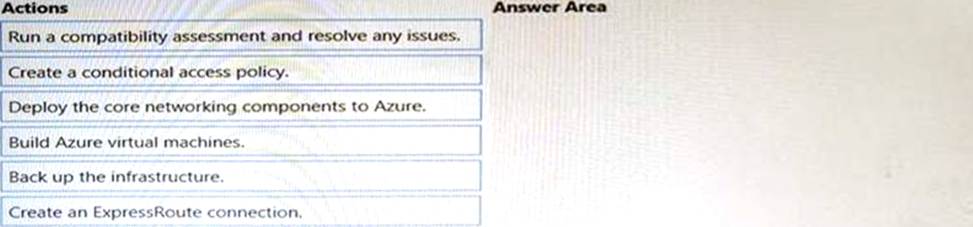
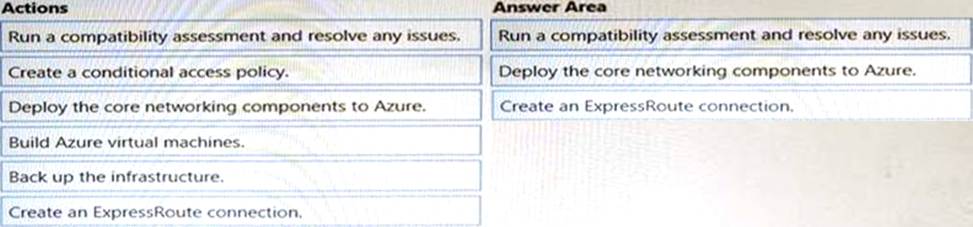
A customer has an on-premises SAP environment. The customer plans to migrate SAP to Azure.
You need to prepare the environment for the planned migration.
Which three actions should you perform in sequence before the migration? To answer, move the appropriate actions from the list of actions to the answer area and arrange them in the correct order.
You plan to deploy an SAP environment on Azure. The SAP environment will have landscapes for production, development. and quality assurance.
You need to minimize the costs associated with running the development and quality assurance landscapes on Azure.
What should you do?
- A . Create Azure Automation runbooks to stop, deallocate, and start Azure virtual machines.
- B . Create a scheduled task that runs the stopsap command.
- C . Configure scaling for Azure App Service.
- D . Configure Azure virtual machine scales sets.
A
Explanation:
You can optimize your Azure Costs by Automating SAP System Start C Stop using runbooks.
Reference: https://techcommunity.microsoft.com/t5/running-sap-applications-on-the/optimize-your-azure-
costs-by-automating-sap-system-start-stop/ba-p/2120675
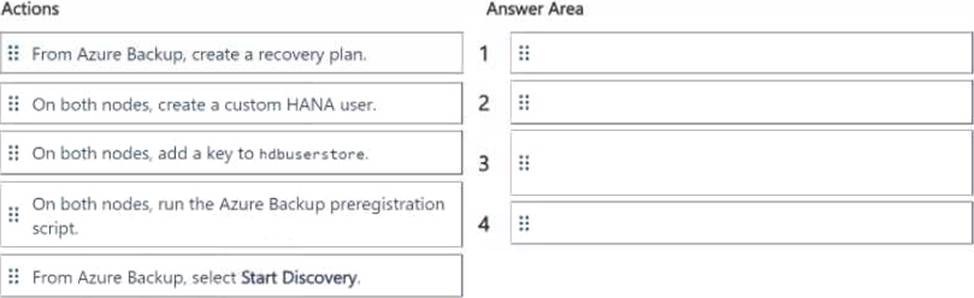
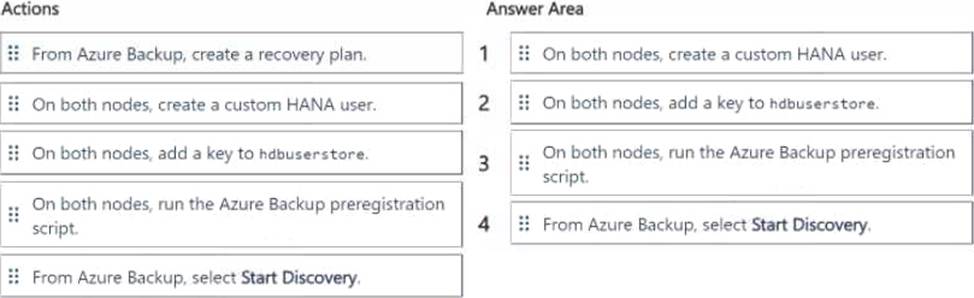
DRAG DROP
You have two Azure virtual machines. The virtual machines host a highly available SAP HANA cluster that has HANA system replication configured.
You plan to configure Azure Backup to protect the replicated databases of the cluster.
You need to ensure that when a failover occurs. Azure Backup automatically uses the new primary node for backups.
Which four actions should you perform in sequence? To answer, move the appropriate actions from the list of actions to the answer area and arrange them in the correct order.
You have a n SAP environment on Azure.
Your on-premises network uses a 1-Gbps ExpresRoute circuit to connect to Azure Private peering is enabled on the circuit. The default route (0.0.0.0/0) from the on-premises network is advertised You need to resolve the issue without modifying the ExpresRoute circuit. The solution must minimize administrative effort.
What should you do?
- A . Create a user-defined route tint redirects traffic to the Blob storage.
- B . Create an application security group.
- C . Change the backup solution to use a third-party software that can write to the Blob storage.
- D . Enable virtual network service endpoints.
D
Explanation:
Private endpoint enables connectivity between the consumers from the same ExpressRoute.
Note: Consult with SAP HANA on Microsoft Service Management. If they advise you to increase the bandwidth of the SAP HANA on Azure (Large Instances) ExpressRoute circuit, create an Azure support request. (You can request an increase for a single circuit bandwidth up to a maximum of 10 Gbps.)
Reference:
https://docs.microsoft.com/en-us/azure/private-link/private-endpoint-overview
https://docs.microsoft.com/bs-cyrl-ba/azure/virtual-machines/workloads/sap/hana-additional-network-requirements#increase-expressroute-circuit-bandwidth
You plan to migrate an on-premises SAP environment to Azure.
You need to identity whether any SAP application servers host multiple SAP system identifiers (SlDs).
What should you do?
- A . Run SAP HAN A sizing report.
- B . From the SAP EarlyWatch Alert report, compare the physical host names to the virtual host names.
- C . Run the SAP Report from ABAPMeter.
- D . From the SAP EarlyWatch Alert report, compare the services to the reference objects
You need to ensure that you can receive technical support to meet the technical requirements.
What should you deploy to Azure?
- A . SAP Landscape Management (LaMa)
- B . SAP Gateway
- C . SAP Web Dispatcher
- D . SAPRouter
A
Explanation:
https://help.sap.com/viewer/f2ad7797884249eeb2e91dc26a991196/3.0.3.0/en-US
You have an SAP environment on Azure.
Your on premises network uses a 1 Gbps ExpressRoute circuit to connect to Azure. Private peering is enabled on the circuit. The default route (0.0.0.0/0) from the on-premises network is advertised. Whenever backups are copied to Azure Blob storage, the ExpressRoute circuit is saturated.
You need to resolve the issue without modifying the ExpressRoute circuit. The solution must minimize administrative effort.
What should you do?
- A . Change the backup solution to use a third-party software that can write to the Blob storage.
- B . Create a user-defined route that redirects traffic to the Blob storage.
- C . Create an application security group.
- D . Enable virtual network service endpoints.
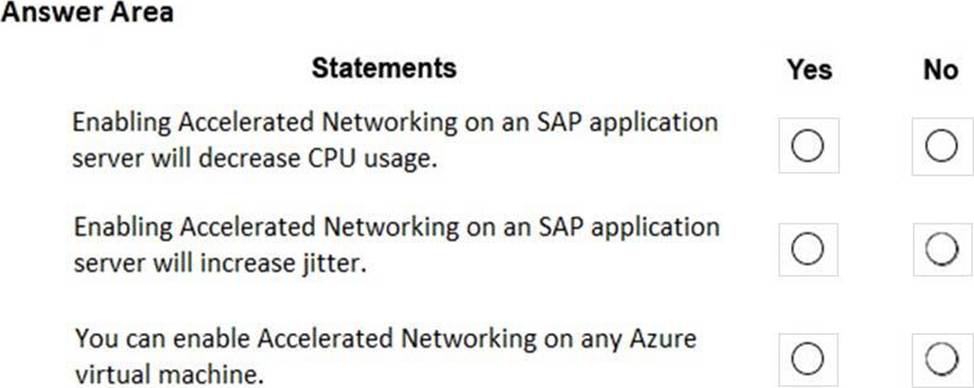
HOTSPOT
For each of the following statements, select Yes if the statement is true. Otherwise, select No. NOTE: Each correct selection is worth one point.
Explanation:
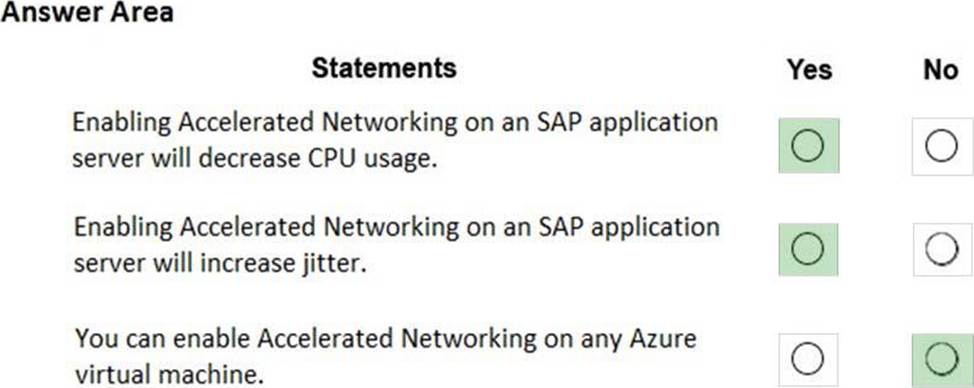
Box 1: Yes
By moving much of Azure’s software-defined networking stack off the CPUs and into FPGA-based SmartNICs, compute cycles are reclaimed by end user applications, putting less load on the VM, decreasing jitter and inconsistency in latency.
Box 2: Yes
Box 3: No
Accelerated Networking (AN) is generally available (GA) and widely available for Windows and the latest distributions of Linux
Reference:
https://azure.microsoft.com/en-us/blog/maximize-your-vm-s-performance-with-accelerated-networking-now-generally-available-for-both-windows-and-linux/
https://azure.microsoft.com/en-gb/blog/maximize-your-vm-s-performance-with-accelerated-networking-now-generally-available-for-both-windows-and-linux/