
Juniper JN0-683 Practice Exams
Last updated on Oct 21,2026- Exam Code: JN0-683
- Exam Name: Data Center Professional (JNCIP-DC) Exam
- Certification Provider: Juniper
- Latest update: Oct 21,2026
You are asked to identify microburst traffic occurring in the network leading lo packet drops in your data center switches.
Which two tools would be used in this scenario? (Choose two.)
- A . port mirroring
- B . Traceoptions
- C . port buffer monitoring
- D . syslog
AC
Explanation:
Identifying Microburst Traffic:
Microbursts are short spikes in network traffic that can overwhelm buffers and cause packet drops.
Detecting and analyzing microbursts is crucial for understanding where packet loss might be occurring in a data center network.
Port Buffer Monitoring:
Port Buffer Monitoring: This tool specifically tracks the usage of switch buffers, helping to identify when microbursts are causing buffers to overflow, leading to packet drops.
Port Mirroring:
Port Mirroring: This tool allows you to monitor real-time traffic on a specific port by copying the traffic to another port where it can be analyzed, often with a packet analyzer. While port mirroring doesn’t directly detect microbursts, it helps capture traffic patterns that can indicate microbursts.
Conclusion:
Option C: Correct―Port buffer monitoring directly identifies buffer overflows caused by microbursts.
Option A: Correct―Port mirroring allows for the detailed capture and analysis of traffic patterns, which can reveal microburst behavior.
Options B (Traceoptions) and D (Syslog) are less effective in identifying microburst traffic. Traceoptions focus on control plane traffic debugging, and Syslog is more about logging system events than detecting high-frequency traffic spikes.
Your organization is implementing EVPN-VXLAN and requires multiple overlapping VLAN-IDs. You decide to use a routing-instance type mac-vrf to satisfy this request.
Which two statements are correct in this scenario? (Choose two.)
- A . Host-facing interfaces must be configured using a service-provider style configuration.
- B . Host-facing interfaces must be configured using enterprise-style configuration.
- C . Spine-facing interfaces must be configured using an enterprise-style configuration.
- D . The routing-instance service type can be VLAN-based.
AD
Explanation:
Understanding the Scenario:
EVPN-VXLAN deployments often involve scenarios where multiple tenants or applications require
overlapping VLAN IDs, which can be managed using the mac-vrf routing instance type. This allows
you to segregate traffic within the same VLAN ID across different tenants.
Host-facing Interface Configuration:
Which two statements are correct about an IP fabric? (Choose two.)
- A . All leaf devices can use the same AS number in an IP fabric without making any adjustments to the EBGP configuration
- B . The multipath multiple-as statement is required to enable ECMP if every device has a different AS number.
- C . Only a single point to point EBGP session is required between peers in an IP fabric.
- D . FBGP is only required to route most routing information to external devices outside the fabric.
AB
Explanation:
BGP in IP Fabric:
In an IP fabric, Border Gateway Protocol (BGP) is used to manage the routing between leaf and spine devices. Each device can have the same or different Autonomous System (AS) numbers depending on the network design.
Multipath Multiple-AS:
Option B: If every device in the fabric has a different AS number, then enabling Equal-Cost Multi-Path (ECMP) routing requires the multipath multiple-as statement. This configuration allows BGP to consider multiple paths across different AS numbers as equal cost, enabling efficient load balancing across the network.
Same AS Number Configuration:
Option A: It’s possible for all leaf devices to use the same AS number in an IP fabric, which simplifies the configuration. EBGP (External BGP) will still function correctly in this setup because BGP considers the peering relationship rather than strictly enforcing different AS numbers in this specific use case.
Conclusion:
Option B: Correct―This statement is essential for enabling ECMP in a multi-AS environment.
Option A: Correct―Leaf devices can share the same AS number without needing special EBGP configuration.
Exhibit.
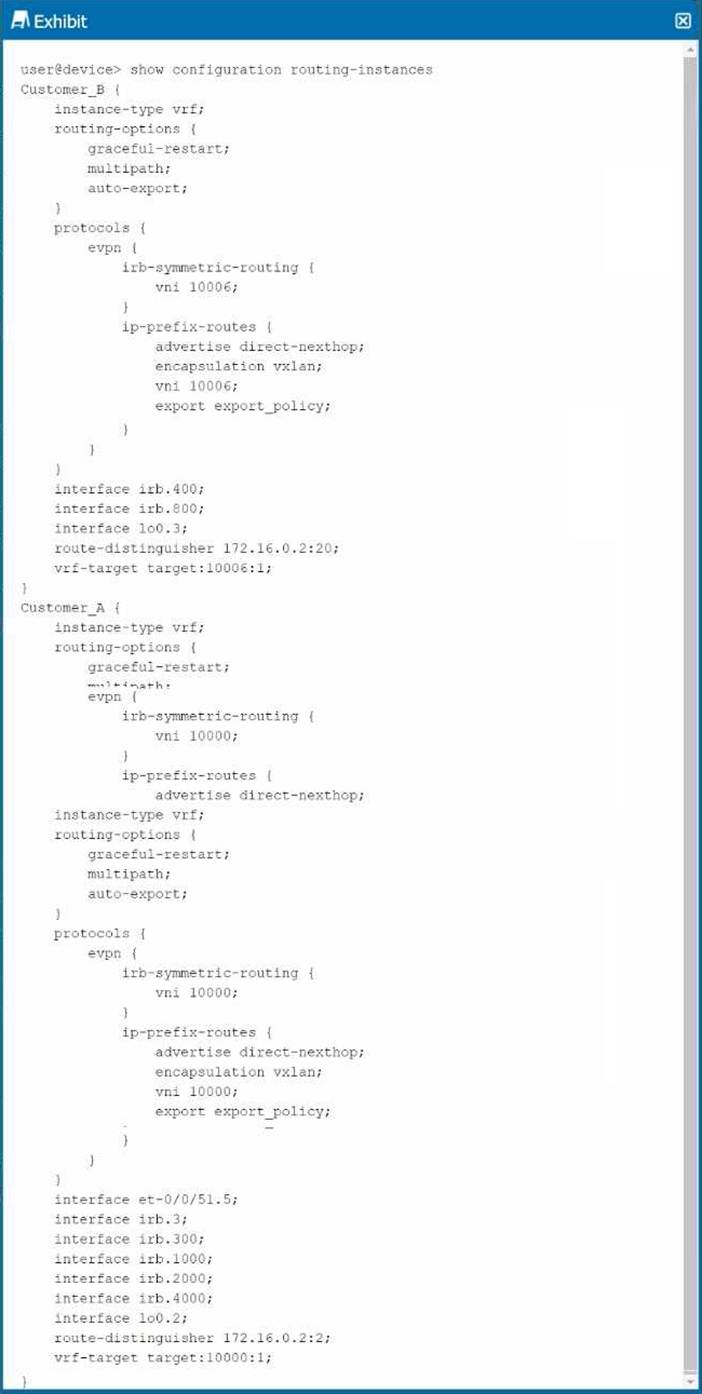
Referring to the configuration shown in the exhibit, assume that there is no external router present, and that the configuration is fabric-only.
Which two statements are true about the example configuration? (Choose two.)
- A . VNI 10006 is assigned to vlan 800 (irb.800).
- B . Devices in irb.400 (vlan 400) are not able to communicate directly with devices in routing instance Customer A.
- C . Devices in routing instance Customer A are able to communicate with devices in routing instance
Customer B - D . Devices in irb.400 (vlan 400) and irb.800 (vlan 800) are able to communicate over the fabric.
BD
Explanation:
Understanding the Configuration:
The exhibit shows configurations for two VRFs (Customer_A and Customer_B) with specific VLANs and VNIs assigned. Each VRF has interfaces (IRBs) associated with particular VLANs.
Communication Between VLANs and Routing Instances:
Option B: VLAN 400 (irb.400) is part of Customer_B, and there is no direct connection or routing between Customer_A and Customer_B in the configuration provided. Therefore, devices in irb.400 cannot communicate directly with devices in the Customer_A routing instance.
Option D: Since irb.400 (VLAN 400) and irb.800 (VLAN 800) are part of the same routing instance (Customer_B), they can communicate over the fabric using VXLAN encapsulation.
Conclusion:
Option B: Correct―There is no direct communication between devices in irb.400 (Customer_B) and routing instance Customer_A.
Option D: Correct―Devices in VLAN 400 and VLAN 800 can communicate within the Customer_B routing instance over the fabric.
You are asked to configure telemetry on the OFX Series devices in your data center fabric. You want to use sensors that have a vendor-neutral data model
Which type of sensor should you use in this scenario?
- A . JTI OpenConfig sensors
- B . JTI native sensors
- C . Python sensors
- D . analog sensors
A
Explanation:
Telemetry in Data Centers:
Telemetry allows for real-time monitoring of network devices by collecting and exporting data such as interface statistics, routing table updates, and other key metrics.
Vendor-Neutral Data Models:
Option A: JTI (Junos Telemetry Interface) OpenConfig sensors use a vendor-neutral data model, which is important for ensuring compatibility across different network devices and systems.
OpenConfig is an industry-standard model, which facilitates integration with various telemetry collection systems.
Conclusion:
Option A: Correct―OpenConfig sensors provide a vendor-neutral solution for telemetry, ensuring broad compatibility and flexibility in data center environments.
Exhibit.
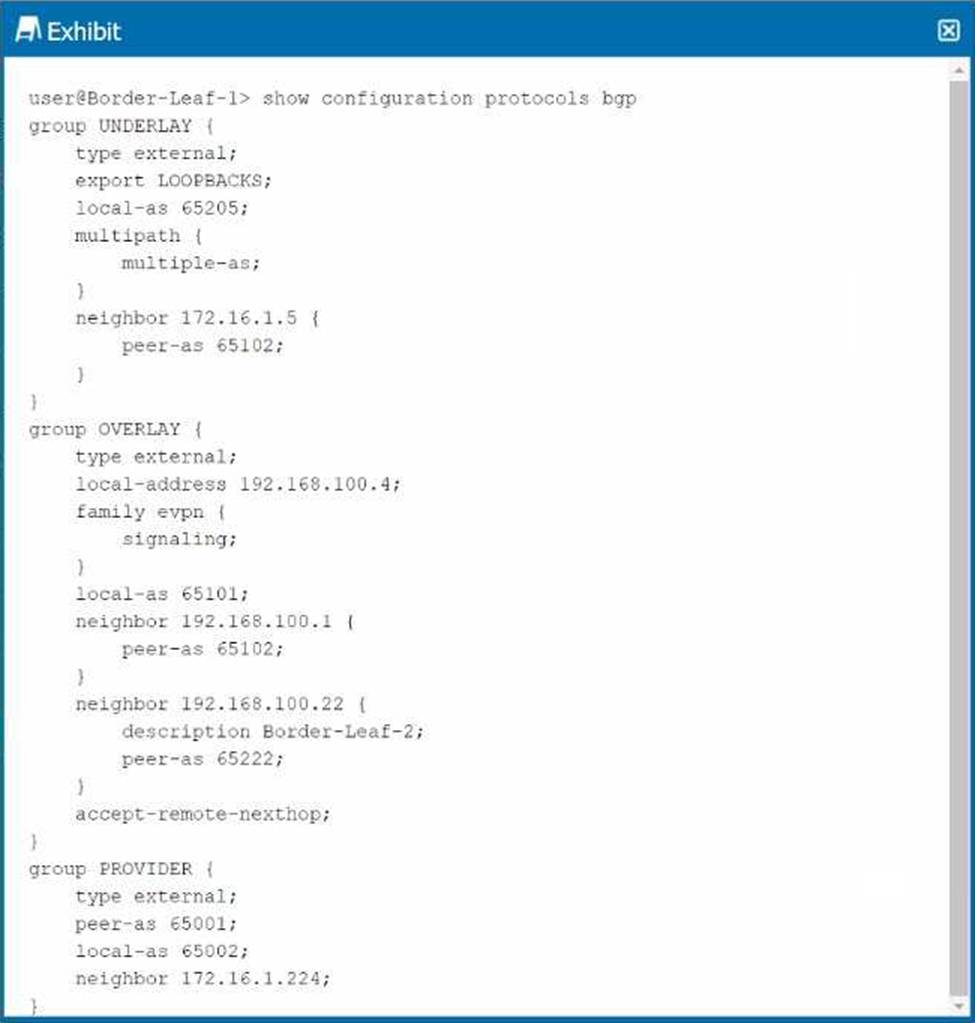
You are troubleshooting a DCI connection to another data center The BGP session to the provider is established, but the session to Border-Leaf-2 is not established.
Referring to the exhibit, which configuration change should be made to solve the problem?
- A . set protocols bgp group overlay export loopbacks
- B . delete protocols bgp group UNDERLAY advertise-external
- C . set protocols bgp group PROVIDER export LOOPBACKS
- D . delete protocols bgp group OVERLAY accept-remote-nexthop
D
Explanation:
Understanding the Configuration:
The exhibit shows a BGP configuration on a Border-Leaf device. The BGP group UNDERLAY is used for the underlay network, OVERLAY for EVPN signaling, and PROVIDER for connecting to the provider network.
The OVERLAY group has the accept-remote-nexthop statement, which is designed to accept the next-hop address learned from the remote peer as is, without modifying it. Problem Identification:
The BGP session to Border-Leaf-2 is not established. A common issue in EVPN-VXLAN environments
is related to next-hop reachability, especially when accept-remote-nexthop is configured.
In typical EVPN-VXLAN setups, the next-hop address should be reachable within the overlay network. However, the accept-remote-nexthop can cause issues if the next-hop IP address is not directly reachable or conflicts with the expected behavior in the overlay. Corrective Action:
D. delete protocols bgp group OVERLAY accept-remote-nexthop: Removing this command will ensure that the device uses its own IP address as the next-hop in BGP advertisements, which is standard practice in many EVPN-VXLAN setups. This change should help establish the BGP session with Border-Leaf-2.
Data Center
Reference: Proper handling of BGP next-hop attributes is critical in establishing and maintaining stable BGP sessions, especially in complex multi-fabric environments like EVPN-VXLAN. Removing accept-remote-nexthop aligns with best practices in many scenarios.
You are asked to interconnect two of your company’s data centers across the IP backbone. Both data centers have their own unique IP space and do not require any bridging.
In this scenario, which two actions would accomplish this task? (Choose two.)
- A . Configure a Type 2 EVPN route for each unique prefix.
- B . Configure peering for EVPN between border leaf nodes in each data center.
- C . Configure a Type 5 EVPN route for each unique prefix.
- D . Configure peering for EVPN between all leaf nodes within each data center.
BC
Explanation:
Interconnecting Data Centers:
The scenario requires interconnecting two data centers with unique IP spaces across an IP backbone.
The key point is that bridging is not required, so Layer 3 routing methods must be used.
EVPN Configuration:
Option B: Establishing EVPN peering between the border leaf nodes in each data center is the most appropriate solution as it allows for exchanging routing information between the two data centers. This ensures that the routes are properly distributed without the need for L2 bridging.
Option C: Configuring Type 5 EVPN routes is necessary for advertising IP prefixes (Layer 3 routes) across the EVPN. Type 5 routes allow for the exchange of IP prefixes between the two data centers, enabling the necessary routing functionality without the need for bridging.
Conclusion:
Option B: Correct―Peering between border leaf nodes sets up the necessary route exchange between data centers.
Option C: Correct―Type 5 EVPN routes are essential for exchanging Layer 3 prefixes between data centers.
You want to convert an MX Series router from a VXLAN Layer 2 gateway to a VXLAN Layer 3 gateway for VNI 100. You have already configured an IRB interface.
In this scenario, which command would you use to accomplish this task?
- A . set protocols isis interface irb.100 passive
- B . set vlans VLAN-100 13-interface irb.100
- C . set bridge-domains VLAN-100 routing-interface irb.100
- D . set protocols ospf area 0.0.0.0 interface irb.100 passive
C
Explanation:
Scenario Overview:
Converting an MX Series router from a VXLAN Layer 2 gateway to a VXLAN Layer 3 gateway involves transitioning the router’s functionality from simply bridging traffic within a VXLAN segment to routing traffic between different segments.
Key Configuration Requirement:
IRB (Integrated Routing and Bridging) Interface: An IRB interface allows for both Layer 2 switching and Layer 3 routing. To enable routing for a specific VNI (VXLAN Network Identifier), the IRB interface must be associated with the routing function in the corresponding bridge domain.
Correct Command:
C. set bridge-domains VLAN-100 routing-interface irb.100: This command correctly binds the IRB interface to the bridge domain, enabling Layer 3 routing functionality within the VXLAN for VNI 100. This effectively transitions the device from operating solely as a Layer 2 gateway to a Layer 3 gateway.
Data Center
Reference: This configuration step is essential when converting a Layer 2 VXLAN gateway to a Layer 3 gateway, enabling the MX Series router to route between VXLAN segments.
What are two supported methods (or exporting data when using the Junos telemetry interface? (Choose two.)
- A . using REST
- B . using UDP
- C . using SNMP
- D . using gRPC
BD
Explanation:
Junos Telemetry Interface (JTI):
The Junos Telemetry Interface is a framework that allows network operators to collect real-time telemetry data from Juniper devices. This data can be used for monitoring, analytics, and network automation.
Data Export Methods:
Option B: UDP (User Datagram Protocol) is a lightweight, connectionless protocol used for exporting telemetry data quickly with minimal overhead. While it doesn’t guarantee delivery, it is suitable for high-speed data transfer where occasional packet loss is acceptable.
Option D: gRPC (gRPC Remote Procedure Call) is a modern, high-performance method for data export that supports streaming and remote procedure calls, making it ideal for more complex telemetry data use cases.
Conclusion:
Option B: Correct―UDP is supported for exporting telemetry data.
Option D: Correct―gRPC is also supported, offering advanced streaming capabilities
You are using a single tenant data center with a bridged overlay architecture.
In this scenario, how do hosts of the different virtual networks communicate with each other?
- A . off-fabric using an external device
- B . using anycast gateway addresses configured on the leaf devices
- C . using EVPN Type 5 routes
- D . using virtual gateway addresses configured on the spine
A
Explanation:
Understanding Bridged Overlay Architecture:
In a single-tenant data center using a bridged overlay architecture, virtual networks (VLANs) are typically isolated within the fabric, with traffic between these VLANs handled outside the fabric.
Communication Between Different Virtual Networks: