
Juniper JN0-683 Practice Exams
Last updated on Oct 21,2026- Exam Code: JN0-683
- Exam Name: Data Center Professional (JNCIP-DC) Exam
- Certification Provider: Juniper
- Latest update: Oct 21,2026
You want to ensure that VXLAN traffic from the xe-0/0/12 interlace is being encapsulated by logical vlep.32770 and sent to a remote leaf device in this scenario, which command would you use to verify that traffic is flowing?
- A . monitor traffic interface xe-0/0/12
- B . show interface terse vtep.32770
- C . show interfaces terse vtep.32770 statistics
- D . show interfaces vtep.32770 detail
C
Explanation:
VXLAN Traffic Verification:
To ensure VXLAN traffic from the xe-0/0/12 interface is correctly encapsulated by the logical vtep.32770 and sent to a remote leaf device, it is essential to monitor the relevant interface statistics.
The command show interfaces terse vtep.32770 statistics provides a concise overview of the traffic
statistics for the specific VTEP interface, which can help verify whether traffic is being correctly
encapsulated and transmitted.
This command is particularly useful for quickly checking the traffic counters and identifying any potential issues with VXLAN encapsulation or transmission.
It allows you to confirm that traffic is flowing as expected, by checking the transmitted and received packet counters.
Data Center
Reference: Monitoring interface statistics is a crucial step in troubleshooting and validating network traffic, particularly in complex overlay environments like EVPN-VXLAN.
Exhibit.
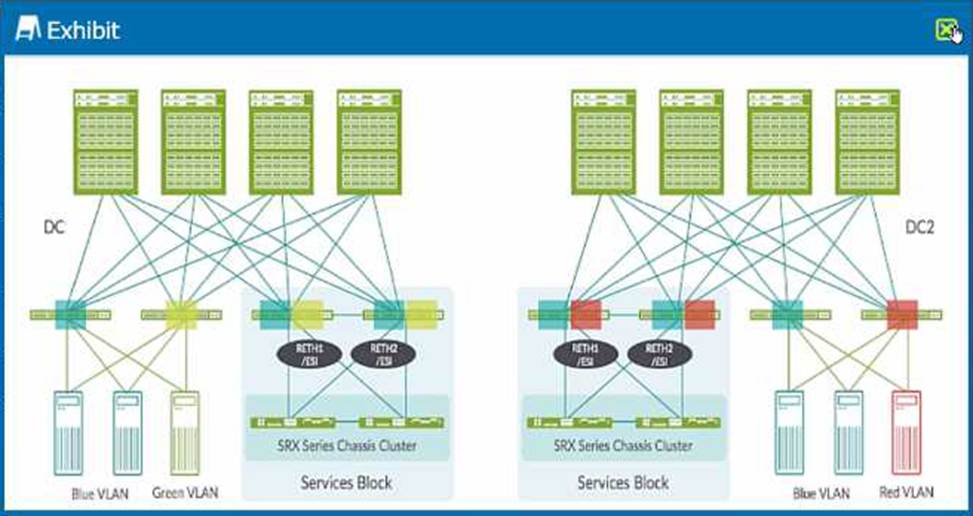
Both DC and DC2 ate using EVPN-VXLAN technology deployed using an ERB architecture. A server on the Red VLAN must communicate with a server on the Green VLAN. The Blue VLAN in DC and DC2 needs to be the same VLAN.
Which statement is correct in this scenario?
- A . The eight spine devices must be configured as border spine devices; a full mush interconnect must exist between all eight spine devices and the Blue VLAN must be stitched together
- B . An interconnect is required between the four SRX Series devices; the Blue VLAN must be stretched and a transit VNI must be added for the Red and Green VLANs.
- C . An interconnect is required between four leaf devices in the services blocks; the Red VLAN and the Green VLAN must be stitched and the Blue VLAN must be stretched.
- D . A lean super spine device must be added to DC and DC2; all VLANs must be stretched to the lean super spine device and the lean super spine devices must stitch all the VLANs together.
B
Explanation:
ERB Architecture in EVPN-VXLAN:
ERB (Edge Routed Bridging) architecture is commonly used in data center networks where routing decisions are made at the network edge (leaf or border devices), while bridging (Layer 2 forwarding) is extended across the fabric. This architecture allows for efficient L3 routing while still enabling L2 services like VLANs to span across multiple locations.
VLAN and VNI Configuration:
The scenario specifies that a server on the Red VLAN needs to communicate with a server on the Green VLAN. Since these VLANs are in different data centers (DC and DC2), and given the use of EVPN-VXLAN, the communication between these VLANs will require a transit VNI (Virtual Network Identifier). This transit VNI will allow traffic to traverse the VXLAN tunnel across the DCI (Data Center Interconnect).
Interconnect between SRX Series Devices:
The exhibit shows SRX Series Chassis Clusters used as service devices (likely for firewalling or other security services). These devices need to be interconnected between the two data centers to ensure that VLANs can communicate effectively. The Blue VLAN needs to be stretched between DC and DC2 to maintain the same Layer 2 domain across both data centers.
Conclusion:
Option B: Correct―Interconnecting the SRX Series devices will ensure the necessary service chaining, while stretching the Blue VLAN and adding a transit VNI for the Red and Green VLANs will enable the required communication across the data centers.
You want to provide a OCI that keeps each data center routing domain isolated, while also supporting translation of VNIs.
Which DCI scheme allows these features?
- A . MPLS DCI label exchange
- B . over the top (OTT) with VNI translation enabled
- C . VXLAN stitching
- D . over the top (OTT) with proxy gateways
C
Explanation:
Understanding DCI (Data Center Interconnect) Schemes:
DCI schemes are used to connect multiple data centers, enabling seamless communication and resource sharing between them. The choice of DCI depends on the specific requirements, such as isolation, VNI translation, or routing domain separation. VXLAN Stitching:
VXLAN stitching involves connecting multiple VXLAN segments, allowing VNIs (VXLAN Network Identifiers) from different segments to communicate with each other while maintaining separate routing domains.
This approach is particularly effective for keeping routing domains isolated while supporting VNI
translation, making it ideal for scenarios where you need to connect different data centers or
networks without merging their control planes.
Other Options:
Which two statements are true about EVPN routes for Data Center Interconnect? (Choose two.)
- A . Type 5 EVPN routes require a VXLAN tunnel to the protocol next hop.
- B . Type 2 EVPN routes do not require a VXLAN tunnel to the protocol next hop.
- C . Type 2 EVPN routes require a VXLAN tunnel to the protocol next hop.
- D . Type 5 EVPN routes do not require a VXLAN tunnel to the protocol next hop.
BD
Explanation:
Type 2 EVPN Routes:
Type 2 routes advertise MAC addresses within an EVPN instance and are used primarily for Layer 2
bridging. These routes do not require a VXLAN tunnel to the protocol next hop because they operate
within the same Layer 2 domain.
Type 5 EVPN Routes:
Type 5 routes are used to advertise IP prefixes (Layer 3 routes) within EVPN. Similar to Type 2 routes, they do not require a VXLAN tunnel to the protocol next hop because they represent L3 routes, which are managed at the routing layer without the need for VXLAN encapsulation.
Conclusion:
Option B: Correct―Type 2 routes do not need a VXLAN tunnel to the next hop, as they are used for Layer 2.
Option D: Correct―Type 5 routes also do not need a VXLAN tunnel because they operate at Layer 3, handling IP prefixes.
You are selling up an EVPN-VXLAN architecture (or your new data center. this initial deployment will be less than 50 switches: however, it could scale up to 250 switches over time supporting 1024 VLANs. You are still deciding whether to use symmetric or asymmetric routing.
In this scenario, which two statements are correct? (Choose two.)
- A . Symmetric routing needs an extra VLAN with an IRB interface for each L3 VRF instance.
- B . Asymmetric routing is easier lo monitor because of the transit VNI.
- C . Symmetric routing supports higher scaling numbers.
- D . Asymmetric routing routes traffic on the egress switch.
CD
Explanation:
Symmetric vs. Asymmetric Routing in EVPN-VXLAN:
Symmetric Routing: Traffic enters and exits the VXLAN network through the same VTEP, regardless of the source or destination. This approach simplifies routing decisions, especially in large networks, and is generally more scalable.
Asymmetric Routing: The routing occurs on the egress VTEP. This method can be simpler to deploy in smaller environments but becomes complex as the network scales, particularly with larger numbers of VNIs and VLANs.
Correct Statements:
C. Symmetric routing supports higher scaling numbers: Symmetric routing is preferred in larger EVPN-VXLAN deployments because it centralizes routing decisions, which can be more easily managed and scaled.
D. Asymmetric routing routes traffic on the egress switch: This is accurate, as asymmetric routing means the routing decision is made at the final hop, i.e., the egress VTEP before the traffic reaches its destination.
Incorrect Statements:
Exhibit.
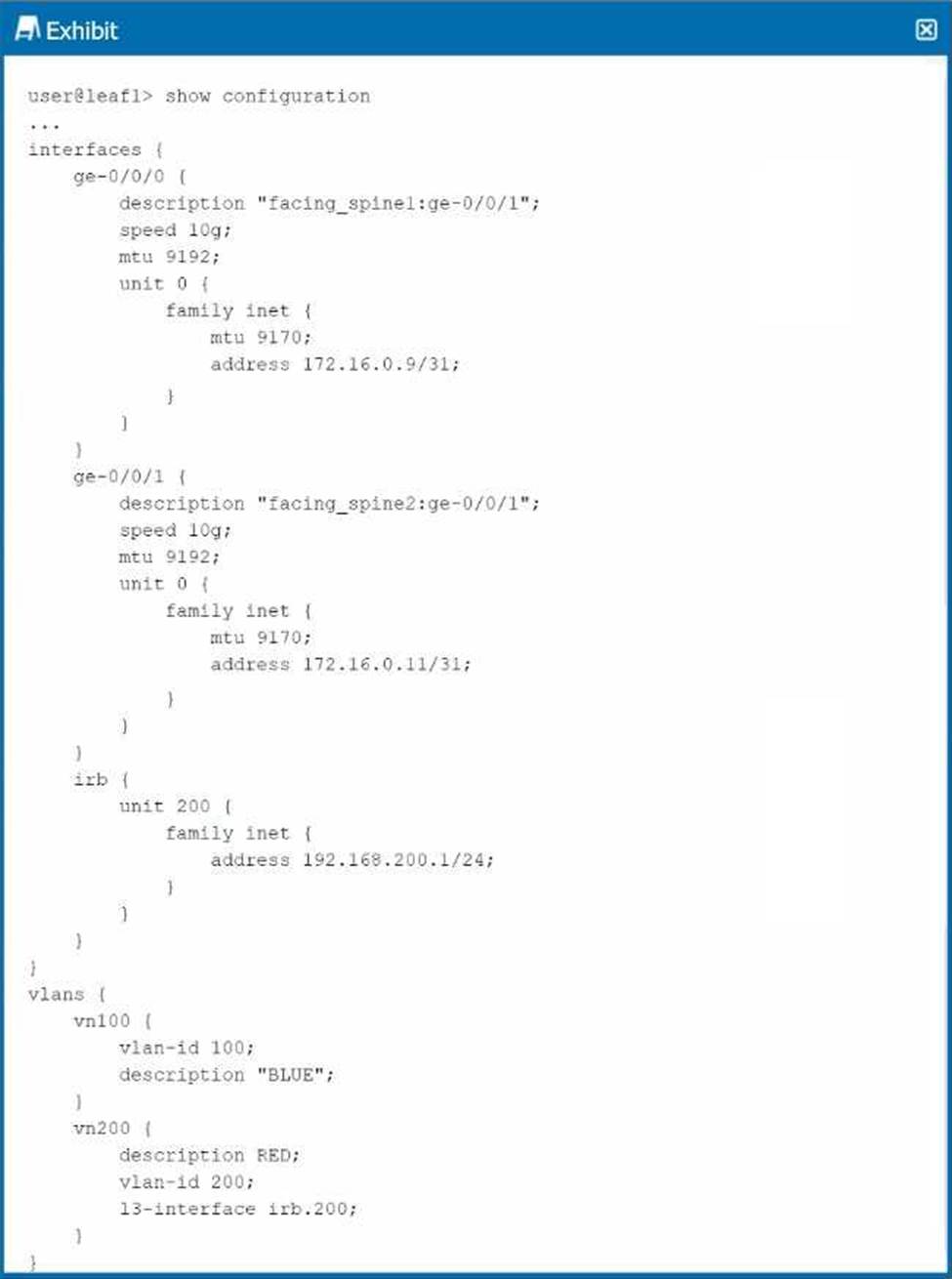
Host A is connected to vlan 100 on lead. Host B is connected to vlan 200 on leaf1. Host A and Host B ate unable to communicate. You have reviewed the touting and your hosts have the correct default route (.1)
Referring to the exhibit, which two commands will solve the problem? (Choose two.)
- A . delete vlans vn200 13-interface irb.200
- B . set interfaces irb unit 100 family inet address 192-168.100.1
- C . set routing-options static route 0.0.0.0/0 next-hop 192.168.200.10
- D . set vlans vn100 13-interface irb.100
CD
Explanation:
In the provided network configuration, Host A is in VLAN 100 and Host B is in VLAN 200. The issue
arises because these two hosts are unable to communicate, which indicates that either the interfaces
are not properly linked to their respective VLANs, or there is a missing static route required for inter-
VLAN routing.
Step-by-Step Analysis:
VLAN Assignment:
The exhibit shows that irb.200 is correctly associated with VLAN 200 in the configuration. However, there is no corresponding irb.100 for VLAN 100. Without irb.100, the network lacks the logical interface to handle routing for VLAN 100. Thus, adding irb.100 to VLAN 100 is necessary.
Command to solve this:
set vlans vn100 13-interface irb.100
Static Route Configuration:
For inter-VLAN routing to occur, a static route needs to be configured that allows traffic to pass between different subnets (in this case, between VLAN 100 and VLAN 200). The command set routing-options static route 0.0.0.0/0 next-hop 192.168.200.10 would add a static route that directs all traffic from VLAN 100 to the correct gateway (192.168.200.10), which is necessary to route traffic between the two VLANs.
Command to solve this:
set routing-options static route 0.0.0.0/0 next-hop 192.168.200.10
Explanation of Incorrect Options:
Option A (delete vlans vn200 13-interface irb.200): This would remove the logical interface associated with VLAN 200, which is not desired because we need VLAN 200 to remain active and properly routed.
Option B (set interfaces irb unit 100 family inet address 192-168.100.1): This command would incorrectly assign an IP address that does not correspond with the subnet of VLAN 100 (192.168.200.1/24). This could create a misconfiguration, leading to routing issues.
Data Center
Reference: For a Data Center, proper VLAN management and static routing are crucial for ensuring that different network segments can communicate effectively, especially when dealing with separated subnets or zones like in different VLANs. This aligns with best practices in DCIM (Data Center Infrastructure Management) which stress the importance of proper network configuration to avoid downtime and ensure seamless communication between all critical IT infrastructure components.
Ensuring that the correct interfaces are associated with the correct VLANs and having the proper static routes in place are both essential steps in maintaining a robust and reliable data center network.
This detailed analysis reflects best practices as noted in standard data center design and network configuration guides.
What are three actions available tor MAC move limiting? (Choose three.)
- A . drop
- B . filter
- C . enable
- D . log
- E . shutdown
ADE
Explanation:
MAC Move Limiting:
MAC move limiting is a security feature used in network switches to detect and mitigate rapid changes in MAC address locations, which could indicate a network issue or an attack such as MAC flapping or spoofing.
When a MAC address is learned on a different interface than it was previously learned, the switch can take various actions to prevent potential issues.
Available Actions:
Exhibit.
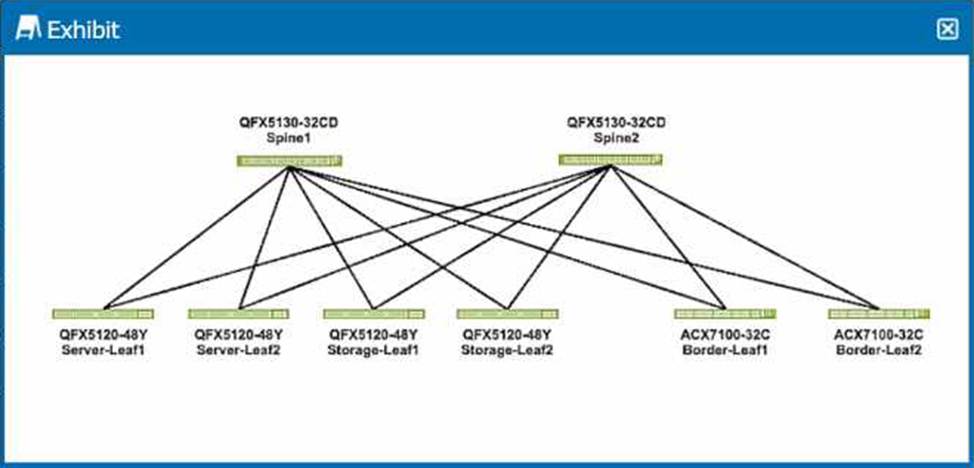
You are deploying a VXLAN overlay with EVPN as the control plane in an ERB architecture.
Referring to the exhibit, which three statements are correct about where the VXLAN gateways will be placed? (Choose three.)
- A . Only the spine devices will have L2 VXLAN gateways.
- B . All leaf devices will have L2 VXLAN gateways.
- C . All leaf devices will have L3 VXLAN gateways.
- D . Only the border and leaf devices will have L3 VXLAN gateways.
- E . Spine devices will have no VXLAN gateways.
BCE
Explanation:
Understanding ERB Architecture:
ERB (Edge Routed Bridging) architecture is a network design where the routing occurs at the edge (leaf devices) rather than in the spine devices. In a VXLAN overlay network with EVPN as the control plane, leaf devices typically act as both Layer 2 (L2) and Layer 3 (L3) VXLAN gateways.
Placement of VXLAN Gateways:
Option B: All leaf devices will have L2 VXLAN gateways to handle the bridging of VLAN traffic into VXLAN tunnels.
Option C: All leaf devices will also have L3 VXLAN gateways to route traffic between different VXLAN segments (VNIs) and external networks.
Option E: Spine devices in an ERB architecture generally do not function as VXLAN gateways. They primarily focus on forwarding traffic between leaf nodes and do not handle VXLAN encapsulation/decapsulation.
Conclusion:
Option B: Correct―All leaf devices will have L2 VXLAN gateways.
Option C: Correct―All leaf devices will have L3 VXLAN gateways.
Option E: Correct―Spine devices will not act as VXLAN gateways
You are adding a server lo a tenant’s network within your data center and must limit access to a specific traffic type within the tenant network without pushing all tenant traffic through a firewall.
What will satisfy this requirement?
- A . Use route leaking with EVPN and a routing policy.
- B . Use filter-based forwarding.
- C . Put the new server on a unique subnet within the tenant’s network.
- D . Use a static route in the tenant VRF with a firewall as the next hop for traffic to the new server.
B
Explanation:
Controlling Traffic Within a Tenant’s Network:
The requirement is to limit access to specific traffic types within a tenant’s network without routing all tenant traffic through a firewall. This requires a selective method that can direct specific types of traffic to different paths based on the nature of the traffic.
Filter-Based Forwarding (FBF):
FBF is a technique that allows for routing decisions based on filters applied to the traffic, such as matching on source IP addresses, destination IP addresses, or even specific application types (like HTTP or FTP). This allows specific types of traffic to be forwarded to a specific next hop (e.g., a firewall) without affecting the entire traffic flow within the tenant’s network.
Conclusion:
Option B: Correct―Filter-based forwarding allows for granular control of traffic, ensuring that only specific types of traffic within the tenant’s network are redirected through a firewall, satisfying the requirement.
You are asked to interconnect Iwo data centers using a method that provides EVPN Type 2 connectivity, is highly scalable, and limits VXLAN tunnels between border leaf devices.
What will satisfy these requirements?
- A . over the top full-mesh interconnect
- B . EVPN Type 2 stretch
- C . IP VPN
- D . Type 2 seamless stitching
D
Explanation:
Requirement Analysis:
The scenario requires a solution to interconnect two data centers that supports EVPN Type 2 connectivity. The solution must be highly scalable and must minimize the number of VXLAN tunnels between border leaf devices.
Understanding Type 2 Seamless Stitching:
Option D: Type 2 seamless stitching is a method used in EVPN to provide Layer 2 connectivity (such as MAC address mobility) across different VXLAN segments. It is scalable because it allows only necessary tunnels to be established between border leaf devices, reducing the overhead of maintaining a full mesh of VXLAN tunnels.
Conclusion:
Option D: Correct―Type 2 seamless stitching satisfies the requirement by enabling scalable, efficient interconnection of two data centers with minimal VXLAN tunnels.