
Juniper JN0-683 Practice Exams
Last updated on Oct 21,2026- Exam Code: JN0-683
- Exam Name: Data Center Professional (JNCIP-DC) Exam
- Certification Provider: Juniper
- Latest update: Oct 21,2026
You are asked to build redundant gateways in your EVPN-VXLAN environment, but you must conserve address space because these gateways must span across seven PES.
What should you implement on the PEs lo satisfy these requirements?
- A . Use IRB interfaces with the same IP address and different MAC addresses.
- B . Use IRB interfaces with the same IP and VGA.
- C . Use IRB interfaces with the same IP and MAC address.
- D . Use IRB interfaces with different IP addresses and the same VGA.
C
Explanation:
Redundant Gateways in EVPN-VXLAN:
In an EVPN-VXLAN environment, providing redundant gateway functionality typically involves the use of Anycast Gateway. This allows multiple PEs (Provider Edge devices) to use the same IP address and MAC address for the gateway, enabling seamless failover and redundancy without IP conflicts. Conserving Address Space:
Using the same IP address across multiple PEs conserves address space because only one IP address is needed for the gateway function, regardless of the number of PEs. The shared MAC address ensures that ARP resolution and forwarding behavior are consistent across all the PEs.
Conclusion:
Option C: Correct―Using IRB interfaces with the same IP and MAC address across all PEs satisfies the need for redundancy while conserving address space.
Options A, B, and D introduce unnecessary complexity or do not fully utilize the efficient Anycast Gateway approach, which is best practice for conserving IP space and providing redundancy.
You manage an IP fabric with an EVPN-VXLAN overlay. You have multiple tenants separated using multiple unique VRF instances. You want to determine the routing information that belongs in each routing instance’s routing table.
In this scenario, which property is used for this purpose?
- A . the VRF target community
- B . the routing instance type
- C . the VRF table label
- D . the route distinguisher value
D
Explanation:
Understanding VRF and Routing Instances:
In an EVPN-VXLAN overlay network, multiple tenants are separated using unique VRF (Virtual Routing and Forwarding) instances. Each VRF instance maintains its own routing table, allowing for isolated routing domains within the same network infrastructure. Role of Route Distinguisher:
Route Distinguisher (RD): The RD is a unique identifier used in MPLS and EVPN environments to distinguish routes belonging to different VRFs. The RD is prepended to the IP address in the route advertisement, ensuring that routes from different tenants remain unique even if they use the same IP address range.
Correct Property:
D. the route distinguisher value: This is the correct answer because the RD is crucial in determining which routing information belongs to which VRF instance. It ensures that each VRF’s routing table only contains relevant routes, maintaining isolation between tenants.
Data Center
Reference: The RD is a key element in MPLS and EVPN-based multi-tenant environments, ensuring proper routing segregation and isolation for different VRFs within the data center fabric.
Which two statements are true about IP fabrics using unnumbered BGP? (Choose two.)
- A . Unnumbered BGP requires that family inet6 is configured on each interface.
- B . Unnumbered BGP peering automatically provisions IPv6 peering.
- C . Unnumbered BGP requires that family inet is configured on each interface.
- D . Unnumbered BGP peering automatically provisions IPv4 peering.
CD
Explanation:
Understanding Unnumbered BGP:
Unnumbered BGP (Border Gateway Protocol) allows BGP peering between routers without assigning specific IP addresses to the interfaces. Instead, it uses the loopback address or another router identifier for the BGP session, making IP address management more straightforward in large-scale networks.
Family inet Configuration:
Option C: The family inet configuration is required on each interface involved in unnumbered BGP peering to support IPv4 address families. This ensures that IPv4 peering sessions can be established between devices.
Automatic IPv4 Peering:
Option D: Unnumbered BGP peering automatically provisions IPv4 peering sessions. This simplifies the configuration by eliminating the need to manually assign and manage IP addresses for BGP peering.
Conclusion:
Option C: Correct―Unnumbered BGP requires the family inet configuration for IPv4.
Option D: Correct―Unnumbered BGP automatically provisions IPv4 peering, simplifying setup.
You are asked to set up an IP fabric that supports Al or ML workloads.
You have chosen to use lossless Ethernet in this scenario, which statement is correct about congestion management?
- A . The switch experiencing the congestion notifies the source device.
- B . Only the source and destination devices need ECN enabled.
- C . ECN marks packets based on WRED settings.
- D . ECN is negotiated only among the switches that make up the IP fabric for each queue.
A
Explanation:
Understanding Lossless Ethernet and Congestion Management:
Lossless Ethernet is crucial for AI and ML workloads, where packet loss can significantly degrade performance. To implement lossless Ethernet, congestion management protocols like ECN (Explicit Congestion Notification) are used.
Role of ECN in Congestion Management:
Option A: In an IP fabric that supports lossless Ethernet, when a switch experiences congestion, it can mark packets using ECN. This marking notifies the source device of the congestion, allowing the source to reduce its transmission rate, thereby preventing packet loss. Conclusion:
Option A: Correct―The switch experiencing congestion notifies the source device via ECN marking.
You are implementing VXLAN broadcast domains in your data center environment.
Which two statements are correct in this scenario? (Choose two.)
- A . A VXLAN packet does not contain a VLAN ID.
- B . The VNI must match the VLAN tag to ensure that the remote VTEP can decapsulate VXLAN packets.
- C . Layer 2 frames are encapsulated by the source VTEP.
- D . The VNI is a 16-bit value and can range from 0 through 16.777.215.
AC
Explanation:
VXLAN Overview:
VXLAN (Virtual Extensible LAN) is a network virtualization technology that encapsulates Layer 2 Ethernet frames into Layer 3 UDP packets for transmission over an IP network. It allows the creation of Layer 2 overlay networks across a Layer 3 infrastructure. Understanding VXLAN Components:
VTEP (VXLAN Tunnel Endpoint): A VTEP is responsible for encapsulating and decapsulating Ethernet frames into and from VXLAN packets.
VNI (VXLAN Network Identifier): A 24-bit identifier used to distinguish different VXLAN segments,
allowing for up to 16 million unique segments.
Correct Statements:
C. Layer 2 frames are encapsulated by the source VTEP: This is correct. In a VXLAN deployment, the source VTEP encapsulates the original Layer 2 Ethernet frame into a VXLAN packet before transmitting it over the IP network to the destination VTEP, which then decapsulates it.
Exhibit.
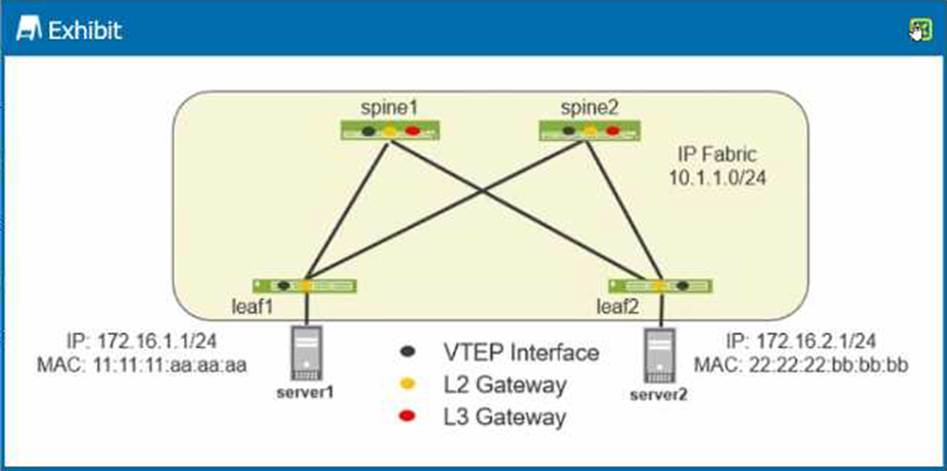
You have implemented an EVPN-VXLAN data center. Device served must be able to communicate with device server2.
Referring to the exhibit, which two statements are correct? (Choose two.)
- A . An IRB interface must be configured on spinel and spine2.
- B . Traffic from server1 to server2 will transit a VXLAN tunnel to spinel or spine2. then a VXLAN tunnel from spinel or spine2 to Ieaf2.
- C . An IRB Interface must be configured on leaf1 and Ieaf2.
- D . Traffic from server! to server2 will transit the VXLAN tunnel between leaf1 and Ieaf2.
CD
Explanation:
Understanding the Exhibit Setup:
The network diagram shows an EVPN-VXLAN setup, a common design for modern data centers enabling Layer 2 and Layer 3 services over an IP fabric.
Leaf1 and Leaf2 are the leaf switches connected to Server1 and Server2, respectively, with each server in a different subnet (172.16.1.0/24 and 172.16.2.0/24).
Spine1 and Spine2 are part of the IP fabric, interconnecting the leaf switches.
EVPN-VXLAN Basics:
EVPN (Ethernet VPN) provides Layer 2 and Layer 3 VPN services using MP-BGP.
VXLAN (Virtual Extensible LAN) encapsulates Layer 2 frames into Layer 3 packets for transmission across an IP network.
VTEP (VXLAN Tunnel Endpoint) interfaces on leaf devices handle VXLAN encapsulation and decapsulation.
Integrated Routing and Bridging (IRB):
IRB interfaces are required on leaf1 and leaf2 (where the endpoints are directly connected) to route between different subnets (in this case, between 172.16.1.0/24 and 172.16.2.0/24).
The IRB interfaces provide the necessary L3 gateway functions for inter-subnet communication.
Traffic Flow Analysis:
Traffic from Server1 (172.16.1.1) destined for Server2 (172.16.2.1) must traverse from leaf1 to leaf2.
The traffic will be VXLAN encapsulated on leaf1, sent over the IP fabric, and decapsulated on leaf2.
Since the communication is between different subnets, the IRB interfaces on leaf1 and leaf2 are
crucial for routing the traffic correctly.
Correct Statements:
C. An IRB Interface must be configured on leaf1 and leaf2: This is necessary to perform the inter-subnet routing for traffic between Server1 and Server2.
D. Traffic from server1 to server2 will transit the VXLAN tunnel between leaf1 and leaf2: This describes the correct VXLAN operation where the traffic is encapsulated by leaf1 and decapsulated by leaf2.
Data Center
Reference: In EVPN-VXLAN architectures, the leaf switches often handle both Layer 2 switching and Layer 3 routing via IRB interfaces. This allows for efficient routing within the data center fabric without the need to involve the spine switches for every routing decision.
The described traffic flow aligns with standard EVPN-VXLAN designs, where direct VXLAN tunnels between leaf switches enable seamless and scalable communication across a data center network.
You are asked for TX and RX traffic statistics for each interface to which an application server is attached. The statistics need to be reported every five seconds.
Using the Junos default settings, which telemetry method would accomplish this request?
- A . gNMI
- B . SNMP
- C . Native Sensors
- D . OpenConfig
C
Explanation:
Telemetry Methods in Junos:
Telemetry is used to collect and report data from network devices. For high-frequency statistics reporting, such as every five seconds, you need a telemetry method that supports this level of granularity and real-time monitoring.
Junos Native Sensors:
Option C: Native Sensors in Junos provide detailed, high-frequency telemetry data, including TX and RX traffic statistics for interfaces. They are designed to offer real-time monitoring with customizable sampling intervals, making them ideal for the five-second reporting requirement.
Conclusion:
Option C: Correct―Native Sensors in Junos are capable of providing the required high-frequency telemetry data every five seconds.
Exhibit.
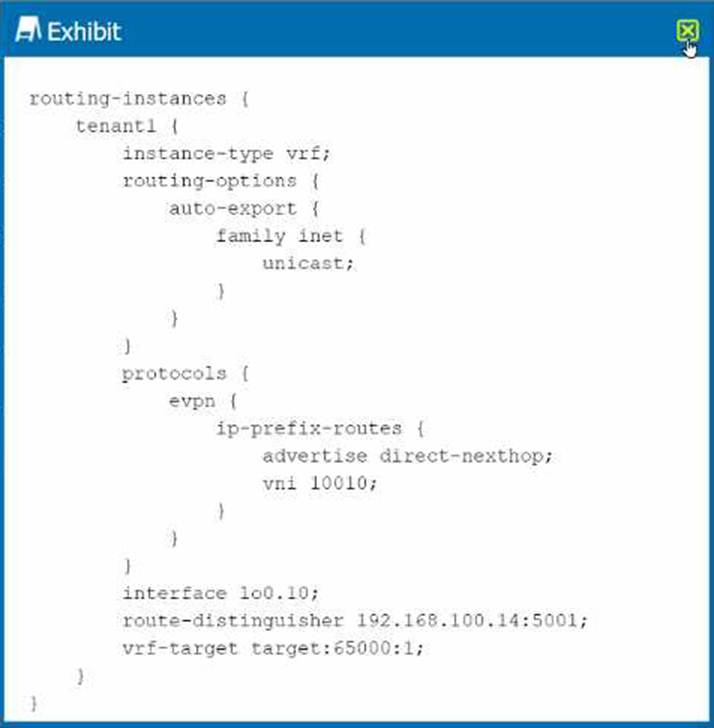
You want to enable the border leaf device to send Type 5 routes of local networks to the border leaf device in another data center.
What must be changed to the configuration shown in the exhibit to satisfy this requirement?
- A . Move vrf-target target: 65000:1 to the evpn hierarchy.
- B . Add a VLAN configuration with an 13-interface to the tenant1 routing instance.
- C . Add encapsulation vxlan to the evpn hierarchy.
- D . Change: 5001 in the route-distinguisher to : 10010.
A
Explanation:
In this scenario, you want the border leaf device to advertise Type 5 EVPN routes to another border leaf in a different data center. Type 5 routes in EVPN are used to advertise IP prefixes, which means that for proper route advertisement, you need to configure the correct settings within the evpn hierarchy.
Step-by-Step Analysis:
Understanding EVPN Type 5 Routes:
EVPN Type 5 routes are used to advertise IP prefixes across EVPN instances, which allow different data centers or networks to exchange routing information effectively.
VRF Target Setting:
The vrf-target configuration is crucial because it defines the export and import policies for the VRF within the EVPN instance. For EVPN Type 5 routes to be advertised to other border leaf devices, the vrf-target needs to be correctly configured under the evpn hierarchy, not just within the routing instance.
Command to solve this:
move vrf-target target:65000:1 to evpn
Other Options:
Option B: Adding a VLAN configuration would not address the requirement to advertise Type 5 routes.
Option C: Adding VXLAN encapsulation may be necessary for other scenarios but does not directly address the Type 5 route advertisement.
Option D: Changing the route-distinguisher will differentiate routes but does not impact the advertisement of Type 5 routes to other data centers.
By moving the vrf-target to the evpn hierarchy, you enable the proper route advertisement, ensuring that the Type 5 routes for local networks are shared with other data center border leaf devices. This is aligned with best practices for multi-data center EVPN implementations, which emphasize the correct placement of routing policies within the EVPN configuration.
You are deploying a Clos IP fabric with an oversubscription ratio of 3:1.
In this scenario, which two statements are correct? (Choose two.)
- A . The oversubscription ratio remains the same when you remove spine devices.
- B . The oversubscription ratio decreases when you add spine devices.
- C . The oversubscription ratio increases when you remove spine devices.
- D . The oversubscription ratio remains the same when you add spine devices.
BC
Explanation:
Understanding Oversubscription in a Clos Fabric:
The oversubscription ratio in a Clos IP fabric measures the ratio of the amount of edge (leaf) bandwidth to the core (spine) bandwidth. An oversubscription ratio of 3:1 means that there is three times more edge bandwidth compared to core bandwidth.
Impact of Adding/Removing Spine Devices:
Option C: If you remove spine devices, the total available core bandwidth decreases, while the edge bandwidth remains the same. This results in an increase in the oversubscription ratio because there is now less core bandwidth to handle the same amount of edge traffic.
Option B: Conversely, if you add spine devices, the total core bandwidth increases. This decreases the oversubscription ratio because more core bandwidth is available to handle the edge traffic. Conclusion:
Option C: Correct―Removing spine devices increases the oversubscription ratio.
Option B: Correct―Adding spine devices decreases the oversubscription ratio.
Which three statements are correct about symmetric IRB routing with EVPN Type 2 routes? (Choose three.)
- A . An L3 interface (IRB) is required for each local VLAN.
- B . Symmetric routing requires MAC-VRF.
- C . Symmetric routing supports the EVPN service VLAN bundle.
- D . Symmetric routing requires an extra transit VNI for each VRF.
- E . Symmetric routing is less efficient than asymmetric routing.
ABD
Explanation:
Symmetric IRB Routing with EVPN Type 2 Routes:
Symmetric Routing: In symmetric IRB (Integrated Routing and Bridging), routing occurs in both directions at the ingress and egress leaf nodes using the same routing logic. This is contrasted with asymmetric routing, where different routing logic is used depending on the direction of the traffic.
Required Components:
Option A: An L3 IRB interface is necessary for each VLAN that participates in routing, as it handles the Layer 3 processing for the VLAN.
Option B: MAC-VRF is required for symmetric routing to maintain a mapping of MAC addresses to the appropriate VRF, ensuring correct forwarding within the EVPN.
Option D: A transit VNI (Virtual Network Identifier) is required for each VRF to encapsulate the Layer 3 traffic as it traverses the network, allowing the IP traffic to be appropriately forwarded. Conclusion:
Option A: Correct―Each local VLAN needs an IRB interface for L3 processing.
Option B: Correct―MAC-VRF is necessary for handling MAC address resolution in symmetric routing.
Option D: Correct―Transit VNIs are required for routing VRF-specific traffic across the network.
Options C and E are incorrect because:
C: Symmetric routing can work with various VLAN models, including single or multiple VLANs within an EVPN instance.
E: Symmetric routing is generally more efficient than asymmetric routing as it uses consistent routing logic in both directions.