
Juniper JN0-683 Practice Exams
Last updated on Oct 21,2026- Exam Code: JN0-683
- Exam Name: Data Center Professional (JNCIP-DC) Exam
- Certification Provider: Juniper
- Latest update: Oct 21,2026
Which parameter is used to associate a received route with a local VPN route table?
- A . route-target community
- B . VLAN ID
- C . VNI
- D . route-distinguisher
A
Explanation:
Understanding VPN Route Table Association:
In MPLS/VPN and EVPN networks, the route-target community is a BGP extended community attribute used to control the import and export of VPN routes. It associates received routes with the appropriate VPN route tables on the PE (Provider Edge) routers.
Function of Route-Target Community:
The route-target community tag ensures that routes are imported into the correct VRF (Virtual Routing and Forwarding) instance, allowing them to be correctly routed within the VPN.
Conclusion:
Option A: Correct―The route-target community is used to associate received routes with a local VPN route table.
What are two ways in which an EVPN-signaled VXLAN is different from a multicast-signaled VXLAN? (Choose two.)
- A . An EVPN-signaled VXLAN can perform autodiscovery of VTEPs using IS-IS.
- B . An EVPN-signaled VXLAN can perform autodiscovery of VTEPs using BGP.
- C . An EVPN-signaled VXLAN is less resource intensive.
- D . An EVPN-signaled VXLAN features slower and more complete convergence.
BC
Explanation:
Multicast-Signaled VXLAN:
In traditional multicast-signaled VXLAN, VTEPs (VXLAN Tunnel Endpoints) use multicast to flood and learn about remote VTEPs. This method relies on multicast in the underlay network to distribute BUM (Broadcast, Unknown unicast, and Multicast) traffic.
This approach can be resource-intensive due to the need for multicast group management and increased network traffic, especially in large deployments.
EVPN-Signaled VXLAN:
EVPN-signaled VXLAN uses BGP (Border Gateway Protocol) to signal the presence of VTEPs and distribute MAC address information. BGP is used for VTEP autodiscovery and the distribution of endpoint information.
This method is more efficient because it reduces the reliance on multicast, instead using BGP control-
plane signaling to handle VTEP discovery and MAC learning, which reduces the overhead on the
network and improves scalability.
Correct Statements:
B. An EVPN-signaled VXLAN can perform autodiscovery of VTEPs using BGP: This is correct because EVPN uses BGP for VTEP autodiscovery, making it more efficient and scalable compared to multicast-based methods.
C. An EVPN-signaled VXLAN is less resource-intensive: This is correct because it eliminates the need for multicast flooding in the underlay, instead using BGP for signaling, which is less demanding on network resources.
Incorrect Statements:
You are asked to deploy 100 QFX Series devices using ZTP Each OFX5120 requires a different configuration.
In this scenario, what are two components that you would configure on the DHCP server? (Choose two.)
- A . the IP address of the FTP server
- B . the MAC address for each OFX5120
- C . the MAC address of the FTP server
- D . the management IP address for each OFX5120
BD
Explanation:
Zero Touch Provisioning (ZTP):
ZTP allows for the automated configuration of network devices, like QFX Series switches, without manual intervention. During ZTP, a switch will obtain its configuration from a DHCP server and then download the required software and configuration files from a specified server (e.g., FTP, HTTP).
DHCP Server Configuration:
Option B: The DHCP server needs to know the MAC address for each QFX5120 to provide a specific configuration based on the device identity. By mapping the MAC address to a particular configuration, the DHCP server can ensure that each switch gets the correct configuration.
Option D: The management IP address for each QFX5120 must also be assigned by the DHCP server. This IP address allows the device to communicate on the network and access the configuration files and other required resources during the ZTP process.
Conclusion:
Option B: Correct―MAC addresses allow the DHCP server to identify each QFX5120 and assign the appropriate configuration.
Option D: Correct―Management IP addresses are essential for network communication during ZTP.
You are deploying an IP fabric using EBGP and notice that your leaf devices are advertising and receiving all the routes. However, the routes are not installed in the routing table and are marked as hidden.
Which two statements describe how to solve the issue? (Choose two.)
- A . You need to configure as-override.
- B . You need to configure a next-hop self policy.
- C . You need to configure loops 2.
- D . You need to configure multipath multiple-as.
BD
Explanation:
Issue Overview:
The leaf devices in an IP fabric using eBGP are advertising and receiving all routes, but the routes are not being installed in the routing table and are marked as hidden. This typically indicates an issue with the BGP configuration, particularly with next-hop handling or AS path concerns. Corrective Actions:
B. You need to configure a next-hop self policy: This action ensures that the leaf devices modify the next-hop attribute to their own IP address before advertising routes to their peers. This is particularly important in eBGP setups where the next-hop may not be directly reachable by other peers.
D. You need to configure multipath multiple-as: This setting allows the router to accept multiple paths from different autonomous systems (ASes) and use them for load balancing. Without this, the BGP process might consider only one path and mark others as hidden.
Incorrect Statements:
Exhibit.
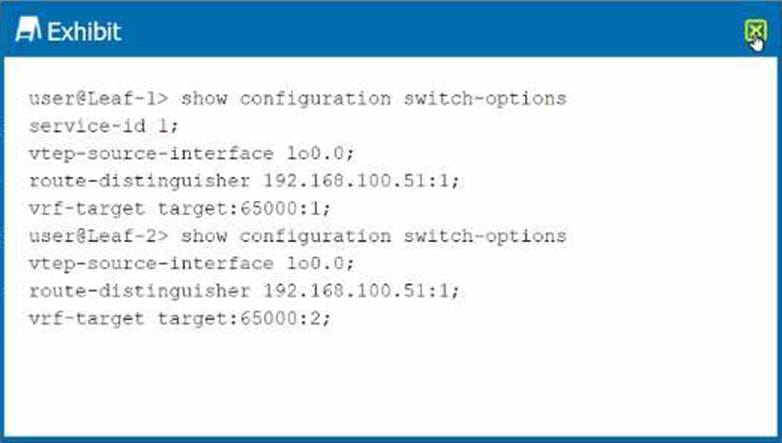
Connections between hosts connected to Leaf-1 and Leaf-2 are not working correctly.
- A . Referring to the exhibit, which two configuration changes are required to solve the problem? (Choose two.)
- B . Configure the set switch-options vtep-source-interface irb.0 parameter on Leaf-1.
- C . Configure the set switch-options vrf-target target:65000:l parameteron Leaf-2.
- D . Configure the set switch-options route-distinguisher i92.168.100.50:i parameter on Leaf-1.
- E . Configure the set switch-options service-id 1 parameter on Leaf-2.
CE
Explanation:
Issue Analysis:
The problem in the exhibit suggests a mismatch in configuration parameters between Leaf-1 and Leaf-2, leading to communication issues between hosts connected to these leaf devices.
Configuration Mismatches:
Service-ID: Leaf-1 has service-id 1 configured, while Leaf-2 does not have this parameter. For consistency and proper operation, the service-id should be the same across both leaf devices. VRF Target: Leaf-1 is configured with vrf-target target:65000:1, while Leaf-2 is configured with vrf-target target:65000:2. To allow proper VRF import/export between the two leafs, these should match.
Corrective Actions:
C. Configure the set switch-options vrf-target target:65000:1 parameter on Leaf-2: This aligns the VRF targets between the two leaf devices, ensuring they can correctly import and export routes.
E. Configure the set switch-options service-id 1 parameter on Leaf-2: This ensures that both Leaf-1 and Leaf-2 use the same service ID, which is necessary for consistency in the EVPN-VXLAN setup. Data Center
Reference: Correct configuration of VRF targets and service IDs is critical in EVPN-VXLAN setups to ensure that routes and services are correctly shared and recognized between different devices in the network fabric.
Which three statements are correct about VXLAN control planes? (Choose three.)
- A . EVPN is inefficient and does not scale well.
- B . Both multicast and EVPN can facilitate MAC learning.
- C . Multicast is not agile and requires manual VNI mapping.
- D . EVPN enables fast convergence and updates.
- E . Multicast does not require as many resources.
BDE
Explanation:
VXLAN Control Planes:
VXLAN (Virtual Extensible LAN) uses different control planes to handle MAC learning and traffic forwarding. The control planes include multicast and EVPN (Ethernet VPN). Multicast and EVPN Comparison:
Option B: Both multicast and EVPN can be used for MAC learning in a VXLAN environment. Multicast is a more traditional approach, while EVPN is more advanced and supports distributed MAC learning. Option D: EVPN offers benefits such as fast convergence and rapid updates, making it more efficient and scalable for modern data center environments.
Option E: Multicast does not require as many resources because it relies on traditional Layer 3 multicast mechanisms to distribute broadcast, unknown unicast, and multicast (BUM) traffic. However, it can be less flexible and less scalable compared to EVPN.
Conclusion:
Option B: Correct―Both control planes facilitate MAC learning.
Option D: Correct―EVPN provides fast convergence and updates.
Option E: Correct―Multicast is resource-efficient but less flexible.
You are implementing seamless stitching between two data centers and have a proposed configuration for a border leaf device.
In this scenario, which two statements are correct? {Choose two.)
- A . The translation-vni must match in both data centers.
- B . The translation-vni must be different in each data center.
- C . The ESI must be different in each data center.
- D . The ESI must match in both data centers.
BD
Explanation:
Understanding Seamless Stitching:
Seamless stitching is used in EVPN to interconnect two data centers, allowing for consistent Layer 2 and Layer 3 connectivity across them. This is often achieved by translating VNIs (Virtual Network Identifiers) between the data centers.
Translation-VNI:
Option B: The translation VNI must be different in each data center to ensure that traffic can be correctly routed and distinguished as it crosses between the data centers. This differentiation helps to maintain the integrity of the traffic flows and prevents any potential overlap or conflict in VNIs. Ethernet Segment Identifier (ESI):
Option D: The ESI must match in both data centers to ensure that the same Ethernet segment (which could be multihomed) is recognized consistently across the data centers. Matching ESIs are crucial for maintaining a unified view of the Ethernet segment across the interconnected fabric.
Conclusion:
Option B: Correct―Translation VNIs must be unique to each data center for proper traffic distinction.
Option D: Correct―Matching ESIs are necessary to maintain consistent Ethernet segment identification across both data centers.
Which statement is correct about a collapsed fabric EVPN-VXLAN architecture?
- A . Fully meshed back-to-back links are needed between the spine devices.
- B . It supports multiple vendors in the fabric as long as all the spine devices are Juniper devices deployed with L2 VTEPs
- C . Using Virtual Chassis at the leaf layer increases resiliency.
- D . Border gateway functions occur on border leaf devices.
D
Explanation:
Collapsed Fabric Architecture:
A collapsed fabric refers to a simplified architecture where the spine and leaf roles are combined, often reducing the number of devices and links required.
In this architecture, the spine typically handles core switching, while leaf switches handle both access and distribution roles.
Understanding Border Gateway Functionality:
Border gateway functions include connecting the data center to external networks or other data centers.
In a collapsed fabric, these functions are usually handled at the leaf level, particularly on border leaf devices that manage the ingress and egress of traffic to and from the data center fabric. Correct Statement:
D. Border gateway functions occur on border leaf devices: This is accurate in collapsed fabric architectures, where the border leaf devices take on the role of managing external connections and handling routes to other data centers or the internet.
Data Center
Reference: The collapsed fabric model is advantageous in smaller deployments or scenarios where simplicity and cost-effectiveness are prioritized. It reduces complexity by consolidating functions into fewer devices, and the border leaf handles the critical task of interfacing with external networks.
In conclusion, border gateway functions are effectively managed at the leaf layer in collapsed fabric architectures, ensuring that the data center can communicate with external networks seamlessly.
Exhibit.
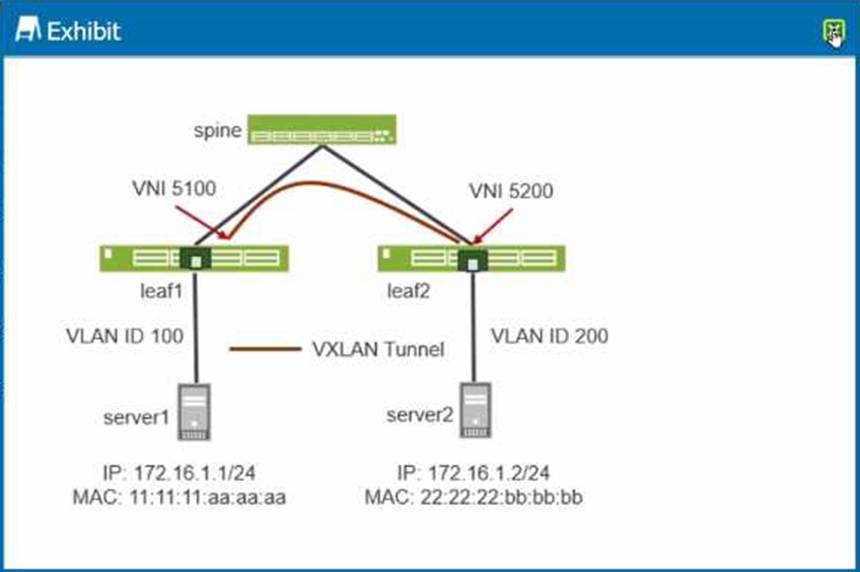
A VXLAN tunnel has been created between leaf1 and Ieaf2 in your data center.
Referring to the exhibit, which statement is correct?
- A . Traffic sent from server1 to server2 will be dropped on Ieaf2.
- B . Traffic sent from server1 to server2 will be tagged with VLAN ID 100 on Ieaf2 and forwarded to server2.
- C . Traffic sent from server1 to server2 will be tagged with VLAN ID 200 on Ieaf2 and forwarded to server2.
- D . Traffic sent from server1 to server2 will be dropped on leaf1.
C
Explanation:
Understanding VXLAN Tunneling:
VXLAN (Virtual Extensible LAN) is a network virtualization technology that addresses the scalability issues associated with traditional VLANs. VXLAN encapsulates Ethernet frames in UDP, allowing Layer 2 connectivity to extend across Layer 3 networks.
Each VXLAN network is identified by a unique VXLAN Network Identifier (VNI). In this exhibit, we have two VNIs, 5100 and 5200, assigned to the VXLAN tunnels between leaf1 and leaf2.
Network Setup Details:
Leaf1: Connected to Server1 with VLAN ID 100 and associated with VNI 5100.
Leaf2: Connected to Server2 with VLAN ID 200 and associated with VNI 5200.
Spine: Acts as the interconnect between leaf switches.
Traffic Flow Analysis:
When traffic is sent from Server1 to Server2, it is initially tagged with VLAN ID 100 on leaf1.
The traffic is encapsulated into a VXLAN packet with VNI 5100 on leaf1.
The packet is then sent across the network (via the spine) to leaf2.
On leaf2, the VXLAN header is removed, and the original Ethernet frame is decapsulated. Leaf2 will then associate this traffic with VLAN ID 200 before forwarding it to Server2.
Correct Interpretation of the Exhibit:
The traffic originating from Server1, which is tagged with VLAN ID 100, will be encapsulated into VXLAN and transmitted to leaf2.
Upon arrival at leaf2, it will be decapsulated, and since it is associated with VNI 5200 on leaf2, the traffic will be retagged with VLAN ID 200.
Therefore, the traffic will reach Server2 tagged with VLAN ID 200, which matches the network
configuration shown in the exhibit.
Data Center
Reference: This configuration is typical in data centers using VXLAN for network virtualization. It allows isolated Layer 2 segments (VLANs) to be stretched across Layer 3 boundaries while maintaining distinct VLAN IDs at each site.
This approach is efficient for scaling large data center networks while avoiding VLAN ID exhaustion and enabling easier segmentation.
In summary, the correct behavior, as per the exhibit and the detailed explanation, is that traffic sent from Server1 will be tagged with VLAN ID 200 when it reaches Server2 via leaf2. This ensures proper traffic segmentation and handling across the VXLAN-enabled data center network.
As part of the onboarding process for new switches being added to your data centers, your company uses Juniper Networks’ ZTP process. As part of the ZTP process, a script is executed by the devices being onboarded.
Which statement is correct in this scenario?
- A . The Junos ZTP process supports Shell. JScript. and Ansible.
- B . The Junos ZTP process supports Python, SLAX, and Perl.
- C . The Junos ZTP process supports JScript. Ansible. and Perl.
- D . The Junos ZTP process supports Shell. Python, and SLAX.
D
Explanation:
Zero Touch Provisioning (ZTP):
Juniper Networks’ ZTP (Zero Touch Provisioning) process automates the deployment of new devices by allowing them to fetch and execute scripts for configuration and setup as they are powered on and connected to the network.
Supported Scripting Languages:
The Junos OS supports several scripting languages that can be used during the ZTP process:
Shell scripts are often used for general automation tasks.
Python is a widely supported language in Junos, offering powerful scripting capabilities for automating network tasks.
SLAX (Service Logic Execution Environment) is a scripting language specific to Junos, designed to automate configuration tasks and simplify network operations.
Conclusion:
Option D: Correct―Junos ZTP supports Shell, Python, and SLAX, making it the correct choice among the provided options.