
Juniper JN0-683 Practice Exams
Last updated on Oct 21,2026- Exam Code: JN0-683
- Exam Name: Data Center Professional (JNCIP-DC) Exam
- Certification Provider: Juniper
- Latest update: Oct 21,2026
You are asked to implement VXLAN group-based policies (GBPs) in your data center.
Which two statements are correct in (his scenario? (Choose two.)
- A . VXLAN GBP uses scalable group tags that must be configured statically on each switch and activated through 802.1X.
- B . VXLAN GBP uses scalable group tags that may be configured on a RADIUS server and pushed to the switch through 802.1X.
- C . VXLAN GBP ensures consistent application of security group policies throughout the network.
- D . VXLAN GBP ensures consistent application of BGP groups throughout the network.
BC
Explanation:
VXLAN Group-Based Policies (GBP):
VXLAN Group-Based Policies are used to apply security policies consistently across the network. These policies are often tied to user or device identities rather than static IP addresses, which allows for more dynamic and scalable security management.
Scalable Group Tags via RADIUS and 802.1X:
Option B: VXLAN GBP can use scalable group tags configured on a RADIUS server, which are then pushed to network devices through 802.1X. This allows for centralized and automated policy application based on user or device identity.
Consistent Security Policy Application:
Option C: GBP ensures that security policies are consistently applied across the network, regardless of where a user or device connects. This consistency is crucial in environments where security policies must follow the user or device.
Conclusion:
Option B: Correct―Group tags can be configured on a RADIUS server and pushed via 802.1X, enabling centralized policy management.
Option C: Correct―GBP ensures consistent application of security policies, which is essential for maintaining security across a dynamic network environment.
You are deploying multiple Juniper switches al the same location. Your switches are currently using the factory-default configuration.
In this scenario, which two statements are correct? (Choose two.)
- A . The DHCP server configuration cannot provide Junos version requirements to DHCP clients.
- B . The switch will try to request an IP address from a DHCP server using all interfaces that are connected and are operational.
- C . The switch will try to request an IP address from a DHCP server using only the management interface.
- D . The DHCP server configuration can provide Junos version requirements to DHCP clients.
BD
Explanation:
DHCP Behavior in Factory-Default Configuration:
Option B: In the factory-default configuration, Juniper switches are designed to send DHCP requests on all operational interfaces. This behavior ensures that the switch can obtain an IP address for management and further configuration from any available DHCP server.
Option D: The DHCP server can provide additional configuration parameters, including the required Junos version. This allows for automated provisioning and ensures that the switch is running the correct software version.
Conclusion:
Option B: Correct―The switch will use any operational interface to request an IP address via DHCP. Option D: Correct―The DHCP server can specify Junos version requirements, enabling automated software management.
Exhibit.
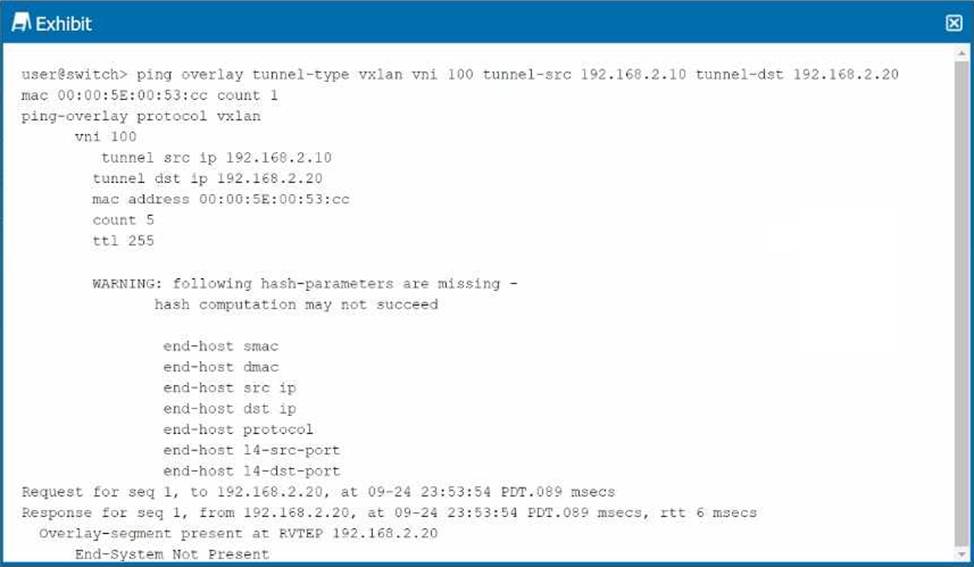
Referring to the exhibit, which statement is correct?
- A . VNI 100 is not configured on the remote VTEP.
- B . The MAC address is unknown and not in the forwarding table of the remote VTEP.
- C . The remote VTEP is not responding.
- D . The MAC address is known but not reachable by the remote VTEP
B
Explanation:
Analyzing the Exhibit Output:
The command ping overlay tunnel-type vxlan is used to test the VXLAN tunnel between two VTEPs (VXLAN Tunnel Endpoints). The output shows a warning about missing hash parameters, but more importantly, it displays the result: End-System Not Present. Understanding the Response:
The message End-System Not Present indicates that the remote VTEP (192.168.2.20) did not find the MAC address 00:00:5E:00:53:CC in its forwarding table. This typically means that the MAC address is unknown to the remote VTEP, and as a result, it could not forward the packet to the intended destination.
Conclusion:
Option B: Correct―The MAC address is unknown and is not in the forwarding table of the remote VTEP, which is why the system reports that the "End-System" is not present.
Exhibit.
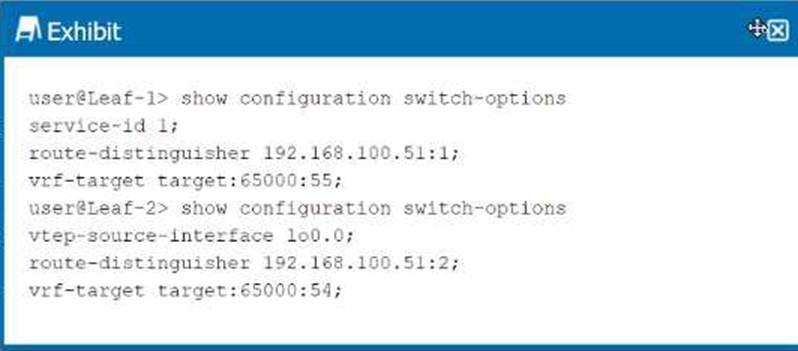
Connections between hosts connected to Leaf-1 and Leaf-2 are not working correctly.
Referring to the exhibit, which two configuration changes are required to solve the problem? (Choose two.)
- A . Configure the set switch-options route-distinguisher 192.168.100.51:2 parameter on Leaf-1.
- B . Configure the set switch-options service-id 1 parameter on Leaf-2.
- C . Configure the set switch-options vtep-source-interface 100. 0 parameter on Leaf-1.
- D . Configure the set switch-options vrf-target target: 65000:55 parameter on Leaf-2.
BD
Explanation:
Review of the Exhibit:
The exhibit shows the switch configuration for Leaf-1 and Leaf-2. The configurations include route distinguishers, VRF targets, and service IDs, all of which are crucial for ensuring proper operation in an EVPN-VXLAN environment.
Service-ID Consistency:
The service ID must be consistent across all participating leaf devices in the same EVPN instance to ensure that they are part of the same VXLAN overlay network.
VRF Target Consistency:
The vrf-target parameter must also be consistent across devices to ensure that VRFs (Virtual Routing and Forwarding instances) are correctly imported and exported between leaf nodes.
Conclusion:
Option B: Correct―Setting the same service-id on Leaf-2 ensures that it is part of the same VXLAN overlay as Leaf-1.
Option D: Correct―The vrf-target on Leaf-2 should match Leaf-1 to ensure consistent routing policies and proper route exchange.
Which two statements are true about a pure IP fabric? (Choose two.)
- A . Devices in an IP fabric function as Layer 3 routers.
- B . An IP fabric supports Layer 2 VLANs.
- C . Devices in an IP fabric must be connected to a fabric controller.
- D . An IP fabric does not support Layer 2 protocols.
AD
Explanation:
Understanding Pure IP Fabric:
A pure IP fabric is a network design where all devices operate at Layer 3, meaning that each device in the fabric is a router that makes forwarding decisions based on IP addresses. Layer 2 Support:
In a pure IP fabric, traditional Layer 2 protocols such as Spanning Tree Protocol (STP) or VLANs are not supported. Instead, the network relies entirely on Layer 3 routing protocols to manage traffic between devices.
Routing Functionality:
Since devices in an IP fabric operate as Layer 3 routers, they handle IP routing and provide network services based on IP addresses, not on MAC addresses or Layer 2 switching.
Conclusion:
Option A: Correct―Devices in an IP fabric function as Layer 3 routers.
Option D: Correct―A pure IP fabric does not support traditional Layer 2 protocols, making it a purely routed environment.
You are deploying a new network lo support your Al workloads on devices that support at least 400 Gbps Ethernet. There is no requirement for any Layer 2 VLANs in this network.
Which network architecture would satisfy this requirement?
- A . an IP fabric using PIM-SM to signal VXLAN overlay
- B . an IP fabric using the EVPN-MPLS architecture
- C . an IP fabric with an EVPN-VXLAN architecture
- D . an IP fabric using EBGP
D
Explanation:
Requirements for AI Workloads:
The scenario requires a network that supports at least 400 Gbps Ethernet and does not require Layer 2 VLANs. This setup is well-suited for a pure Layer 3 network, which can efficiently route traffic between devices without the overhead or complexity of maintaining Layer 2 domains. Choosing the Right Network Architecture:
Option D: An IP fabric using EBGP (External BGP) is ideal for this scenario. In a typical IP fabric, EBGP is used to handle routing between spine and leaf switches, creating a scalable and efficient network. Since there is no need for Layer 2 VLANs, the pure IP fabric design with EBGP provides a straightforward and effective solution.
Options A, B, and C involve more complex architectures (like VXLAN or EVPN), which are unnecessary when there’s no requirement for Layer 2 overlays or VLANs.
Conclusion:
Option D: Correct―An IP fabric with EBGP is the most suitable and straightforward architecture for a network that needs to support high-speed AI workloads without Layer 2 VLANs.
Exhibit.
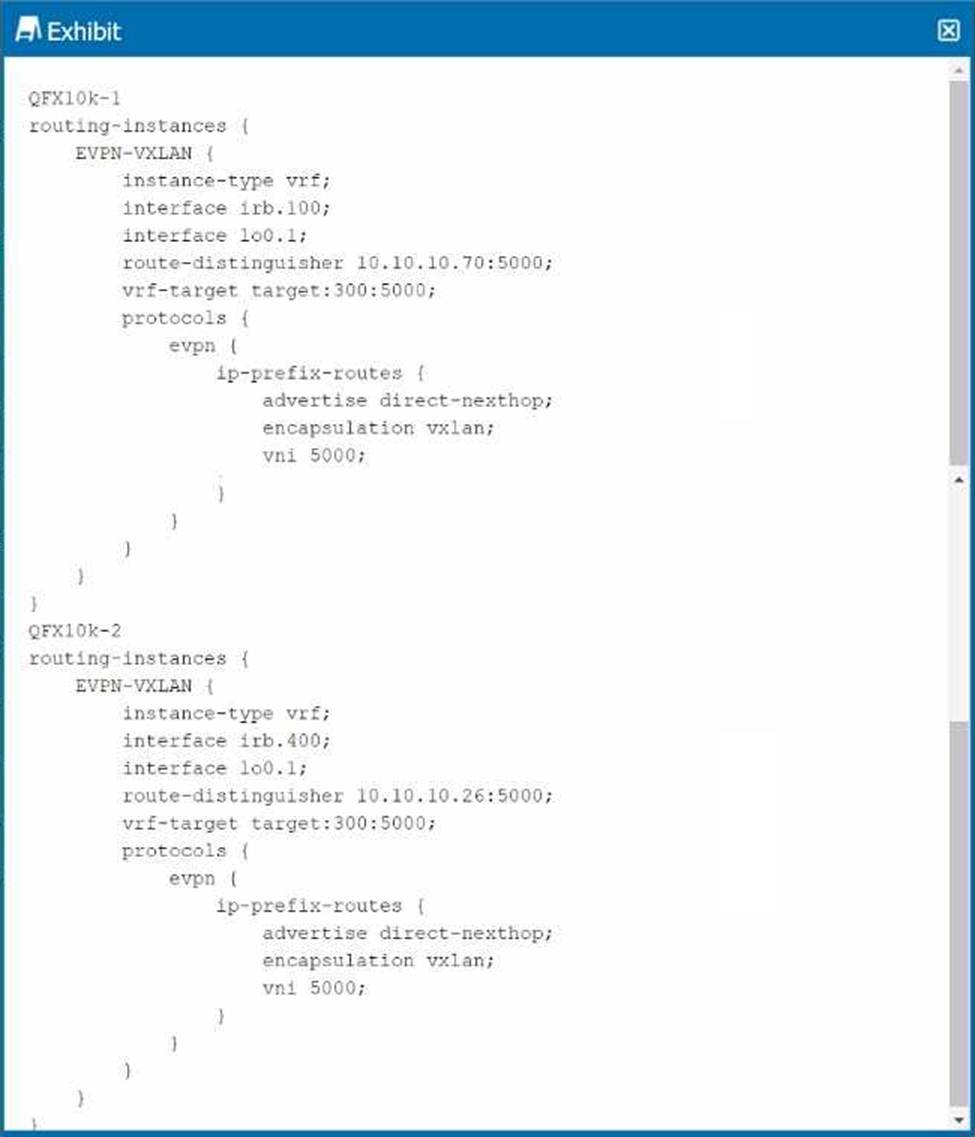
You have a sample configuration for connecting two sites through EVPN-VXLAN by exchanging IP prefix routes.
Referring to the exhibit, which two statements regarding the configuration are true? {Choose two.)
- A . The advertise direct-nexthop option enables the receiver to resolve the next-hop route using only information carried in the Type 5 route.
- B . The advertise direct-nexthop option enables the receiver to resolve the next-hop route using only information carried in the Type 2 route.
- C . The VNI must match on all devices for the same customer.
- D . The VNI should be unique on all devices for each customer site.
AC
Explanation:
EVPN-VXLAN Configuration:
The configuration provided in the exhibit shows an EVPN-VXLAN setup where IP prefix routes are exchanged between two sites. The advertise direct-nexthop option and the VNI (Virtual Network Identifier) settings are crucial in this context.
Advertise Direct-Nexthop:
Option A: The advertise direct-nexthop option ensures that the next-hop route is resolved using only the information carried in the EVPN Type 5 route. Type 5 routes are used for IP prefix advertisement in EVPN, which is key to enabling Layer 3 interconnectivity between different VXLAN segments. VNI Consistency:
Option C: For the same customer across different devices, the VNI must be consistent. This consistency ensures that all devices can correctly map traffic to the appropriate VXLAN segment, maintaining seamless Layer 2 and Layer 3 connectivity.
Exhibit.
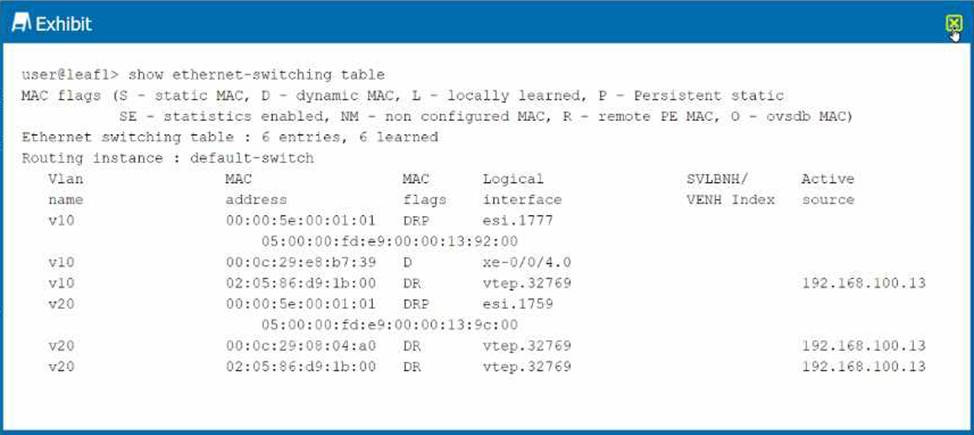
Referring to the exhibit, why is the active source field blank for the entry that uses the 00:0c:29:e8:b7:39 MAC address?
- A . The EVPN route for this host does not have a valid next hop.
- B . The ARP lookup for this host has failed.
- C . The host for this entry is locally connected to leaf1.
- D . This entry is associated with a multicast EVPN route.
A
Explanation:
In this scenario, the active source field is blank for the MAC address 00:0c:29:e8:b7:39, indicating an issue with how this MAC entry is being processed within the EVPN/VXLAN environment.
Step-by-Step Analysis:
Understanding the MAC Entry:
The active source field should normally indicate the source of the route advertisement for a specific MAC address within the EVPN. If it is blank, it suggests that there is a problem with how this entry is being learned or propagated.
Possible Issues:
Option A: If the EVPN route for this MAC address does not have a valid next hop, the entry might exist in the MAC table, but it will not have a valid path for forwarding, leading to a blank active source.
Option B: If the ARP lookup had failed, the entry might not even appear in the MAC table. However, the entry does exist, suggesting that ARP is not the primary issue here.
Option C: If the host were locally connected, the active source should reflect a local interface, but the field is blank, ruling out local connection as the cause.
Option D: Multicast EVPN routes typically do not appear in this manner in the MAC table, and this would not cause the active source to be blank.
Conclusion: The most logical explanation is that the EVPN route for this host exists but does not have a valid next hop, leading to the absence of an active source. This is consistent with how EVPN routing tables work in a VXLAN environment, where the lack of a valid next hop would prevent proper route advertisement and forwarding for the specific MAC address.
Exhibit.
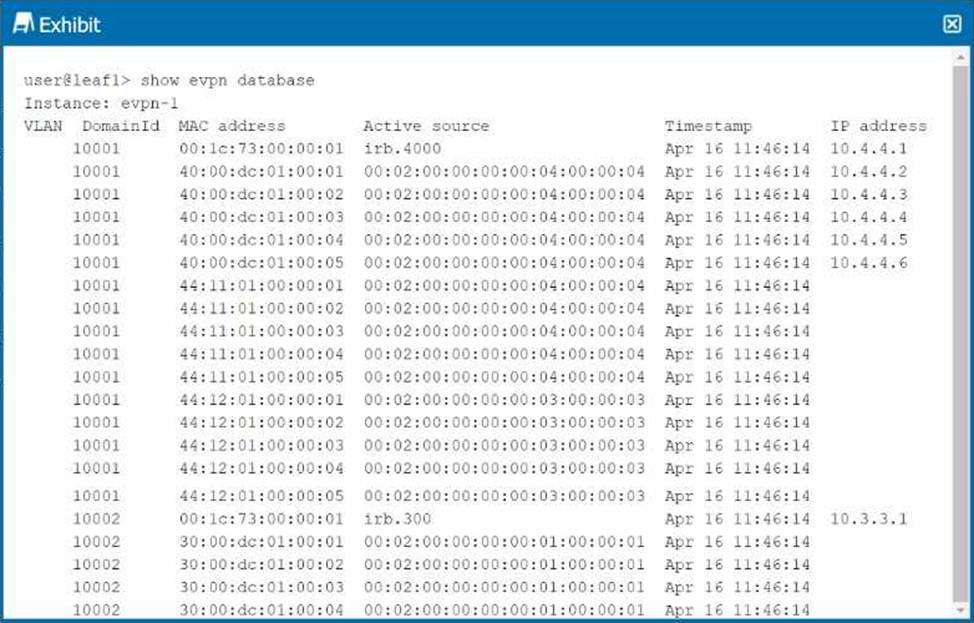
The exhibit shows the truncated output of the show evpn database command.
Given this output, which two statements are correct about the host with MAC address 40:00:dc:01:00:04? (Choose two.)
- A . The host is assigned IP address 10.4.4.5.
- B . The host is originating from irb.300.
- C . The host is located on VN110002.
- D . The host is originating from an ESI LAG.
AD
Explanation:
Understanding the Output:
The show evpn database command output shows the MAC address, VLAN, active source, timestamp, and IP address associated with various hosts in the EVPN instance.
Analysis of the MAC Address:
Option A: The MAC address 40:00:dc:01:00:04 is associated with the IP address 10.4.4.5, as indicated by the output in the IP address column. This confirms that this host has been assigned the IP 10.4.4.5.
Option D: The active source for the MAC address 40:00:dc:01:00:04 is listed as 00:02:00:00:00:04:00:04:00:00:04:00:04, which indicates that the host is connected via an ESI (Ethernet Segment Identifier) LAG (Link Aggregation Group). This setup is typically used in multi-homing scenarios to provide redundancy and load balancing across multiple physical links.
Conclusion:
Option A: Correct―The host with MAC 40:00:dc:01:00:04 is assigned IP 10.4.4.5.
Option D: Correct―The host is originating from an ESI LAG, as indicated by the active source value.
You are deploying an EVPN-VXLAN overlay. You must ensure that Layer 3 routing happens on the spine devices.
In this scenario, which deployment architecture should you use?
- A . ERB
- B . CRB
- C . bridged overlay
- D . distributed symmetric routing
B
Explanation:
Understanding EVPN-VXLAN Architectures:
EVPN-VXLAN overlays allow for scalable Layer 2 and Layer 3 services in modern data centers.
CRB (Centralized Routing and Bridging): In this architecture, the Layer 3 routing is centralized on
spine devices, while the leaf devices focus on Layer 2 switching and VXLAN tunneling. This setup is
optimal when the goal is to centralize routing for ease of management and to avoid complex routing
at the leaf level.
ERB (Edge Routing and Bridging): This architecture places routing functions on the leaf devices, making it a distributed model where each leaf handles routing for its connected hosts.
Architecture Choice for Spine Routing:
Given the requirement to ensure Layer 3 routing happens on the spine devices, the CRB (Centralized Routing and Bridging) architecture is the correct choice. This configuration offloads routing tasks to the spine, centralizing control and potentially simplifying the overall design.
With CRB, the spine devices perform all routing between VXLAN segments. Leaf switches handle local switching and VXLAN encapsulation, but routing decisions are centralized at the spine level. This model is particularly advantageous in scenarios where centralized management and routing control are desired, reducing the complexity and configuration burden on the leaf switches.
Data Center
Reference: The CRB architecture is commonly used in data centers where centralized control and simplified management are key design considerations. It allows the spines to act as the primary routing engines, ensuring that routing is handled in a consistent and scalable manner across the fabric.