
Juniper JN0-683 Practice Exams
Last updated on Oct 21,2026- Exam Code: JN0-683
- Exam Name: Data Center Professional (JNCIP-DC) Exam
- Certification Provider: Juniper
- Latest update: Oct 21,2026
Exhibit.
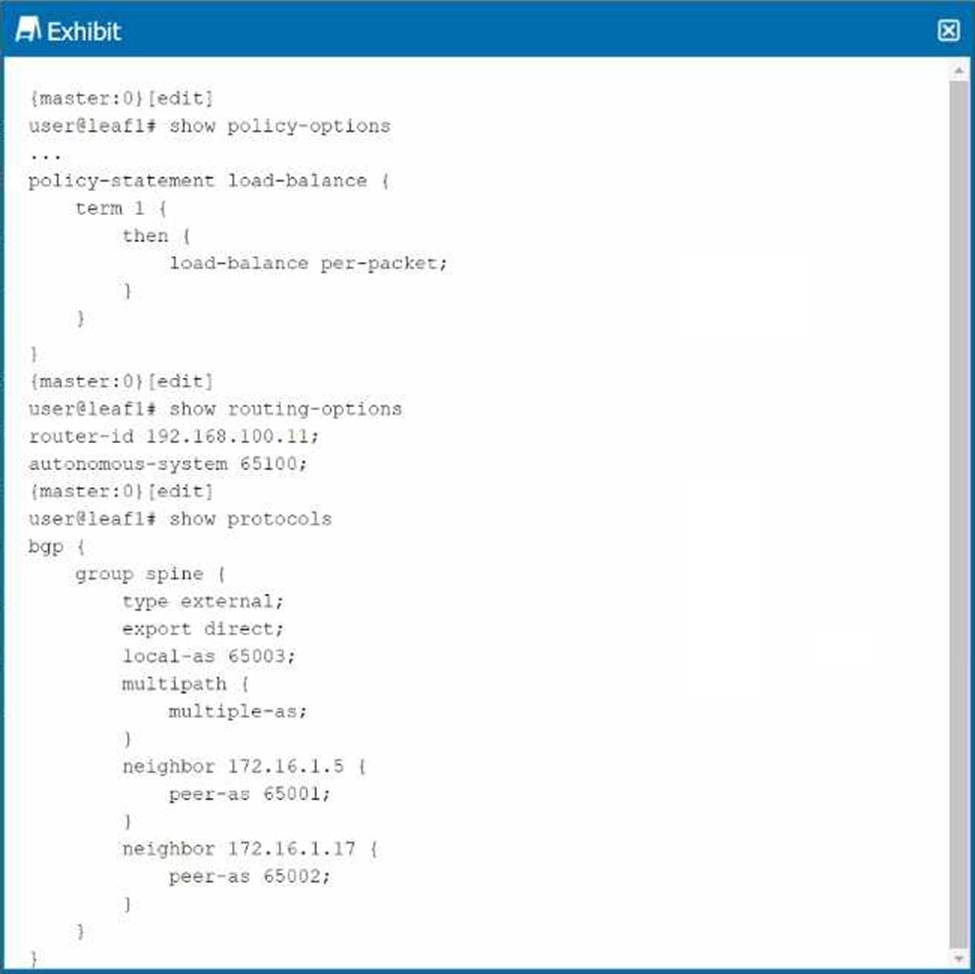
You are troubleshooting an IP fabric (or your data center. You notice that your traffic is not being load balanced to your spine devices from your leaf devices.
Referring to the configuration shown in the exhibit, what must be configured to solve this issue?
- A . The load-balance policy must be applied to the forwarding table under the routing-options hierarchy.
- B . The multipast multiple -as configuration must be configured for each peer in the BGP spine group.
- C . The load-balance policy must be applied as an export policy to your BGP
- D . The load-balance policy must have a from statement that matches on protocol bgp.
B
Explanation:
IP Fabric Load Balancing:
In the provided configuration, traffic is not being load-balanced to the spine devices. The issue likely relates to how BGP routes are being selected and whether Equal-Cost Multi-Path (ECMP) is functioning correctly.
Multipath Multiple-AS:
Option B: The multipath multiple-as configuration is essential when using BGP in an IP fabric where
devices belong to different Autonomous Systems (AS). This setting allows BGP to consider multiple
paths (even across different AS numbers) as equal cost, enabling ECMP and proper load balancing
across spine devices.
Conclusion:
Option B: Correct―The multipath multiple-as configuration is necessary for achieving ECMP and effective load balancing in a multi-AS BGP environment.
In your EVPN-VXAN environment, you want to prevent a multihomed server from receiving multiple copies of BUM traffic in active/active scenarios.
Which EVPN route type would satisfy this requirement?
- A . Type 8
- B . Type 7
- C . Type 4
- D . Type 5
C
Explanation:
Understanding the Scenario:
In an EVPN-VXLAN environment, when using multi-homing in active/active scenarios, there’s a risk that a multihomed server might receive duplicate copies of Broadcast, Unknown unicast, and Multicast (BUM) traffic. This is because multiple VTEPs might forward the same BUM traffic to the server.
EVPN Route Types:
Type 4 Route (Ethernet Segment Route): This route type is used to advertise the Ethernet Segment (ES) to which the device is connected. It is specifically used in multi-homing scenarios to signal the ES and its associated Ethernet Tag to all the remote VTEPs. The Type 4 route includes information that helps prevent BUM traffic duplication in active/active multi-homing by using a split-horizon mechanism, which ensures that traffic sent to a multihomed device does not get looped back.
The Type 4 route is crucial for ensuring that in a multi-homed setup, particularly in an active/active configuration, BUM traffic does not result in duplication at the server. The route helps coordinate which VTEP is responsible for forwarding the BUM traffic to the server, thereby preventing duplicate traffic.
Data Center
Reference: Type 4 routes are essential for managing multi-homing in EVPN to avoid the issues of BUM traffic duplication, which could otherwise lead to inefficiencies and potential network issues.
A local VTEP has two ECMP paths to a remote VTEP
Which two statements are correct when load balancing is enabled in this scenario? (Choose two.)
- A . The inner packet fields are not used in the hash for load balancing.
- B . The destination port in the UDP header is used to load balance VXLAN traffic.
- C . The source port in the UDP header is used to load balance VXLAN traffic.
- D . The inner packet fields are used in the hash for load balancing.
CD
Explanation:
Load Balancing in VXLAN:
VXLAN uses UDP encapsulation to transport Layer 2 frames over an IP network. For load balancing across Equal-Cost Multi-Path (ECMP) links, various fields in the packet can be used to ensure even distribution of traffic.
Key Load Balancing Fields:
C. The source port in the UDP header is used to load balance VXLAN traffic: This is correct. The source UDP port in the VXLAN packet is typically calculated based on a hash of the inner packet’s fields. This makes the source port vary between packets, enabling effective load balancing across multiple paths.
D. The inner packet fields are used in the hash for load balancing: This is also correct. Fields such as the source and destination IP addresses, source and destination MAC addresses, and possibly even higher-layer protocol information from the inner packet can be used to generate the hash that determines the ECMP path.
Incorrect Statements:
You are asked to automatically provision new Juniper Networks devices in your network with minimal manual intervention Before you begin, which two statements are correct? (Choose two.)
- A . You must have a DHCP server that provides the location of the software image and configuration files.
- B . You must have a system log (syslog) server to manage system log messages and alerts.
- C . You must have an NTP server to perform time synchronization.
- D . You must have a file server that stores software image and configuration files.
AD
Explanation:
Zero-Touch Provisioning (ZTP):
ZTP is a feature that allows for the automatic provisioning of devices with minimal manual intervention. It is widely used in large-scale deployments to quickly bring new devices online. Key Requirements for ZTP:
You are using E8GP peering in an underlay IP fabric.
Which two statements are correct in this scenario? (Choose two.)
- A . EBGP peering requires an IGP protocol tor adjacency establishment.
- B . EBGP peering does not require an IGP protocol tor adjacency establishment.
- C . Every leaf node has one peering session to every spine node.
- D . Every leaf node has a peering session to every other leaf node.
BC
Explanation:
Understanding EBGP in an IP Fabric:
EBGP (External Border Gateway Protocol) is commonly used in IP fabrics to establish peering between routers, such as leaf and spine nodes, without relying on an Interior Gateway Protocol (IGP) like OSPF or IS-IS.
IGP Requirement for EBGP:
Option B: EBGP peering does not require an IGP for adjacency establishment. This is because EBGP peers are typically directly connected, and BGP establishes its own sessions without needing an underlying IGP.
Leaf-to-Spine Peering:
Option C: In a typical IP fabric, each leaf node establishes an EBGP session with every spine node.
This ensures full connectivity between leaves and spines, facilitating efficient routing and forwarding within the fabric.
Conclusion:
Option B: Correct―EBGP does not require an IGP for establishing peering sessions.
Option C: Correct―Each leaf node peers with every spine node, which is a standard practice in IP fabrics to ensure connectivity and redundancy.
Exhibit.
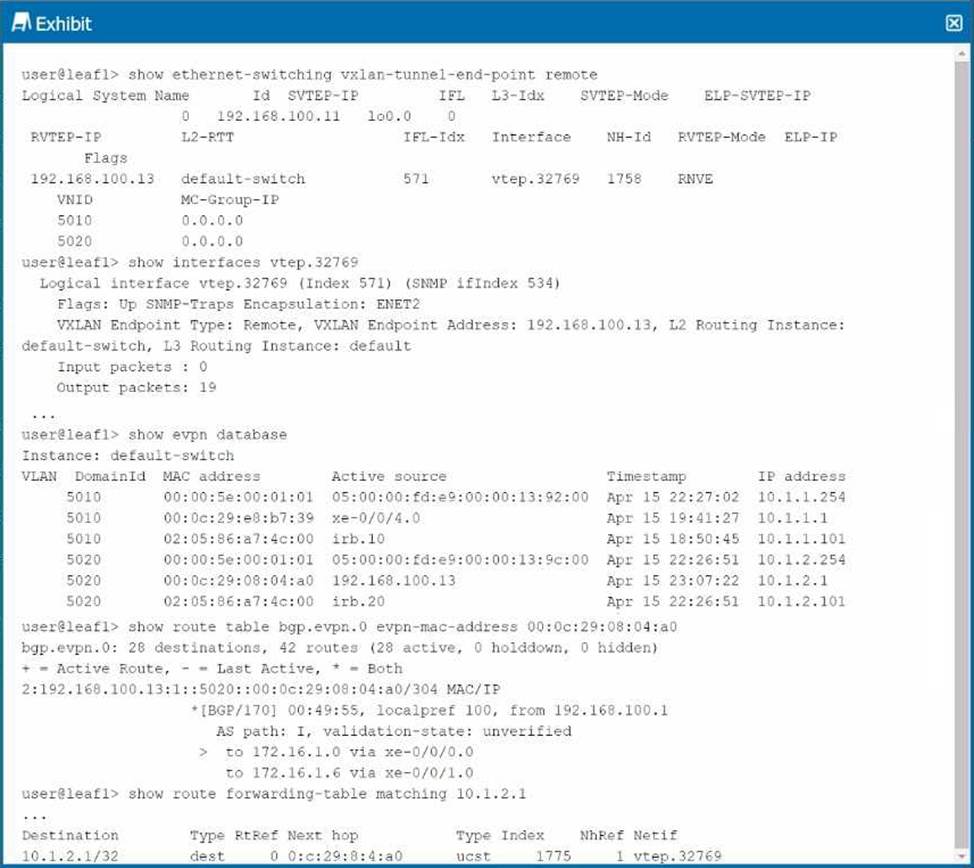
Referring to the exhibit, Host1 (10.1.1.1) is failing to communicate with Host2 (10.1.2.1) in a data center that uses an ERB architecture.
What do you determine from the output?
- A . The traffic is failing because load balancing is not configured correctly.
- B . The traffic is entering the VXLAN tunnel.
- C . Host1 and Host2 are directly connected to leaf1.
- D . The irb.20 interface is not configured on leaf1.
B
Explanation:
Understanding the Problem:
Host1 (10.1.1.1) is failing to communicate with Host2 (10.1.2.1) within an EVPN-VXLAN environment using ERB architecture.
Analysis of the Exhibit:
The provided output includes information from the show route forwarding-table matching command for IP 10.1.2.1. The next hop is shown as vtep.32769, which indicates that the traffic destined for 10.1.2.1 is being forwarded into the VXLAN tunnel with the correct VTEP (VXLAN Tunnel Endpoint).
Conclusion:
Option B: Correct―The traffic from Host1 is entering the VXLAN tunnel, as evidenced by the next hop pointing to a VTEP. However, the issue could lie elsewhere, possibly with the remote VTEP, routing configurations, or the receiving leaf/spine devices.
You are asked to interconnect two of your company’s data centers across an IP backbone. Both data centers require Layer 2 and Layer 3 connectivity.
In this scenario, which three actions would accomplish this task? (Choose three.)
- A . Advertise Type 2 EVPN routes across the DCI.
- B . Ensure border leaf nodes in each data center can exchange EVPN routes.
- C . Ensure there is a full mesh of VTEPs between all spine nodes within both data centers.
- D . Advertise Type 5 EVPN routes across the DCI.
- E . Ensure there is a full mesh of VTEPs between all leaf nodes within data centers.
ABD
Explanation:
Layer 2 and Layer 3 Connectivity Requirements:
To interconnect two data centers across an IP backbone with both Layer 2 (L2) and Layer 3 (L3) connectivity, EVPN-VXLAN (Ethernet VPN with Virtual Extensible LAN) is the ideal solution. EVPN supports L2 VPNs while also enabling L3 connectivity across multiple locations.
Necessary EVPN Route Types:
Type 2 EVPN Routes: These routes are used to advertise MAC addresses for Layer 2 connectivity.
They are essential for enabling seamless L2 communication across data centers.
Type 5 EVPN Routes: These routes are necessary for advertising IP prefixes for Layer 3 connectivity between data centers. They enable the exchange of L3 information across the IP backbone, ensuring routed traffic can reach its destination.
Border Leaf Nodes:
Border Leaf Nodes: Ensuring that the border leaf nodes (the entry and exit points for traffic between data centers) can exchange EVPN routes is critical for the correct dissemination of both L2 and L3 information across the data centers.
Conclusion:
Option A: Correct―Type 2 EVPN routes are required for Layer 2 MAC address learning and communication across the DCI (Data Center Interconnect).
Option B: Correct―Border leaf nodes need to exchange EVPN routes to maintain connectivity between data centers.
Option D: Correct―Type 5 EVPN routes are essential for Layer 3 connectivity across the DCI.
Options C and E are incorrect because they refer to establishing full mesh VTEPs (VXLAN Tunnel Endpoints) across all spine or leaf nodes, which is unnecessary for the scenario provided. The focus should be on border leaf nodes and appropriate route advertisements for L2 and L3 connectivity.
Why is a designated forwarder required in a multihomed CE-to-PE VXLAN environment using EVPN signalling?
- A . The designated forwarder is required to prevent packets from looping between the PEs.
- B . The designated forwarder is required to prevent flooding of MAC addresses to multihomed hosts.
- C . The designated forwarder is required to prevent a traffic storm from being received on multihomed hosts.
- D . The designated forwarder is required to prevent duplicate packets from being received on multihomed hosts.
D
Explanation:
Understanding Multihomed CE-to-PE VXLAN Environment:
In a VXLAN environment using EVPN signaling, multiple PEs (Provider Edge devices) can be connected to the same CE (Customer Edge device). This setup is referred to as multihoming, where a CE device has multiple connections to the network to ensure redundancy and load balancing.
Role of the Designated Forwarder:
The designated forwarder (DF) is a mechanism used in EVPN to manage the forwarding of broadcast,
unknown unicast, and multicast (BUM) traffic in a multihomed environment. The DF is selected to
ensure that only one of the PEs forwards this type of traffic to the CE, preventing loops and
unnecessary duplicate packets.
Avoiding Duplicate Packets:
Without a designated forwarder, all PEs connected to a multihomed CE could potentially forward the same packet to the CE, resulting in duplicate packets. This duplication can cause issues with packet processing on the CE, leading to inefficiencies and potential network problems. Conclusion:
Option D: Correct―The designated forwarder is essential to prevent duplicate packets from being received on multihomed hosts, ensuring that only one PE forwards BUM traffic to the CE.
Exhibit.
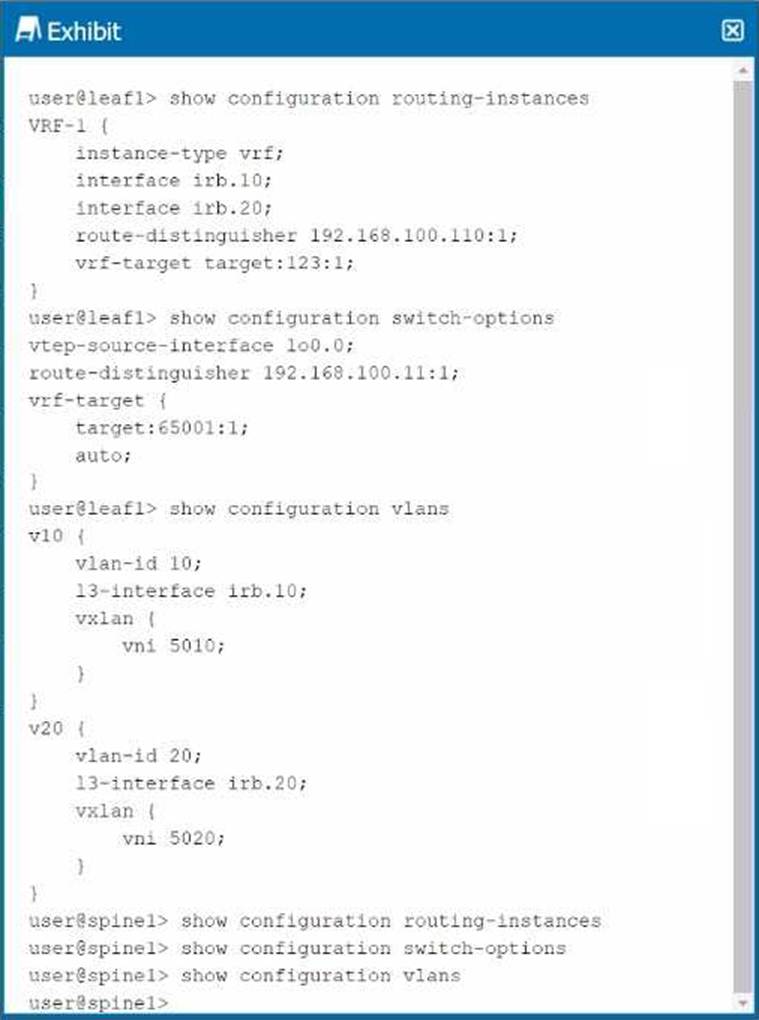
Referring to the exhibit, which statement Is true?
- A . A PBB-EVPN architecture is being used.
- B . An ERB architecture is being used.
- C . An OTT architecture is being used.
- D . A CRB architecture is being used.
B
Explanation:
Understanding Network Architectures:
ERB (Edge Routed Bridging) architecture involves routing at the network’s edge (leaf nodes), while traffic between leaf nodes is switched. This is commonly used in VXLAN-EVPN setups.
Analysis of the Exhibit:
The exhibit shows configurations related to routing instances, VXLAN, and VLANs, with VNIs being used for each VLAN. This setup is characteristic of an ERB architecture where each leaf device handles Layer 3 routing for its connected devices.
Conclusion:
Option B: Correct―The configuration shown corresponds to an ERB architecture where routing occurs at the network’s edge (leaf devices).
Exhibit.
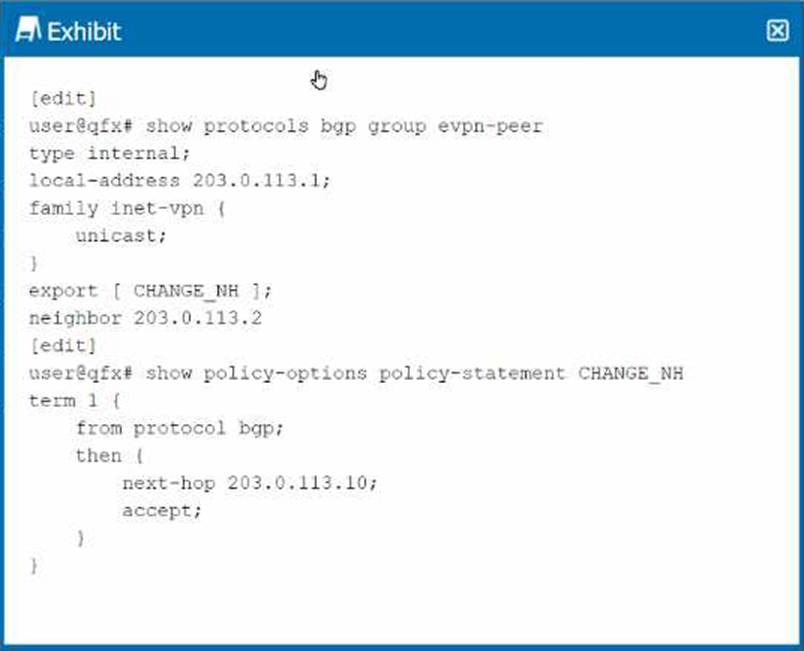
Given the configuration shown in the exhibit, why has the next hop remained the same for the EVPN routes advertised to the peer 203.0.113.2?
- A . EVPN routes cannot have the next hop changed.
- B . The export policy is incorrectly configured.
- C . The vrf-export parameter must be applied.
- D . The vpn-apply-export parameter must be applied to this peer.
D
Explanation:
Understanding the Configuration:
The configuration shown in the exhibit involves an EVPN (Ethernet VPN) setup using BGP as the routing protocol. The export policy named CHANGE_NH is applied to the BGP group evpn-peer, which includes a rule to change the next hop for routes that match the policy.
Issue with Next Hop Not Changing:
The policy CHANGE_NH is correctly configured to change the next hop to 203.0.113.10 for the matching routes. However, the next hop remains unchanged when advertising EVPN routes to the
peer 203.0.113.2.
Reason for the Issue:
In Junos OS, when exporting routes for VPNs (including EVPN), the next-hop change defined in a policy will not take effect unless the vpn-apply-export parameter is used in the BGP configuration. This parameter ensures that the export policy is applied specifically to VPN routes.
The vpn-apply-export parameter must be included to apply the next-hop change to EVPN routes.
Correct Answer
D. The vpn-apply-export parameter must be applied to this peer: This is the correct solution because
the next hop in EVPN routes won’t be altered without this parameter in the BGP configuration. It instructs the BGP process to apply the export policy to the EVPN routes.
Data Center
Reference: This behavior is standard in EVPN deployments with Juniper Networks devices, where the export policies applied to VPN routes require explicit invocation using vpn-apply-export to take effect.