
Juniper JN0-281 Practice Exams
Last updated on Oct 22,2026- Exam Code: JN0-281
- Exam Name: Data Center, Associate (JNCIA-DC)
- Certification Provider: Juniper
- Latest update: Oct 22,2026
A routing policy has been created to advertise OSPF routes in BGP.
Which statement is correct in this scenario?
- A . Apply the policy as an export policy within BGP.
- B . Apply the policy as an export policy within OSPF.
- C . Apply the policy as an import policy within BGP.
- D . Apply the policy as an import policy within OSPF.
A
Explanation:
When advertising OSPF routes into BGP, the appropriate routing policy should be applied as an export policy in BGP.
Step-by-Step Breakdown:
OSPF to BGP Route Advertisement:
Routes learned via OSPF (a dynamic IGP) need to be exported into BGP to be advertised to external BGP peers. In Junos OS, this is done using export policies.
Export Policies in BGP:
An export policy controls which routes are advertised out of a BGP session. In this scenario, the routing policy must be applied to BGP as an export policy to export the OSPF-learned routes to external BGP peers.
Policy Configuration:
Example configuration:
set policy-options policy-statement EXPORT_OSPF term 1 from protocol ospf set policy-options policy-statement EXPORT_OSPF term 1 then accept
set protocols bgp group <group-name> export EXPORT_OSPF This policy ensures that only OSPF routes are exported into BGP. Juniper
Reference: Routing Policy: Export policies are used in BGP to control route advertisements to peers, including those learned via OSPF.
Exhibit:
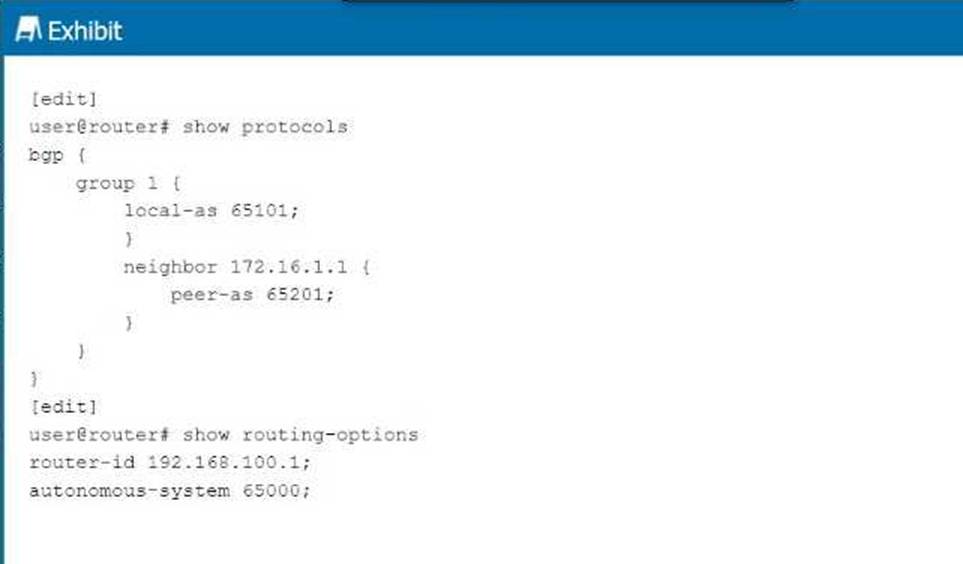
Referring to the exhibit, which statement is correct?
- A . The configuration will commit successfully and BGP group 1 will operate as IBGP.
- B . The configuration will commit successfully and BGP group 1 will operate as EBGP.
- C . BGP group 1 requires a type external parameter.
- D . BGP group 1 requires a type internal parameter.
B
Explanation:
In the exhibit, BGP is configured with local AS 65101 and a neighbor at 172.16.1.1 in peer AS 65201.
This setup involves two different Autonomous Systems (AS), indicating an External BGP (EBGP) configuration.
Step-by-Step Breakdown:
EBGP vs. IBGP:
EBGP is used between routers in different ASes. In this case, the local AS is 65101 and the peer AS is 65201, meaning the BGP session is EBGP.
IBGP is used between routers within the same AS, which is not applicable here as the AS numbers are different.
BGP Group Configuration:
The configuration does not require a type external parameter because Junos OS automatically recognizes the session as EBGP when the local and peer AS numbers are different. The BGP session will operate as EBGP, and the configuration will commit successfully.
Juniper
Reference: BGP Configuration: In Juniper, EBGP is automatically recognized when the local and peer AS numbers differ, without needing to specify type external.
Which two statements about IBGP are correct? (Choose two.)
- A . By default, IBGP has a TTL of 1.
- B . IBGP uses AS path for loop prevention.
- C . By default, IBGP has a TTL of 255.
- D . IBGP uses full mesh for loop prevention.
C, D
Explanation:
IBGP (Internal Border Gateway Protocol) is used to exchange routing information between routers
within the same AS (Autonomous System).
Step-by-Step Breakdown:
TTL of 255:
By default, IBGP sessions are established with a TTL (Time to Live) value of 255. This allows IBGP neighbors to communicate over multiple hops within the AS without requiring any additional configuration.
Full Mesh Requirement:
IBGP requires a logical full mesh between all IBGP routers to ensure that routing information is fully distributed within the AS. Since IBGP does not propagate routes learned from one IBGP peer to another by default, a full mesh topology is needed unless route reflectors or BGP confederations are used.
Juniper
Reference: IBGP Full Mesh: Juniper recommends using route reflectors in large networks to simplify IBGP full-mesh requirements.
You want to enable a Junos device to support aggregated Ethernet interfaces. In this scenario, which configuration hierarchy would you use?
- A . [edit switch-options]
- B . [edit system]
- C . [edit interfaces]
- D . [edit chassis]
D
Explanation:
To configure aggregated Ethernet (AE) interfaces on a Junos device, the configuration is done under the [edit chassis] hierarchy.
Step-by-Step Breakdown:
Chassis Configuration:
The chassis configuration is responsible for enabling the hardware to support Link Aggregation Groups (LAGs), allowing multiple physical interfaces to be bundled into a single logical interface for load balancing and redundancy.
Command Example:
set chassis aggregated-devices ethernet device-count <number>
This command enables a specific number of aggregated Ethernet interfaces on the device.
Juniper
Reference: LAG Configuration in Junos: The chassis hierarchy is used to allocate and manage hardware resources for aggregated Ethernet interfaces in Juniper devices.
MACsec provides protection against which two types of threats? (Choose two.)
- A . Data decryption
- B . Playback attacks
- C . Hashing attacks
- D . Man-in-the-middle attack
B, D
Explanation:
MACsec (Media Access Control Security) provides data confidentiality, integrity, and origin authenticity at Layer 2, protecting against several types of threats.
Step-by-Step Breakdown:
Man-in-the-Middle Attack Protection:
MACsec encrypts traffic at Layer 2, preventing man-in-the-middle attacks where an attacker intercepts and manipulates traffic between two communicating devices. Since the data is encrypted, any intercepted packets are unreadable.
Protection Against Playback Attacks:
MACsec also protects against playback attacks by using sequence numbers and timestamps to ensure that old, replayed packets are not accepted by the receiver. Juniper
Reference: MACsec Configuration: Juniper devices support MACsec for securing Layer 2 communications, ensuring protection against replay and man-in-the-middle attacks in sensitive environments.
Which statement is correct about an IRB interface?
- A . An IRB interface switches traffic within the same VLAN.
- B . An IRB interface trunks together VLANs on different switches.
- C . An IRB interface is a physical Layer 3 interface that connects VLANs together.
- D . An IRB interface is a Layer 3 interface that can be used to route between VLANs.
D
Explanation:
An IRB (Integrated Routing and Bridging) interface provides routing functionality between VLANs at Layer 3, allowing devices in different VLANs to communicate with each other.
Step-by-Step Breakdown:
IRB Functionality:
The IRB interface enables routing between different VLANs by acting as a Layer 3 gateway. Traffic within the same VLAN is handled by Layer 2 switching, while traffic between VLANs is routed through the IRB interface.
Layer 3 Routing Between VLANs:
Each VLAN can be assigned an IP address on the IRB interface, which allows traffic to flow between VLANs based on Layer 3 IP routing.
Juniper
Reference: IRB Interface Configuration: Juniper supports IRB for inter-VLAN routing on devices like the EX and QFX series switches, facilitating Layer 3 communication in data centers.
Layer 2 interfaces operate in which two modes? (Choose two.)
- A . Access
- B . Modular
- C . Trunk
- D . Tagged
A, C
Explanation:
Comprehensive Detailed Step by Step Explanation with all Juniper Data Center References Layer 2 interfaces on a switch operate in two key modes: Access and Trunk.
Step-by-Step Breakdown:
Access Mode:
Access ports are used to connect end devices, like PCs or servers, and they are assigned to a single VLAN. These interfaces handle untagged traffic and do not pass VLAN tags. Example: A port assigned to VLAN 10 will only handle traffic for that VLAN.
Trunk Mode:
Trunk ports are used to connect switches or other networking devices that need to handle traffic from multiple VLANs. Trunk interfaces carry tagged traffic, allowing multiple VLANs to traverse the same physical link.
Trunk ports typically use 802.1Q VLAN tagging to differentiate between VLANs.
Juniper
Reference: Access and Trunk Ports: Juniper switches use these modes to manage VLAN traffic at Layer 2, with access ports handling untagged traffic and trunk ports handling tagged traffic from multiple VLANs.
You want to minimize topology disruptions in your network when the rpd process restarts on a device.
Which service would accomplish this task?
- A . Bidirectional Forwarding Detection (BFD)
- B . link aggregation groups
- C . graceful restart (GR)
- D . Virtual Chassis
C
Explanation:
Graceful Restart (GR) is a feature that allows a router to maintain forwarding even when the routing process (e.g., the rpd process in Junos) is restarting, minimizing disruption to the network.
Step-by-Step Breakdown:
Graceful Restart Function:
During a GR event, the forwarding plane continues to forward packets based on existing routes, while the control plane (rpd process) is restarting. This prevents traffic loss and maintains routing stability. Minimizing Disruptions:
GR is particularly useful in ensuring continuous packet forwarding during software upgrades or routing protocol process restarts.
Juniper
Reference: Graceful Restart in Junos: GR ensures high availability by maintaining forwarding continuity during control plane restarts, enhancing network reliability.
Which three technologies improve high availability and convergence in a data center network? (Choose three.)
- A . graceful restart (GR)
- B . Bidirectional Forwarding Detection (BFD)
- C . link loss adjacency
- D . Failover Group (FG)
- E . link aggregation group (LAG)
A, B, E
Explanation:
High availability and fast convergence are critical in data center networks to minimize downtime and maintain optimal performance.
The following technologies contribute to achieving these goals:
Graceful Restart (GR):
GR allows routers to maintain forwarding state during control plane restarts, ensuring continuous packet forwarding while minimizing network disruptions.
Bidirectional Forwarding Detection (BFD):
BFD provides fast detection of path failures, allowing routing protocols to converge quickly by detecting link failures much faster than traditional timers.
Link Aggregation Group (LAG):
LAG increases both redundancy and bandwidth by combining multiple physical links into one logical
link, providing load balancing and fault tolerance.
Juniper
Reference: High Availability Techniques: These technologies are fundamental in ensuring rapid recovery and failover within Juniper-based data center environments.
Which two statements are correct about EVPN-VXLAN overlay networking? (Choose two.)
- A . It is the only option to provide reachability between servers that reside in the same network segment in a data center.
- B . BGP provides the control plane within the overlay network.
- C . An encapsulation of the original packet is required to transport the packet across the network.
- D . OSPF provides the control plane within the overlay network.
B, C
Explanation:
EVPN-VXLAN is an overlay technology used in data center networks to extend Layer 2 services over a
Layer 3 network.
Step-by-Step Breakdown:
BGP Control Plane:
BGP (Border Gateway Protocol) is used as the control plane for EVPN-VXLAN. BGP advertises MAC addresses and IP address reachability information across the VXLAN network, enabling efficient multi-tenant Layer 2 connectivity over a Layer 3 infrastructure.
Encapsulation:
VXLAN (Virtual Extensible LAN) encapsulates Layer 2 frames into Layer 3 packets. This encapsulation allows Layer 2 traffic to be transported across a Layer 3 network, effectively creating a tunnel for Ethernet frames.
Juniper
Reference: EVPN-VXLAN Configuration: Juniper supports EVPN-VXLAN with BGP as the control plane, allowing scalable Layer 2 connectivity over a routed infrastructure in modern data centers.