
HP HPE7-A02 Practice Exams
Last updated on Oct 23,2026- Exam Code: HPE7-A02
- Exam Name: HPE Network Security Professional Exam
- Certification Provider: HP
- Latest update: Oct 23,2026
What is one benefit of integrating HPE Aruba Networking ClearPass Policy Manager (CPPM) with third-party solutions such as Mobility Device Management (MDM) and firewalls?
- A . CPPM can exchange contextual information about clients with third-party solutions, which helps make better decisions.
- B . CPPM can make the third-party solutions more secure by adding signature-based threat detection capabilities.
- C . CPPM can offload policy decisions to the third-party solutions, enabling CPPM to respond to authentication requests more quickly.
- D . CPPM can take over filtering internal traffic so that the third-party solutions have more processing power to devote to filtering external traffic.
A
Explanation:
Contextual Exchange for Better Decisions:
HPE Aruba ClearPass can integrate with third-party solutions like MDM and firewalls to exchange contextual information about endpoints (e.g., device type, posture, location).
This integration allows ClearPass and the third-party solutions to make better access control and security decisions.
For example:
An MDM can inform CPPM about device compliance, and CPPM can adjust enforcement policies dynamically.
Firewalls can receive updated context about users and devices to enforce policies more effectively.
Option Analysis:
Option A: Correct. Exchanging contextual information improves access control decisions.
Option B: Incorrect. CPPM does not provide signature-based threat detection.
Option C: Incorrect. CPPM does not offload policy decisions; it integrates for collaboration.
Option D: Incorrect. CPPM does not replace third-party traffic filtering capabilities.
Refer to the Exhibit.
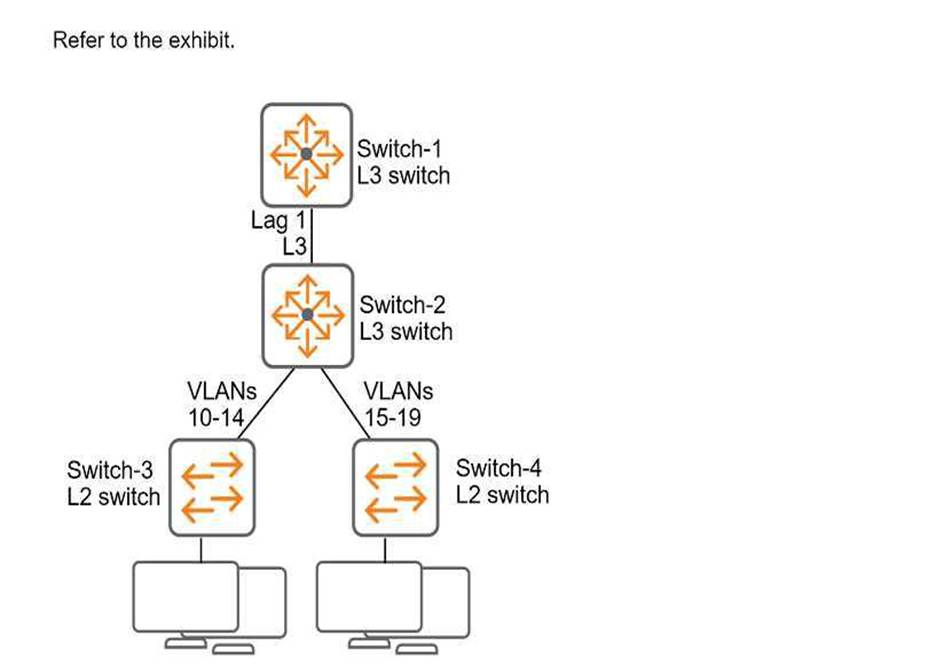
All of the switches in the exhibit are AOS-CX switches.
What is the preferred configuration on Switch-2 for preventing rogue OSPF routers in this network?
- A . Disable OSPF entirely on VLANs 10-19.
- B . Configure OSPF authentication on VLANs 10-19 in password mode.
- C . Configure OSPF authentication on Lag 1 in MD5 mode.
- D . Configure passive-interface as the OSPF default and disable OSPF passive on Lag 1.
C
Explanation:
To prevent rogue OSPF routers in the network shown in the exhibit, the preferred configuration on Switch-2 is to configure OSPF authentication on Lag 1 in MD5 mode. This setup enhances security by ensuring that only routers with the correct MD5 authentication credentials can participate in the OSPF routing process. This method protects the OSPF sessions against unauthorized devices that might attempt to introduce rogue routing information into the network.
Refer to the Exhibit.
All of the switches in the exhibit are AOS-CX switches.
What is the preferred configuration on Switch-2 for preventing rogue OSPF routers in this network?
- A . Disable OSPF entirely on VLANs 10-19.
- B . Configure OSPF authentication on VLANs 10-19 in password mode.
- C . Configure OSPF authentication on Lag 1 in MD5 mode.
- D . Configure passive-interface as the OSPF default and disable OSPF passive on Lag 1.
C
Explanation:
To prevent rogue OSPF routers in the network shown in the exhibit, the preferred configuration on Switch-2 is to configure OSPF authentication on Lag 1 in MD5 mode. This setup enhances security by ensuring that only routers with the correct MD5 authentication credentials can participate in the OSPF routing process. This method protects the OSPF sessions against unauthorized devices that might attempt to introduce rogue routing information into the network.
A company wants to implement Virtual Network based Tunneling (VNBT) on a particular group of users and assign those users to an overlay network with VNI 3000.
Assume that an AOS-CX switch is already set up to:
. Implement 802.1X to HPE Aruba Networking ClearPass Policy Manager (CPPM)
. Participate in an EVPN VXLAN solution that includes VNI 3000
Which setting should you configure in the users’ AOS-CX role to apply VNBT to them when they connect?
- A . Gateway zone set to "3000" with no gateway role set
- B . Gateway zone set to "vni-3000" with no gateway role set
- C . Access VLAN set to the VLAN mapped to VNI 3000
- D . Access VLAN ID set to "3000"
C
Explanation:
To apply Virtual Network based Tunneling (VNBT) to a particular group of users and assign them to an overlay network with VNI 3000, you should configure the users’ AOS-CX role to set the Access VLAN to the VLAN mapped to VNI 3000. This ensures that when users connect, their traffic is tunneled through the specified VNI, integrating seamlessly with the EVPN VXLAN solution.
A company is using HPE Aruba Networking ClearPass Device Insight (CPDI) (the standalone application). In the CPDI security settings, Security Analysis is On, the Data Source is ClearPass Device Insight, and Enable Posture Assessment is On. You see that a device has a Risk Score of 90.
What can you know from this information?
- A . The posture is unknown, and CPDI has detected exactly four vulnerabilities on the device.
- B . The posture is healthy, but CPDI has detected multiple vulnerabilities on the device.
- C . The posture is unhealthy, and CPDI has also detected at least one vulnerability on the device.
- D . The posture is unhealthy, but CPDI has not detected any vulnerabilities on the device.
C
Explanation: