
HP HPE7-A02 Practice Exams
Last updated on Oct 23,2026- Exam Code: HPE7-A02
- Exam Name: HPE Network Security Professional Exam
- Certification Provider: HP
- Latest update: Oct 23,2026
A company is using HPE Aruba Networking ClearPass Device Insight (CPDI) (the standalone application). In the CPDI security settings, Security Analysis is On, the Data Source is ClearPass Device Insight, and Enable Posture Assessment is On. You see that a device has a Risk Score of 90.
What can you know from this information?
- A . The posture is unknown, and CPDI has detected exactly four vulnerabilities on the device.
- B . The posture is healthy, but CPDI has detected multiple vulnerabilities on the device.
- C . The posture is unhealthy, and CPDI has also detected at least one vulnerability on the device.
- D . The posture is unhealthy, but CPDI has not detected any vulnerabilities on the device.
C
Explanation:
A company has HPE Aruba Networking APs, which authenticate users to HPE Aruba Networking ClearPass Policy Manager (CPPM).
What does HPE Aruba Networking recommend as the preferred method for assigning clients to a role on the AOS firewall?
- A . Configure CPPM to assign the role using a RADIUS enforcement profile with a RADIUS:IETF Username attribute.
- B . Configure CPPM to assign the role using a RADIUS enforcement profile with an Aruba-User-Role VSA.
- C . OCreate server rules on the APs to assign clients to roles based on RADIUS IETF attributes returned by CPPM.
- D . Create user rules on the APs to assign clients to roles based on a variety of criteria.
B
Explanation:
The preferred method for assigning clients to a role on the AOS firewall is to configure HPE Aruba Networking ClearPass Policy Manager (CPPM) to assign the role using a RADIUS enforcement profile with an Aruba-User-Role VSA (Vendor-Specific Attribute). This method allows ClearPass to dynamically assign the appropriate user roles to clients during the authentication process, ensuring that role-based access policies are consistently enforced across the network.
Reference: Aruba ClearPass documentation and RADIUS configuration guides provide detailed instructions on setting up RADIUS enforcement profiles and using the Aruba-User-Role VSA for role assignment.
Refer to Exhibit:
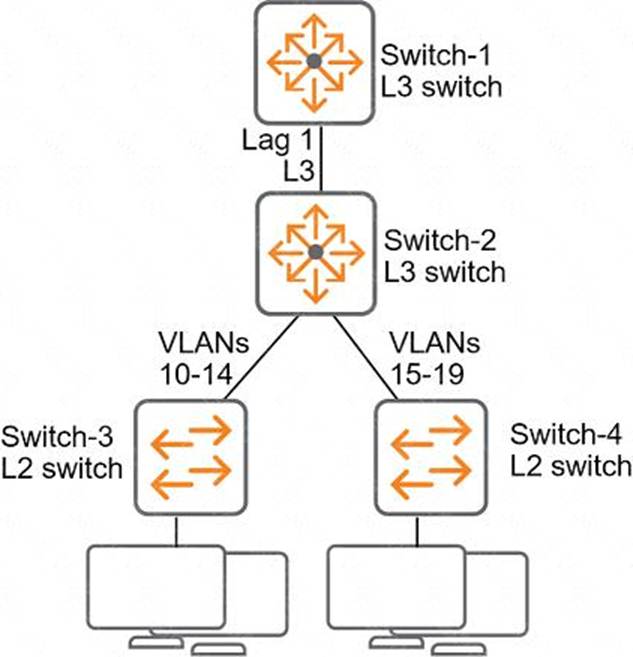
All of the switches in the exhibit are AOS-CX switches.
What is the preferred configuration on Switch-2 for preventing rogue OSPF routers in this network?
- A . Configure OSPF authentication on VLANs 10-19 in password mode.
- B . Configure OSPF authentication on Lag 1 in MD5 mode.
- C . Disable OSPF entirely on VLANs 10-19.
- D . Configure passive-interface as the OSPF default and disable OSPF passive on Lag 1.
B
Explanation:
Why MD5 Authentication on Lag 1 is Preferred:
Lag 1 is the primary link between Switch-2 and Switch-1, both of which are Layer 3 switches running
OSPF.
By enabling MD5 authentication, OSPF routers exchange authenticated packets, preventing unauthorized or rogue OSPF routers from forming adjacencies or injecting routes.
MD5 is a secure authentication method and ensures the integrity and authenticity of OSPF communications.
Other Options Analysis:
Refer to Exhibit:
All of the switches in the exhibit are AOS-CX switches.
What is the preferred configuration on Switch-2 for preventing rogue OSPF routers in this network?
- A . Configure OSPF authentication on VLANs 10-19 in password mode.
- B . Configure OSPF authentication on Lag 1 in MD5 mode.
- C . Disable OSPF entirely on VLANs 10-19.
- D . Configure passive-interface as the OSPF default and disable OSPF passive on Lag 1.
B
Explanation:
Why MD5 Authentication on Lag 1 is Preferred:
Lag 1 is the primary link between Switch-2 and Switch-1, both of which are Layer 3 switches running
OSPF.
By enabling MD5 authentication, OSPF routers exchange authenticated packets, preventing unauthorized or rogue OSPF routers from forming adjacencies or injecting routes.
MD5 is a secure authentication method and ensures the integrity and authenticity of OSPF communications.
Other Options Analysis:
A company is implementing HPE Aruba Networking Wireless IDS/IPS (WIDS/WIPS) on its AOS-10 APs, which are managed in HPE Aruba Networking Central.
What is one requirement for enabling detection of rogue APs?
- A . Each VLAN in the network assigned on at least one AP’s or AM’s port
- B . A Foundation with Security license for each of the APs
- C . One AM deployed for every one AP deployed
- D . A manual radio profile that enables non-regulatory channels
B
Explanation:
To enable the detection of rogue APs with HPE Aruba Networking Wireless IDS/IPS (WIDS/WIPS) on AOS-10 APs managed in HPE Aruba Networking Central, each AP must have a Foundation with Security license. This license enables advanced security features, including rogue AP detection, which is crucial for maintaining a secure wireless environment and protecting against unauthorized access points.
Reference: Aruba’s licensing documentation and WIDS/WIPS setup guides specify the need for appropriate licenses to activate security features such as rogue AP detection.
Refer to the exhibit:
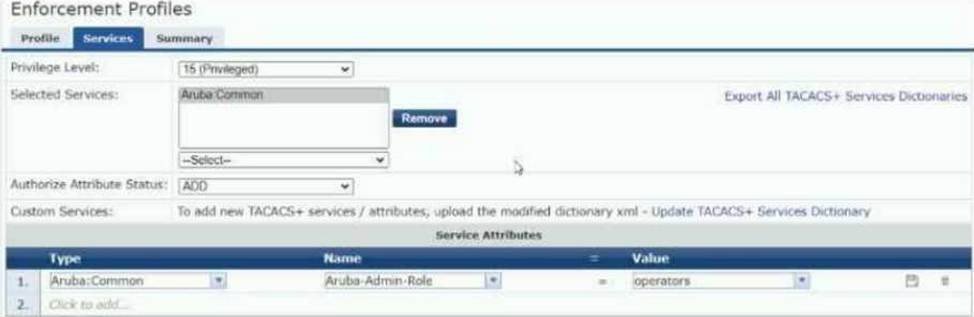
The exhibit shows the TACACS+ enforcement profile that HPE Aruba Networking ClearPass Policy Manager (CPPM) assigns to a manager.
When this manager logs into an AOS-CX switch, what does the switch do?
- A . Assigns the manager operator-level privileges
- B . Assigns the manager administrator-level privileges
- C . Rejects the manager with an error message
- D . Assigns the manager auditor-level privileges
A
Explanation:
TACACS+ Enforcement Profile:
The profile specifies a Service Attribute under Aruba: Common with:
Name: Aruba-Admin-Role
Value: operators
AOS-CX Role Mapping:
On Aruba AOS-CX switches, the Aruba-Admin-Role attribute maps the authenticated user to predefined roles:
operators: Operator-level privileges (read-only access, limited commands).
administrators: Full administrator privileges.
Other roles like auditors may exist based on configuration.
Analysis:
The value operators explicitly maps the user to operator-level privileges, granting read-only access to the AOS-CX switch.
Since the Aruba-Admin-Role is correctly set and recognized, the switch assigns the appropriate role
without errors.
Option Breakdown:
Option A: Correct. The switch assigns operator-level privileges based on the Aruba-Admin-Role value.
Option B: Incorrect. Administrator-level privileges require the role value to be administrators.
Option C: Incorrect. The manager is successfully authenticated and authorized; there is no error.
Option D: Incorrect. There is no reference to an auditor role in the configuration shown.
Conclusion:
The operators value in the TACACS+ enforcement profile ensures that the manager is assigned operator-level privileges on the AOS-CX switch.
You are using OpenSSL to obtain a certificate signed by a Certification Authority (CA). You have entered this command:
openssl req -new -out file1.pem -newkey rsa:3072 -keyout file2.pem Enter PEM pass phrase: ********** Verifying – Enter PEM pass phrase: **********
Country Name (2 letter code) [AU]:US
State or Province Name (full name) [Some-State]: California
Locality Name (eg, city) []: Sunnyvale
Organization Name (eg, company) [Internet Widgits Pty Ltd]: example.com
Organizational Unit Name (eg, section) []: Infrastructure
Common Name (e.g. server FQDN or YOUR name) []: radius.example.com
What is one guideline for continuing to obtain a certificate?
- A . You should use a third-party tool to encrypt file2.pem before sending it and file1.pem to the CA.
- B . You should concatenate file1.pem and file2.pem into a single file, and submit that to the desired CA to sign.
- C . You should submit file1.pem, but not file2.pem, to the desired CA to sign.
- D . You should submit file2.pem, but not file1.pem, to the desired CA to sign.
C
Explanation:
When using OpenSSL to obtain a certificate signed by a Certification Authority (CA), you should
submit the Certificate Signing Request (CSR) file, which is file1.pem, to the CA. The CSR contains the information about the entity requesting the certificate and the public key, but not the private key, which is in file2.pem.
The CA uses the information in the CSR to create and sign the certificate.