
HP HPE7-A02 Practice Exams
Last updated on Oct 23,2026- Exam Code: HPE7-A02
- Exam Name: HPE Network Security Professional Exam
- Certification Provider: HP
- Latest update: Oct 23,2026
Which statement describes Zero Trust Security?
- A . Companies should focus on protecting their resources rather than on protecting the boundaries of their internal network.
- B . Companies must apply the same access controls to all users, regardless of identity.
- C . Companies that support remote workers cannot achieve zero trust security and must determine if the benefits outweigh the cost.
- D . Companies can achieve zero trust security by strengthening their perimeter security to detect a wider range of threats.
A
Explanation:
Zero Trust Security is a security model that operates on the principle that no entity, whether inside or outside the network, should be trusted by default. Instead, every access request is thoroughly verified before granting access to resources. This model emphasizes protecting resources rather than merely securing the network perimeter, acknowledging that threats can originate both inside and outside the network.
Which use case is fulfilled by applying a time range to a firewall rule on an AOS device?
- A . Enforcing the rule only during the specified time range
- B . Tuning the session timeout for sessions established with this rule
- C . Locking clients that violate the rule for the specified time range
- D . Setting the time range over which hit counts for the rule are aggregated
A
Explanation:
Applying a time range to a firewall rule on an AOS device fulfills the use case of enforcing the rule only during the specified time range. This allows administrators to control when specific firewall rules are active, which can be useful for implementing policies that only need to be in effect during certain hours, such as blocking or allowing access to specific resources outside of business hours.
A company wants to apply role-based access control lists (ACLs) on AOS-CX switches, which are implementing authentication to HPE Aruba Networking ClearPass Policy Manager (CPPM). The company wants to centralize configuration as much as possible.
Which correctly describes your options?
- A . You can configure the role on CPPM; however, the CPPM role must reference a policy name that is configured on the switch.
- B . You can configure the role name on CPPM; however, the role settings, including policy and classes, must be configured locally on the switch.
- C . You can configure the role, its policy, and the classes referenced in the policy all on CPPM.
- D . You can configure the role and its policy on CPPM; however, the classes referenced in the policy must be configured locally on the switch.
A
Explanation:
Centralized Role Configuration on CPPM:
CPPM can assign roles to clients dynamically during authentication.
However, the actual ACL policies (e.g., firewall policies) must already exist and be referenced locally on the switch.
CPPM cannot directly configure ACL details on AOS-CX switches.
Option Analysis:
Option A: Correct. The role is defined on CPPM, but it references a policy pre-configured on the switch.
Option B: Incorrect. This does not align with Aruba’s centralized role-based access control design. Option C: Incorrect. CPPM cannot configure the ACL policies and classes directly; they must exist locally.
Option D: Incorrect. Policies can be referenced centrally but not fully configured on CPPM.
Refer to Exhibit.
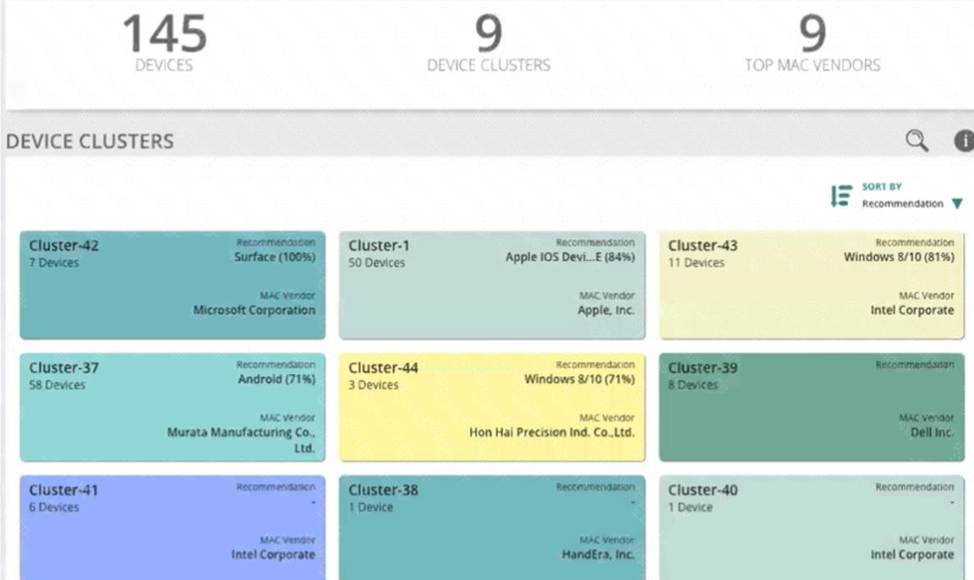
A company is using HPE Aruba Networking ClearPass Device Insight (CPDI) (the standalone application). In the CPDI interface, you go to the Generic Devices page and see the view shown in the exhibit.
What correctly describes what you see?
- A . Each cluster is a group of unclassified devices that CPDI’s machine learning has discovered to have similar attributes.
- B . Each cluster is a group of devices that match one of the tags configured by admins.
- C . Each cluster is all the devices that have been assigned to the same category by one of CPDI’s built-in system rules.
- D . Each cluster is a group of devices that have been classified with user rules, but for which CPDI offers different recommendations.
A
Explanation:
In HPE Aruba Networking ClearPass Device Insight (CPDI), the clusters shown in the exhibit represent groups of unclassified devices that CPDI’s machine learning algorithms have identified as having similar attributes. These clusters are formed based on observed characteristics and behaviors of the devices, helping administrators to categorize and manage devices more effectively.
What is one benefit of integrating HPE Aruba Networking ClearPass Policy Manager (CPPM) with third-party solutions such as Mobility Device Management (MDM) and firewalls?
- A . CPPM can exchange contextual information about clients with third-party solutions, which helps make better decisions.
- B . CPPM can make the third-party solutions more secure by adding signature-based threat detection capabilities.
- C . CPPM can offload policy decisions to the third-party solutions, enabling CPPM to respond to authentication requests more quickly.
- D . CPPM can take over filtering internal traffic so that the third-party solutions have more processing power to devote to filtering external traffic.
A
Explanation:
Contextual Exchange for Better Decisions:
HPE Aruba ClearPass can integrate with third-party solutions like MDM and firewalls to exchange contextual information about endpoints (e.g., device type, posture, location).
This integration allows ClearPass and the third-party solutions to make better access control and security decisions.
For example:
An MDM can inform CPPM about device compliance, and CPPM can adjust enforcement policies dynamically.
Firewalls can receive updated context about users and devices to enforce policies more effectively.
Option Analysis:
Option A: Correct. Exchanging contextual information improves access control decisions.
Option B: Incorrect. CPPM does not provide signature-based threat detection.
Option C: Incorrect. CPPM does not offload policy decisions; it integrates for collaboration.
Option D: Incorrect. CPPM does not replace third-party traffic filtering capabilities.