
Google Professional Cloud Developer Practice Exams
Last updated on Oct 24,2026- Exam Code: Professional Cloud Developer
- Exam Name: Professional Cloud Developer
- Certification Provider: Google
- Latest update: Oct 24,2026
You are planning to deploy your application in a Google Kubernetes Engine (GKE) cluster. Your application can scale horizontally, and each instance of your application needs to have a stable network identity and its own persistent disk.
Which GKE object should you use?
- A . Deployment
- B . StatefulSet
- C . ReplicaSet
- D . ReplicaController
B
Explanation:
Reference: https://livebook.manning.com/book/kubernetes-in-action/chapter-10/46
You are designing an application that uses a microservices architecture. You are planning to deploy the application in the cloud and on-premises. You want to make sure the application can scale up on demand and also use managed services as much as possible.
What should you do?
- A . Deploy open source Istio in a multi-cluster deployment on multiple Google Kubernetes Engine (GKE) clusters managed by Anthos.
- B . Create a GKE cluster in each environment with Anthos, and use Cloud Run for Anthos to deploy your application to each cluster.
- C . Install a GKE cluster in each environment with Anthos, and use Cloud Build to create a Deployment for your application in each cluster.
- D . Create a GKE cluster in the cloud and install open-source Kubernetes on-premises. Use an external load balancer service to distribute traffic across the two environments.
B
Explanation:
https://cloud.google.com/anthos/run
Integrated with Anthos, Cloud Run for Anthos provides a flexible serverless development platform for hybrid and multicloud environments. Cloud Run for Anthos is Google’s managed and fully supported Knative offering, an open source project that enables serverless workloads on Kubernetes.
You need to copy directory local-scripts and all of its contents from your local workstation to a Compute
Engine virtual machine instance.
Which command should you use?
- A . gsutil cp –project “my-gcp-project” -r ~/local-scripts/ gcp-instance-name:~/ server-scripts/ –zone “us-east1-b”
- B . gsutil cp –project “my-gcp-project” -R ~/local-scripts/ gcp-instance-name:~/ server-scripts/ –zone “us-east1-b”
- C . gcloud compute scp –project “my-gcp-project” –recurse ~/local-scripts/ gcpinstance-name:~/server-scripts/ –zone “us-east1-b”
- D . gcloud compute mv –project “my-gcp-project” –recurse ~/local-scripts/ gcpinstance-name:~/server-scripts/ –zone “us-east1-b”
C
Explanation:
Reference: https://cloud.google.com/sdk/gcloud/reference/compute/copy-files
Your company has a new security initiative that requires all data stored in Google Cloud to be encrypted by customer-managed encryption keys. You plan to use Cloud Key Management Service (KMS) to configure access to the keys. You need to follow the "separation of duties" principle and Google-recommended best practices.
What should you do? (Choose two.)
- A . Provision Cloud KMS in its own project.
- B . Do not assign an owner to the Cloud KMS project.
- C . Provision Cloud KMS in the project where the keys are being used.
- D . Grant the roles/cloudkms.admin role to the owner of the project where the keys from Cloud KMS are being used.
- E . Grant an owner role for the Cloud KMS project to a different user than the owner of the project where the keys from Cloud KMS are being used.
AB
Explanation:
https://cloud.google.com/kms/docs/separation-of-duties#using_separate_project
Your company stores their source code in a Cloud Source Repositories repository. Your company wants to build and test their code on each source code commit to the repository and requires a solution that is managed and has minimal operations overhead.
Which method should they use?
- A . Use Cloud Build with a trigger configured for each source code commit.
- B . Use Jenkins deployed via the Google Cloud Platform Marketplace, configured to watch for source code commits.
- C . Use a Compute Engine virtual machine instance with an open source continuous integration tool, configured to watch for source code commits.
- D . Use a source code commit trigger to push a message to a Cloud Pub/Sub topic that triggers an App Engine service to build the source code.
A
Explanation:
https://cloud.google.com/build/docs/automating-builds/create-manage-triggers#:~:text=A%20Cloud%20Build%20trigger%20automatically,changes%20that%20match%20cer tain%20criteria.
You are load testing your server application. During the first 30 seconds, you observe that a previously inactive Cloud Storage bucket is now servicing 2000 write requests per second and 7500 read requests per second.
Your application is now receiving intermittent 5xx and 429 HTTP responses from the Cloud Storage JSON API as the demand escalates. You want to decrease the failed responses from the Cloud Storage API.
What should you do?
- A . Distribute the uploads across a large number of individual storage buckets.
- B . Use the XML API instead of the JSON API for interfacing with Cloud Storage.
- C . Pass the HTTP response codes back to clients that are invoking the uploads from your application.
- D . Limit the upload rate from your application clients so that the dormant bucket’s peak request rate is reached more gradually.
A
Explanation:
Reference: https://cloud.google.com/storage/docs/request-rate
You have decided to migrate your Compute Engine application to Google Kubernetes Engine. You need to build a container image and push it to Artifact Registry using Cloud Build.
What should you do? (Choose two.)
A) Run gcloud builds submit in the directory that contains the application source code.
B) Run gcloud run deploy app-name –image gcr.io/$PROJECT_ID/app-name in the directory that
contains the application source code.
C) Run gcloud container images add-tag gcr.io/$PROJECT_ID/app-name gcr.io/$PROJECT_ID/app-name:latest in the directory that contains the application source code.
D) In the application source directory, create a file named cloudbuild.yaml that contains the following contents:

E) In the application source directory, create a file named cloudbuild.yaml that contains the following contents:
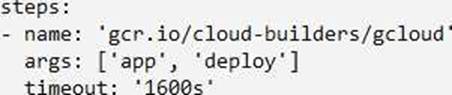
- A . Option A
- B . Option B
- C . Option C
- D . Option D
- E . Option E
A, D
Explanation:
https://cloud.google.com/sdk/gcloud/reference/builds/submit
https://cloud.google.com/artifact-registry/docs/configure-cloud-build
You recently developed a new application. You want to deploy the application on Cloud Run without a Dockerfile. Your organization requires that all container images are pushed to a centrally managed container repository.
How should you build your container using Google Cloud services? (Choose two.)
- A . Push your source code to Artifact Registry.
- B . Submit a Cloud Build job to push the image.
- C . Use the pack build command with pack CLI.
- D . Include the –source flag with the gcloud run deploy CLI command.
- E . Include the –platform=kubernetes flag with the gcloud run deploy CLI command.
AC
Explanation:
https://cloud.google.com/run/docs/deploying#images
https://cloud.google.com/blog/products/containers-kubernetes/google-cloud-now-supports-buildpacks
Your API backend is running on multiple cloud providers. You want to generate reports for the network latency of your API.
Which two steps should you take? (Choose two.)
- A . Use Zipkin collector to gather data.
- B . Use Fluentd agent to gather data.
- C . Use Stackdriver Trace to generate reports.
- D . Use Stackdriver Debugger to generate report.
- E . Use Stackdriver Profiler to generate report.
AC
Explanation:
https://cloud.google.com/trace/docs/zipkin
"receive traces from Zipkin clients and forward those traces to Cloud Trace for analysis."
https://cloud.google.com/trace/docs/quickstart#analysis_reports_window