
Google Professional Cloud Developer Practice Exams
Last updated on Oct 24,2026- Exam Code: Professional Cloud Developer
- Exam Name: Professional Cloud Developer
- Certification Provider: Google
- Latest update: Oct 24,2026
You support an application that uses the Cloud Storage API. You review the logs and discover multiple HTTP 503 Service Unavailable error responses from the API. Your application logs the error and does not take any further action. You want to implement Google-recommended retry logic to improve success rates.
Which approach should you take?
- A . Retry the failures in batch after a set number of failures is logged.
- B . Retry each failure at a set time interval up to a maximum number of times.
- C . Retry each failure at increasing time intervals up to a maximum number of tries.
- D . Retry each failure at decreasing time intervals up to a maximum number of tries.
C
Explanation:
https://cloud.google.com/storage/docs/retry-strategy
You recently developed an application. You need to call the Cloud Storage API from a Compute Engine instance that doesn’t have a public IP address.
What should you do?
- A . Use Carrier Peering
- B . Use VPC Network Peering
- C . Use Shared VPC networks
- D . Use Private Google Access
D
Explanation:
https://cloud.google.com/vpc/docs/private-google-access
You have an application running on Google Kubernetes Engine (GKE). The application is currently using a logging library and is outputting to standard output You need to export the logs to Cloud Logging, and you need the logs to include metadata about each request. You want to use the simplest method to accomplish this.
What should you do?
- A . Change your application s logging library to the Cloud Logging library and configure your application to export logs to Cloud Logging
- B . Update your application to output logs in CSV format, and add the necessary metadata to the CSV.
- C . Install the Fluent Bit agent on each of your GKE nodes, and have the agent export all logs from /var/ log.
- D . Update your application to output logs in JSON format, and add the necessary metadata to the JSON
You are in the final stage of migrating an on-premises data center to Google Cloud. You are quickly
approaching your deadline, and discover that a web API is running on a server slated for decommissioning. You need to recommend a solution to modernize this API while migrating to Google Cloud.
The modernized web API must meet the following requirements:
• Autoscales during high traffic periods at the end of each month
• Written in Python 3.x
• Developers must be able to rapidly deploy new versions in response to frequent code changes
You want to minimize cost, effort, and operational overhead of this migration.
What should you do?
- A . Modernize and deploy the code on App Engine flexible environment.
- B . Modernize and deploy the code on App Engine standard environment.
- C . Deploy the modernized application to an n1-standard-1 Compute Engine instance.
- D . Ask the development team to re-write the application to run as a Docker container on Google Kubernetes Engine.
B
Explanation:
https://cloud.google.com/appengine/docs/standard
HipLocal has connected their Hadoop infrastructure to GCP using Cloud Interconnect in order to
query data stored on persistent disks.
Which IP strategy should they use?
- A . Create manual subnets.
- B . Create an auto mode subnet.
- C . Create multiple peered VPCs.
- D . Provision a single instance for NAT.
HipLocal is configuring their access controls.
Which firewall configuration should they implement?
- A . Block all traffic on port 443.
- B . Allow all traffic into the network.
- C . Allow traffic on port 443 for a specific tag.
- D . Allow all traffic on port 443 into the network.
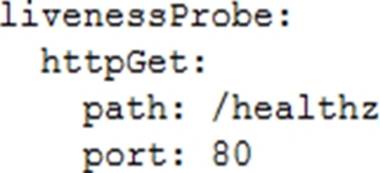
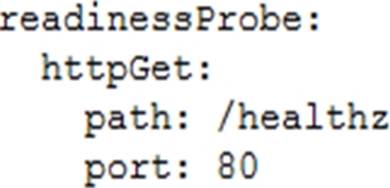
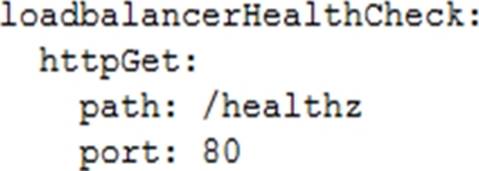
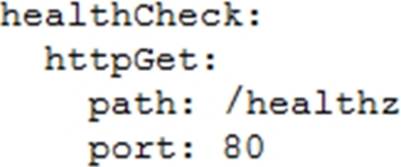
You are planning to deploy your application in a Google Kubernetes Engine (GKE) cluster. The application exposes an HTTP-based health check at /healthz. You want to use this health check endpoint to determine whether traffic should be routed to the pod by the load balancer.
Which code snippet should you include in your Pod configuration?
A)
B)
C)
D)
- A . Option A
- B . Option B
- C . Option C
- D . Option D
B
Explanation:
For the GKE ingress controller to use your readiness Probes as health checks, the Pods for an Ingress must exist at the time of Ingress creation. If your replicas are scaled to 0, the default health check will apply.
You migrated your applications to Google Cloud Platform and kept your existing monitoring platform. You now find that your notification system is too slow for time critical problems.
What should you do?
- A . Replace your entire monitoring platform with Stackdriver.
- B . Install the Stackdriver agents on your Compute Engine instances.
- C . Use Stackdriver to capture and alert on logs, then ship them to your existing platform.
- D . Migrate some traffic back to your old platform and perform AB testing on the two platforms concurrently.
B
Explanation:
Reference: https://cloud.google.com/monitoring/
You are planning to deploy your application in a Google Kubernetes Engine (GKE) cluster. Your application can scale horizontally, and each instance of your application needs to have a stable network identity and its own persistent disk.
Which GKE object should you use?
- A . Deployment
- B . StatefulSet
- C . ReplicaSet
- D . ReplicaController
B
Explanation:
Reference: https://livebook.manning.com/book/kubernetes-in-action/chapter-10/46