
Fortinet FCSS_EFW_AD-7.4 Practice Exams
Last updated on Nov 16,2026- Exam Code: FCSS_EFW_AD-7.4
- Exam Name: FCSS - Enterprise Firewall 7.4 Administrator
- Certification Provider: Fortinet
- Latest update: Nov 16,2026
View the exhibit, which contains the partial output of the web filtering cache, and then answer the question below.
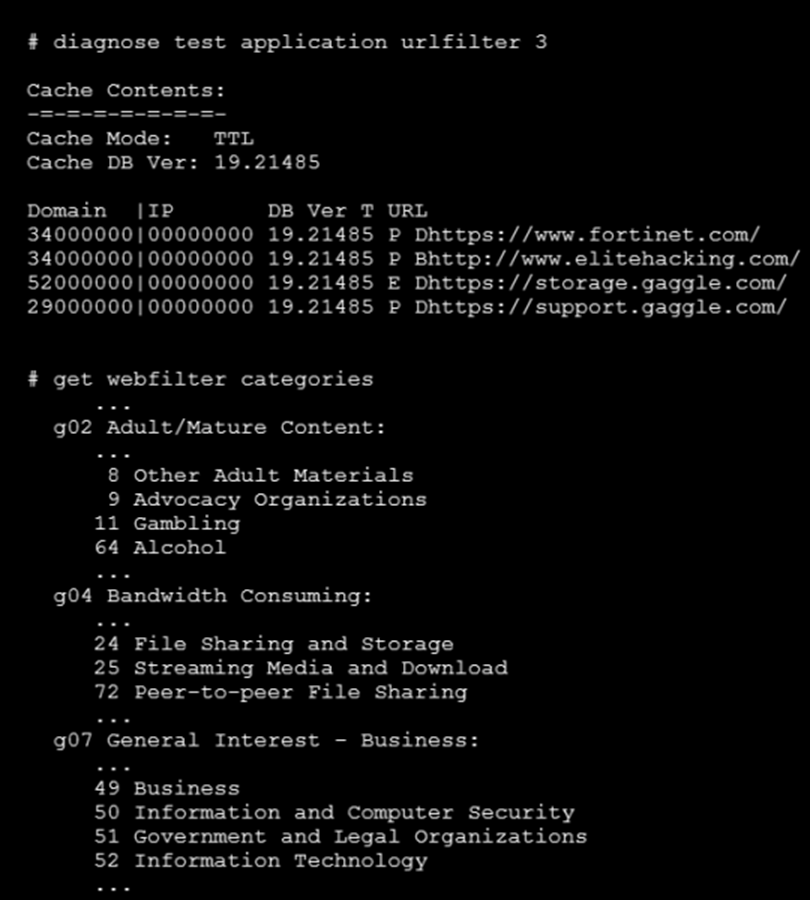
Which category does www.elitehacking.com belong to?
- A . Information Technology
- B . Peer-to-peer File Sharing
- C . Other Adult Materials
- D . Business
Examine these partial outputs from two routing debug commands:
# get router info routing-table database
S 0.0.0.0/0 [20/0] via 100.64.2.254, port2, [10/0]
S *> 0.0.0.0/0 [10/0] via 100.64.1.254, port1
# get router info routing-table all
S* 0.0.0.0/0 [10/0] via 100.64.1.254, port1
Why is the default route that uses port2 not in the output of the second command?
- A . It has a higher distance than the default route using port1.
- B . There can be only one default route present in an active routing table.
- C . It has a higher priority than the default route using port1.
- D . It is disabled in the FortiGate configuration.
Examine the IPsec configuration shown in the exhibit; then answer the question below.
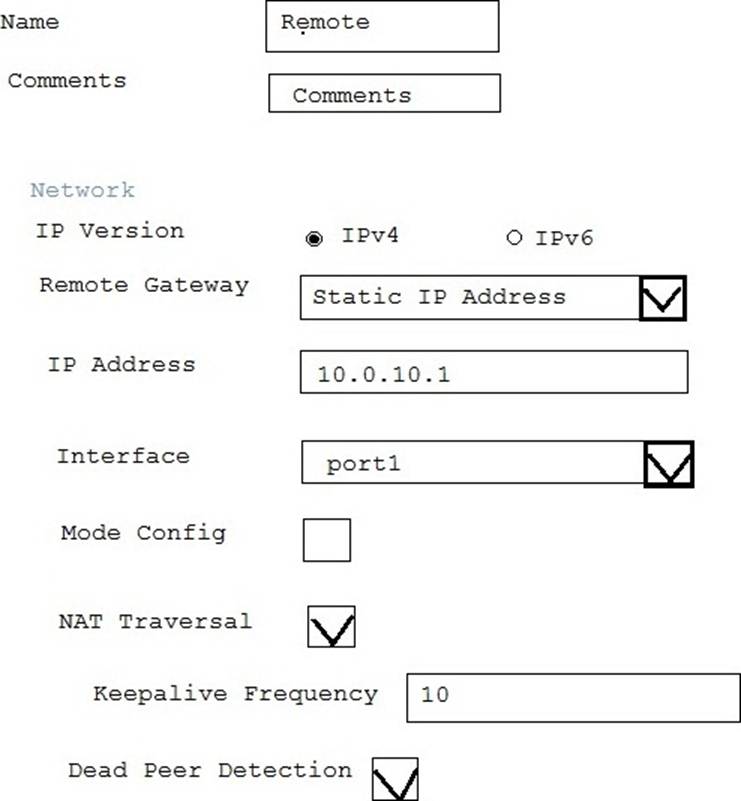
An administrator wants to monitor the VPN by enable the IKE real time debug using these commands:
diagnose vpn ike log-filter src-addr4 10.0.10.1
diagnose debug application ike -1
diagnose debug enable
The VPN is currently up, there is no traffic crossing the tunnel and DPD packets are being interchanged between both Ipsec gateways. However, the IKE rea time debug does NOT show any output.
Why isn’t there any output?
- A . The IKE real time debug shows the phases 1 and 2 negotiations only. It does not show any more output once the tunnel is up.
- B . The log-filter setting is set incorrectly. The VPN’s traffic does not match this filter.
- C . The IKF real time debug shows the phase 1 negotiation only. For information after that, the administrator must use the IPsec real time debug instead: diagnose debug application ipsec -1.
- D . The IKE real time debug shows error messages only. If it does not provide any output, it indicates that the tunnel is operating normally.
Examine the IPsec configuration shown in the exhibit; then answer the question below.
An administrator wants to monitor the VPN by enable the IKE real time debug using these commands:
diagnose vpn ike log-filter src-addr4 10.0.10.1
diagnose debug application ike -1
diagnose debug enable
The VPN is currently up, there is no traffic crossing the tunnel and DPD packets are being interchanged between both Ipsec gateways. However, the IKE rea time debug does NOT show any output.
Why isn’t there any output?
- A . The IKE real time debug shows the phases 1 and 2 negotiations only. It does not show any more output once the tunnel is up.
- B . The log-filter setting is set incorrectly. The VPN’s traffic does not match this filter.
- C . The IKF real time debug shows the phase 1 negotiation only. For information after that, the administrator must use the IPsec real time debug instead: diagnose debug application ipsec -1.
- D . The IKE real time debug shows error messages only. If it does not provide any output, it indicates that the tunnel is operating normally.
View the exhibit, which contains an entry in the session table, and then answer the question below.
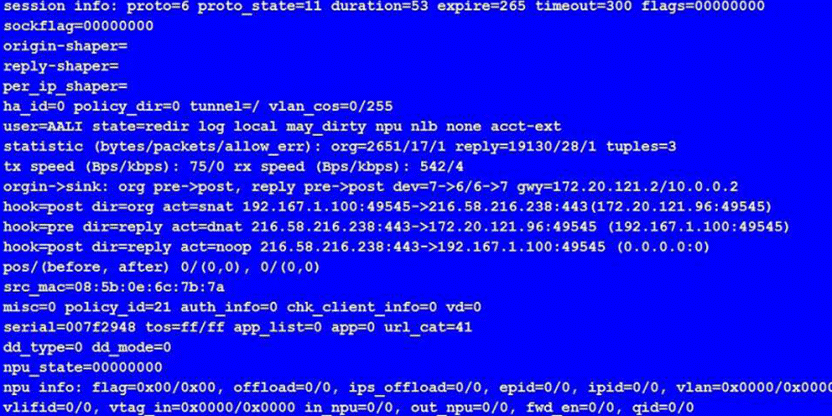
Which one of the following statements is true regarding FortiGate’s inspection of this session?
- A . FortiGate applied proxy-based inspection.
- B . FortiGate forwarded this session without any inspection.
- C . FortiGate applied flow-based inspection.
- D . FortiGate applied explicit proxy-based inspection.
A FortiGate’s port1 is connected to a private network. Its port2 is connected to the Internet. Explicit web proxy is enabled in port1 and only explicit web proxy users can access the Internet. Web cache is NOT enabled. An internal web proxy user is downloading a file from the Internet via HTTP.
Which statements are true regarding the two entries in the FortiGate session table related with this traffic? (Choose two.)
- A . Both session have the local flag on.
- B . The destination IP addresses of both sessions are IP addresses assigned to FortiGate’s interfaces.
- C . One session has the proxy flag on, the other one does not.
- D . One of the sessions has the IP address of port2 as the source IP address.
Refer to the exhibit, which contains the output of a debug command.
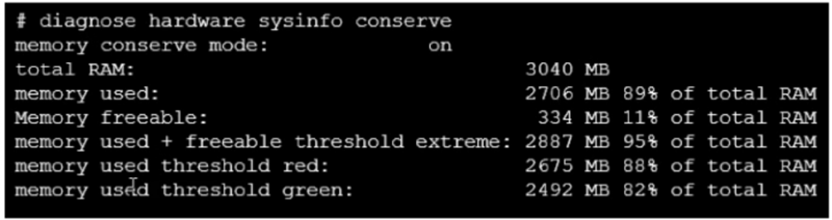
If the default settings are in place, what can be concluded about the conserve mode shown in the exhibit?
- A . FortiGate is currently blocking all new sessions regardless of the content inspection requirements or configuration settings due to high memory use.
- B . FortiGate is currently allowing new sessions that require flow-based or proxy-based content inspection but is not performing inspection on those sessions.
- C . FortiGate is currently blocking new sessions that require flow-based or proxy-based content inspection.
- D . FortiGate is currently allowing new sessions that require flow-based content inspection and blocking sessions that require proxy-based content inspection.
An administrator is deploying APs that are connecting over an IPsec network. All APs have been configured to connect to FortiGate manually. FortiGate can discover the APs and authorize them.
However, FortiGate is unable to establish CAPWAP tunnels to manage the APs.
Which configuration setting can the administrator perform to resolve the problem?
- A . Decrease the CAPWAP tunnel MTU size for APs to prevent fragmentation
- B . Enable CAPWAP administrative access on the IPsec interface
- C . Upgrade the FortiAP firmware image to ensure compatibility with the FortiOS version
- D . Assign a custom AP profile for the remote APs with the set mpls-connection option enabled
Refer to the exhibit, which shows partial outputs from two routing debug commands.
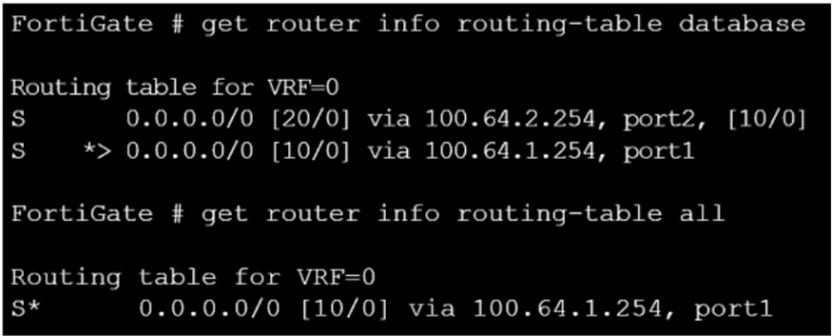
Why is the port2 default route not in the second command output?
- A . The port2 interface is disabled in the FortiGate configuration.
- B . The port1 default route has a lower distance than the default route using port2.
- C . The port1 default route has a higher priority value than the default route using port2.
- D . The port1 default route has a lower priority value than the default route using port2.
What action does FortiSwitch take when it receives a loop guard data packet (LGDP) that was sent by itself?
- A . The receiving port is shut down
- B . The sending port is shut down
- C . The receiving port is moved to the STP blocking state
- D . The sending port is moved to the STP blocking state