
Fortinet FCSS_EFW_AD-7.4 Practice Exams
Last updated on Nov 16,2026- Exam Code: FCSS_EFW_AD-7.4
- Exam Name: FCSS - Enterprise Firewall 7.4 Administrator
- Certification Provider: Fortinet
- Latest update: Nov 16,2026
Refer to the exhibit, which shows the output of get system ha status. NGFW-1 and NGFW-2 have been up for a week.
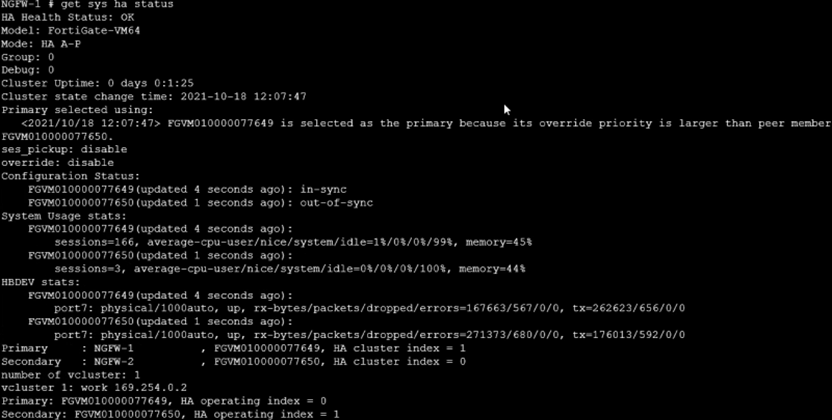
Which two statements about the output are true? (Choose two.)
- A . If FGVM…649 is rebooted, FGVM…650 will become the primary and retain that role, even after FGVM…649 rejoins the cluster.
- B . If no action is taken, the primary FortiGate will leave the cluster due to the current sync status.
- C . If port7 becomes disconnected on the secondary, both FortiGate devices will elect itself the primary.
- D . If a configuration change is made to the primary FortiGate at this time, the secondary will initiate a synchronization reset.
What events are recorded in the crashlogs of a ForitGate device? (Choose two.)
- A . A process crash.
- B . Configuration changes.
- C . Changes in the status of any of the FortiGuard licenses.
- D . System entering to and leaving from the proxy conserve mode.
Which of the following conditions must be met for a static route to be active in the routing table? (Choose three.)
- A . The next-hop IP address is up.
- B . There is no other route, to the same destination, with a higher distance.
- C . The link health monitor (if configured) is up.
- D . The next-hop IP address belongs to one of the outgoing interface subnets.
- E . The outgoing interface is up.
View the following FortiGate configuration.
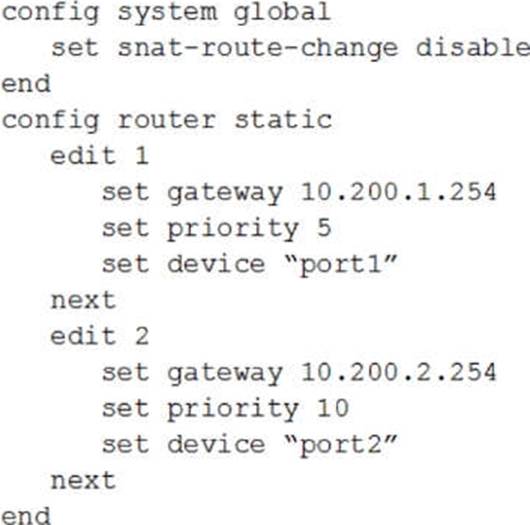
All traffic to the Internet currently egresses from port1.
The exhibit shows partial session information for Internet traffic from a user on the internal network:
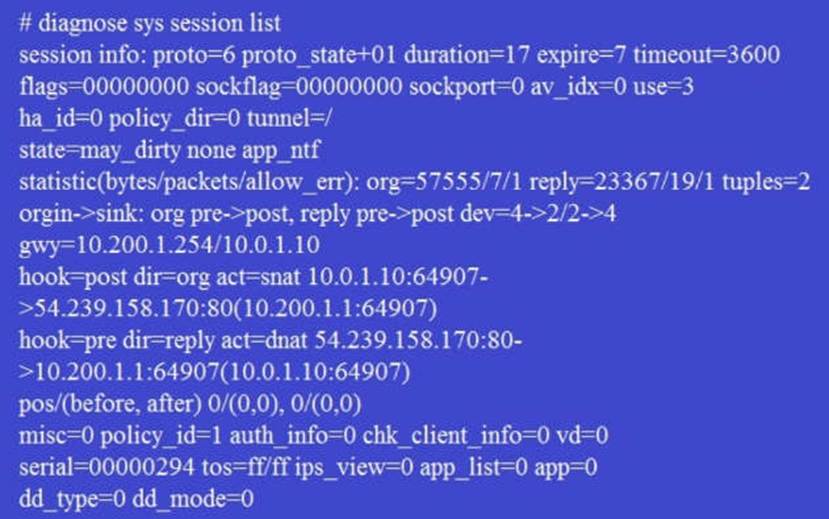
If the priority on route ID 1 were changed from 5 to 20, what would happen to traffic matching that user’s session?
- A . The session would remain the session table, and its traffic would still egress from port 1.
- B . The session would remain the session table, but its traffic would now egress from both port 1and port2
- C . The session would remain the session table, and its traffic would start to egress from port2.
- D . The session would be deleted, so the client would need to start a new session.
View the following exhibit:
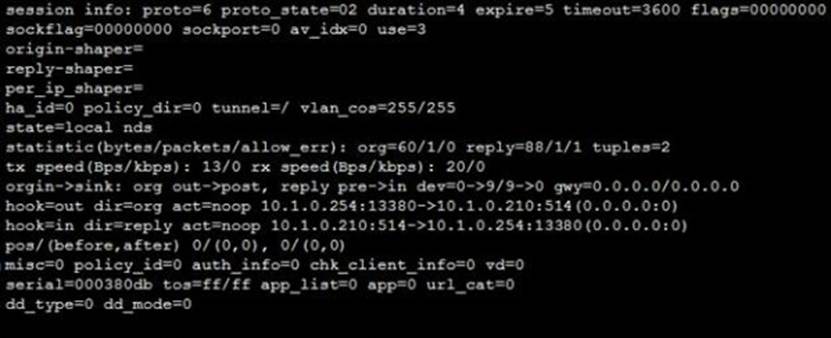
What two statements about this session are correct? (Choose two.)
- A . It is a UDP session that has seen traffic flow both ways.
- B . This is a TCP session that was blocked by firewall policy ID 0.
- C . This session terminates or originates in the FortiGate device.
- D . It is a TCP session in SYN_SENT state.
View the exhibit, which of the contains the partial output of an IKE real-time debug, then answer the question below.
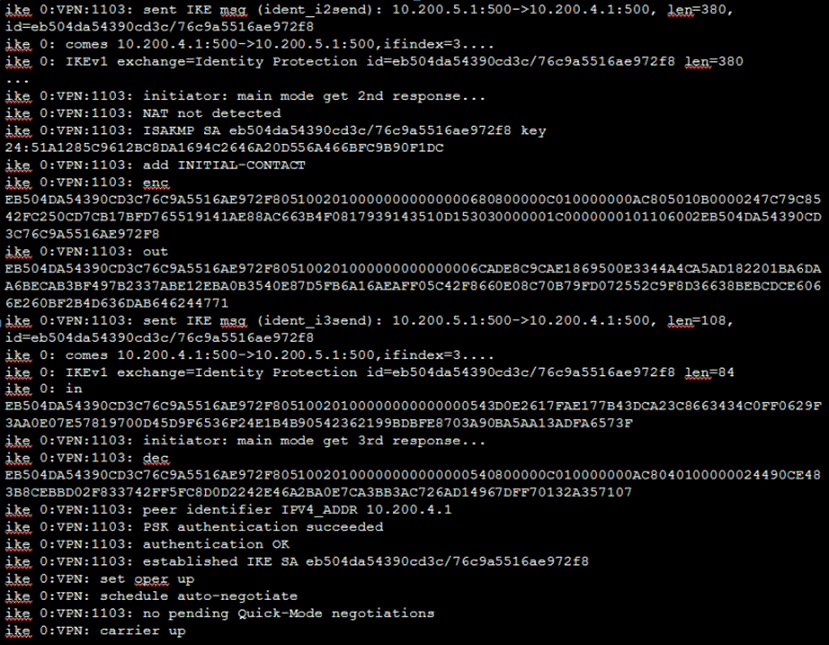
Which of the following statements about this debug output are true? (Choose two.)
- A . The name of the tunnel being negotiated is VPN.
- B . Both phases 1 and 2 are up.
- C . Both gateways are using aggressive mode.
- D . Phase 1 is using a pre-shared key for authentication.
Examine the output of the ‘get router info ospf interface’ command shown in the exhibit; then answer the question below.
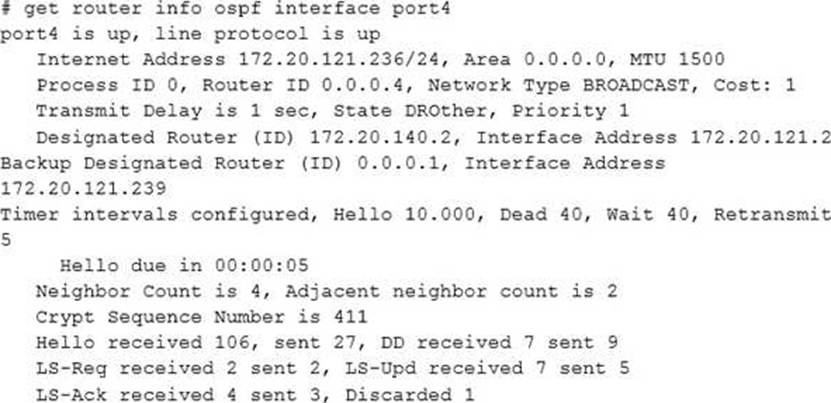
Which statements are true regarding the above output? (Choose two.)
- A . The port4 interface is connected to the OSPF backbone area.
- B . The local FortiGate has been elected as the OSPF backup designated router.
- C . There are at least 5 OSPF routers connected to the port4 network.
- D . Two OSPF routers are down in the port4 network.
An administrator must automate a weekly backup of all the FortiGate devices in an enterprise network.
Which two steps must the administrator follow to implement this? (Choose two.)
- A . Integrate all the FortiGate devices in a Security Fabric environment.
- B . Create a script to be run in the device database.
- C . Create metadata variables for all the FortiGate devices.
- D . Create an automation stitch.
A company’s guest internet policy, operating in proxy mode, blocks access to Artificial Intelligence Technology sites using FortiGuard. However, a guest user accessed a page in this category using port 8443.
Which configuration changes are required for FortiGate to analyze HTTPS traffic on nonstandard ports like 8443 when full SSL inspection is active in the guest policy?
- A . Add a URL wildcard domain to the website CA certificate and use it in the SSL/SSH Inspection Profile.
- B . In the Protocol Port Mapping section of the SSL/SSH Inspection Profile, enter 443, 8443 to analyze both standard (443) and non-standard (8443) HTTPS ports.
- C . To analyze nonstandard ports in web filter profiles, use TLSv1.3 in the SSL/SSH Inspection Profile.
- D . Administrators can block traffic on nonstandard ports by enabling the SNI check in the SSL/SSH Inspection Profile.
B
Explanation:
When FortiGate is operating inproxy modewithfull SSL inspection enabled, it inspects encrypted HTTPS traffic by default onport 443. However, some websites may usenon-standard HTTPS ports (such as 8443), which FortiGate does not inspect unless explicitly configured.
To ensure that FortiGate inspects HTTPS traffic onport 8443, administrators mustmanually add port 8443in theProtocol Port Mappingsection of theSSL/SSH Inspection Profile. This allows FortiGate to treat HTTPS traffic on port 8443 the same as traffic on port 443, enabling proper inspection and enforcement of FortiGuard category-based web filtering.
Which three tasks are part of the manual registration process for adding a FortiGate device to FortiManager for central management? (Choose three.)
- A . Import the policy package from the managed FortiGate device.
- B . Start the rating services on FortiManager.
- C . Wait for the rating databases to download on FortiManager.
- D . Add the FortiManager IP address to the FortiGate central management configuration.
- E . In FortiManager, add the unregistered FortiGate device.