
Fortinet FCSS_EFW_AD-7.4 Practice Exams
Last updated on Nov 16,2026- Exam Code: FCSS_EFW_AD-7.4
- Exam Name: FCSS - Enterprise Firewall 7.4 Administrator
- Certification Provider: Fortinet
- Latest update: Nov 16,2026
View the exhibit, which contains the output of a diagnose command, and then answer the question below.
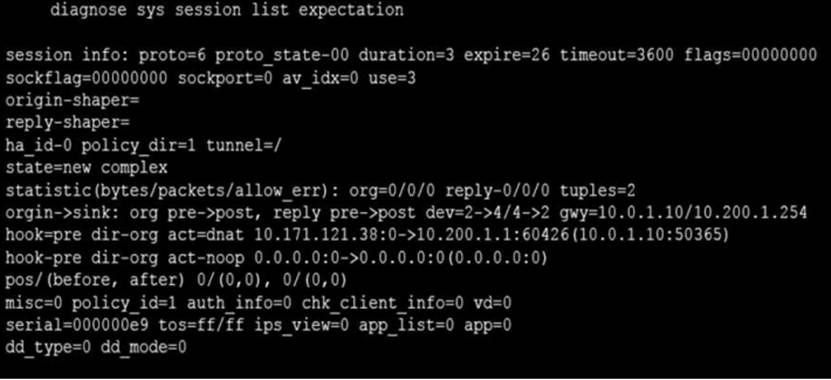
What statements are correct regarding the output? (Choose two.)
- A . This is an expected session created by a session helper
- B . Traffic in the original direction (coming from the IP address 10.171.122.38) will be routed to the next-hop IP address 10.0.1.10
- C . Traffic in the original direction (coming from the IP address 10.171.122.38) will be routed to the next-hop IP address 10.200.1.1.
- D . This is an expected session created by an application control profile.
What does the dirty flag mean in a FortiGate session?
- A . Traffic has been blocked by the antivirus inspection.
- B . The next packet must be re-evaluated against the firewall policies.
- C . The session must be removed from the former primary unit after an HA failover.
- D . Traffic has been identified as from an application that is not allowed.
View the exhibit, which contains the output of a diagnose command, and then answer the question below.
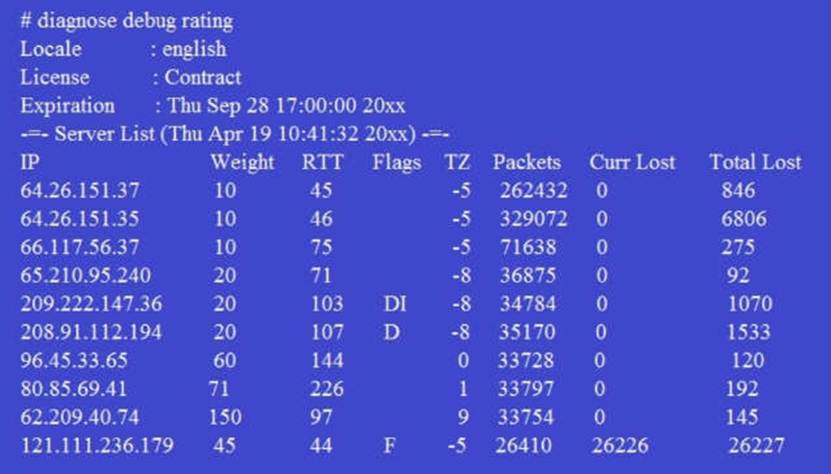
Which statements are true regarding the output in the exhibit? (Choose two.)
- A . FortiGate will probe 121.111.236.179 every fifteen minutes for a response.
- B . Servers with the D flag are considered to be down.
- C . Servers with a negative TZ value are experiencing a service outage.
- D . FortiGate used 209.222.147.36 as the initial server to validate its contract.
Refer to the exhibit, which shows an ADVPN network.
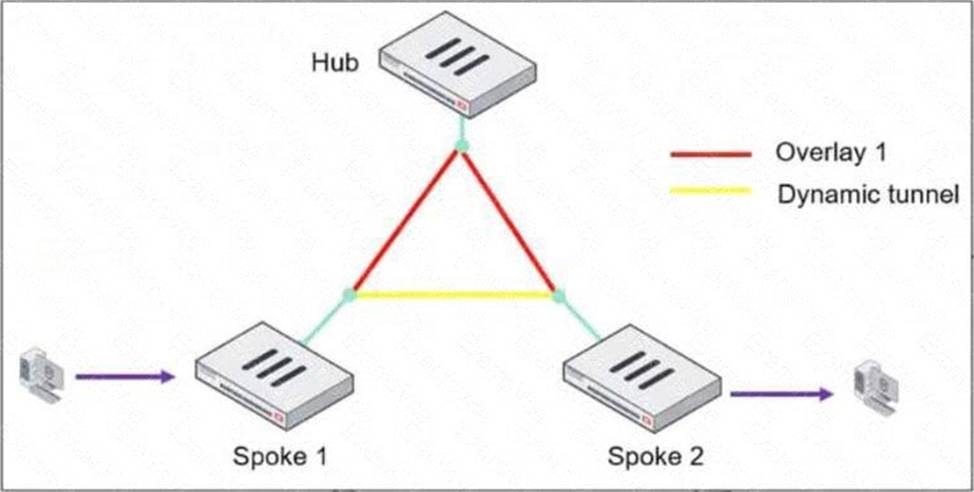
The client behind Spoke-1 generates traffic to the device located behind Spoke-2.
What is the first message that the hub sends to Spoke-1 to bring up the dynamic tunnel?
- A . Shortcut query
- B . Shortcut offer
- C . Shortcut reply
- D . Shortcut forward
B
Explanation:
In anADVPN (Auto-Discovery VPN) network, adynamic VPN tunnelis establishedon-demandbetween spokes to optimize traffic flow and reduce latency.
Process:
Two independent FortiGate HA clusters are connected to the same broadcast domain. The administrator has reported that both clusters are using the same HA virtual MAC address. This creates a duplicated MAC address problem in the network.
What HA setting must be changed in one of the HA clusters to fix the problem?
- A . Group ID.
- B . Group name.
- C . Session pickup.
- D . Gratuitous ARPs.
A company that acquired multiple branches across different countries needs to install new FortiGate devices on each of those branches. However, the IT staff lacks sufficient knowledge to implement the initial configuration on the FortiGate devices.
Which three approaches can the company take to successfully deploy advanced initial configurations on remote branches? (Choose three.)
- A . Use metadata variables to dynamically assign values according to each FortiGate device.
- B . Use provisioning templates and install configuration settings at the device layer.
- C . Use the Global ADOM to deploy global object configurations to each FortiGate device.
- D . Apply Jinja in the FortiManager scripts for large-scale and advanced deployments.
- E . Add FortiGate devices on FortiManager as model devices, and use ZTP or LTP to connect to FortiGate devices.
A B E
Explanation:
Use metadata variables to dynamically assign values according to each FortiGate device:Metadata variables in FortiManager allow device-specific configurations to be dynamically assigned without manually configuring each FortiGate. This is especially useful when deploying multiple devices with similar base configurations.
Use provisioning templates and install configuration settings at the device layer:Provisioning templates in FortiManager provide a structured way to configure FortiGate devices. These templates can define interfaces, policies, and settings, ensuring that each device is correctly configured upon deployment.
Add FortiGate devices on FortiManager as model devices, and use ZTP or LTP to connect to FortiGate devices:Zero-Touch Provisioning (ZTP) and Local Touch Provisioning (LTP) help automate the deployment of FortiGate devices. By adding devices as model devices in FortiManager, configurations can be pushed automatically when devices connect for the first time, reducing manual effort.
Refer to the exhibit, which shows VDOM link interfaces.
For the VDOM link shown, what is the meaning of np0 and np1?
- A . They are the VRD ID numbers of each VDOM interface.
- B . FortiGate automatically assigns a native ASIC network processor to available VDOM interfaces.
- C . They represent the ID number of each VDOM for traffic management.
- D . FortiGate automatically assigns unique names to VDOM links by appending 0 and 1.
What is the diagnose test application ipsmenitor 5 command used for?
- A . To enable IPS bypass mode
- B . To disable the IPS engine
- C . To restart all IPS engines and monitors
- D . To provide information regarding IPS sessions
Examine the following routing table and BGP configuration; then answer the question below.
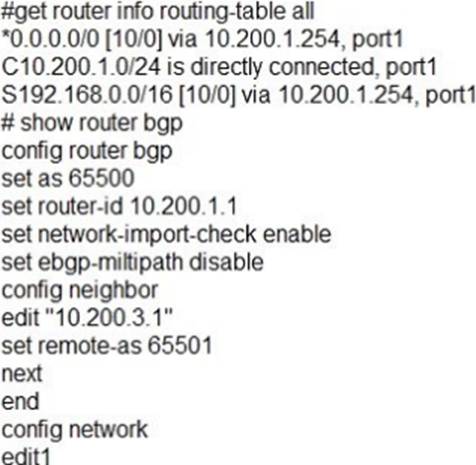
The BGP connection is up, but the local peer is NOT advertising the prefix 192.168.1.0/24.
Which configuration change will make the local peer advertise this prefix?
- A . Enable the redistribution of connected routers into BGP.
- B . Enable the redistribution of static routers into BGP.
- C . Disable the setting network-import-check.
- D . Enable the setting ebgp-multipath.
Which statements about bulk configuration changes using FortiManager CLI scripts are correct? (Choose two.)
- A . When executed on the All FortiGate in ADOM, changes are automatically installed without creating a new revision history.
- B . When executed on the Remote FortiGate directly, administrators do not have the option to review the changes prior to installation.
- C . When executed on the Device Database, you must use the installation wizard to apply the changes to the managed FortiGate.
- D . When executed on the Policy Package, ADOM database, changes are applied directly to the managed FortiGate.