
Fortinet FCSS_EFW_AD-7.4 Practice Exams
Last updated on Nov 16,2026- Exam Code: FCSS_EFW_AD-7.4
- Exam Name: FCSS - Enterprise Firewall 7.4 Administrator
- Certification Provider: Fortinet
- Latest update: Nov 16,2026
An administrator cannot connect to the GIU of a FortiGate unit with the IP address 10.0.1.254. The administrator runs the debug flow while attempting the connection using HTTP.
The output of the debug flow is shown in the exhibit.

Based on the error displayed by the debug flow, which are valid reasons for this problem? (Choose two.)
- A . HTTP administrative access is disabled in the FortiGate interface with the IP address 10.0.1.254.
- B . Redirection of HTTP to HTTPS administrative access is disabled.
- C . HTTP administrative access is configured with a port number different than 80.
- D . The packet is denied because of reverse path forwarding check.
Which security feature is most commonly enabled on DCFW firewalls to protect servers in a data center?
- A . Application control
- B . IPS
- C . Antivirus
- D . Web filtering
Refer to the exhibit, which shows the output of a debug command.

What can be concluded from the debug command output?
- A . The OSPF router with the ID 0.0.0.69 has its OSPF priority set to 0.
- B . The local FortiGate has a different MTU value from the OSPF router with ID 0.0.0.2, based on the state information.
- C . There are more than two OSPF routers on the wan2 network.
- D . The interface ToRemote is a broadcast OSPF network.
Examine the output from the BGP real time debug shown in the exhibit, then the answer the question below.
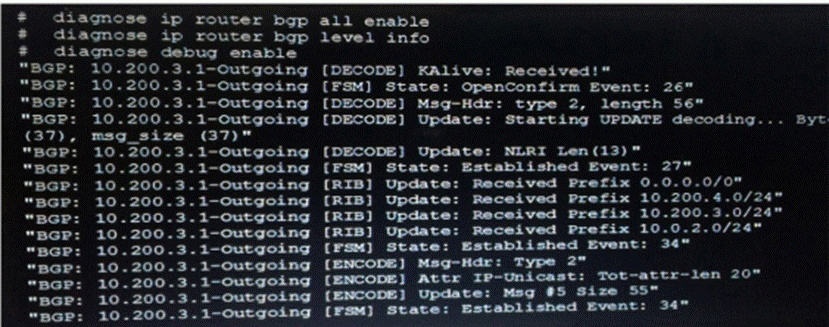
Which statements are true regarding the output in the exhibit? (Choose two.)
- A . BGP peers have successfully inter changed Open and Keep alive messages.
- B . Local BGP peer received a prefix for a default route.
- C . The state of the remote BGP peer is Open Confirm.
- D . The state of the remote BGP peer will go to Connect after it confirms the received prefixes.
View the exhibit, which contains the output of a diagnose command, and the answer the question below.
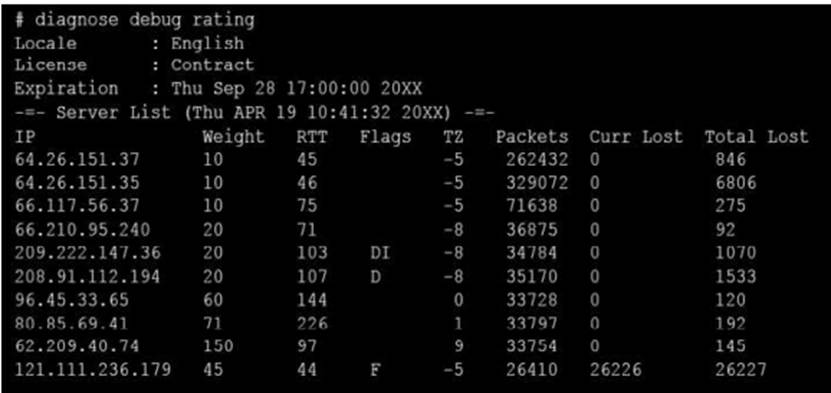
Which statements are true regarding the Weight value?
- A . Its initial value is calculated based on the round trip delay (RTT).
- B . Its initial value is statically set to 10.
- C . Its value is incremented with each packet lost.
- D . It determines which FortiGuard server is used for license validation.
Refer to the exhibit, which contains the partial output of an IKE real-time debug.
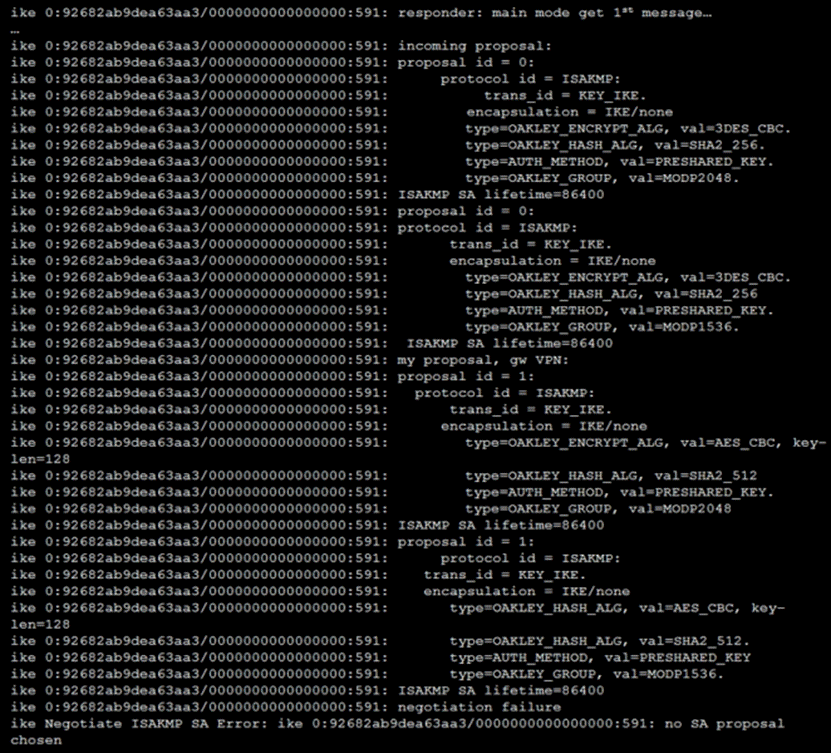
The administrator does not have access to the remote gateway. Based on the debug output, which configuration change can the administrator make to the local gateway to resolve the phase 1 negotiation error?
- A . Change phase 1 encryption to AESCBC and authentication to SHA128.
- B . Change phase 1 encryption to 3DES and authentication to CBC.
- C . Change phase 1 encryption to AES128 and authentication to SHA512.
- D . Change phase 1 encryption to 3DES and authentication to SHA256.
Refer to the exhibit, which shows the packet capture output of a three-way handshake between FortiGate and FortiManager Cloud.
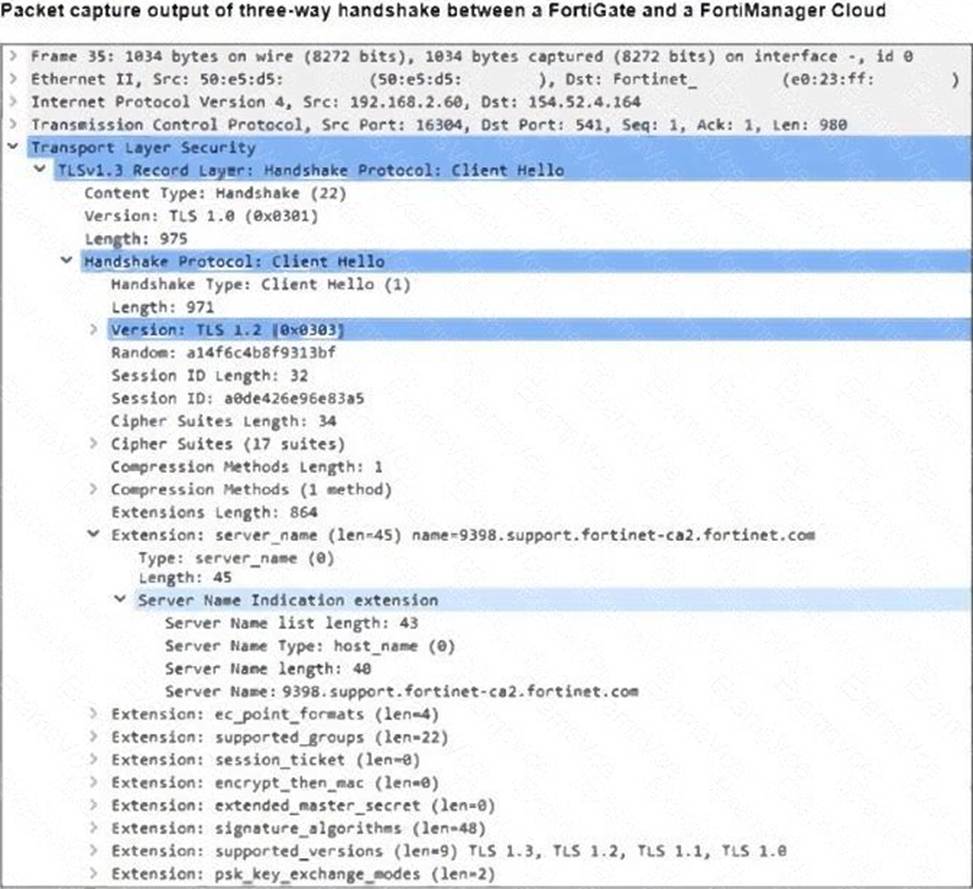
What two conclusions can you draw from the exhibit? (Choose two.)
- A . FortiGate will receive a certificate that supports multiple domains because FortiManager operates in a cloud computing environment.
- B . FortiGate is connecting to the same IP server and will receive an independent certificate for its connection between FortiGate and FortiManager Cloud.
- C . If the TLS handshake contains 17 cipher suites it means the TLS version must be 1.0 on this three-way handshake.
- D . The wildcard for the domain *.fortinet-ca2.support.fortinet.com must be supported by FortiManager Cloud.
D
Explanation:
The packet capture output displays aTLS Client Hellomessage from FortiGate to FortiManager Cloud. This message containsServer Name Indication (SNI), which is used to indicate the domain name that FortiGate is trying to connect to.
FortiGate will receive a certificate that supports multiple domains because FortiManager operates in a cloud computing environment.
# FortiManager Cloud hostsmultiple customersand domains under ashared infrastructure.
# The TLS handshake includesSNI (Server Name Indication), which allows FortiManager Cloud toserve multiple certificatesbased on the requested domain.
# This means FortiGate will likely receive amulti-domain or wildcard certificatethat can be used for multiple customers under FortiManager Cloud.
The wildcard for the domain .fortinet-ca2.support.fortinet.com must be supported by FortiManager Cloud.
# The SNI extension contains the domain9398.support.fortinet-ca2.fortinet.com.
# FortiManager Cloud must supportwildcard certificatessuch as *.fortinet-ca2.support.fortinet.com to securely manage multiple subdomains and customers.
# This ensures that FortiGate can validate the server certificate without any TLS errors.
Refer to the exhibit, which shows a session table entry.
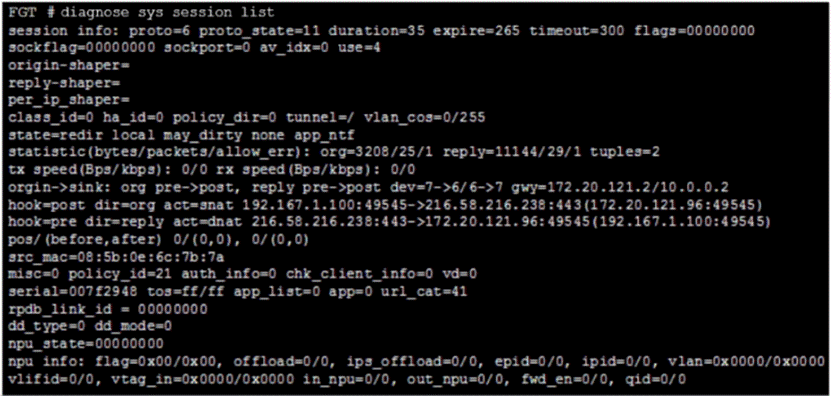
Which statement about FortiGate behavior relating to this session is true?
- A . FortiGate redirected the client to the captive portal to authenticate, so that a correct policy match could be made.
- B . FortiGate forwarded this session without any inspection.
- C . FortiGate is performing security profile inspection using the CPU.
- D . FortiGate applied only IPS inspection to this session.
In which of the following states is a given session categorized as ephemeral? (Choose two.)
- A . A TCP session waiting to complete the three-way handshake.
- B . A TCP session waiting for FIN ACK.
- C . A UDP session with packets sent and received.
- D . A UDP session with only one packet received.
An administrator is designing an ADVPN network for a large enterprise with spokes that have varying numbers of internet links. They want to avoid a high number of routes and peer connections at the hub.
Which method should be used to simplify routing and peer management?
- A . Deploy a full-mesh VPN topology to eliminate hub dependency.
- B . Implement static routing over IPsec interfaces for each spoke.
- C . Use a dynamic routing protocol using loopback interfaces to streamline peers and routes.
- D . Establish a traditional hub-and-spoke VPN topology with policy routes.
C
Explanation:
When designing an ADVPN (Auto-Discovery VPN) network for alarge enterprisewith spokes that havevarying numbers of internet links, the main challenge is tominimize the number of peer connections and routesat the hub while maintainingscalability and efficiency.
Using a dynamic routing protocol (such as BGP or OSPF) with loopback interfaces helps in several ways:
#Reduces the number of peer connectionsat the hub byusing a single loopback address per spokeinstead of individual physical interfaces.
#Enables simplified route advertisementby dynamically learning and propagating routes instead of manually configuring static routes.
#Supports multiple internet links per spokeefficiently, as dynamic routing can automatically adjust to the best available path.
#Allows seamless failoverif a spoke’s internet link fails, ensuring continuous connectivity.