
Fortinet FCSS_EFW_AD-7.4 Practice Exams
Last updated on Nov 16,2026- Exam Code: FCSS_EFW_AD-7.4
- Exam Name: FCSS - Enterprise Firewall 7.4 Administrator
- Certification Provider: Fortinet
- Latest update: Nov 16,2026
An administrator has configured a dial-up IPsec VPN with one phase 2, extended authentication (XAuth) and IKE mode configuration.
The administrator has also enabled the IKE real time debug:
diagnose debug application ike-1
diagnose debug enable
In which order is each step and phase displayed in the debug output each time a new dial-up user is connecting to the VPN?
- A . Phase1; IKE mode configuration; XAuth; phase 2.
- B . Phase1; XAuth; IKE mode configuration; phase2.
- C . Phase1; XAuth; phase 2; IKE mode configuration.
- D . Phase1; IKE mode configuration; phase 2; XAuth.
Refer to the exhibit, which shows a corporate network and a new remote office network.
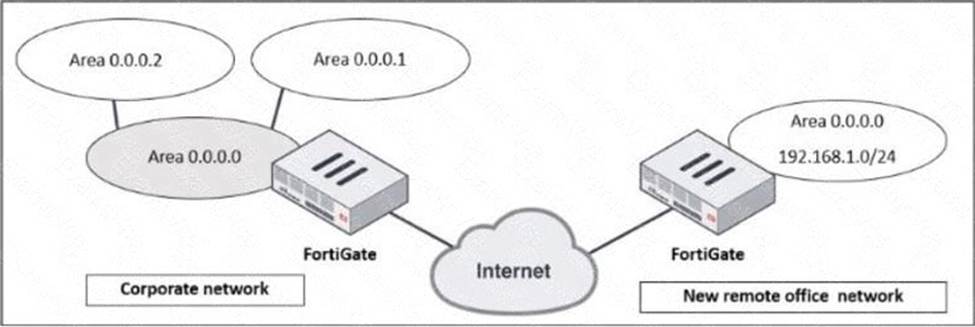
An administrator must integrate the new remote office network with the corporate enterprise network.
What must the administrator do to allow routing between the two networks?
- A . The administrator must implement BGP to inject the new remote office network into the corporate FortiGate device
- B . The administrator must configure a static route to the subnet 192.168.l.0/24 on the corporate FortiGate device.
- C . The administrator must configure virtual links on both FortiGate devices.
- D . The administrator must implement OSPF over IPsec on both FortiGate devices.
D
Explanation:
In this scenario, thecorporate networkand thenew remote office networkneed to communicate over the Internet, which requires asecure and dynamic routing method. Since both networks are usingOSPF (Open Shortest Path First)as the routing protocol, the best approach is to establish anOSPF over IPsec VPNto ensure secure and dynamic route propagation.
OSPF is already running on the corporate network, and extending it over an IPsec tunnel allows dynamic route exchange between the corporate FortiGate and the remote office FortiGate.IPsec provides encryption for traffic over the Internet, ensuring secure communication.OSPF over IPsec eliminates the need for manual static routes, allowing automatic route updates if networks change.
The new remote office’s192.168.1.0/24 subnetwill be advertised dynamically to the corporate network without additional configuration.
Refer to the exhibit, which shows the output of a diagnose command.
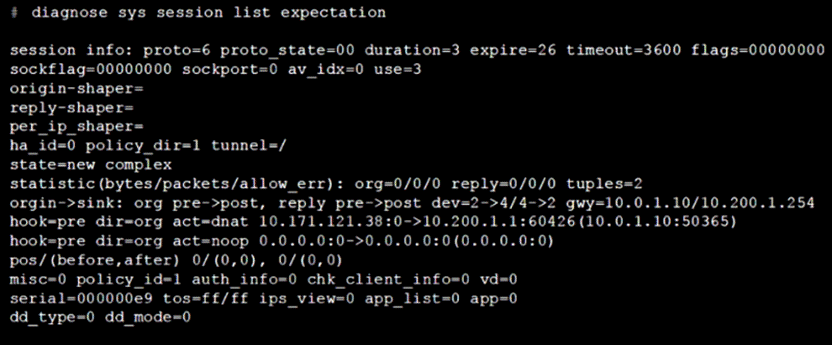
What can you conclude from the output shown in the exhibit? (Choose two.)
- A . This is a pinhole session created to allow traffic for a protocol that requires additional sessions to operate through FortiGate.
- B . This is an expected session created by the IPS engine.
- C . Traffic in the original direction (coming from the IP address 10.171.121.38) will be routed to the next-hop IP address 10.200.1.1.
- D . Traffic in the original direction (coming from the IP address 10.171.121.38) will be routed to the next-hop IP address 10.0.1.10.
Examine the output of the ‘get router info ospf neighbor’ command shown in the exhibit; then answer the question below.
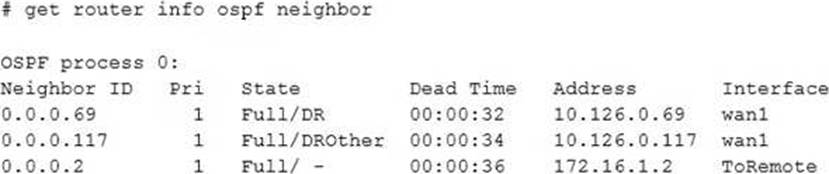
Which statements are true regarding the output in the exhibit? (Choose two.)
- A . The interface ToRemote is OSPF network type point-to-point.
- B . The OSPF router with the ID 0.0.0.2 is the designated router for the ToRemote network.
- C . The local FortiGate is the backup designated router for the wan1 network.
- D . The OSPF routers with the IDs 0.0.0.69 and 0.0.0.117 are both designated routers for the wan1 network.
View the exhibit, which contains the partial output of an IKE real-time debug, and then answer the question below.

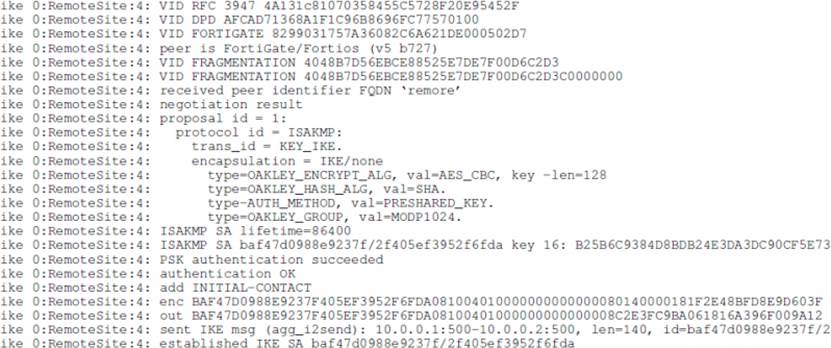
Which statements about this debug output are correct? (Choose two.)
- A . The remote gateway IP address is 10.0.0.1.
- B . It shows a phase 1 negotiation.
- C . The negotiation is using AES128 encryption with CBC hash.
- D . The initiator has provided remote as its IPsec peer ID.