
Fortinet FCSS_EFW_AD-7.4 Practice Exams
Last updated on Nov 16,2026- Exam Code: FCSS_EFW_AD-7.4
- Exam Name: FCSS - Enterprise Firewall 7.4 Administrator
- Certification Provider: Fortinet
- Latest update: Nov 16,2026
Refer to the exhibit, which shows a LAN interface connected from FortiGate to two FortiSwitch devices.
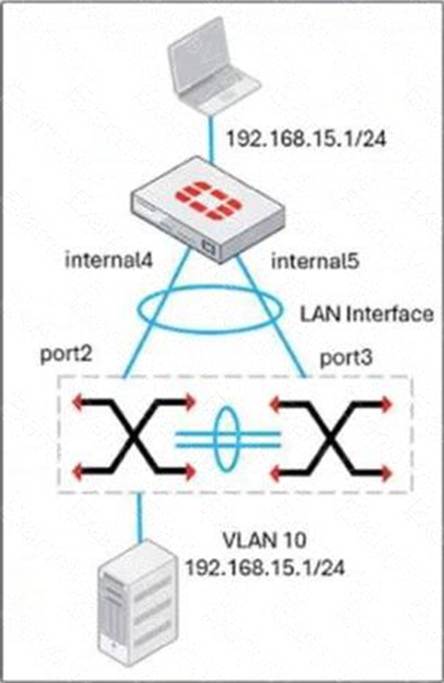
What two conclusions can you draw from the corresponding LAN interface? (Choose two.)
- A . You must enable STP or RSTP on FortiGate and FortiSwitch to avoid layer 2 loopbacks.
- B . The LAN interface must use a 802.3ad type interface.
- C . This connection is using a FortiLInk to manage VLANs on FortiGate.
- D . FortiGate is using an SD-WAN-type interface to connect to a FortiSwitch device with MCLAG.
B C
Explanation:
The diagram shows a FortiGate connected to two FortiSwitches, which suggests the use ofFortiLink, Fortinet’s protocol for managing switches directly from a FortiGate. Since multiple connections are being used, the LAN interface must be set to802.3ad (LAG)mode to aggregate the links for redundancy and load balancing.
This setup allows FortiGate to handle VLAN assignments dynamically, as seen withVLAN 10 (192.168.15.1 /24). FortiLink ensures seamless integration between FortiGate and FortiSwitches, making STP unnecessary because Fortinet’sMCLAGprevents loops at Layer 2. SD-WAN, on the other hand, is used for WAN interfaces and does not apply to switch connectivity in this scenario.
Refer to the exhibit, which contains a partial VPN configuration.
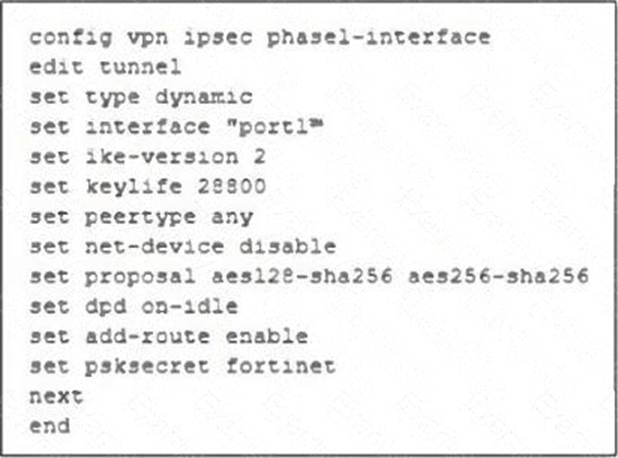
What can you conclude from this VPN IPsec phase 1 configuration?
- A . This configuration is the best for networks with regular traffic intervals, providing a balance between connectivity assurance and resource utilization.
- B . Peer IDs are unencrypted and exposed, creating a security risk.
- C . FortiGate will not add a route to its routing or forwarding information base when the dynamic tunnel is negotiated.
- D . A separate interface is created for each dial-up tunnel, which can be slower and more resource intensive, especially in large networks.
A
Explanation:
ThisIPsec Phase 1 configurationdefines adynamicVPN tunnel that can accept connections from multiple peers. The settings chosen here suggest a configuration optimized fornetworks with intermittent traffic patternswhile ensuring resources are used efficiently.
Key configurations and their impact:
#set type dynamic# This allows multiple peers to establish connections dynamically without needing predefined IP addresses.
#set ike-version 2# UsesIKEv2, which is more efficient and supports features like EAP authentication and reduced rekeying overhead.
#set dpd on-idle# Dead Peer Detection (DPD) is triggeredonly when the tunnel is idle, reducing unnecessary keep-alive packets and improving resource utilization.
#set add-route enable# FortiGate automatically adds the route to the routing table when the tunnel is established, ensuring connectivity when needed.
#set proposal aes128-sha256 aes256-sha256# Uses strong encryption and hashing algorithms, ensuring a secure connection.
#set keylife 28800# Sets alonger key lifetime(8 hours), reducing the frequency of rekeying, which is beneficial for stable connections.
BecauseDPD is set to on-idle, the tunnel will not constantly send keep-alive messages but will still ensure connectivity when traffic is detected. This makes the configuration ideal fornetworks with regular but non-continuous traffic, balancing security and resource efficiency.
Which statement about NGFW policy-based application filtering is true?
- A . After the application has been identified, the kernel uses only the Layer 4 header to match the traffic.
- B . FortiGate will drop all packets until the application can be identified.
- C . After IPS identifies the application, it adds an entry to a dynamic ISDB table.
- D . The IPS security profile is the only security option you can apply to the security policy with the action set to ACCEPT.
View the exhibit, which contains the partial output of a diagnose command, and then answer the question below.
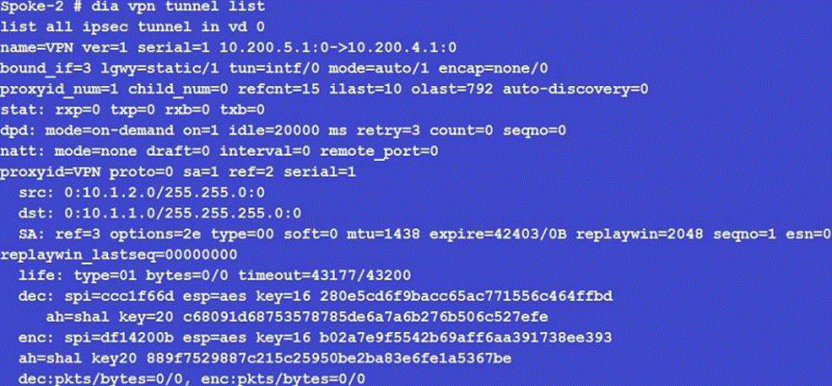
Based on the output, which of the following statements is correct?
- A . Anti-replay is enabled.
- B . DPD is disabled.
- C . Quick mode selectors are disabled.
- D . Remote gateway IP is 10.200.5.1.
In which order are firewall policies processed on a FortiGate unit?
- A . From top to down, according with their sequence number.
- B . From top to down, according with their policy ID number.
- C . Based on best match.
- D . Based on the priority value.
Which real time debug should an administrator enable to troubleshoot RADIUS authentication problems?
- A . Diagnose debug application radius -1.
- B . Diagnose debug application fnbamd -1.
- C . Diagnose authd console Clog enable.
- D . Diagnose radius console Clog enable.
Refer to the exhibit.
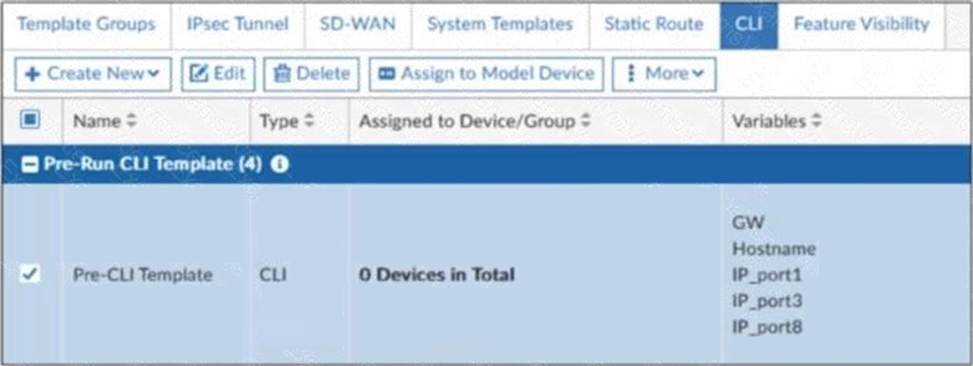
A pre-run CLI template that is used in zero-touch provisioning (ZTP) and low-touch provisioning (LTP) with FortiManager is shown.
The template is not assigned even though the configuration has already been installed on FortiGate.
What is true about this scenario?
- A . The administrator did not assign the template correctly when adding the model device because pre-CLI templates remain permanently assigned to the firewall
- B . Pre-run CLI templates are automatically unassigned after their initial installation
- C . Pre-run CLI templates for ZTP and LTP must be unassigned manually after the first installation to avoid conflicting error objects when importing a policy package
- D . The administrator must use post-run CLI templates that are designed for ZTP and LTP
B
Explanation:
InFortiManager,pre-run CLI templatesare used inZero-Touch Provisioning (ZTP)andLow-Touch Provisioning (LTP)to configure a FortiGate devicebeforeit is fully managed by FortiManager.
These templatesapply configurationswhen a device is initially provisioned.Once the pre-run CLI template is executed, FortiManagerautomatically unassignsit from the device because it isnot meant to persistlike other policy configurations. This prevents conflicts and ensures that the FortiGate configuration isnot repeatedly appliedafter the initial setup.
Refer to the exhibit, which contains a partial routing table.
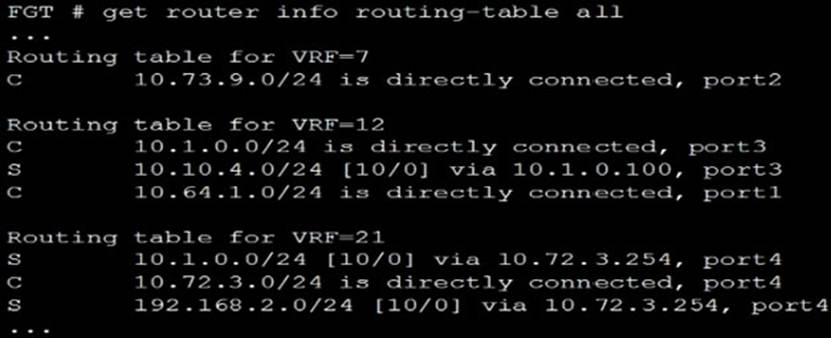
Assuming all the appropriate firewall policies are configured, which two pings will FortiGate route? (Choose two.)
- A . Source IP address 10.1.0.24, Destination IP address 10.72.3.20.
- B . Source IP address 10.72.3.52, Destination IP address 10.1.0.254.
- C . Source IP address 10.72.3.27, Destination IP address 10.1.0.52.
- D . Source IP address 10.73.9.10, Destination IP address 10.72.3.15.
You have configured FortiManager as a local FDS to provide FortiGate AV and IPS updates, but FortiGate devices are not receiving updates to their AV signature databases, IPS engines, or IPS signature databases.
Which two settings need to be verified for these features to function? (Choose two.)
- A . FortiGate needs to have the server list entry for FortiManager set to server-type update under config system central-management.
- B . FortiManager needs to be the license validation server for FortiGate devices trying to retrieve updated AV and IPS packages.
- C . Service access needs to be enabled on FortiManager under System Settings > Network.
- D . FortiGate needs to have include-default-servers disabled under config system central-management.
Refer to the exhibit, which contains the partial output of an OSPF command.
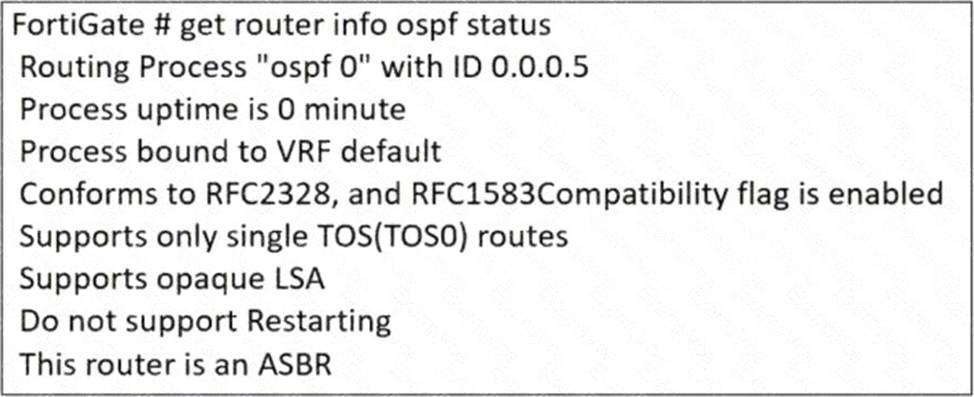
An administrator is checking the OSPF status of a FortiGate device and receives the output shown in the exhibit.
Which statement on this FortiGate device is correct?
- A . The FortiGate device can inject external routing information.
- B . The FortiGate device is in the area 0.0.0.5.
- C . The FortiGate device does not support OSPF ECMP.
- D . The FortiGate device is a backup designated router.
A
Explanation:
From theOSPF status output, the key information is:
#"This router is an ASBR"# This means the FortiGate is acting as anAutonomous System Boundary Router (ASBR).
# AnASBRis responsible for injectingexternal routing informationinto OSPF from another routing protocol (such as BGP, static routes, or connected networks).