
Fortinet FCSS_EFW_AD-7.4 Practice Exams
Last updated on Nov 16,2026- Exam Code: FCSS_EFW_AD-7.4
- Exam Name: FCSS - Enterprise Firewall 7.4 Administrator
- Certification Provider: Fortinet
- Latest update: Nov 16,2026
During the maintenance window, an administrator must sniff all the traffic going through a specific firewall policy, which is handled by NP6 interfaces. The output of the sniffer trace provides just a few packets.
Why is the output of sniffer trace limited?
- A . The traffic corresponding to the firewall policy is encrypted.
- B . auto-asic-off load is set to enable in the firewall policy,
- C . inspection-mode is set to proxy in the firewall policy.
- D . The option npudbg is not added in the diagnose sniff packet command.
B
Explanation:
FortiGate devices withNP6 (Network Processor 6) accelerationoffload traffic directly to hardware, bypassing the CPU for improved performance. Whenauto-asic-offloadis enabled in a firewall policy, most of the trafficdoes not reach the CPU, which means it won’t be captured by the standard sniffer trace command.
Since NP6-accelerated traffic is handled entirely in hardware, onlya small portion of initial packets(such as session setup packets or exceptions) might be seen in the sniffer output.
To capture all packets, the administrator must disable hardware offloading using:
config firewall policy
edit <policy_ID>
set auto-asic-offload disable
end
Disabling ASIC offload forces traffic to be processed by the CPU, allowing the sniffer tool to capture all packets.
View the following exhibit, which contains the sniffer output for a passive mode FTP request.
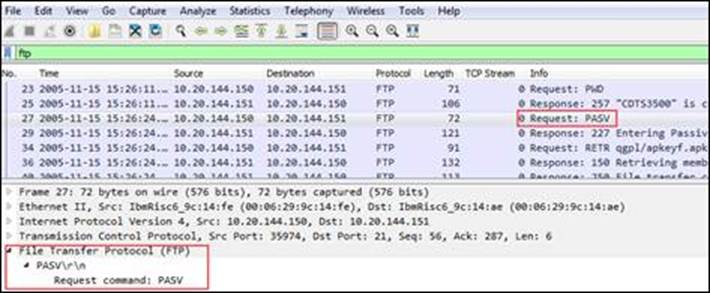
An administrator has created the following custom IPS signature to block all FTP requests for passive mode: F-SBID (–attack_id 1002; –name "Block.FTP "; –protocol tcp; –flow from_client; –pattern "PASV"; –no_case;) Soon after the signature is enabled in an active IPS sensor, some false positive detections are generated.
Which option and value pair will allow more specific detection?
- A . –protocol ftp
- B . –service ftp
- C . –name "Block.FTP.PASV"
- D . –attack_id 1001
View the exhibit, which contains the output of diagnose sys session stat, and then answer the question below.
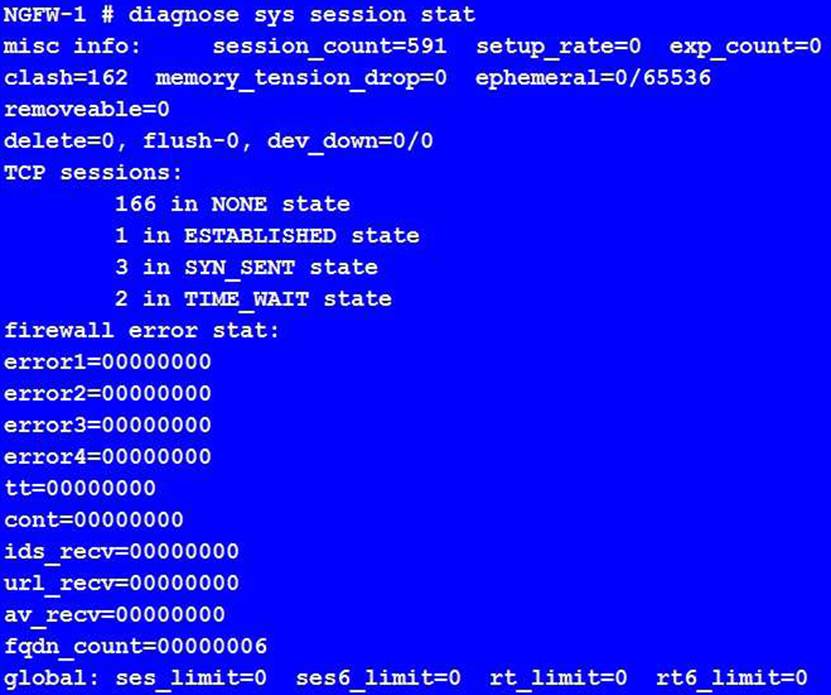
Which statements are correct regarding the output shown? (Choose two.)
- A . There are 0 ephemeral sessions.
- B . All the sessions in the session table are TCP sessions.
- C . No sessions have been deleted because of memory pages exhaustion.
- D . There are 166 TCP sessions waiting to complete the three-way handshake.
Which two statements about FortiManager is true when it is deployed as a local FDS? (Choose two.)
- A . It supports rating requests from both managed and unmanaged devices.
- B . It caches available firmware updates for unmanaged devices.
- C . It can be configured as an update server, or a rating server, but not both.
- D . It provides VM license validation services.
View the exhibit, which contains the output of a debug command, and then answer the question below.
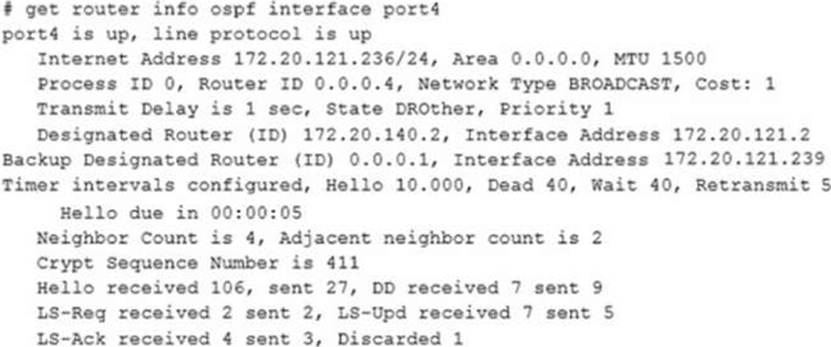
Which of the following statements about the exhibit are true? (Choose two.)
- A . In the network on port4, two OSPF routers are down
- B . Port4 is connected to the OSPF backbone area.
- C . The local FortiGate’s OSPF router ID is 0.0.0.4
- D . The local FortiGate has been elected as the OSPF backup designated router.
Which troubleshooting step is applicable when investigating antivirus and IPS update issues on FortiGate?
- A . Verify outbound ICMP connectivity.
- B . Validate DNS resolution for update.fortiguard.net.
- C . Use the diagnose debug rating command to check active servers.
- D . Use the alternate service port 8888.
A FortiGate device with UTM profiles is reaching the resource limits, and the administrator expects the traffic in the enterprise network to increase.
The administrator has received an additional FortiGate of the same model.
Which two protocols should the administrator use to integrate the additional FortiGate device into this enterprise network? (Choose two.)
- A . FGSP with external load balancers
- B . FGCP in active-active mode and with switches
- C . FGCP in active-passive mode and with VDOM disabled
- D . VRRP with switches
A B
Explanation:
Whenadding an additional FortiGateto an enterprise network that is already reaching itsresource limits, the goal is to distribute traffic efficiently and ensurehigh availability.
FGSP (FortiGate Session Life Support Protocol) with external load balancers
FGSP allowssession-aware load balancingbetween multiple FortiGate units without requiring them to be in an HA (High Availability) cluster.

Withexternal load balancers, incoming traffic isevenly distributedacross multiple FortiGate devices.
This approach is useful forscaling outtraffic handling capacity while ensuring that sessions remainsynchronizedbetween firewalls.
FGSP is effectivewhen stateful failover is requiredbut without the constraints of traditional HA.
FGCP (FortiGate Clustering Protocol) in active-active mode and with switches
FGCPactive-active modeenables multiple FortiGate devices toshare traffic loads, increasing throughput and efficiency.
Active-active mode is suitable forbalancing UTM processingacross multiple FortiGates, making it ideal whenresource limits are a concern.
Usingswitchesensures redundancy and avoids single points of failure in the network.
This mode is commonly used inenterprise networkswhere bothscalability and redundancyare required.
Refer to the exhibit, which shows the output of a web filtering diagnose command.
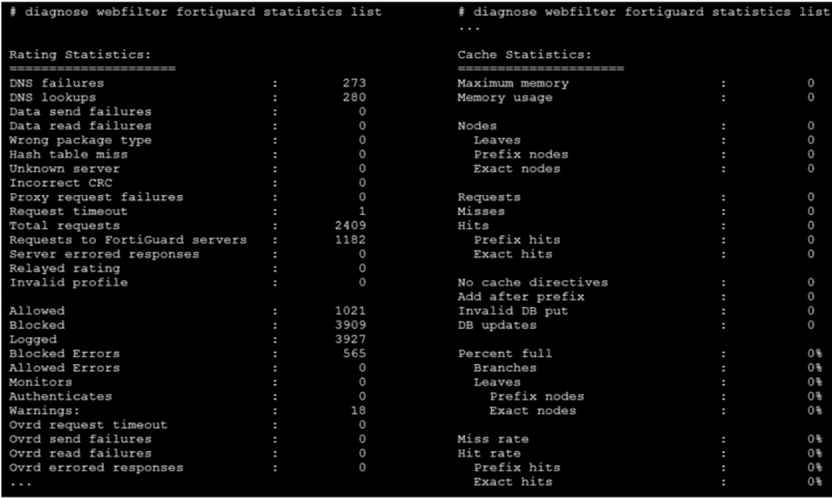
Which configuration change would result in non-zero results in the cache statistics section?
- A . set server-type rating under config system central-management
- B . set webfilter-cache enable under config system fortiguard
- C . set webfilter-force-off disable under config system fortiguard
- D . set ngfw-mode policy-based under config system settings
Refer to the exhibit, which contains the output of diagnose sys session list.
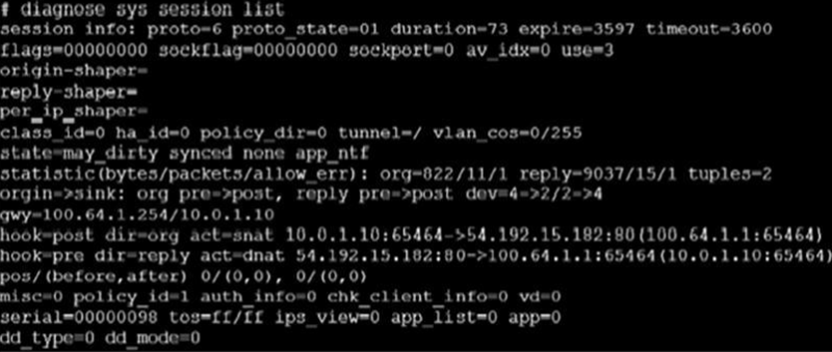
If the HA ID for the primary unit is zero (0), which statement about the output is true?
- A . This session cannot be synced with the slave unit.
- B . The inspection of this session has been offloaded to the slave unit.
- C . The master unit is processing this traffic.
- D . This session is for HA heartbeat traffic.
Refer to the exhibits, which contain the partial configurations of two VPNs on FortiGate.
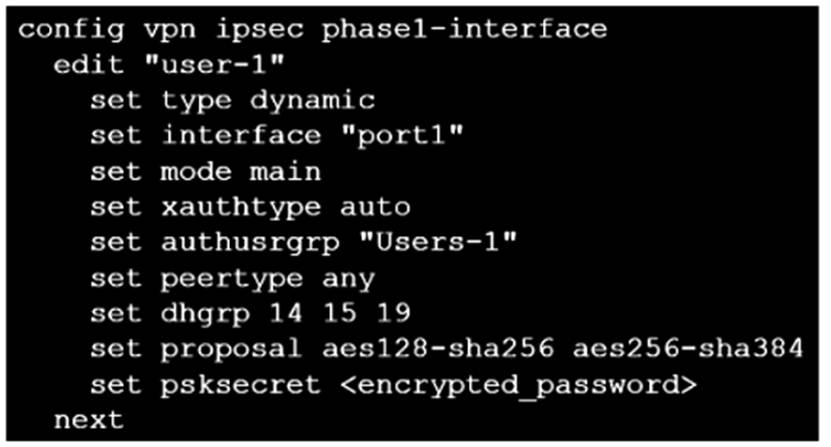
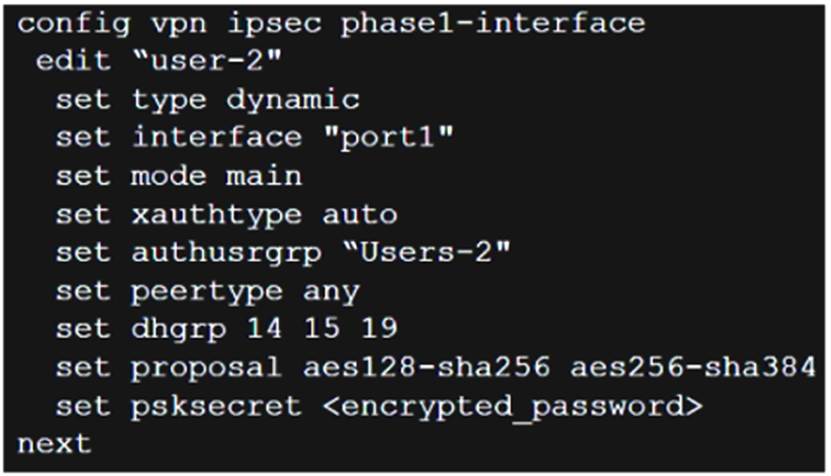
An administrator has configured two VPNs for two different user groups. Users who are in the Users-2 group are not able to connect to the VPN. After running a diagnostics command, the administrator discovered that FortiGate is not matching the user-2 VPN for members of the Users-2 group.
Which two changes must the administrator make to fix the issue? (Choose two.)
- A . Use different pre-shared keys on both VPNs.
- B . Enable XAuth on both VPNs.
- C . Set up specific peer IDs on both VPNs.
- D . Change to aggressive mode on both VPNs.