
Fortinet FCSS_EFW_AD-7.4 Practice Exams
Last updated on Nov 16,2026- Exam Code: FCSS_EFW_AD-7.4
- Exam Name: FCSS - Enterprise Firewall 7.4 Administrator
- Certification Provider: Fortinet
- Latest update: Nov 16,2026
View the exhibit, which contains a session entry, and then answer the question below.
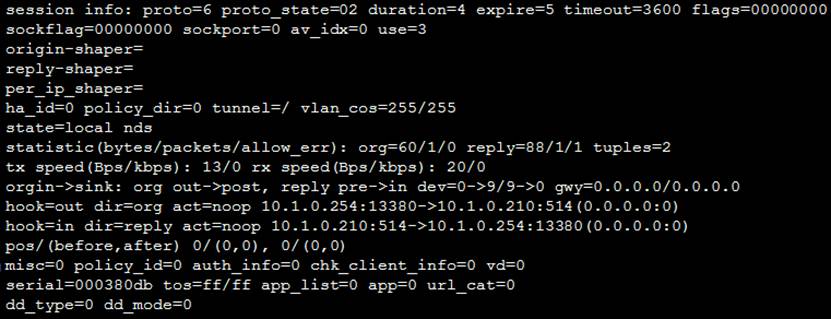
What statements are correct regarding this session? (Choose two.)
- A . It is an UDP session that has seen traffic flow both ways.
- B . It is a TCP session in SYN_SENT state.
- C . This session terminates or originates in the FortiGate device.
- D . This is a TCP session that was blocked by firewall policy ID 0.
Refer to the exhibit, which contains the output of a diagnose command.
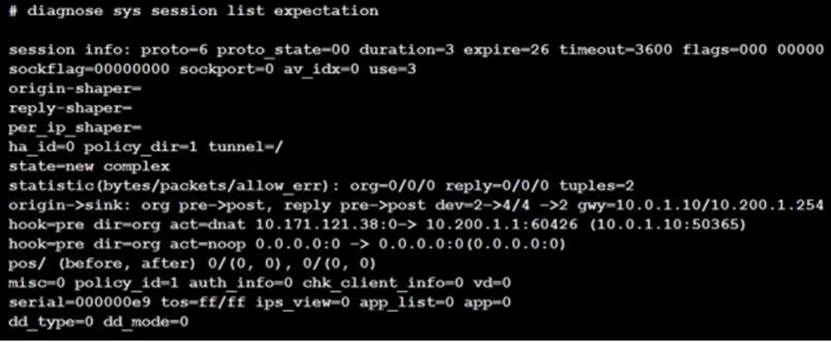
Which two statements about the output are true? (Choose two.)
- A . This is an expected session created by a session helper
- B . This is an expected session created by an application control profile.
- C . Traffic in the original direction (coming from the IP address 10.171.121.38) will be routed to the next-hop IP address 10.0.1.10.
- D . Traffic in the original direction (coming from the IP address 10.171.121.38) will be routed to the next-hop IP address 10.200.1.1.
Which three conditions are required for two FortiGate devices to form an OSPF adjacency? (Choose three.)
- A . OSPF interface network types match.
- B . OSPF router IDs are unique.
- C . OSPF interface priority settings are unique.
- D . Authentication settings match.
- E . OSPF link costs match.
An administrator has decreased all the TCP session timers to optimize the FortiGate memory usage. However, after the changes, one network application started to have problems.
During the troubleshooting, the administrator noticed that the FortiGate deletes the sessions after the clients send the SYN packets, and before the arrival of the SYN/ACKs.
When the SYN/ACK packets arrive to the FortiGate, the unit has already deleted the respective sessions.
Which TCP session timer must be increased to fix this problem?
- A . TCP half open.
- B . TCP half close.
- C . TCP time wait.
- D . TCP session time to live.
Which two conditions would prevent a static route from being added to the routing table? (Choose two.)
- A . There is another other route to the same destination, with a lower distance.
- B . The route has a lower priority value than another route to the same destination.
- C . The next-hop IP address is unreachable.
- D . The interface specified in the route configuration is down
What are two functions of automation stitches? (Choose two.)
- A . Automation stitches can be configured on any FortiGate device in a Security Fabric environment.
- B . An automation stitch configured to execute actions sequentially can take parameters from previous actions as input for the current action.
- C . Automation stitches can be created to run diagnostic commands and attach the results to an email message when CPU or memory usage exceeds specified thresholds.
- D . An automation stitch configured to execute actions in parallel can be set to insert a specific delay between actions.
View the central management configuration shown in the exhibit, and then answer the question below.
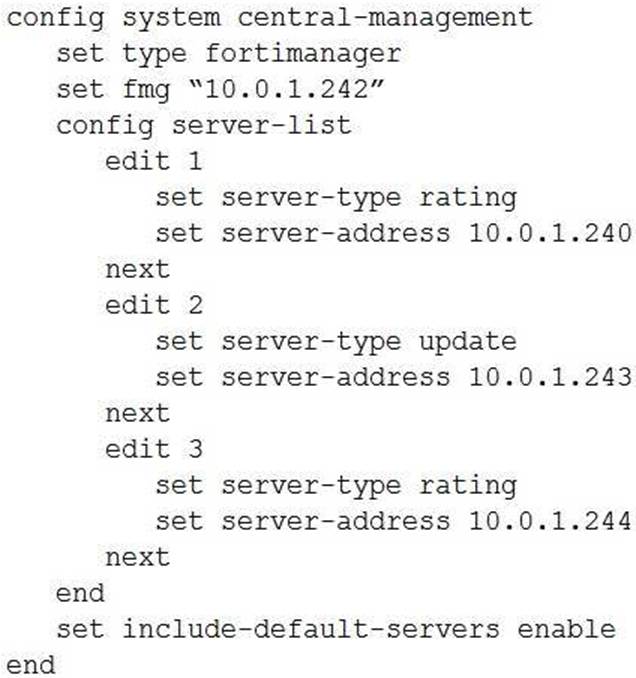
Which server will FortiGate choose for antivirus and IPS updates if 10.0.1.243 is experiencing an outage?
- A . 10.0.1.240
- B . One of the public FortiGuard distribution servers
- C . 0.0.1.244
- D . 10.0.1.242
An administrator wants to capture ESP traffic between two FortiGates using the built-in sniffer. If the administrator knows that there is no NAT device located between both FortiGates,
What command should the administrator execute?
- A . diagnose sniffer packet any ‘udp port 500’
- B . diagnose sniffer packet any ‘udp port 4500’
- C . diagnose sniffer packet any ‘esp’
- D . diagnose sniffer packet any ‘udp port 500 or udp port 4500’
Refer to the exhibits, which contain configuration on FortiGate and partial session information.
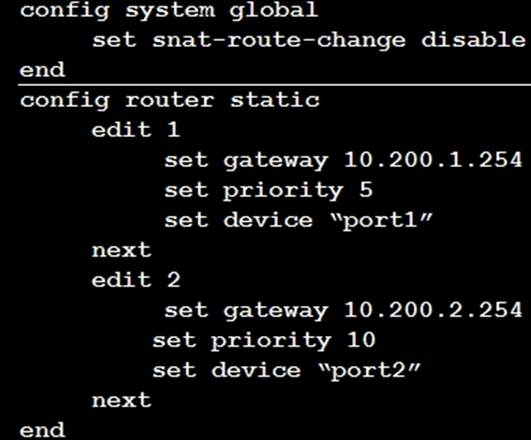
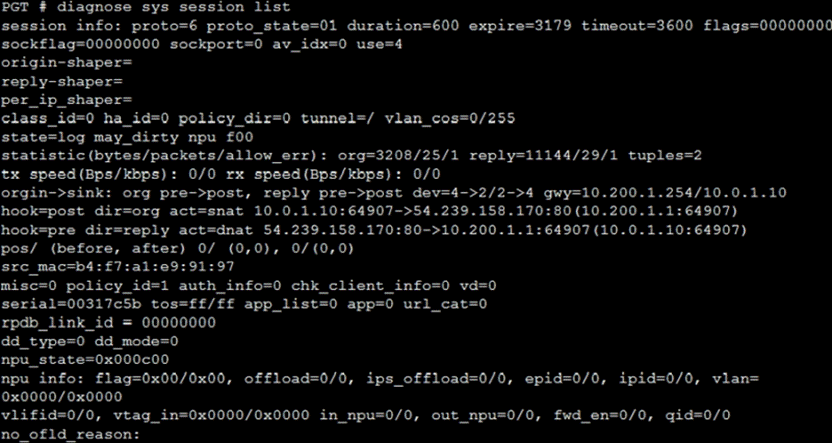
All traffic to the Internet currently egresses from port1. The exhibit shows partial session information for Internet traffic from a user on the internal network.
If the priority on route ID 1 were changed from 5 to 20, what would happen to traffic matching that user’s session?
- A . The session would remain in the session table, but its traffic would now egress from both port1 and port2.
- B . The session would remain in the session table, and its traffic would still egress from port1.
- C . The session would remain in the session table, and its traffic would start to egress from port2.
The session would be deleted, so the client would need to start a new session.