
Fortinet FCSS_EFW_AD-7.4 Practice Exams
Last updated on Nov 16,2026- Exam Code: FCSS_EFW_AD-7.4
- Exam Name: FCSS - Enterprise Firewall 7.4 Administrator
- Certification Provider: Fortinet
- Latest update: Nov 16,2026
View the exhibit, which contains the output of a debug command, and then answer the question below.
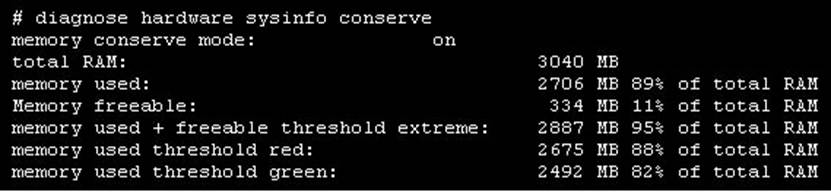
Which one of the following statements about this FortiGate is correct?
- A . It is currently in system conserve mode because of high CPU usage.
- B . It is currently in proxy conserve mode because of high memory usage.
- C . It is currently in memory conserve mode because of high memory usage.
- D . It is currently in extreme conserve mode because of high memory usage.
Which two statements about IKEv2 are true if an administrator decides to implement IKEv2 in the VPN topology? (Choose two.)
- A . It includes stronger Diffie-Hellman (DH) groups, such as Elliptic Curve (ECP) groups.
- B . It supports interoperability with devices using IKEv1.
- C . It exchanges a minimum of two messages to establish a secure tunnel.
- D . It supports the extensible authentication protocol (EAP).
A D
Explanation:
IKEv2 (Internet Key Exchange version 2) is an improvement over IKEv1, offering enhanced security, efficiency, and flexibility in VPN configurations.
It includes stronger Diffie-Hellman (DH) groups, such as Elliptic Curve (ECP) groups.
IKEv2 supports stronger cryptographic algorithms, includingElliptic Curve Diffie-Hellman (ECDH) groups such asECP256 and ECP384, providing improved security compared to IKEv1.
It supports the extensible authentication protocol (EAP).
IKEv2 natively supports EAP authentication, which allows integration with external authentication mechanisms such asRADIUS, certificates, and smart cards. This is particularly useful forremote access VPNswhere user authentication must be flexible and secure.
An administrator needs to install an IPS profile without triggering false positives that can impact applications and cause problems with the user’s normal traffic flow.
Which action can the administrator take to prevent false positives on IPS analysis?
- A . Use the IPS profile extension to select an operating system, protocol, and application for all the network internal services and users to prevent false positives.
- B . Enable Scan Outgoing Connections to avoid clickingsuspicious links or attachments that can deliver botnet malware and create false positives.
- C . Use an IPS profile with action monitor, however, the administrator must be aware that this can compromise network integrity.
- D . Install missingor expired SSUTLS certificates on the client PC to prevent expected false positives.
A
Explanation:
False positives inIntrusion Prevention System (IPS)analysis can disrupt legitimate traffic and negatively impact user experience. To reduce false positives while maintaining security, administrators can:
#Use IPS profile extensions to fine-tune the settings based on the organization’s environment.
#Select the correct operating system, protocol, and application typesto ensure that IPS signatures match the network’s actual traffic patterns, reducing false positives.
#Customize signature selectionbased on the network’s specific services, filtering out unnecessary or irrelevant signatures.
Refer to the exhibit, which shows theADVPNIPsec interface representing the VPN IPsec phase 1 from Hub A to Spoke 1 and Spoke 2, and from Hub # to Spoke 3 and Spoke 4.
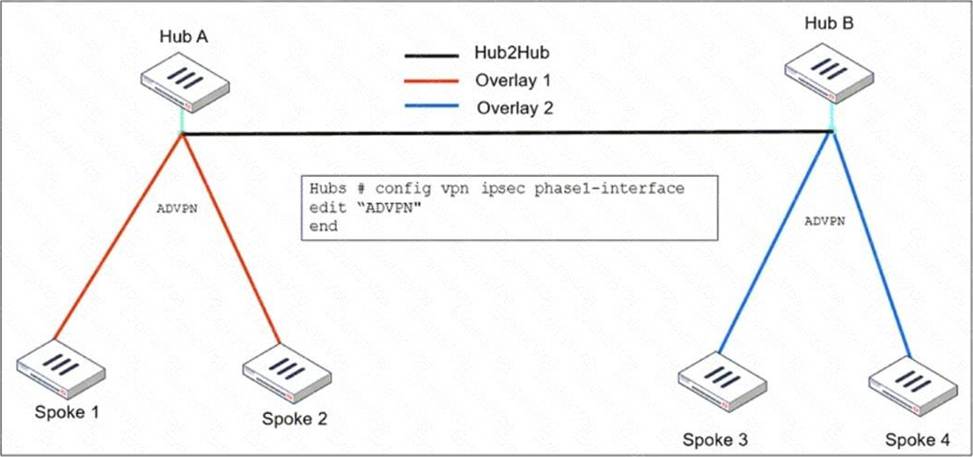
An administrator must configure an ADVPN using IBGP and EBGP to connect overlay network 1 with 2.
What must the administrator configure in the phase 1 VPN IPsec configuration of theADVPNtunnels?
- A . set auto-discovery-sender enable and set network-id x
- B . set auto-discovery-forwarder enable and set remote-as x
- C . set auto-discovery-crossover enable and set enforce-multihop enable
- D . set auto-discovery-receiver enable and set npu-offload enable
C
Explanation:
When configuringADVPN (Auto-Discovery VPN)to connectoverlay networks across different hubs using IBGP and EBGP, special configurations are required to allow spokes from different overlay networks to dynamically establish tunnels.
#set auto-discovery-crossover enable
# Thisallows cross-hub tunnel discoveryin an ADVPN deployment where multiple hubs are used.
# SinceHub A and Hub Bbelong to different overlays, enablingcrossover discoveryensures that spokes from one overlay can dynamically create direct tunnels to spokes in the other overlay when needed.
#set enforce-multihop enable
# This setting ensures thatBGP peers using loopback interfacescan establish connectivityeven if they are not directly connected.
#Multihop BGP sessionsare required when usingloopback addresses as BGP peer sourcesbecause the connection might need to traverse multiple routers before reaching the BGP neighbor.
# This is especially useful inADVPN deployments with multiple hubs, where routes might need to cross from one hub to another.
Examine the following traffic log; then answer the question below.
date-20xx-02-01 time=19:52:01 devname=masterdevice_id="xxxxxxx" log_id=0100020007 type=event subtype=system pri critical vd=root service=kemel status=failure msg="NAT port is exhausted."
What does the log mean?
- A . There is not enough available memory in the system to create a new entry in the NAT port table.
- B . The limit for the maximum number of simultaneous sessions sharing the same NAT port has been reached.
- C . FortiGate does not have any available NAT port for a new connection.
- D . The limit for the maximum number of entries in the NAT port table has been reached.
Which two tasks are automated using the Import Configuration wizard on FortiManager? (Choose two.)
- A . Importing firewall address objects from managed devices
- B . Importing interface mappings from managed devices
- C . Importing static and dynamic route configurations from managed devices
- D . Importing devices to FortiManager
Examine the partial output from two web filter debug commands; then answer the question below:
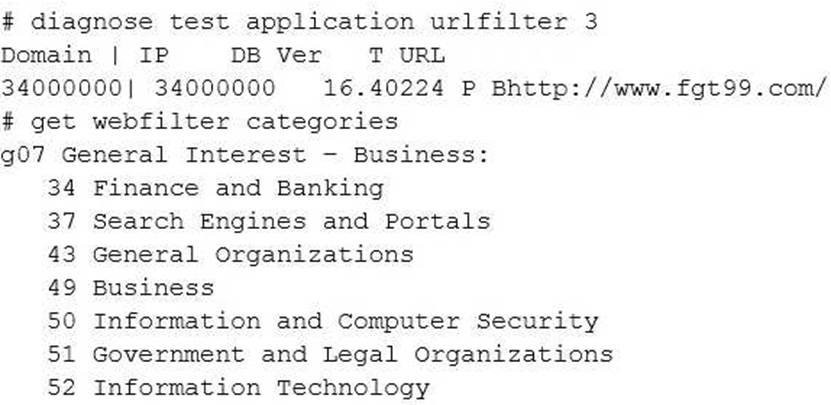
Based on the above outputs, which is the FortiGuard web filter category for the web site www.fgt99.com?
- A . Finance and banking
- B . General organization.
- C . Business.
- D . Information technology.
View the following exhibit:
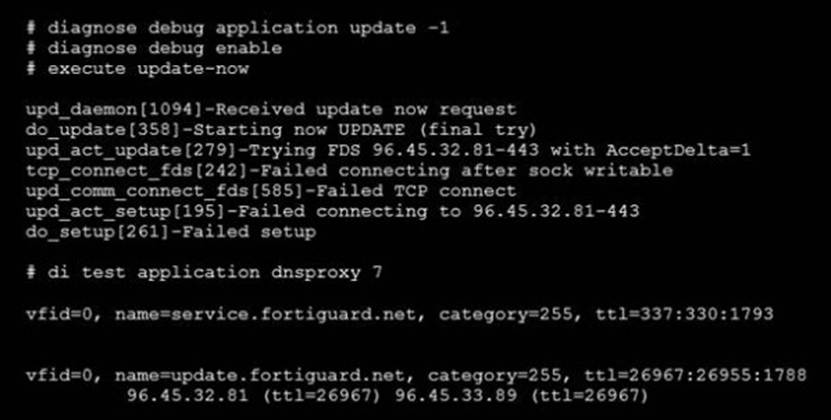
Given the output showing a real-time debug, which statement describes why the update is failing?
- A . FortiGate is unable to establish a TCP connection with FDS.
- B . FortiGate is unable to resolve the required FQDN (service.fortiguard.net) for AV and IPS updates.
- C . The administrator should use the execute update-wf command instead.
- D . The update should be using port 53 or port 8888, instead of port 443.
Refer to the exhibit, which contains the debug output of diagnose dvm device list.

Which two statements about the output shown in the exhibit are correct? (Choose two.)
- A . ADOMs are disabled on the FortiManager
- B . The FortiGate configuration is in sync with latest running revision history.
- C . There are pending device-level changes yet to be installed on Local-FortiGate.
- D . The policy package has been modified for Local-FortiGate.
An administrator configured FGSP cluster members to encrypt the session synchronization. When the administrator takes a sniffer trace on the dedicated interface for the synchronization, the sniffer trace shows UDP packets only.
Which two reasons could cause the sniffer to capture only UDP packets? (Choose two.)
- A . The administration has not configured the SESSYNC_1 tunnel.
- B . encryption is not set to enable on both members.
- C . The psksecret value does not match.
- D . The encryption is encapsulated in UDP packets.