
Fortinet FCSS_EFW_AD-7.4 Practice Exams
Last updated on Nov 16,2026- Exam Code: FCSS_EFW_AD-7.4
- Exam Name: FCSS - Enterprise Firewall 7.4 Administrator
- Certification Provider: Fortinet
- Latest update: Nov 16,2026
Refer to the exhibits, which show the configuration on FortiGate and partial internet session information from a user on the internal network.
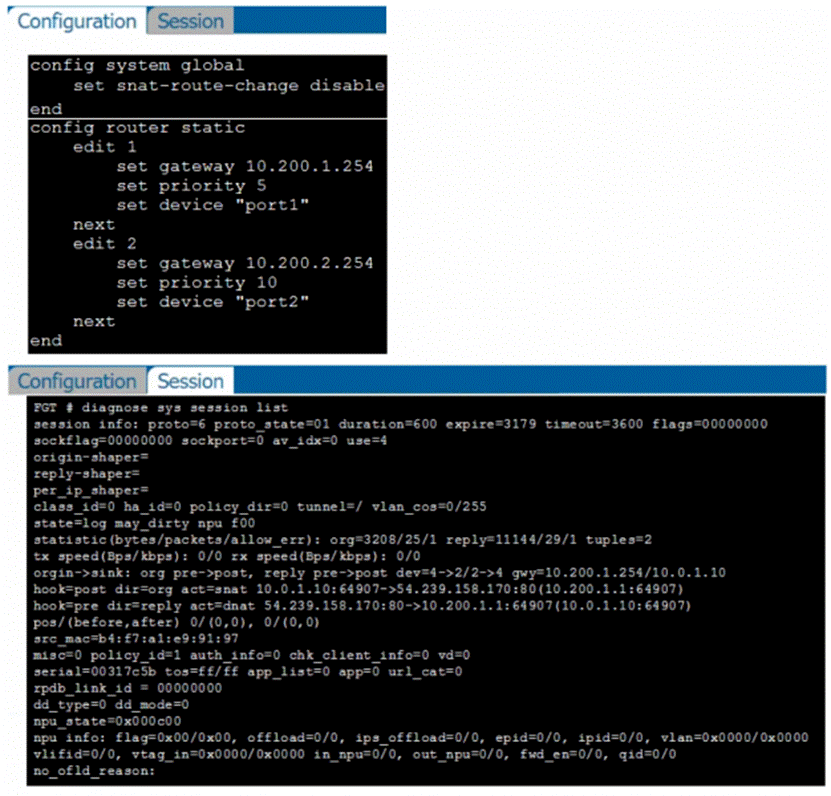
An administrator would like to test session failover between the two service provider connections.
What changes must the administrator make to force this existing session to immediately start using the other interface? (Choose two.)
- A . Configure set snat-route-change enable.
- B . Change the priority of the port2 static route to 5.
- C . Change the priority of the port1 static route to 11.
- D . unset snat-route-change to return it to the default setting.
Which of the following statements are correct regarding application layer test commands? (Choose two.)
- A . They are used to filter real-time debugs.
- B . They display real-time application debugs.
- C . Some of them display statistics and configuration information about a feature or process.
- D . Some of them can be used to restart an application.
Refer to the exhibit, which contains partial outputs from two routing debug commands.
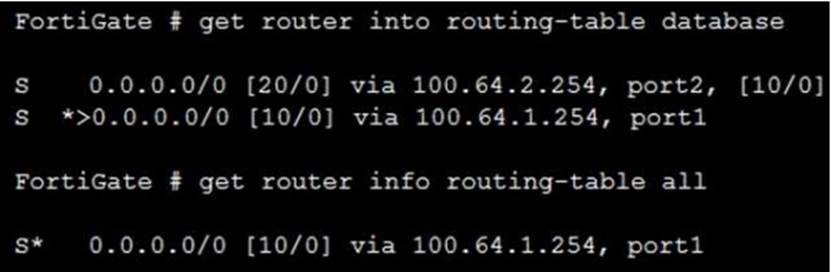
Why is the port2 default route not in the second command’s output?
- A . It has a lower priority value that the default route using port1.
- B . It has a higher priority value than the default route using port1.
- C . It is disabled in the FortiGate configuration.
- D . It has a higher distance than the default route using port1.
Refer to the exhibit, which shows the output of a diagnose command
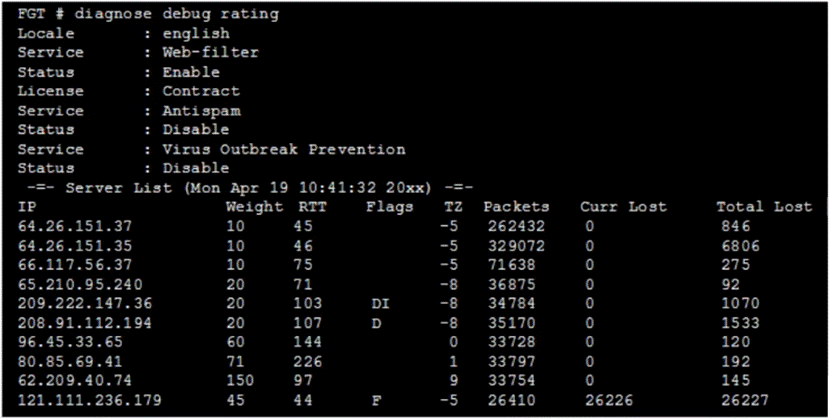
What can you conclude from the RTT value?
- A . Its value is incremented with each packet lost.
- B . Its initial value is statically set to 10.
- C . It determines which FortiGuard server is used for license validation.
- D . Its value represents the time it takes to receive a response after a rating request is sent to a particular server.
An administrator is setting up an ADVPN configuration and wants to ensure that peer IDs are not exposed during VPN establishment.
Which protocol can the administrator use to enhance security?
- A . Use IKEv2, which encrypts peer IDs and prevents exposure.
- B . Opt for SSL VPN web mode because it does not use peer IDs at all.
- C . Choose IKEv1 aggressive mode because it simplifies peer identification.
- D . Stick with IKEv1 main mode because it offers better performance.
A
Explanation:
InADVPN (Auto-Discovery VPN) configurations, security concerns includeprotecting peer IDsduring VPN establishment. Peer IDs are exchanged in theIKE (Internet Key Exchange) negotiation phase, and their exposure could lead toprivacy risks or targeted attacks.
#IKEv2 encrypts peer IDs, making itmore securecompared to IKEv1, where peer IDs can beexposed in plaintextin aggressive mode.
#IKEv2 also provides better performance and flexibilitywhile supporting dynamic tunnel establishment in ADVPN.
An administrator is setting up an ADVPN configuration and wants to ensure that peer IDs are not exposed during VPN establishment.
Which protocol can the administrator use to enhance security?
- A . Use IKEv2, which encrypts peer IDs and prevents exposure.
- B . Opt for SSL VPN web mode because it does not use peer IDs at all.
- C . Choose IKEv1 aggressive mode because it simplifies peer identification.
- D . Stick with IKEv1 main mode because it offers better performance.
A
Explanation:
InADVPN (Auto-Discovery VPN) configurations, security concerns includeprotecting peer IDsduring VPN establishment. Peer IDs are exchanged in theIKE (Internet Key Exchange) negotiation phase, and their exposure could lead toprivacy risks or targeted attacks.
#IKEv2 encrypts peer IDs, making itmore securecompared to IKEv1, where peer IDs can beexposed in plaintextin aggressive mode.
#IKEv2 also provides better performance and flexibilitywhile supporting dynamic tunnel establishment in ADVPN.
What does DHCP snooping MAC verification do?
- A . Drops DHCP release packets on untrusted ports
- B . Drops DHCP packets with no relay agent information (option 82) on untrusted ports
- C . Drops DHCP offer packets on untrusted ports
- D . Drops DHCP packets on untrusted ports when the client hardware address does not match the source MAC
Refer to the exhibit, which shows an ADVPN network
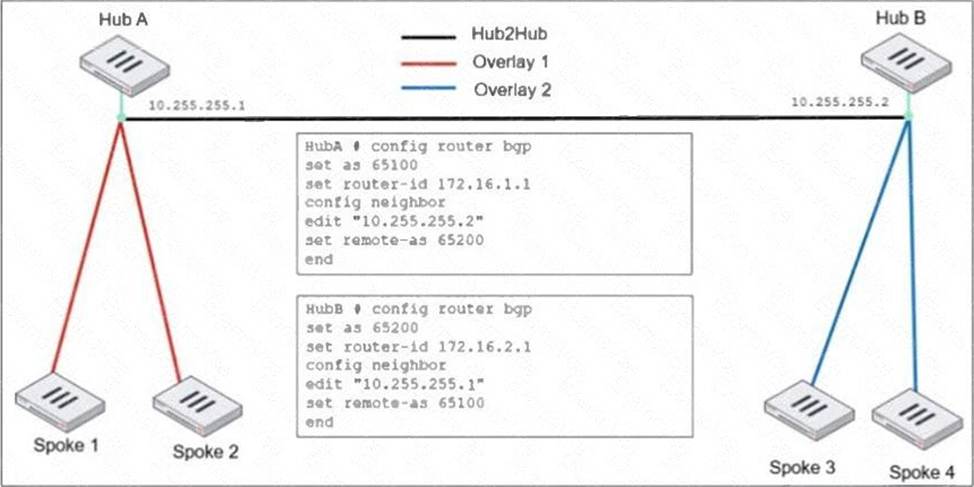
An administrator must configure an ADVPN using IBGP and EBGP to connect overlay network 1 with 2.
What two options must the administrator configure in BGP? (Choose two.)
- A . set ebgp-enforce-multrhop enable
- B . set next-hop-self enable
- C . set ibgp-enforce-multihop advpn
- D . set attribute-unchanged next-hop
A B
Explanation:
In thisADVPN (Auto-Discovery VPN) network, there are two hubs (Hub A and Hub B) connected via EBGP, whileIBGPis used within each overlay. To ensure proper BGP routing between the overlays, the administrator must configure specific BGP options..
set ebgp-enforce-multihop enable
By default, EBGP requires directly connected neighbors. Since Hub A and Hub B are not directly connected but reach each other over an IPsec tunnel, multihop must be enabled for EBGP sessions to work.
set next-hop-self enable
In IBGP, the next-hop attribute does not change by default. When an IBGP route is advertised from a spoke to another hub or spoke, the next-hop needs to be updated to ensure proper reachability. Enabling next-hop-self forces the BGP speaker to advertise itself as the next-hop, ensuring that all spokes properly reach routes across the overlays.
What does hyperscale capability in data center firewalls typically support?
- A . Application layer operations such as intrusion prevention
- B . Network speeds ranging from 10 Gbps to 1000 Gbps
- C . Enhanced encryption and decryption processes only
- D . Bundling of multiple physical interfaces for a single logical interface
The IT department discovered during the last network migration that all zero phase selectors in phase 2 IPsec configurations impacted network operations.
What are two valid approaches to prevent this during future migrations? (Choose two.)
- A . Use routing protocols to specify allowed subnets over the tunnel.
- B . Configure an IPsec-aggregate to create redundancy between each firewall peer.
- C . Clearly indicate to the VPN which segments will be encrypted in the phase two selectors.
- D . Configure an IP address on the IPsec interface of each firewall to establish unique peer connections and avoid impacting network operations.
A C
Explanation:
Zero phase selectors inIPsec Phase 2mean thatno specific traffic selectors (subnets) are defined, allowing any traffic to be encryptedthrough the VPN tunnel. This can causeunintended traffic forwarding issues and disrupt network operations.
To prevent this from happening during future migrations:
#Using routing protocolsensures thatonly specific subnets are advertised over the tunnel. Dynamic routing (such as OSPF or BGP) helps define which networks should use the tunnel, preventing unintended traffic from being encrypted.
#Clearly defining phase 2 selectorsavoids the problem of encrypting all traffic byexplicitly stating the allowed source and destination subnets. This prevents the tunnel from affecting unrelated network traffic.