
DELL EMC D-VXB-DY-A-24 Practice Exams
Last updated on Oct 22,2026- Exam Code: D-VXB-DY-A-24
- Exam Name: Dell VxBlock Deploy Achievement
- Certification Provider: DELL EMC
- Latest update: Oct 22,2026
What is a primary use of the RCM Assessment Workbook?
- A . Collect the health report of all VxBlock remediation components
- B . Create the upgrade plan for the ToR switch only
- C . Identify items and components that require remediation
- D . Create the upgrade plan for Compute only
C
Explanation:
Review the RCM Assessment Workbook: The RCM (Release Certification Matrix) Assessment Workbook is a tool used during the upgrade process of VxBlock systems1.
Understand the Workbook’s Purpose: Its primary use is to identify items and components within the VxBlock system that require remediation before an upgrade can be performed1.
Utilize the Workbook: By using the RCM Assessment Workbook, engineers can systematically review the current state of the system and pinpoint areas that need attention1.
Ensure Compliance: This step is crucial to ensure that all components meet the necessary standards and are compatible with the new RCM version1.
Which statement about the differences between Cisco ACI and VMware NSX is NOT correct?
- A . NSX supports both x86 and non-x86 servers; ACI does not
- B . NSX requires a gateway for the physical environment; ACI works the same for physical and virtual environments
- C . NSX is hardware independent; ACI is hardware dependent
- D . NSX is network topology independent; ACI supports only spine-leaf architecture
A
Explanation:
Review the Core Differences: Both Cisco ACI and VMware NSX have similar qualities and features. The main difference is that VMware NSX focuses on virtualized networks, while Cisco ACI can connect to both physical and virtual networks1.
Identify Incorrect Statement: The statement that NSX supports both x86 and non-x86 servers; ACI does not is not correct. Cisco ACI is not limited to x86 servers and can work with a variety of hardware platforms1.
Understand ACI’s Capabilities: Cisco ACI is an integrated solution that addresses both the physical and virtual networks, providing a policy-driven framework that is not limited by server architecture1. Validate with Documentation: The Official Dell VxBlock Deploy Achievement document would align with this understanding, as it would detail the capabilities of Cisco ACI in working with different network and server environments1.
A standard virtual switch is deployed on an ESXi host. Four virtual machines are connected to the vSwitch, which has no uplink ports configured.
Which statement is accurate about network connectivity between the VMs?
- A . All VMs can communicate, but only with one another.
- B . VMs can only communicate with one another if virtual guest tagging is used.
- C . No communication is possible between VMs.
- D . VMs can communicate to outside networks if CDP is being used.
A
Explanation:
Understand vSwitch Functionality: A standard virtual switch (vSwitch) operates at the data link layer of the OSI model to connect virtual machines on the same ESXi host2.
Recognize vSwitch without Uplinks: When a vSwitch has no uplink ports configured, it cannot communicate with external networks, but it can still facilitate communication between VMs connected to it1.
Identify VM Communication: The VMs connected to the vSwitch without uplinks can communicate with each other, as the vSwitch can bridge traffic internally between VMs on the same VLAN2. Exclude External Communication: Without uplinks, the VMs cannot communicate with outside networks, regardless of whether Cisco Discovery Protocol (CDP) is used2.
Which document contains all software baseline information post-RCM upgrade?
- A . LCS
- B . MSP
- C . SCR
- D . Assessment Workbook
A
Explanation:
The LCS (Logical Configuration Survey) document contains all software baseline information post-RCM upgrade. It details the current configuration of the system, including software versions and settings, which are critical for maintaining system integrity and for future reference during support and maintenance activities.
Reference: Dell EMC documentation on VxBlock systems.
Best practices for configuration management and documentation.
DRAG DROP
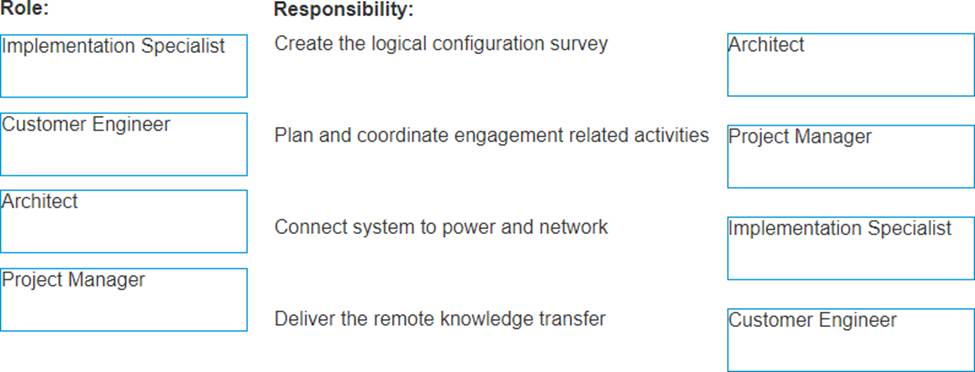
Match each role to its responsibility.
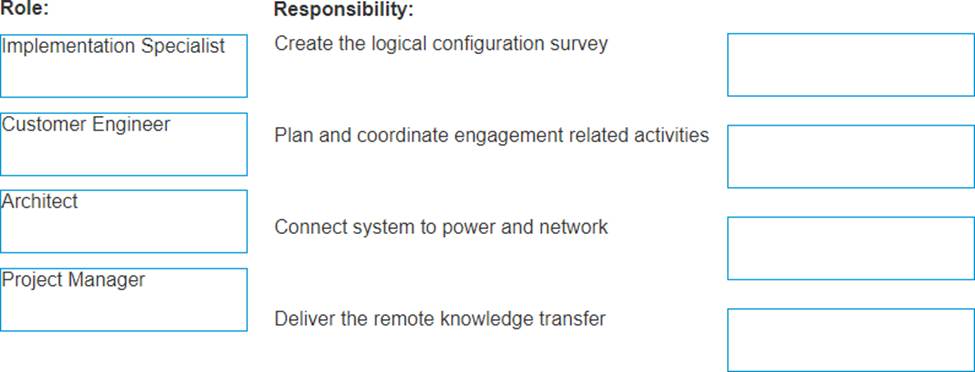
Explanation:
Based on the Dell VxBlock Deploy Achievement document, the roles and their responsibilities are matched as follows:
Implementation Specialist: Connect system to power and network1.
Architect: Create the logical configuration survey1.
Customer Engineer: Deliver the remote knowledge transfer1.
Project Manager: Plan and coordinate engagement related activities1.
Implementation Specialist: This role is typically responsible for the physical aspects of the deployment, such as connecting the system to power sources and the network1.
Architect: The Architect’s responsibility includes designing and creating surveys that capture the logical configuration of the system1.
Customer Engineer: This role often involves interfacing with the customer and providing knowledge transfer to ensure they understand the system1.
Project Manager: The Project Manager oversees the project, planning, and coordinating all activities related to the engagement1.
Who is responsible for raising the Internal Assessment (IA) during an RCM upgrade?
- A . RCM Lead
- B . Project Manager
- C . Implementation Specialist
- D . District Manager
A
Explanation:
Review the RCM Upgrade Process: The RCM (Release Certification Matrix) upgrade process involves a series of steps to ensure that the VxBlock system is updated according to Dell EMC’s standards1. Identify the Role of the RCM Lead: The RCM Lead is typically responsible for overseeing the RCM upgrade process, which includes raising the Internal Assessment (IA) to ensure that all components are compliant with the latest RCM standards1.
Understand the Importance of IA: The Internal Assessment is a critical part of the RCM upgrade process. It helps identify any potential issues that might affect the upgrade and ensures that the system is ready for the new RCM1.
Acknowledge the Responsibilities: While the Project Manager, Implementation Specialist, and District Manager may have roles in the RCM upgrade process, it is the RCM Lead who is specifically responsible for raising the IA as part of their duties1.
How are policies applied within an ACI fabric?
- A . Between two or more EPGs; all EPGs can be either unidirectional or bidirectional
- B . Between two or more EPGs; all EPGs must be bidirectional
- C . Between only two EPGs; both EPGs can be either unidirectional or bidirectional
- D . Between only two EPGs; both EPGs must be unidirectional
A
Explanation:
Understand ACI Fabric: ACI fabric policies are applied to manage and control the network traffic within the fabric1.
Identify Policy Application: Policies in ACI are applied between Endpoint Groups (EPGs), which are collections of network endpoints with common policy requirements1.
Recognize Policy Direction: These policies can be applied in a unidirectional or bidirectional manner, providing flexibility in controlling the flow of traffic between EPGs1.
Reference Official Documentation: The Official Dell VxBlock Deploy Achievement document would align with Cisco’s guidelines on ACI fabric policies, which state that policies can be applied between two or more EPGs and can be either unidirectional or bidirectional1.
A System Engineer has completed a VxBlock 1000 system installation.
What needs to be validated?
- A . Storage processors are online and operational
- B . Network switches are installed as per the Build Guide
- C . Management hosts are installed as per the Build guide
- D . Configuration of network, storage, compute, and virtualization
D
Explanation:
Review VxBlock 1000 Installation: After completing the installation of a VxBlock 1000 system, it is crucial to validate the entire configuration to ensure all components are correctly set up and operational1.
Validate Configuration: This includes checking the network setup, ensuring storage processors are online, verifying that management hosts are installed correctly, and confirming that the compute and virtualization layers are configured as per the design specifications1.
Use Validation Tools: The Logical Configuration Survey (LCS) and Test Plan are typically used to validate a VxBlock 1000 installation, ensuring that all system elements are pre-integrated, pre-configured, and tested before being put into operation1.
Ensure System Readiness: The validation process is essential to confirm that the system is ready for production use and that any potential issues are addressed before the system is handed over to the
customer1.
What is a required step when creating an NSX logical switch?
- A . Create a new name for the logical switch
- B . Change the default transport zone
- C . Choose Unicast or Multicast replication mode
- D . Choose Enable IP Discovery or Enable MAC Learning
A
Explanation:
When creating an NSX logical switch, a required step is to create a new name for the logical switch. Naming the logical switch is necessary to identify and manage it within the NSX environment.
Reference: VMware NSX documentation on creating logical switches.
Best practices for network virtualization.
Which file system architecture is used on Isilon storage to deliver increased performance for file-based data applications and workflows?
- A . Distributed
- B . Single
- C . Multiple
- D . Hybrid
A
Explanation:
Understand Isilon Storage: Isilon storage systems are designed to provide a scalable solution for file-based data applications and workflows1.
Identify the File System Architecture: The Isilon storage uses a single volume, single namespace, single file system architecture known as OneFS. This architecture is inherently distributed, allowing for easy scaling from tens of terabytes to tens of petabytes1.
Recognize the Benefits of a Distributed Architecture: The distributed nature of the OneFS file system architecture allows Isilon storage systems to deliver increased performance and scalability, which is essential for handling large volumes of file-based data1.
Map to VxBlock 1000: In the context of the VxBlock 1000, the Isilon storage with its distributed file system architecture integrates with the converged infrastructure to support high-performance workloads and efficient data management2.