
DELL EMC D-VXB-DY-A-24 Practice Exams
Last updated on Oct 21,2026- Exam Code: D-VXB-DY-A-24
- Exam Name: Dell VxBlock Deploy Achievement
- Certification Provider: DELL EMC
- Latest update: Oct 21,2026
A VxBlock 1000 system is being deployed at a customer site. The system is equipped with a Nexus 93180YC aggregation switch to support routing features. A Juniper switch is used at the customer site as the core switch. The customer intends to run a dynamic routing protocol between the Nexus and Juniper switches.
Which routing protocol is recommended?
- A . EIGRP
- B . IGMP
- C . IGRP
- D . OSPF
D
Explanation:
Review the VxBlock and Nexus Documentation: The VxBlock 1000 system documentation and the Nexus 93180YC switch documentation should be reviewed to understand the supported routing protocols1.
Consider the Juniper Switch Capabilities: Since the customer is using a Juniper switch as the core switch, it’s important to consider the routing protocols supported by Juniper switches. Juniper switches support a variety of routing protocols, including OSPF2.
Evaluate Routing Protocol Options: EIGRP is typically Cisco proprietary and not supported on Juniper devices. IGMP is not a routing protocol but a multicast management protocol. IGRP is an older Cisco proprietary routing protocol and is less commonly used today2.
Recommend OSPF: OSPF (Open Shortest Path First) is a widely supported, robust, and scalable dynamic routing protocol that is suitable for diverse environments, including mixed vendor setups like Cisco’s Nexus and Juniper switches2.
Validate with Best Practices: Best practices and recommendations from both Cisco and Juniper suggest using OSPF for dynamic routing between devices from different vendors2.
Which data layout technique is used on an Isilon cluster?
- A . Parity Correction Error (PCR)
- B . Backward Correction Error (BCR)
- C . Error Correction Code (ECC)
- D . Forward Correction Error (FEC)
D
Explanation:
The data layout technique used on an Isilon cluster is Forward Correction Error (FEC). This method ensures data integrity and availability by distributing error correction information across the nodes in the cluster, allowing for data recovery in the event of hardware failures.
Reference: Dell EMC Isilon OneFS technical documentation.
Information on data protection techniques in distributed storage systems.
What is a benefit of Software Defined Networking?
- A . Simplifies licensing requirements
- B . Increases network-provisioning time
- C . Improves network management efficiency
- D . Reduces the amount of hardware required for the solution
C
Explanation:
Understand SDN: Software Defined Networking (SDN) is a transformative approach to network management that allows for centralized control and dynamic resource management1. Identify Key Benefits: One of the primary benefits of SDN is the improvement in network management efficiency. By centralizing control, SDN simplifies the management of network resources and services1.
Recognize Efficiency Gains: With SDN, network administrators can quickly respond to changing network conditions and demands without the need for manual configuration of individual network devices1.
Reference Industry Insights: The improvement in network management efficiency is a widely recognized benefit of SDN, as it enables more agile and responsive network operations1.
Which three layers of traditional storage architecture form an Isilon OneFS?
- A . FileSystem, DataManager, VolumeManager
- B . FileSystem, VolumeManager, RAID
- C . FileSystem, DataManager, RAID
- D . FileSystem, NetworkSystem, VolumeManager
A
Explanation:
The Isilon OneFS operating system integrates the traditional storage architecture layers of FileSystem, DataManager, and VolumeManager. This integration simplifies management and improves performance by combining file system, data management, and volume management functions into a single layer.
Reference: Dell EMC Isilon OneFS documentation.
Technical guides on Isilon architecture and features.
A VxBlock 1000 system engineer is powering on Advanced Management Pod components.
If AMP-VX is used, what is the first component to be powered on?
- A . VMware VCSA
- B . Primary PSC
- C . AMP physical server
- D . Vision Core VM
C
Explanation:
In a VxBlock 1000 system using AMP-VX, the first component to be powered on is the AMP physical server. This server hosts the management and orchestration tools required to manage the VxBlock system. Ensuring that the AMP physical server is powered on first provides the necessary foundation for other components and services to be initialized and managed properly.
Reference: Dell EMC VxBlock System installation and power-on procedures.
AMP-VX deployment and configuration guides.
Which document provides a representation of all the connections on the recently upgraded switch?
- A . Port Map
- B . Switch Administration Guide
- C . Solutions Abstract
- D . Switch Release Notes
A
Explanation:
Identify the Correct Document: The Port Map is typically used to provide a visual representation of all the connections on a network switch, including those that have been recently upgraded1.
Understand the Purpose of a Port Map: A Port Map is a detailed diagram that shows the physical and logical connections to and from a network switch. It is an essential tool for network administrators to visualize the network topology and troubleshoot connectivity issues1.
Utilize the Port Map: After an upgrade, the Port Map can be referenced to verify that all connections have been correctly re-established and that the switch is functioning as expected within the network infrastructure1.
What is the main advantage of separating the network control plane from the data plane in a Software Defined Network?
- A . Rapid provisioning and decommissioning of network devices and resources
- B . Reduces the complexity of human intervention and potential errors
- C . Addresses security concerns and management complexity
- D . Programmatic control over both physical and virtual network devices
D
Explanation:
Understand SDN Architecture: In a Software Defined Network (SDN), separating the control plane from the data plane allows for centralized management of the network1.
Recognize the Control Plane’s Role: The control plane is responsible for making decisions about where traffic is sent, while the data plane moves packets from place to place1.
Identify the Advantage: The main advantage of this separation is the ability to programmatically control both physical and virtual network devices, which enables more flexible and dynamic network management1.
Apply SDN Benefits: This programmatic control facilitates rapid changes to network configurations, policies, and security, which can be applied consistently across the entire network1.
Reference Official Documentation: The Official Dell VxBlock Deploy Achievement document outlines
the benefits of SDN, including the programmatic control that comes with separating the control and data planes1.
Refer to the exhibit.
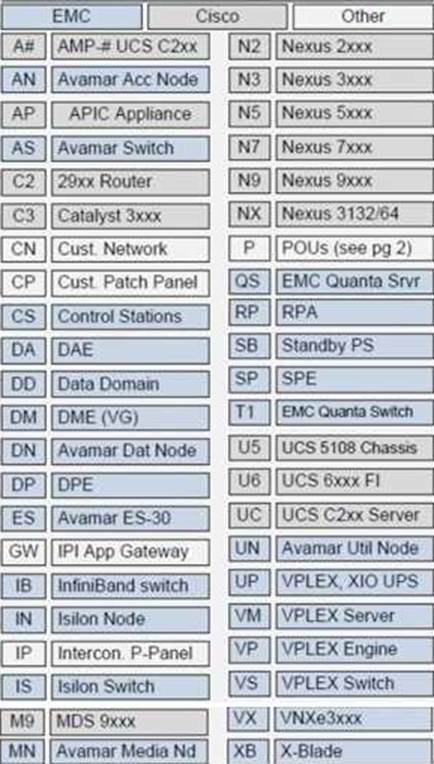
A cable with the following label was connected to the wrong equipment type:
* M91A-01:01 U61A-01:09
Based on the exhibit, what is the target equipment type?
- A . Nexus 9xxx, Slot A, Port1
- B . UCS 5108 Chasses A, Slot 1, Port 9
- C . MDS 9xxx, Slot 1, Port 1
- D . UCS 6xxx FI, Uplink A, Slot 1, port 9
C
Explanation:
The label on the cable indicates two parts: “M91A-01:01” and “U61A-01:09”. The first part of the label “M91A” refers to a specific type of equipment as per the exhibit. According to the exhibit, “M9” corresponds to “MDS 9xxx”, which is a Cisco Multilayer Director Switch. The second part of the label, “U61A”, does not directly match any category in the provided list; however, it seems to be an internal reference that could be related to user-specific configurations or locations.
Since we are looking for the target equipment type and not where it was mistakenly connected, we focus on the first part of the cable label. The numbers following “M91A” indicate slot and port information. Therefore, based on this labeling system and referring to the exhibit provided, which lists various EMC and Cisco equipment types along with their corresponding codes (like AP for APIC Appliance or CN for Cust. Network), we can deduce that “M91A” stands for “MDS 9xxx”. The subsequent numbers “-01:01” suggest Slot 1, Port 1.
DRAG DROP
Match each team member with their RACI role.
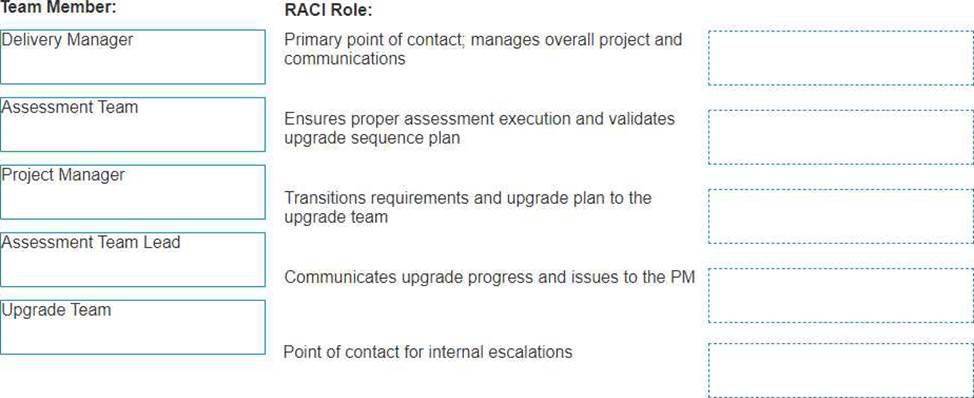
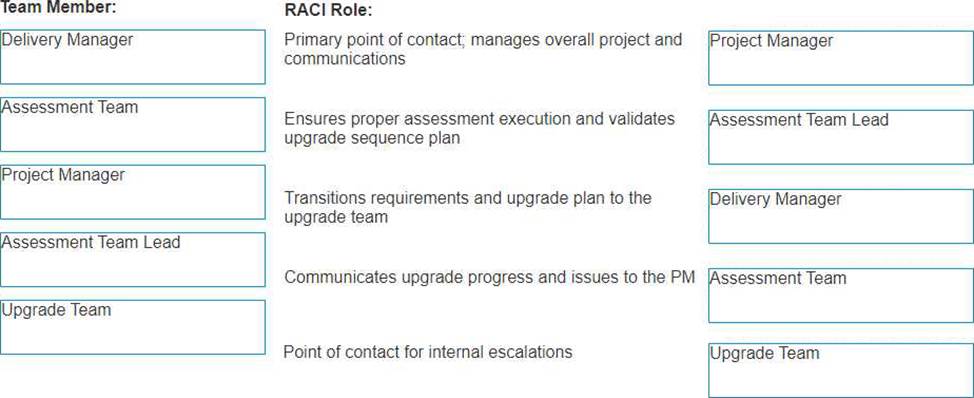
Explanation:
Match each team member with their RACI role as follows:
Project Manager: Primary point of contact; manages overall project and communications
Assessment Team Lead: Ensures proper assessment execution and validates upgrade sequence plan
Assessment Team: Communicates upgrade progress and issues to the PM
Delivery Manager: Transitions requirements and upgrade plan to the upgrade team
Upgrade Team: Point of contact for internal escalations
Project Manager: Primary point of contact; manages overall project and communications
The Project Manager is responsible for overseeing the entire project, coordinating all activities, and serving as the main point of contact for stakeholders.
Assessment Team Lead: Ensures proper assessment execution and validates upgrade sequence plan The Assessment Team Lead oversees the assessment phase, ensuring that the evaluation is thorough and that the upgrade sequence is properly planned and validated. Assessment Team: Communicates upgrade progress and issues to the PM
The Assessment Team members are responsible for executing the assessment tasks and reporting progress and any issues encountered to the Project Manager.
Delivery Manager: Transitions requirements and upgrade plan to the upgrade team
The Delivery Manager is responsible for ensuring that all requirements and the upgrade plan are effectively communicated and handed over to the upgrade team for execution. Upgrade Team: Point of contact for internal escalations
The Upgrade Team handles the actual upgrade process and serves as the primary point of contact for any internal escalations that may arise during the upgrade.
Reference: Dell EMC project management and RACI documentation.
Industry best practices for defining roles and responsibilities in a RACI matrix.
Based on the RCM Upgrade Process RACI, who is responsible and accountable for the pre-upgrade questionnaire used during the Initiation Phase?
- A . Customer and Customer Advocate
- B . Customer and Assessment Lead
- C . Project Manager and Assessment Lead
- D . Project Manager and Customer
D
Explanation:
In the RCM (Release Certification Matrix) Upgrade Process RACI (Responsible, Accountable, Consulted, Informed) matrix, the pre-upgrade questionnaire used during the Initiation Phase is typically the responsibility and accountability of the Project Manager and the Customer. The Project Manager ensures the completion of the questionnaire to gather necessary information for planning the upgrade, while the Customer provides the required data.
Reference: Dell EMC RCM documentation.
Standard RACI matrix practices in project management.