
Databricks Databricks Certified Data Engineer Professional Practice Exams
Last updated on Oct 22,2026- Exam Code: Databricks Certified Data Engineer Professional
- Exam Name: Databricks Certified Data Engineer Professional Exam
- Certification Provider: Databricks
- Latest update: Oct 22,2026
A data pipeline uses Structured Streaming to ingest data from kafka to Delta Lake. Data is being stored in a bronze table, and includes the Kafka_generated timesamp, key, and value. Three months after the pipeline is deployed the data engineering team has noticed some latency issued during certain times of the day.
A senior data engineer updates the Delta Table’s schema and ingestion logic to include the current timestamp (as recoded by Apache Spark) as well the Kafka topic and partition. The team plans to use the additional metadata fields to diagnose the transient processing delays:
Which limitation will the team face while diagnosing this problem?
- A . New fields not be computed for historic records.
- B . Updating the table schema will invalidate the Delta transaction log metadata.
- C . Updating the table schema requires a default value provided for each file added.
- D . Spark cannot capture the topic partition fields from the kafka source.
A junior data engineer is working to implement logic for a Lakehouse table named silver_device_recordings. The source data contains 100 unique fields in a highly nested JSON structure.
The silver_device_recordings table will be used downstream for highly selective joins on a number of fields, and will also be leveraged by the machine learning team to filter on a handful of relevant fields, in total, 15 fields have been identified that will often be used for filter and join logic.
The data engineer is trying to determine the best approach for dealing with these nested fields before declaring the table schema.
Which of the following accurately presents information about Delta Lake and Databricks that may Impact their decision-making process?
- A . Because Delta Lake uses Parquet for data storage, Dremel encoding information for nesting can be directly referenced by the Delta transaction log.
- B . Tungsten encoding used by Databricks is optimized for storing string data: newly-added native support for querying JSON strings means that string types are always most efficient.
- C . Schema inference and evolution on Databricks ensure that inferred types will always accurately match the data types used by downstream systems.
- D . By default Delta Lake collects statistics on the first 32 columns in a table; these statistics are leveraged for data skipping when executing selective queries.
Which statement describes Delta Lake optimized writes?
- A . A shuffle occurs prior to writing to try to group data together resulting in fewer files instead of each executor writing multiple files based on directory partitions.
- B . Optimized writes logical partitions instead of directory partitions partition boundaries are only represented in metadata fewer small files are written.
- C . An asynchronous job runs after the write completes to detect if files could be further compacted; yes, an OPTIMIZE job is executed toward a default of 1 GB.
- D . Before a job cluster terminates, OPTIMIZE is executed on all tables modified during the most recent job.
An upstream source writes Parquet data as hourly batches to directories named with the current date.
A nightly batch job runs the following code to ingest all data from the previous day as indicated by the date variable:
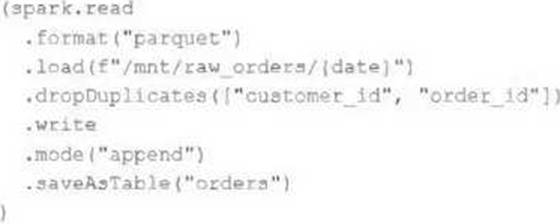
Assume that the fields customer_id and order_id serve as a composite key to uniquely identify each order.
If the upstream system is known to occasionally produce duplicate entries for a single order hours apart, which statement is correct?
- A . Each write to the orders table will only contain unique records, and only those records without duplicates in the target table will be written.
- B . Each write to the orders table will only contain unique records, but newly written records may have duplicates already present in the target table.
- C . Each write to the orders table will only contain unique records; if existing records with the same key are present in the target table, these records will be overwritten.
- D . Each write to the orders table will only contain unique records; if existing records with the same key are present in the target table, the operation will tail.
- E . Each write to the orders table will run deduplication over the union of new and existing records,
ensuring no duplicate records are present.
The DevOps team has configured a production workload as a collection of notebooks scheduled to run daily using the Jobs UI. A new data engineering hire is onboarding to the team and has requested access to one of these notebooks to review the production logic.
What are the maximum notebook permissions that can be granted to the user without allowing accidental changes to production code or data?
- A . Can Manage
- B . Can Edit
- C . No permissions
- D . Can Read
- E . Can Run
The Databricks CLI is use to trigger a run of an existing job by passing the job_id parameter. The response that the job run request has been submitted successfully includes a filed run_id.
Which statement describes what the number alongside this field represents?
- A . The job_id is returned in this field.
- B . The job_id and number of times the job has been are concatenated and returned.
- C . The number of times the job definition has been run in the workspace.
- D . The globally unique ID of the newly triggered run.
A junior data engineer has configured a workload that posts the following JSON to the Databricks REST API endpoint 2.0/jobs/create.
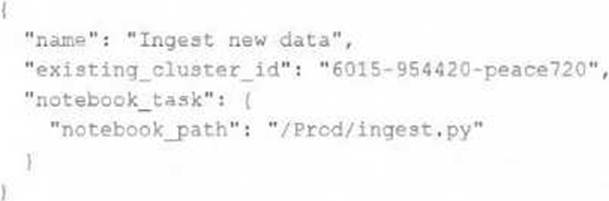
Assuming that all configurations and referenced resources are available, which statement describes the result of executing this workload three times?
- A . Three new jobs named "Ingest new data" will be defined in the workspace, and they will each run once daily.
- B . The logic defined in the referenced notebook will be executed three times on new clusters with the configurations of the provided cluster ID.
- C . Three new jobs named "Ingest new data" will be defined in the workspace, but no jobs will be executed.
- D . One new job named "Ingest new data" will be defined in the workspace, but it will not be executed.
- E . The logic defined in the referenced notebook will be executed three times on the referenced existing all purpose cluster.
The data engineering team is migrating an enterprise system with thousands of tables and views into the Lakehouse. They plan to implement the target architecture using a series of bronze, silver, and gold tables. Bronze tables will almost exclusively be used by production data engineering workloads, while silver tables will be used to support both data engineering and machine learning workloads. Gold tables will largely serve business intelligence and reporting purposes. While personal identifying information (PII) exists in all tiers of data, pseudonymization and anonymization rules are in place for all data at the silver and gold levels.
The organization is interested in reducing security concerns while maximizing the ability to collaborate across diverse teams.
Which statement exemplifies best practices for implementing this system?
- A . Isolating tables in separate databases based on data quality tiers allows for easy permissions management through database ACLs and allows physical separation of default storage locations for managed tables.
- B . Because databases on Databricks are merely a logical construct, choices around database organization do not impact security or discoverability in the Lakehouse.
- C . Storinq all production tables in a single database provides a unified view of all data assets available throughout the Lakehouse, simplifying discoverability by granting all users view privileges on this database.
- D . Working in the default Databricks database provides the greatest security when working with managed tables, as these will be created in the DBFS root.
- E . Because all tables must live in the same storage containers used for the database they’re created in, organizations should be prepared to create between dozens and thousands of databases depending on their data isolation requirements.
The data engineer is using Spark’s MEMORY_ONLY storage level.
Which indicators should the data engineer look for in the spark UI’s Storage tab to signal that a cached table is not performing optimally?
- A . Size on Disk is> 0
- B . The number of Cached Partitions> the number of Spark Partitions
- C . The RDD Block Name included the ” annotation signaling failure to cache
- D . On Heap Memory Usage is within 75% of off Heap Memory usage
A Data engineer wants to run unit’s tests using common Python testing frameworks on python functions defined across several Databricks notebooks currently used in production.
How can the data engineer run unit tests against function that work with data in production?
- A . Run unit tests against non-production data that closely mirrors production
- B . Define and unit test functions using Files in Repos
- C . Define units test and functions within the same notebook
- D . Define and import unit test functions from a separate Databricks notebook