
Databricks Databricks Certified Data Engineer Professional Practice Exams
Last updated on Oct 22,2026- Exam Code: Databricks Certified Data Engineer Professional
- Exam Name: Databricks Certified Data Engineer Professional Exam
- Certification Provider: Databricks
- Latest update: Oct 22,2026
Which statement characterizes the general programming model used by Spark Structured Streaming?
- A . Structured Streaming leverages the parallel processing of GPUs to achieve highly parallel data throughput.
- B . Structured Streaming is implemented as a messaging bus and is derived from Apache Kafka.
- C . Structured Streaming uses specialized hardware and I/O streams to achieve sub-second latency for data transfer.
- D . Structured Streaming models new data arriving in a data stream as new rows appended to an unbounded table.
- E . Structured Streaming relies on a distributed network of nodes that hold incremental state values for cached stages.
The data governance team has instituted a requirement that all tables containing Personal Identifiable Information (PH) must be clearly annotated. This includes adding column comments, table comments, and setting the custom table property "contains_pii" = true.
The following SQL DDL statement is executed to create a new table:
Which command allows manual confirmation that these three requirements have been met?
- A . DESCRIBE EXTENDED dev.pii test
- B . DESCRIBE DETAIL dev.pii test
- C . SHOW TBLPROPERTIES dev.pii test
- D . DESCRIBE HISTORY dev.pii test
- E . SHOW TABLES dev
Incorporating unit tests into a PySpark application requires upfront attention to the design of your jobs, or a potentially significant refactoring of existing code.
Which statement describes a main benefit that offset this additional effort?
- A . Improves the quality of your data
- B . Validates a complete use case of your application
- C . Troubleshooting is easier since all steps are isolated and tested individually
- D . Yields faster deployment and execution times
- E . Ensures that all steps interact correctly to achieve the desired end result
A data team’s Structured Streaming job is configured to calculate running aggregates for item sales to update a downstream marketing dashboard. The marketing team has introduced a new field to track the number of times this promotion code is used for each item. A junior data engineer suggests updating the existing query as follows: Note that proposed changes are in bold.
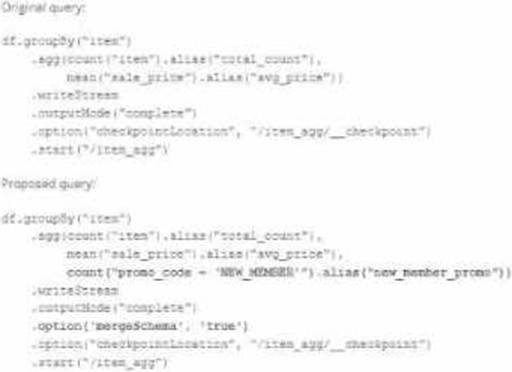
Which step must also be completed to put the proposed query into production?
- A . Increase the shuffle partitions to account for additional aggregates
- B . Specify a new checkpointlocation
- C . Run REFRESH TABLE delta, /item_agg’
- D . Remove .option (mergeSchema’, true’) from the streaming write
A Delta table of weather records is partitioned by date and has the below schema:
date DATE, device_id INT, temp FLOAT, latitude FLOAT, longitude FLOAT
To find all the records from within the Arctic Circle, you execute a query with the below filter:
latitude > 66.3
Which statement describes how the Delta engine identifies which files to load?
- A . All records are cached to an operational database and then the filter is applied
- B . The Parquet file footers are scanned for min and max statistics for the latitude column
- C . All records are cached to attached storage and then the filter is applied
- D . The Delta log is scanned for min and max statistics for the latitude column
- E . The Hive metastore is scanned for min and max statistics for the latitude column
The data engineering team maintains the following code:
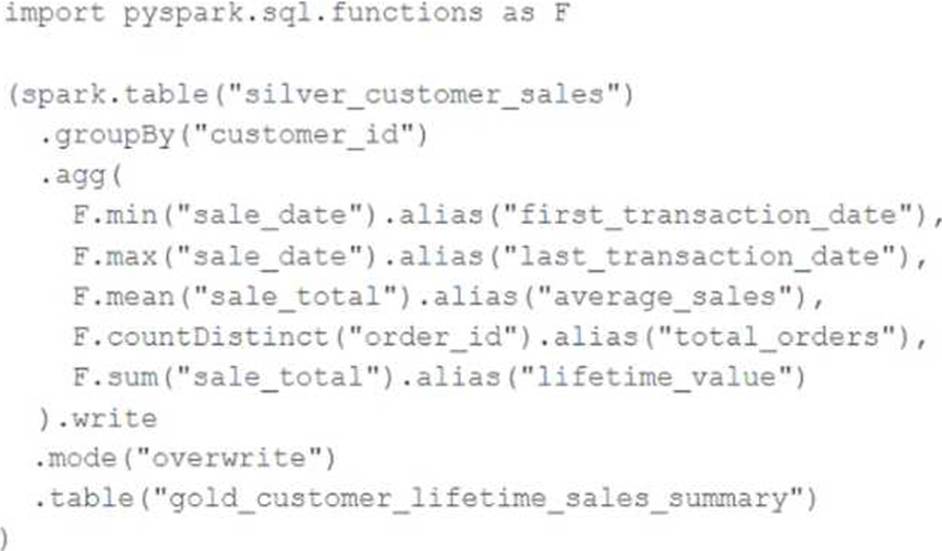
Assuming that this code produces logically correct results and the data in the source table has been de-duplicated and validated, which statement describes what will occur when this code is executed?
- A . The silver_customer_sales table will be overwritten by aggregated values calculated from all records in the gold_customer_lifetime_sales_summary table as a batch job.
- B . A batch job will update the gold_customer_lifetime_sales_summary table, replacing only those rows that have different values than the current version of the table, using customer_id as the primary key.
- C . The gold_customer_lifetime_sales_summary table will be overwritten by aggregated values calculated from all records in the silver_customer_sales table as a batch job.
- D . An incremental job will leverage running information in the state store to update aggregate values in the gold_customer_lifetime_sales_summary table.
- E . An incremental job will detect if new rows have been written to the silver_customer_sales table; if new rows are detected, all aggregates will be recalculated and used to overwrite the gold_customer_lifetime_sales_summary table.
The data engineering team maintains a table of aggregate statistics through batch nightly updates. This includes total sales for the previous day alongside totals and averages for a variety of time periods including the 7 previous days, year-to-date, and quarter-to-date.
This table is named store_saies_summary and the schema is as follows:
The table daily_store_sales contains all the information needed to update store_sales_summary.
The schema for this table is:
store_id INT, sales_date DATE, total_sales FLOAT
If daily_store_sales is implemented as a Type 1 table and the total_sales column might be adjusted after manual data auditing, which approach is the safest to generate accurate reports in the store_sales_summary table?
- A . Implement the appropriate aggregate logic as a batch read against the daily_store_sales table and overwrite the store_sales_summary table with each Update.
- B . Implement the appropriate aggregate logic as a batch read against the daily_store_sales table and append new rows nightly to the store_sales_summary table.
- C . Implement the appropriate aggregate logic as a batch read against the daily_store_sales table and use upsert logic to update results in the store_sales_summary table.
- D . Implement the appropriate aggregate logic as a Structured Streaming read against the daily_store_sales table and use upsert logic to update results in the store_sales_summary table.
- E . Use Structured Streaming to subscribe to the change data feed for daily_store_sales and apply changes to the aggregates in the store_sales_summary table with each update.
A data engineer, User A, has promoted a new pipeline to production by using the REST API to programmatically create several jobs. A DevOps engineer, User B, has configured an external orchestration tool to trigger job runs through the REST API. Both users authorized the REST API calls using their personal access tokens.
Which statement describes the contents of the workspace audit logs concerning these events?
- A . Because the REST API was used for job creation and triggering runs, a Service Principal will be automatically used to identity these events.
- B . Because User B last configured the jobs, their identity will be associated with both the job creation
events and the job run events. - C . Because these events are managed separately, User A will have their identity associated with the job creation events and User B will have their identity associated with the job run events.
- D . Because the REST API was used for job creation and triggering runs, user identity will not be captured in the audit logs.
- E . Because User A created the jobs, their identity will be associated with both the job creation events and the job run events.
An hourly batch job is configured to ingest data files from a cloud object storage container where each batch represent all records produced by the source system in a given hour. The batch job to process these records into the Lakehouse is sufficiently delayed to ensure no late-arriving data is missed.
The user_id field represents a unique key for the data, which has the following schema:
user_id BIGINT, username STRING, user_utc STRING, user_region STRING, last_login BIGINT, auto_pay BOOLEAN, last_updated BIGINT
New records are all ingested into a table named account_history which maintains a full record of all data in the same schema as the source. The next table in the system is named account_current and is implemented as a Type 1 table representing the most recent value for each unique user_id.
Assuming there are millions of user accounts and tens of thousands of records processed hourly, which implementation can be used to efficiently update the described account_current table as part of each hourly batch job?
- A . Use Auto Loader to subscribe to new files in the account history directory; configure a Structured Streaminq trigger once job to batch update newly detected files into the account current table.
- B . Overwrite the account current table with each batch using the results of a query against the account history table grouping by user id and filtering for the max value of last updated.
- C . Filter records in account history using the last updated field and the most recent hour processed, as well as the max last iogin by user id write a merge statement to update or insert the most recent
value for each user id. - D . Use Delta Lake version history to get the difference between the latest version of account history and one version prior, then write these records to account current.
- E . Filter records in account history using the last updated field and the most recent hour processed, making sure to deduplicate on username; write a merge statement to update or insert the most recent value for each username.
The business reporting tem requires that data for their dashboards be updated every hour. The total processing time for the pipeline that extracts transforms and load the data for their pipeline runs in 10 minutes.
Assuming normal operating conditions, which configuration will meet their service-level agreement requirements with the lowest cost?
- A . Schedule a jo to execute the pipeline once and hour on a dedicated interactive cluster.
- B . Schedule a Structured Streaming job with a trigger interval of 60 minutes.
- C . Schedule a job to execute the pipeline once hour on a new job cluster.
- D . Configure a job that executes every time new data lands in a given directory.