
Databricks Databricks Certified Data Engineer Professional Practice Exams
Last updated on Oct 22,2026- Exam Code: Databricks Certified Data Engineer Professional
- Exam Name: Databricks Certified Data Engineer Professional Exam
- Certification Provider: Databricks
- Latest update: Oct 22,2026
Each configuration below is identical to the extent that each cluster has 400 GB total of RAM, 160 total cores and only one Executor per VM.
Given a job with at least one wide transformation, which of the following cluster configurations will result in maximum performance?
- A . • Total VMs; 1
• 400 GB per Executor
• 160 Cores / Executor - B . • Total VMs: 8
• 50 GB per Executor
• 20 Cores / Executor C.
• Total VMs: 4
• 100 GB per Executor
• 40 Cores/Executor D.
• Total VMs:2
• 200 GB per Executor
• 80 Cores / Executor
What is a method of installing a Python package scoped at the notebook level to all nodes in the currently active cluster?
- A . Use &Pip install in a notebook cell
- B . Run source env/bin/activate in a notebook setup script
- C . Install libraries from PyPi using the cluster UI
- D . Use &sh install in a notebook cell
The downstream consumers of a Delta Lake table have been complaining about data quality issues impacting performance in their applications. Specifically, they have complained that invalid latitude and longitude values in the activity_details table have been breaking their ability to use other geolocation processes.
A junior engineer has written the following code to add CHECK constraints to the Delta Lake table:
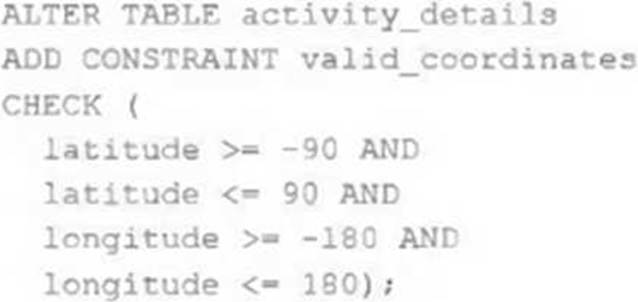
A senior engineer has confirmed the above logic is correct and the valid ranges for latitude and longitude are provided, but the code fails when executed.
Which statement explains the cause of this failure?
- A . Because another team uses this table to support a frequently running application, two-phase locking is preventing the operation from committing.
- B . The activity details table already exists; CHECK constraints can only be added during initial table creation.
- C . The activity details table already contains records that violate the constraints; all existing data must pass CHECK constraints in order to add them to an existing table.
- D . The activity details table already contains records; CHECK constraints can only be added prior to inserting values into a table.
- E . The current table schema does not contain the field valid coordinates; schema evolution will need to be enabled before altering the table to add a constraint.
A Delta Lake table representing metadata about content from user has the following schema:
Based on the above schema, which column is a good candidate for partitioning the Delta Table?
- A . Date
- B . Post_id
- C . User_id
- D . Post_time
An upstream system has been configured to pass the date for a given batch of data to the Databricks Jobs API as a parameter.
The notebook to be scheduled will use this parameter to load data with the following code:
df = spark.read.format("parquet").load(f"/mnt/source/(date)")
Which code block should be used to create the date Python variable used in the above code block?
- A . date = spark.conf.get("date")
- B . input_dict = input()
date= input_dict["date"] - C . import sys
date = sys.argv[1] - D . date = dbutils.notebooks.getParam("date")
- E . dbutils.widgets.text("date", "null")
date = dbutils.widgets.get("date")
Review the following error traceback:
Which statement describes the error being raised?
- A . The code executed was PvSoark but was executed in a Scala notebook.
- B . There is no column in the table named heartrateheartrateheartrate
- C . There is a type error because a column object cannot be multiplied.
- D . There is a type error because a DataFrame object cannot be multiplied.
- E . There is a syntax error because the heartrate column is not correctly identified as a column.
A Delta Lake table was created with the below query:
Realizing that the original query had a typographical error, the below code was executed:
ALTER TABLE prod.sales_by_stor RENAME TO prod.sales_by_store
Which result will occur after running the second command?
- A . The table reference in the metastore is updated and no data is changed.
- B . The table name change is recorded in the Delta transaction log.
- C . All related files and metadata are dropped and recreated in a single ACID transaction.
- D . The table reference in the metastore is updated and all data files are moved.
- E . A new Delta transaction log Is created for the renamed table.
The data architect has mandated that all tables in the Lakehouse should be configured as external Delta Lake tables.
Which approach will ensure that this requirement is met?
- A . Whenever a database is being created, make sure that the location keyword is used
- B . When configuring an external data warehouse for all table storage. leverage Databricks for all ELT.
- C . Whenever a table is being created, make sure that the location keyword is used.
- D . When tables are created, make sure that the external keyword is used in the create table statement.
- E . When the workspace is being configured, make sure that external cloud object storage has been mounted.
Although the Databricks Utilities Secrets module provides tools to store sensitive credentials and avoid accidentally displaying them in plain text users should still be careful with which credentials are stored here and which users have access to using these secrets.
Which statement describes a limitation of Databricks Secrets?
- A . Because the SHA256 hash is used to obfuscate stored secrets, reversing this hash will display the value in plain text.
- B . Account administrators can see all secrets in plain text by logging on to the Databricks Accounts console.
- C . Secrets are stored in an administrators-only table within the Hive Metastore; database administrators have permission to query this table by default.
- D . Iterating through a stored secret and printing each character will display secret contents in plain text.
- E . The Databricks REST API can be used to list secrets in plain text if the personal access token has proper credentials.
Which statement regarding stream-static joins and static Delta tables is correct?
- A . Each microbatch of a stream-static join will use the most recent version of the static Delta table as of each microbatch.
- B . Each microbatch of a stream-static join will use the most recent version of the static Delta table as of the job’s initialization.
- C . The checkpoint directory will be used to track state information for the unique keys present in the join.
- D . Stream-static joins cannot use static Delta tables because of consistency issues.
- E . The checkpoint directory will be used to track updates to the static Delta table.