
Databricks Databricks Certified Data Engineer Professional Practice Exams
Last updated on Oct 22,2026- Exam Code: Databricks Certified Data Engineer Professional
- Exam Name: Databricks Certified Data Engineer Professional Exam
- Certification Provider: Databricks
- Latest update: Oct 22,2026
A Databricks job has been configured with 3 tasks, each of which is a Databricks notebook. Task A does not depend on other tasks. Tasks B and C run in parallel, with each having a serial dependency on task A.
If tasks A and B complete successfully but task C fails during a scheduled run, which statement describes the resulting state?
- A . All logic expressed in the notebook associated with tasks A and B will have been successfully completed; some operations in task C may have completed successfully.
- B . All logic expressed in the notebook associated with tasks A and B will have been successfully completed; any changes made in task C will be rolled back due to task failure.
- C . All logic expressed in the notebook associated with task A will have been successfully completed; tasks B and C will not commit any changes because of stage failure.
- D . Because all tasks are managed as a dependency graph, no changes will be committed to the Lakehouse until ail tasks have successfully been completed.
- E . Unless all tasks complete successfully, no changes will be committed to the Lakehouse; because task C failed, all commits will be rolled back automatically.
Which Python variable contains a list of directories to be searched when trying to locate required modules?
- A . importlib.resource path
- B . ,sys.path
- C . os-path
- D . pypi.path
- E . pylib.source
What is the correct way to handle parameter passing through the Databricks Jobs API for date variables in scheduled notebooks?
- A . date = spark.conf.get("date")
- B . input_dict = input(); date = input_dict["date"]
- C . import sys; date = sys.argv[1]
- D . date = dbutils.notebooks.getParam("date")
The data architect has mandated that all tables in the Lakehouse should be configured as external (also known as "unmanaged") Delta Lake tables.
Which approach will ensure that this requirement is met?
- A . When a database is being created, make sure that the LOCATION keyword is used.
- B . When configuring an external data warehouse for all table storage, leverage Databricks for all ELT.
- C . When data is saved to a table, make sure that a full file path is specified alongside the Delta format.
- D . When tables are created, make sure that the EXTERNAL keyword is used in the CREATE TABLE statement.
- E . When the workspace is being configured, make sure that external cloud object storage has been mounted.
A junior data engineer is working to implement logic for a Lakehouse table named silver_device_recordings. The source data contains 100 unique fields in a highly nested JSON structure.
The silver_device_recordings table will be used downstream to power several production monitoring dashboards and a production model. At present, 45 of the 100 fields are being used in at least one of these applications.
The data engineer is trying to determine the best approach for dealing with schema declaration given the highly-nested structure of the data and the numerous fields.
Which of the following accurately presents information about Delta Lake and Databricks that may impact their decision-making process?
- A . The Tungsten encoding used by Databricks is optimized for storing string data; newly-added native support for querying JSON strings means that string types are always most efficient.
- B . Because Delta Lake uses Parquet for data storage, data types can be easily evolved by just modifying file footer information in place.
- C . Human labor in writing code is the largest cost associated with data engineering workloads; as such, automating table declaration logic should be a priority in all migration workloads.
- D . Because Databricks will infer schema using types that allow all observed data to be processed, setting types manually provides greater assurance of data quality enforcement.
- E . Schema inference and evolution on .Databricks ensure that inferred types will always accurately match the data types used by downstream systems.
Which statement regarding spark configuration on the Databricks platform is true?
- A . Spark configuration properties set for an interactive cluster with the Clusters UI will impact all notebooks attached to that cluster.
- B . When the same spar configuration property is set for an interactive to the same interactive cluster.
- C . Spark configuration set within an notebook will affect all SparkSession attached to the same interactive cluster
- D . The Databricks REST API can be used to modify the Spark configuration properties for an interactive cluster without interrupting jobs.
Which REST API call can be used to review the notebooks configured to run as tasks in a multi-task job?
- A . /jobs/runs/list
- B . /jobs/runs/get-output
- C . /jobs/runs/get
- D . /jobs/get
- E . /jobs/list
A table named user_ltv is being used to create a view that will be used by data analysts on various teams. Users in the workspace are configured into groups, which are used for setting up data access using ACLs.
The user_ltv table has the following schema:
email STRING, age INT, ltv INT
The following view definition is executed:
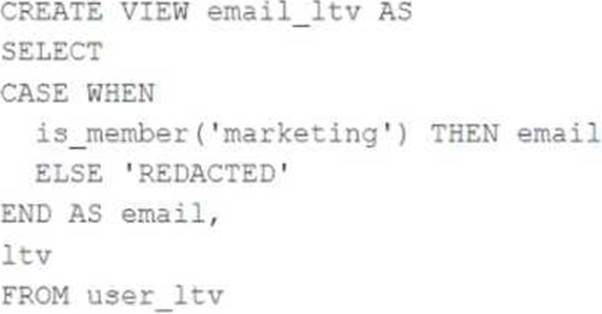
An analyst who is not a member of the marketing group executes the following query:
SELECT * FROM email_ltv
Which statement describes the results returned by this query?
- A . Three columns will be returned, but one column will be named "redacted" and contain only null values.
- B . Only the email and itv columns will be returned; the email column will contain all null values.
- C . The email and ltv columns will be returned with the values in user itv.
- D . The email, age. and ltv columns will be returned with the values in user ltv.
- E . Only the email and ltv columns will be returned; the email column will contain the string "REDACTED" in each row.
What statement is true regarding the retention of job run history?
- A . It is retained until you export or delete job run logs
- B . It is retained for 30 days, during which time you can deliver job run logs to DBFS or S3
- C . t is retained for 60 days, during which you can export notebook run results to HTML
- D . It is retained for 60 days, after which logs are archived
- E . It is retained for 90 days or until the run-id is re-used through custom run configuration
A data architect has designed a system in which two Structured Streaming jobs will concurrently write to a single bronze Delta table. Each job is subscribing to a different topic from an Apache Kafka source, but they will write data with the same schema. To keep the directory structure simple, a data engineer has decided to nest a checkpoint directory to be shared by both streams.
The proposed directory structure is displayed below:
Which statement describes whether this checkpoint directory structure is valid for the given scenario and why?
- A . No; Delta Lake manages streaming checkpoints in the transaction log.
- B . Yes; both of the streams can share a single checkpoint directory.
- C . No; only one stream can write to a Delta Lake table.
- D . Yes; Delta Lake supports infinite concurrent writers.
- E . No; each of the streams needs to have its own checkpoint directory.