
Databricks Databricks Certified Data Engineer Professional Practice Exams
Last updated on Oct 22,2026- Exam Code: Databricks Certified Data Engineer Professional
- Exam Name: Databricks Certified Data Engineer Professional Exam
- Certification Provider: Databricks
- Latest update: Oct 22,2026
A Structured Streaming job deployed to production has been experiencing delays during peak hours of the day. At present, during normal execution, each microbatch of data is processed in less than 3 seconds. During peak hours of the day, execution time for each microbatch becomes very inconsistent, sometimes exceeding 30 seconds. The streaming write is currently configured with a trigger interval of 10 seconds.
Holding all other variables constant and assuming records need to be processed in less than 10 seconds, which adjustment will meet the requirement?
- A . Decrease the trigger interval to 5 seconds; triggering batches more frequently allows idle executors to begin processing the next batch while longer running tasks from previous batches finish.
- B . Increase the trigger interval to 30 seconds; setting the trigger interval near the maximum execution time observed for each batch is always best practice to ensure no records are dropped.
- C . The trigger interval cannot be modified without modifying the checkpoint directory; to maintain the current stream state, increase the number of shuffle partitions to maximize parallelism.
- D . Use the trigger once option and configure a Databricks job to execute the query every 10 seconds; this ensures all backlogged records are processed with each batch.
- E . Decrease the trigger interval to 5 seconds; triggering batches more frequently may prevent records from backing up and large batches from causing spill.
A data engineer is testing a collection of mathematical functions, one of which calculates the area under a curve as described by another function.
Which kind of the test does the above line exemplify?
- A . Integration
- B . Unit
- C . Manual
- D . functional
A table named user_ltv is being used to create a view that will be used by data analysis on various teams. Users in the workspace are configured into groups, which are used for setting up data access using ACLs.
The user_ltv table has the following schema:
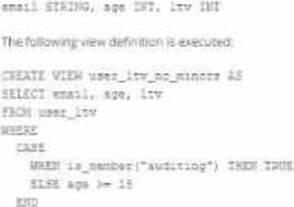
An analyze who is not a member of the auditing group executing the following query:

Which result will be returned by this query?
- A . All columns will be displayed normally for those records that have an age greater than 18; records not meeting this condition will be omitted.
- B . All columns will be displayed normally for those records that have an age greater than 17; records not meeting this condition will be omitted.
- C . All age values less than 18 will be returned as null values all other columns will be returned with the values in user_ltv.
- D . All records from all columns will be displayed with the values in user_ltv.
A junior member of the data engineering team is exploring the language interoperability of Databricks notebooks. The intended outcome of the below code is to register a view of all sales that occurred in countries on the continent of Africa that appear in the geo_lookup table.
Before executing the code, running SHOW TABLES on the current database indicates the database contains only two tables: geo_lookup and sales.
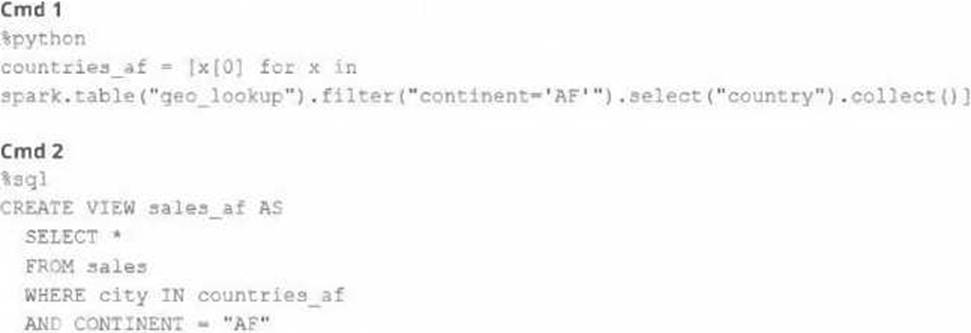
Which statement correctly describes the outcome of executing these command cells in order in an interactive notebook?
- A . Both commands will succeed. Executing show tables will show that countries at and sales at have been registered as views.
- B . Cmd 1 will succeed. Cmd 2 will search all accessible databases for a table or view named countries af: if this entity exists, Cmd 2 will succeed.
- C . Cmd 1 will succeed and Cmd 2 will fail, countries at will be a Python variable representing a PySpark DataFrame.
- D . Both commands will fail. No new variables, tables, or views will be created.
- E . Cmd 1 will succeed and Cmd 2 will fail, countries at will be a Python variable containing a list of strings.
A data engineer is configuring a pipeline that will potentially see late-arriving, duplicate records.
In addition to de-duplicating records within the batch, which of the following approaches allows the data engineer to deduplicate data against previously processed records as it is inserted into a Delta table?
- A . Set the configuration delta.deduplicate = true.
- B . VACUUM the Delta table after each batch completes.
- C . Perform an insert-only merge with a matching condition on a unique key.
- D . Perform a full outer join on a unique key and overwrite existing data.
- E . Rely on Delta Lake schema enforcement to prevent duplicate records.
A small company based in the United States has recently contracted a consulting firm in India to implement several new data engineering pipelines to power artificial intelligence applications. All the company’s data is stored in regional cloud storage in the United States.
The workspace administrator at the company is uncertain about where the Databricks workspace used by the contractors should be deployed.
Assuming that all data governance considerations are accounted for, which statement accurately informs this decision?
- A . Databricks runs HDFS on cloud volume storage; as such, cloud virtual machines must be deployed in the region where the data is stored.
- B . Databricks workspaces do not rely on any regional infrastructure; as such, the decision should be made based upon what is most convenient for the workspace administrator.
- C . Cross-region reads and writes can incur significant costs and latency; whenever possible, compute should be deployed in the same region the data is stored.
- D . Databricks leverages user workstations as the driver during interactive development; as such, users should always use a workspace deployed in a region they are physically near.
- E . Databricks notebooks send all executable code from the user’s browser to virtual machines over the open internet; whenever possible, choosing a workspace region near the end users is the most secure.
A production workload incrementally applies updates from an external Change Data Capture feed to a Delta Lake table as an always-on Structured Stream job. When data was initially migrated for this table, OPTIMIZE was executed and most data files were resized to 1 GB. Auto Optimize and Auto Compaction were both turned on for the streaming production job. Recent review of data files shows that most data files are under 64 MB, although each partition in the table contains at least 1 GB of data and the total table size is over 10 TB.
Which of the following likely explains these smaller file sizes?
- A . Databricks has autotuned to a smaller target file size to reduce duration of MERGE operations
- B . Z-order indices calculated on the table are preventing file compaction
- C . Bloom filler indices calculated on the table are preventing file compaction
- D . Databricks has autotuned to a smaller target file size based on the overall size of data in the table
- E . Databricks has autotuned to a smaller target file size based on the amount of data in each partition
To monitor temperatures via a Databricks SQL query and create alerts, the trigger condition for an alert is based on:
- A . The maximum temperature across all sensors
- B . The average temperature across all sensors
- C . The minimum temperature across any sensor
- D . The average temperature for at least one sensor
The data engineering team has configured a Databricks SQL query and alert to monitor the values in
a Delta Lake table. The recent_sensor_recordings table contains an identifying sensor_id alongside the timestamp and temperature for the most recent 5 minutes of recordings.
The below query is used to create the alert:

The query is set to refresh each minute and always completes in less than 10 seconds. The alert is set to trigger when mean (temperature) > 120. Notifications are triggered to be sent at most every 1 minute.
If this alert raises notifications for 3 consecutive minutes and then stops, which statement must be true?
- A . The total average temperature across all sensors exceeded 120 on three consecutive executions of the query
- B . The recent_sensor_recordingstable was unresponsive for three consecutive runs of the query
- C . The source query failed to update properly for three consecutive minutes and then restarted
- D . The maximum temperature recording for at least one sensor exceeded 120 on three consecutive executions of the query
- E . The average temperature recordings for at least one sensor exceeded 120 on three consecutive executions of the query
A junior data engineer is migrating a workload from a relational database system to the Databricks Lakehouse. The source system uses a star schema, leveraging foreign key constrains and multi-table inserts to validate records on write.
Which consideration will impact the decisions made by the engineer while migrating this workload?
- A . All Delta Lake transactions are ACID compliance against a single table, and Databricks does not enforce foreign key constraints.
- B . Databricks only allows foreign key constraints on hashed identifiers, which avoid collisions in highly-parallel writes.
- C . Foreign keys must reference a primary key field; multi-table inserts must leverage Delta Lake’s upsert functionality.
- D . Committing to multiple tables simultaneously requires taking out multiple table locks and can lead to a state of deadlock.