
Databricks Databricks Certified Data Engineer Professional Practice Exams
Last updated on Oct 22,2026- Exam Code: Databricks Certified Data Engineer Professional
- Exam Name: Databricks Certified Data Engineer Professional Exam
- Certification Provider: Databricks
- Latest update: Oct 22,2026
Which statement describes Delta Lake Auto Compaction?
- A . An asynchronous job runs after the write completes to detect if files could be further compacted;
if yes, an optimize job is executed toward a default of 1 GB. - B . Before a Jobs cluster terminates, optimize is executed on all tables modified during the most recent job.
- C . Optimized writes use logical partitions instead of directory partitions; because partition boundaries are only represented in metadata, fewer small files are written.
- D . Data is queued in a messaging bus instead of committing data directly to memory; all data is committed from the messaging bus in one batch once the job is complete.
- E . An asynchronous job runs after the write completes to detect if files could be further compacted; if yes, an optimize job is executed toward a default of 128 MB.
A Delta Lake table in the Lakehouse named customer_parsams is used in churn prediction by the machine learning team. The table contains information about customers derived from a number of upstream sources. Currently, the data engineering team populates this table nightly by overwriting the table with the current valid values derived from upstream data sources.
Immediately after each update succeeds, the data engineer team would like to determine the difference between the new version and the previous of the table.
Given the current implementation, which method can be used?
- A . Parse the Delta Lake transaction log to identify all newly written data files.
- B . Execute DESCRIBE HISTORY customer_churn_params to obtain the full operation metrics for the update, including a log of all records that have been added or modified.
- C . Execute a query to calculate the difference between the new version and the previous version using Delta Lake’s built-in versioning and time travel functionality.
- D . Parse the Spark event logs to identify those rows that were updated, inserted, or deleted.
Two of the most common data locations on Databricks are the DBFS root storage and external object storage mounted with dbutils.fs.mount().
Which of the following statements is correct?
- A . DBFS is a file system protocol that allows users to interact with files stored in object storage using syntax and guarantees similar to Unix file systems.
- B . By default, both the DBFS root and mounted data sources are only accessible to workspace administrators.
- C . The DBFS root is the most secure location to store data, because mounted storage volumes must have full public read and write permissions.
- D . Neither the DBFS root nor mounted storage can be accessed when using %sh in a Databricks notebook.
- E . The DBFS root stores files in ephemeral block volumes attached to the driver, while mounted directories will always persist saved data to external storage between sessions.
A member of the data engineering team has submitted a short notebook that they wish to schedule as part of a larger data pipeline. Assume that the commands provided below produce the logically correct results when run as presented.
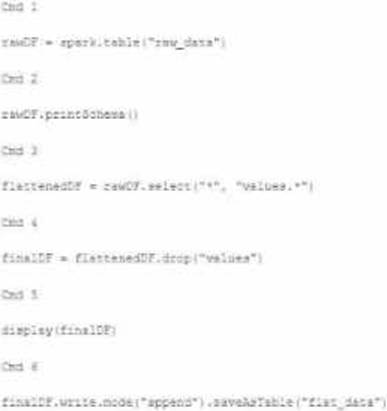
Which command should be removed from the notebook before scheduling it as a job?
- A . Cmd 2
- B . Cmd 3
- C . Cmd 4
- D . Cmd 5
- E . Cmd 6
A team of data engineer are adding tables to a DLT pipeline that contain repetitive expectations for many of the same data quality checks.
One member of the team suggests reusing these data quality rules across all tables defined for this pipeline.
What approach would allow them to do this?
- A . Maintain data quality rules in a Delta table outside of this pipeline’s target schema, providing the schema name as a pipeline parameter.
- B . Use global Python variables to make expectations visible across DLT notebooks included in the same pipeline.
- C . Add data quality constraints to tables in this pipeline using an external job with access to pipeline configuration files.
- D . Maintain data quality rules in a separate Databricks notebook that each DLT notebook of file.
Which statement describes integration testing?
- A . Validates interactions between subsystems of your application
- B . Requires an automated testing framework
- C . Requires manual intervention
- D . Validates an application use case
- E . Validates behavior of individual elements of your application
The data engineering team maintains the following code:
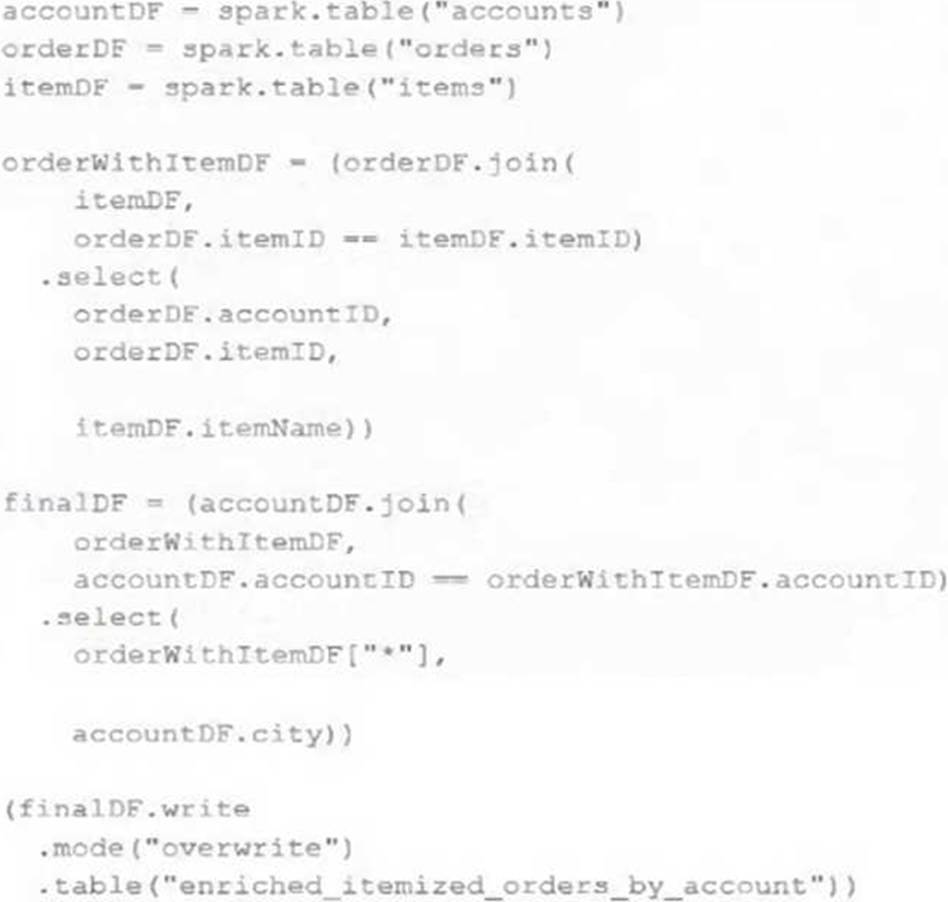
Assuming that this code produces logically correct results and the data in the source tables has been de-duplicated and validated, which statement describes what will occur when this code is executed?
- A . A batch job will update the enriched_itemized_orders_by_account table, replacing only those rows that have different values than the current version of the table, using accountID as the primary key.
- B . The enriched_itemized_orders_by_account table will be overwritten using the current valid version of data in each of the three tables referenced in the join logic.
- C . An incremental job will leverage information in the state store to identify unjoined rows in the source tables and write these rows to the enriched_iteinized_orders_by_account table.
- D . An incremental job will detect if new rows have been written to any of the source tables; if new rows are detected, all results will be recalculated and used to overwrite the enriched_itemized_orders_by_account table.
- E . No computation will occur until enriched_itemized_orders_by_account is queried; upon query materialization, results will be calculated using the current valid version of data in each of the three tables referenced in the join logic.
A user wants to use DLT expectations to validate that a derived table report contains all records from the source, included in the table validation_copy.
The user attempts and fails to accomplish this by adding an expectation to the report table definition.
Which approach would allow using DLT expectations to validate all expected records are present in
this table?
- A . Define a SQL UDF that performs a left outer join on two tables, and check if this returns null values for report key values in a DLT expectation for the report table.
- B . Define a function that performs a left outer join on validation_copy and report and report, and check against the result in a DLT expectation for the report table
- C . Define a temporary table that perform a left outer join on validation_copy and report, and define an expectation that no report key values are null
- D . Define a view that performs a left outer join on validation_copy and report, and reference this view in DLT expectations for the report table
To reduce storage and compute costs, the data engineering team has been tasked with curating a series of aggregate tables leveraged by business intelligence dashboards, customer-facing applications, production machine learning models, and ad hoc analytical queries.
The data engineering team has been made aware of new requirements from a customer-facing application, which is the only downstream workload they manage entirely. As a result, an aggregate
table used by numerous teams across the organization will need to have a number of fields renamed, and additional fields will also be added.
Which of the solutions addresses the situation while minimally interrupting other teams in the organization without increasing the number of tables that need to be managed?
- A . Send all users notice that the schema for the table will be changing; include in the communication the logic necessary to revert the new table schema to match historic queries.
- B . Configure a new table with all the requisite fields and new names and use this as the source for the customer-facing application; create a view that maintains the original data schema and table name by aliasing select fields from the new table.
- C . Create a new table with the required schema and new fields and use Delta Lake’s deep clone functionality to sync up changes committed to one table to the corresponding table.
- D . Replace the current table definition with a logical view defined with the query logic currently writing the aggregate table; create a new table to power the customer-facing application.
- E . Add a table comment warning all users that the table schema and field names will be changing on a given date; overwrite the table in place to the specifications of the customer-facing application.
Which configuration is ideal for scheduling Structured Streaming jobs for production with considerations for cost and failure recovery?
- A . Cluster: New Job Cluster; Retries: Unlimited; Maximum Concurrent Runs: Unlimited
- B . Cluster: Existing All-Purpose Cluster; Retries: None; Maximum Concurrent Runs: 1
- C . Cluster: New Job Cluster; Retries: None; Maximum Concurrent Runs: 1
- D . Cluster: Existing All-Purpose Cluster; Retries: Unlimited; Maximum Concurrent Runs: 1