
CompTIA 220-1201 Practice Exams
Last updated on Nov 16,2026- Exam Code: 220-1201
- Exam Name: CompTIA A+ Certification Exam: Core 1
- Certification Provider: CompTIA
- Latest update: Nov 16,2026
A help desk technician inspects a laptop keyboard because a single key has stopped working. The technician checks the keyboard for debris.
Which of the following actions should the technician do next to troubleshoot the issue cost-effectively?
- A . Replace the keyboard.
- B . Replace the key switch
- C . Replace the circuit board.
- D . Replace the keycap
D
Explanation:
If only one key is not functioning and debris has been checked, replacing the individual keycap is the most cost-effective next step. It’s a simple, low-cost option before considering more extensive repairs like replacing the entire keyboard.
#Reference: "CompTIA A+ Complete Practice Tests" by Jeff T. Parker C Chapter 1, Question 10, page 8.
Which of the following cloud models would multiple organizations in the same industry most likely use?
- A . Public
- B . Hybrid
- C . Community
- D . Private
C
Explanation:
A Community Cloudis designed for use by several organizations with shared concerns (e.g., security, compliance, jurisdiction). It’s common in industries like healthcare or finance where multiple entities benefit from a common infrastructure with shared policies.
Option A (Public): Open to general public or large industry group ― less secure.
Option B (Hybrid): Mix of public and private ― does not imply industry collaboration.
Option D (Private): Dedicated to a single organization.
CompTIA A+ Core 1 Exam Objective
Reference:
Objective 2.1: Compare and contrast cloud computing concepts.
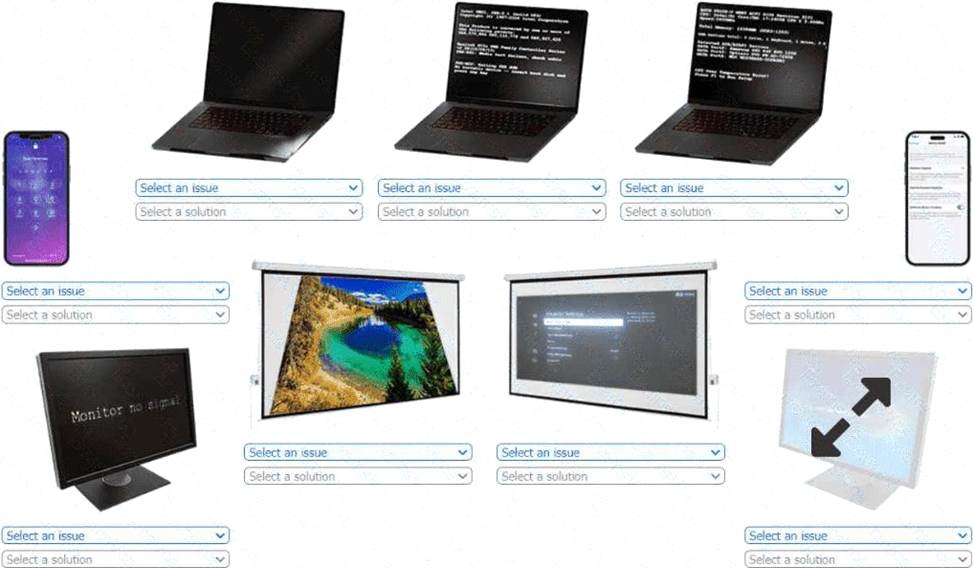
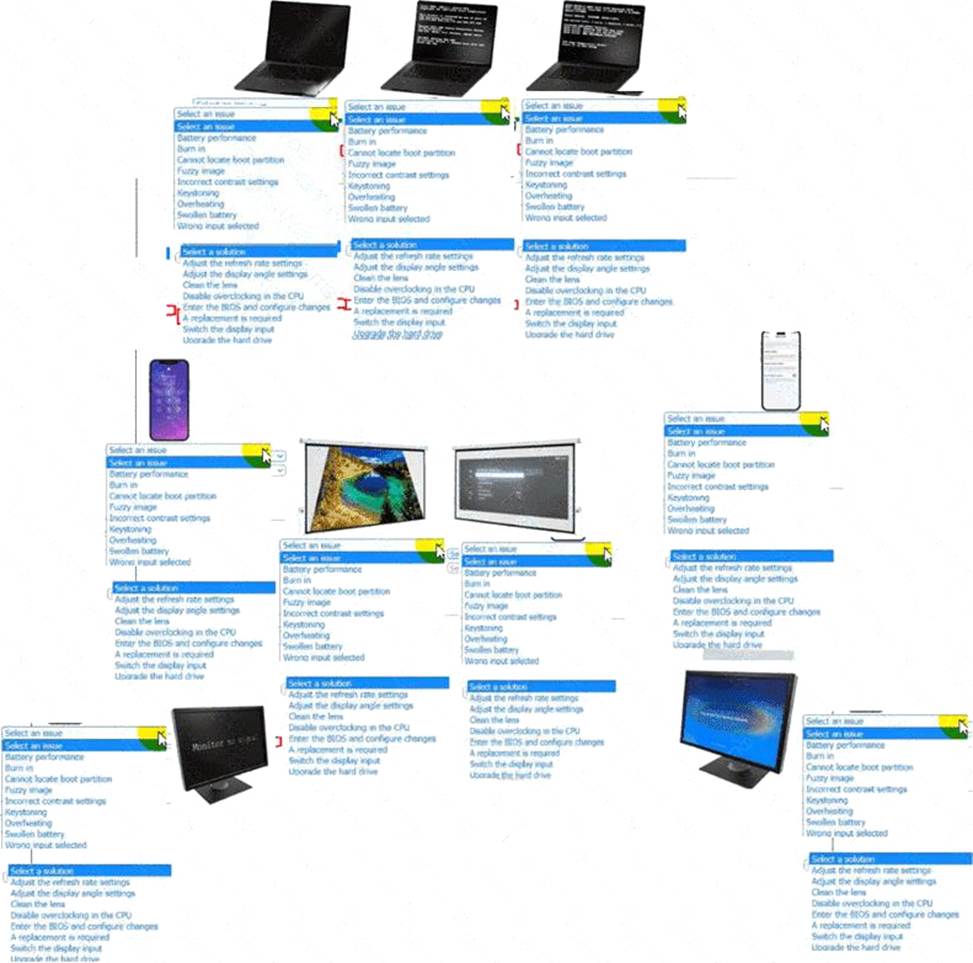
A technician is diagnosing several device issues reported by employees.
INSTRUCTIONS
Click on each device to review the issue. Then select the appropriate issue and solution from the drop-down menu. Each option may be used more than once.
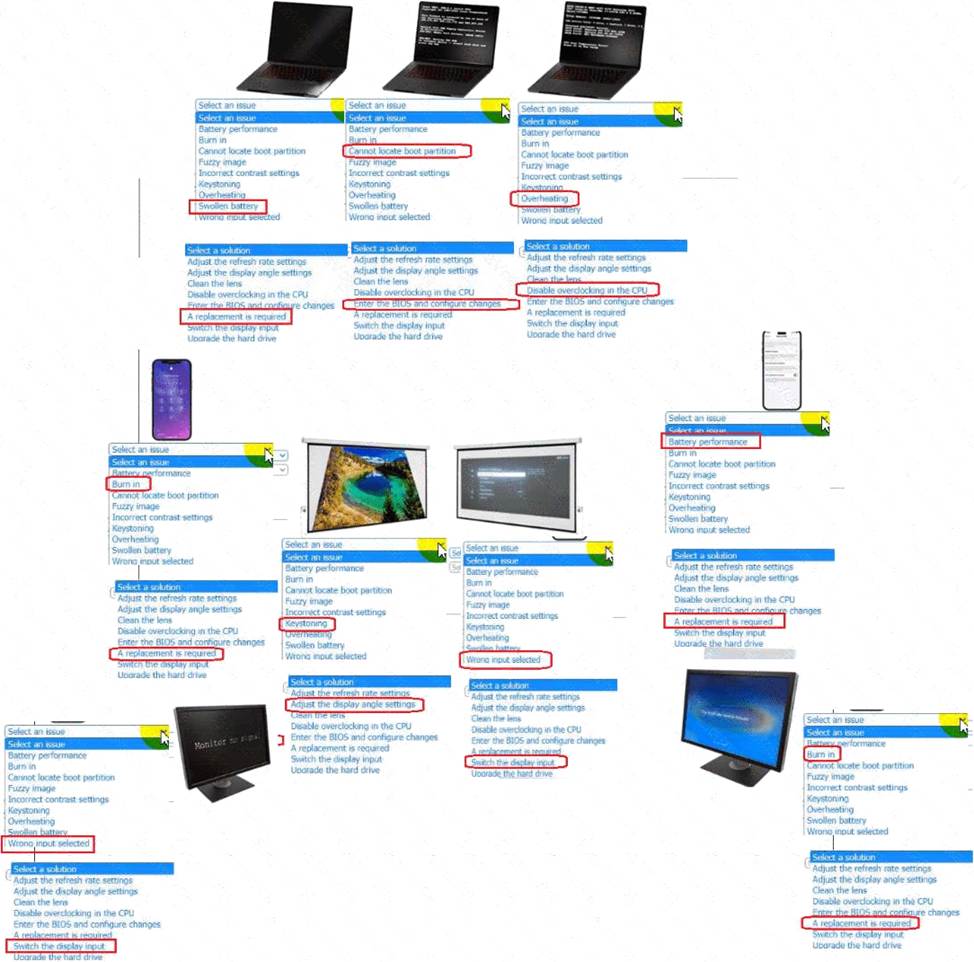
Explanation:
A screenshot of a computer AI-generated content may be incorrect.
Which of the following is an advantage of using VDI?
- A . Authentication is not required on a domain.
- B . Licensing costs are minimized.
- C . Less manual configuration is needed for each workstation.
- D . A virus is automatically contained locally.
C
Explanation:
Virtual Desktop Infrastructure (VDI)hosts desktop environments on centralized servers. This allows rapid deployment and consistent configuration across multiple users, minimizing manual setup and easing IT management.
Option A: VDI still uses standard authentication methods.
Option B: Licensing can actually be more expensive due to virtualization software and backend servers.
Option D: VDI centralizes the desktop environment ― viruses would affect the virtual session, not be "contained locally."
CompTIA A+ Core 1 Exam Objective
Reference:
Objective 4.1: Compare and contrast cloud computing concepts.
A technician receives a tablet that looks like it has a bulge inside. The bulge is pushing the screen away from the backplate. The tablet still turns on when it is plugged in, but the screen looks damaged and turns off when unplugged.
Which of the following is the most likely cause of this issue?
- A . Malfunctioning power supply
- B . Damaged charge port
- C . Deprecated battery
- D . Broken screen
C
Explanation:
Abulging tablet casingis a classic sign of aswollen lithium-ion battery, often caused by age, overheating, or overcharging. This is adangerous condition, as swollen batteries can rupture or catch fire. It also explains why the tablet only works when plugged in ― the battery is no longer holding a charge.
Option A: Power supply issues wouldn’t cause physical bulging.
Option B: A bad charge port wouldn’t cause screen damage or physical distortion.
Option D: A broken screen could cause display issues, but not the bulging chassis.
CompTIA A+ Core 1 Exam Objective
Reference: Objective 1.4: Given a scenario, configure settings and use cases for laptops and mobile devices.
Which of the following network services is used to assign an IP address to a network host?
- A . DHCP
- B . DNS
- C . LDAP
- D . SMTP
A
Explanation:
DHCP (Dynamic Host Configuration Protocol) is the service used to automatically assign IP addresses to network hosts. It dynamically manages the distribution of IP addresses and configuration details (like subnet mask, gateway, and DNS servers), ensuring no two devices are assigned the same address on the network.
Option B (DNS): Incorrect. DNS translates domain names into IP addresses but does not assign them.
Option C (LDAP): Incorrect. LDAP is a protocol used for accessing and maintaining directory services, such as user information and permissions.
Option D (SMTP): Incorrect. SMTP is used for sending and receiving email, not for IP address assignment.
References:
CompTIA A+ Core 1 Objectives: 2.5 (Network configuration)
A user prints a spreadsheet in duplex mode. The spreadsheet is difficult to read because some of the columns spill onto the second side of the page.
Which of the following should the user do to prevent the issue but still print on both sides of the page?
- A . Turn off duplex printing.
- B . Try a smaller font size in the spreadsheet.
- C . Change the page orientation.
- D . Use a different print driver.
C
Explanation:
Changing the page orientation(e.g., fromportrait to landscape) allows wider columns to fit on one side of the page. This maintains readability while continuing to use duplex printing.
Option A: Disabling duplex defeats the goal of printing on both sides.
Option B: May help, but could make the document harder to read if the font is too small.
Option D: Unlikely to resolve formatting issues related to layout and dimensions.
CompTIA A+ Core 1 Exam Objective
Reference:
Objective 3.7: Given a scenario, troubleshoot common printer problems.
A technician is troubleshooting a computer that has random BSOD alerts and intermittently freezes during normal use. Performance degrades as the day goes on. No new software or hardware changes have been implemented. Freezing occurs under performance-intensive operations.
Which of the following hardware components is most likely at fault?
- A . Video card
- B . HDD
- C . RAM module
- D . TPM
C
Explanation:
Random BSODs (Blue Screen of Death), intermittent freezing, and degraded performance under load are common symptoms of failing or faulty RAM (Random Access Memory). Here’s the reasoning:
RAM Module (Correct Answer):
Faulty or failing RAM can cause random BSODs due to memory errors when the system attempts to read or write to corrupted memory locations.
Intermittent freezing, especially under performance-intensive operations, can occur because the CPU relies heavily on RAM for active processing tasks.
Over time, heat generated during usage can exacerbate RAM instability, leading to progressively worse performance throughout the day.
Solution: The technician should run a memory diagnostic tool, such as Windows Memory Diagnostic or MemTest86, to confirm if the RAM is at fault.
Incorrect Options:
Which of the following is a benefit of using a VLAN?
- A . It minimizes collision domains.
- B . It provides private access to cloud resources.
- C . It increases network address space.
- D . It enables secure network segmentation.
D
Explanation:
A VLAN (Virtual Local Area Network) segments a physical network into separate logical networks, enhancing security by isolating traffic.
Why Not A (Minimizes collision domains): VLANs manage broadcast domains, not collision domains.
Why Not B (Provides private access to cloud resources): VLANs operate within a local network, not cloud-specific.
Why Not C (Increases network address space): VLANs do not affect address space.
CompTIA A+ Exam
Reference: Core 1 (220-1201), Section 2.6, VLAN concepts.
A systems administrator deploys BitLocker to all devices. However, one of the desktop PCs is not able to encrypt the boot drive.
Which of the following should the administrator check?
- A . TPM
- B . CPU
- C . RAM
- D . HDD
A
Explanation:
BitLocker Drive Encryption in Windows requires a Trusted Platform Module (TPM)to encrypt the boot drive securely. The TPM is a dedicated microcontroller designed to secure hardware through integrated cryptographic keys. It validates system integrity during boot and securely stores the encryption keys. If BitLocker cannot find a TPM or it is disabled in BIOS/UEFI, drive encryption cannot proceed.
BitLocker can function without TPM using a USB startup key, but this compromises some security and is not recommended for managed enterprise environments.
#Reference:
"CompTIA A+ Certification All-in-One Exam Guide, Eleventh Edition" by Travis Everett and Andrew Hutz C Chapter 13, page 536C537.
"CompTIA A+ Guide to Managing and Troubleshooting PCs" by Mark Soper C Chapter 13, page 446C 447.
"CompTIA A+ Complete Study Guide" by Quentin Docter C Chapter 1, page 36C38.