
Cisco 300-630 Practice Exams
Last updated on Oct 22,2026- Exam Code: 300-630
- Exam Name: Implementing Cisco Application Centric Infrastructure - Advanced (DCACIA)
- Certification Provider: Cisco
- Latest update: Oct 22,2026
The servers are dual-homed to Cisco ACI Leaf1001 and Leaf1002 and must be connected in an active-active mode. The server NICs do not support LACP.
These settings have already been configured on the Cisco ACI:
• interface policy group type Leaf Access Port named active-active-noLACP
• three port selectors: port-1. port-2. and port-3
• AEP called active-active-noLACP has three associated EPGs: EPG-A. EPG-B, and EPG-C
Which action must be taken to migrate the server ports to a different leaf switch in the event of a catastrophic failure?
- A . Enable IP Data Plane Learning.
- B . Configure failover VLANs in the VLAN pool.
- C . Enable Port Tracking under System Settings.
- D . Configure the AEP on a physical domain.
D
Explanation:
Configuring the Attachable Entity Profile (AEP) on a physical domain is necessary to ensure server ports can migrate to a different leaf switch in the event of a catastrophic failure. This configuration associates server ports with specific leaf switches and allows for seamless migration of connections without relying on Link Aggregation Control Protocol (LACP), which the server NICs do not support.
Reference: = (Implementing Cisco Application Centric Infrastructure Official Cert Guide)
Refer to the exhibit.
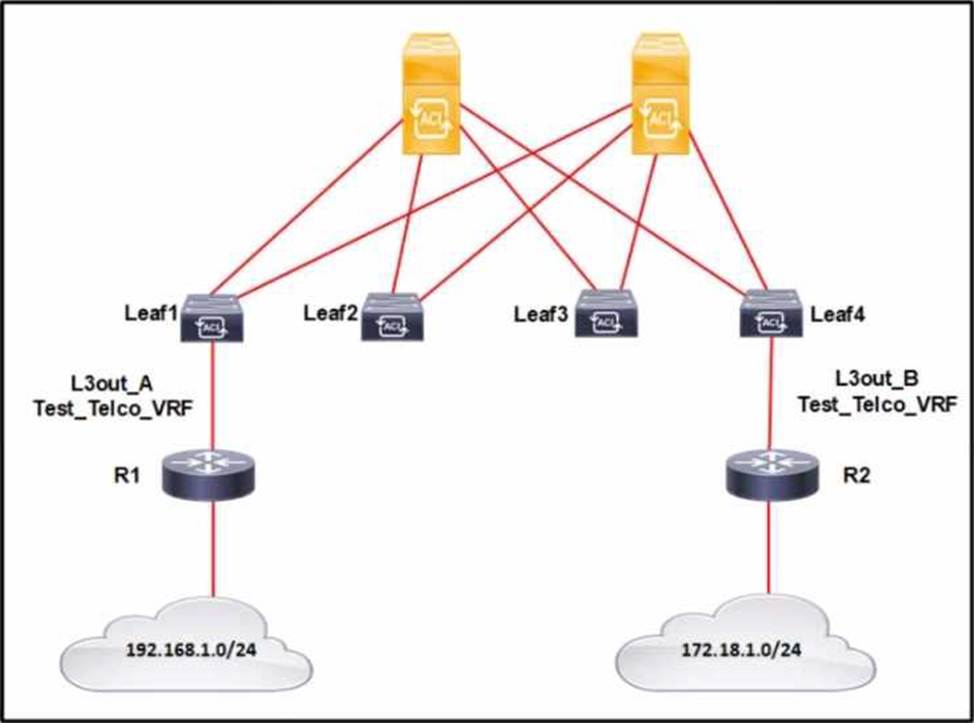
Which two sets of actions must be taken to permit subnet 192.168.1.0/24 to communicate with subnet 172.18.1.0/24 using Cisco ACI fabric? (Choose two.)
- A . Configure 192.168.1.0/24 with scope Export Route Control subnet under L3out_B.
Configure 192.168.1.0/24 with scope External subnet for external EPG under L3out_A. - B . Configure 172.18.1.0/24 with scope External subnet for external EPG under L3out_A.
Configure 192.168.1.0/24 with scope External subnet for external EPG under L3out_B. - C . Configure 172.18.1.0/24 with scope Export Route Control subnet under L3out_A.
Configure 172.18.1.0/24 with scope External subnet for external EPG under L3out_B. - D . Configure 172.18.1.0/24 with scope Export Route Control subnet under L3out_B.
Configure 192.168.1.0/24 with scope External subnet for external EPG under L3out_A. - E . Configure 192.168.1.0/24 with scope Export Route Control subnet under L3out_A. C
Configure 172.18.1.0/24 with scope External subnet for external EPG under L3out B.
B, D
Explanation:
To enable communication between the subnets 192.168.1.0/24 and 172.18.1.0/24 using Cisco ACI fabric, it is necessary to configure the subnets appropriately. For option B, setting 172.18.1.0/24 as an External subnet for an external EPG under L3out_A allows it to be recognized as part of an external network, facilitating communication with other networks within the ACI environment. Similarly, for option D, configuring 172.18.1.0/24 with the Export Route Control scope under L3out_B ensures that this route is advertised out of L3out_B, allowing it to reach other network segments, including those connected via L3out_A where the subnet 192.168.1.0/24 resides. These configurations are crucial for proper routing between these two distinct subnets across the Cisco ACI fabric.
Reference: = (Implementing Cisco Application Centric Infrastructure Official Cert Guide)
What is a characteristic of application-centric design in Cisco ACI?
- A . One-to-one mapping between EPGs and bridge domains Is enforced.
- B . A bridge domain has only one subnet.
- C . EPGs represent different application tiers.
- D . It simplifies gradual migration from a traditional network.
C
Explanation:
An application-centric design in Cisco ACI focuses on the application requirements and interactions between different application components. In this design, EPGs (Endpoint Groups) represent different application tiers, such as web, application, and database tiers. This approach allows for a more flexible and scalable network configuration that aligns with the application architecture, enabling policies to be applied based on the application’s needs rather than the network topology.
Reference: = Implementing Cisco Application Centric Infrastructure Official Cert Guide
Refer to the exhibit.
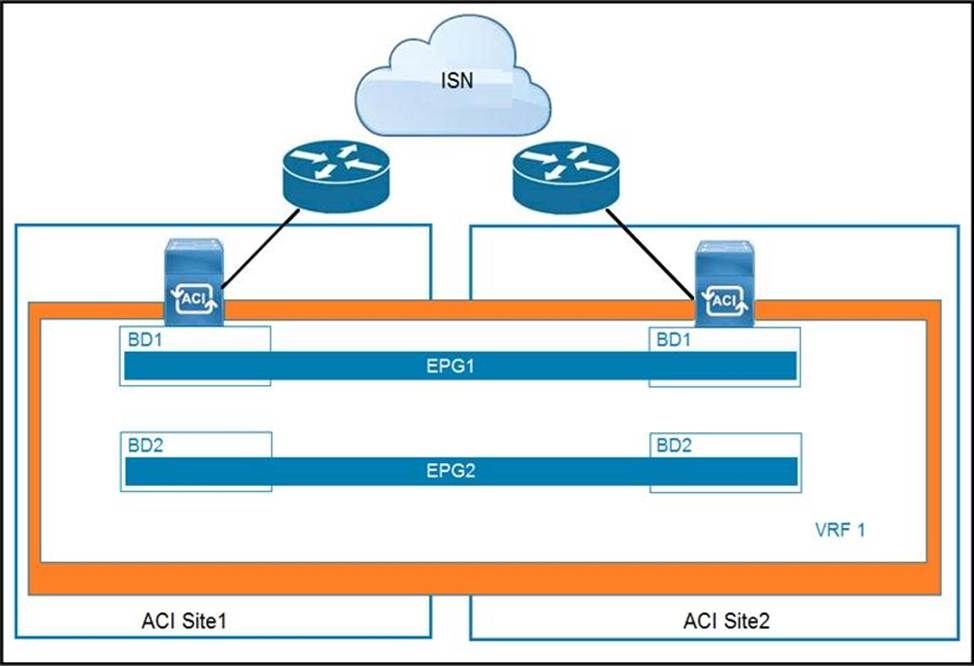
Which feature is available across sites if EPGs are stretched?
- A . active-active high-availability firewall clustering
- B . Layer 3 routing between sites
- C . Layer 2 flooding across sites
- D . live virtual machine migration
C
Explanation:
When EPGs (Endpoint Groups) are stretched across sites, Layer 2 flooding is available across these sites. This allows for the extension of the Layer 2 domain and the sharing of broadcast, unknown unicast, and multicast traffic between EPGs at different locations.
Reference: = Implementing Cisco Application Centric Infrastructure Official Cert Guide
An organization deploys active-active data centers and active-standby firewalls in each data center.
Which action should be taken in a Cisco ACI Multi-Pod to maintain traffic symmetry through the firewalls?
- A . Enable Endpoint Dataplane Learning
- B . Disable service node Health Tracking
- C . Enable Pod ID Aware Redirection
- D . Disable Resilient Hashing
C
Explanation:
In a scenario where an organization deploys active-active data centers with active-standby firewalls in each data center within a Cisco ACI Multi-Pod environment, maintaining traffic symmetry through firewalls is crucial for consistent security policy enforcement and avoiding asymmetric routing issues. Enabling Pod ID Aware Redirection allows for intelligent redirection of traffic based on pod identification numbers so that return traffic can be directed back through the same path it originated from, thus maintaining symmetry even in complex multi-pod deployments.
Reference: Implementing Cisco Application Centric Infrastructure Official Cert Guide
Exhibit.
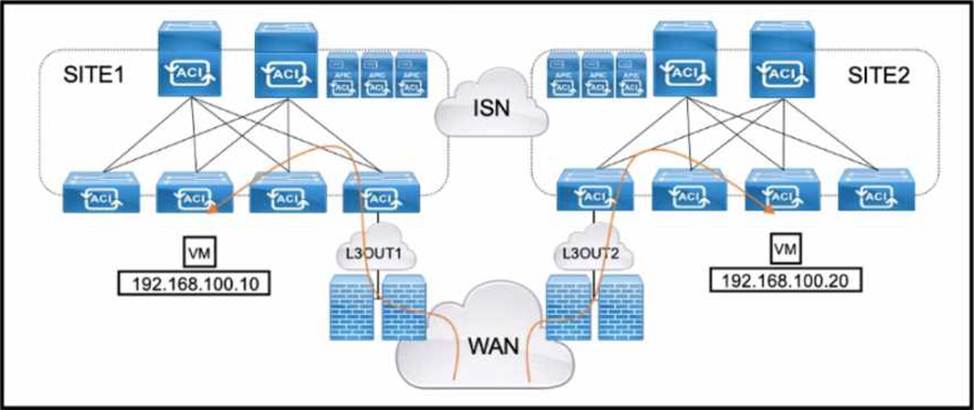
An engineer must implement a solution to ensure that ingress and egress traffic flows are symmetric for all stretched bridge domains in the customer multisite architecture.
Which configuration accomplishes this goal?
- A . Configure host route advertisement on the bridge domains.
- B . Enable anycast services to the firewalls in both fabrics.
- C . Implement a policy-based redirect using a service graph.
- D . Add a new stretched external EPG to the existing L3outs.
A
Explanation:
In a Cisco ACI multisite setup, symmetric ingress and egress traffic flows for stretched bridge domains are essential for consistent network behavior. Configuring host route advertisement on the bridge domains allows each site to advertise its local endpoints’ routes. This ensures that return traffic is directed to the originating site, maintaining symmetric traffic flow. When host routes are advertised from the bridge domains, it allows for more granular control of traffic, ensuring that packets take the same path into and out of the network, which is particularly important in stretched scenarios where applications might span multiple sites.
Reference: = (Implementing Cisco Application Centric Infrastructure Official Cert Guide)
Which two components must be configured as stretched to establish intra-VRF communication between two EPGs that are deployed in different sites and different bridge domains? (Choose two.)
- A . contract
- B . tenant
- C . application profile
- D . bridge domain
- E . EPG
D, E
Explanation:
To establish intra-VRF communication between two EPGs deployed across different sites with different bridge domains, stretching the bridge domain and EPG components is necessary.
Option D, “bridge domain,” and Option E, “EPG,” must be configured as stretched to facilitate communication across different sites within the same VRF.
Reference: = Implementing Cisco Application Centric Infrastructure Official Cert Guide
Refer to the exhibit.
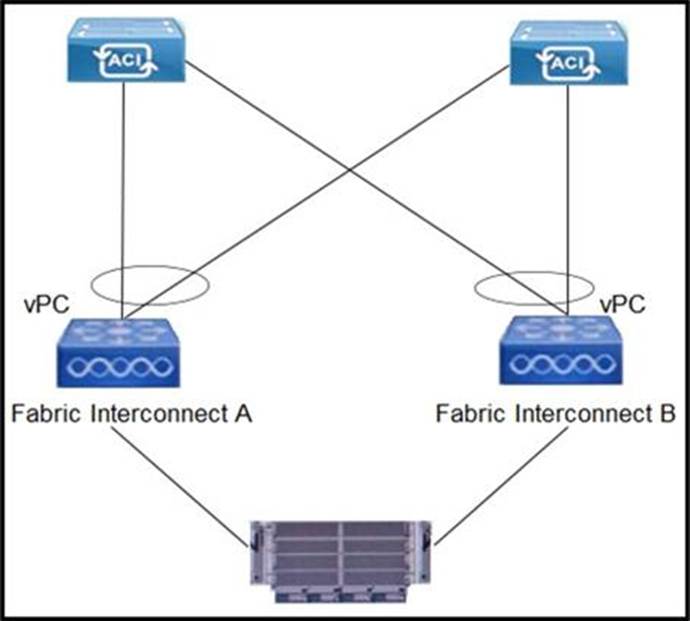
Which configuration mode must be selected for the VMM vSwitch Port Channel policy to avoid MAC flapping on the Cisco UCS Fls and Cisco ACI leaf switches?
- A . LACP Passive
- B . MAC Pinning
- C . LACP Active
- D . Static Channel C Mode On
B
Explanation:
To prevent MAC flapping on Cisco UCS Fabric Interconnects and ACI leaf switches, MAC Pinning should be selected for the VMM vSwitch Port Channel policy. This ensures consistent uplink usage for each virtual machine’s traffic, avoiding MAC address movement across multiple uplinks.
Reference: = Implementing Cisco Application Centric Infrastructure Official Cert Guide
Refer to the exhibit.
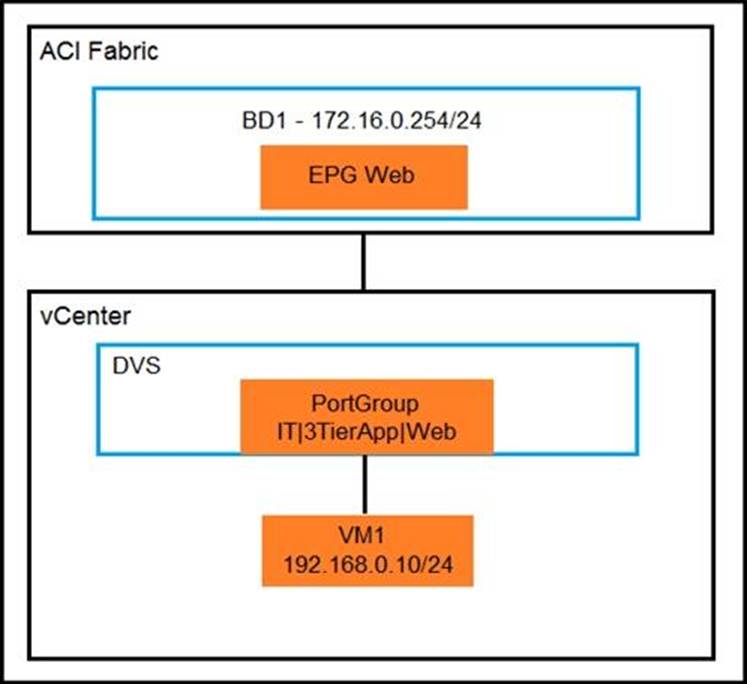
An organization migrates its virtualized servers from a legacy environment to Cisco ACI. VM1 is incorrectly attached to PortGroup IT|3TierApp|Web.
Which action limits IP address learning in BD1?
- A . Enable Enforce Subnet Check
- B . Enable Rouge Endpoint Control
- C . Enable GARP-based EP Move Detection Mode
- D . Disable Remote EP Learn
A
Explanation:
To limit IP address learning in BD1 when VM1 is incorrectly attached to a PortGroup, enabling the Enforce Subnet Check is the correct action. This feature ensures that only IP addresses belonging to the defined subnets under the bridge domain are learned, preventing incorrect IP data from being disseminated across the network.
Reference: = (Implementing Cisco Application Centric Infrastructure Official Cert Guide)
Refer to the exhibit.
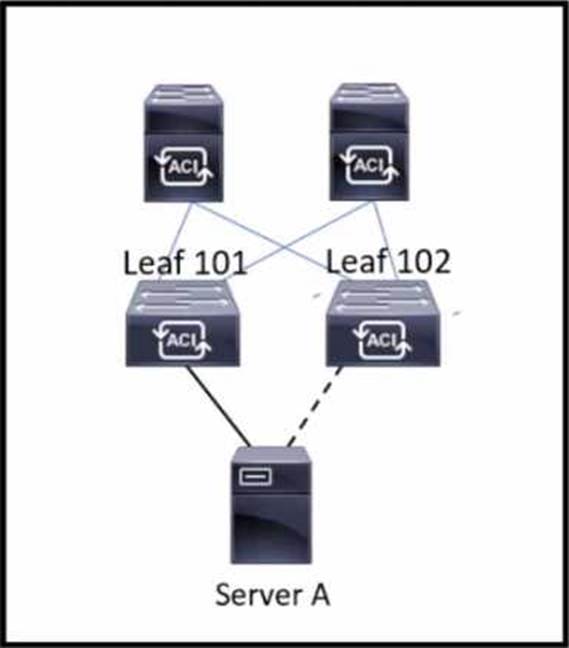
Server A is connected to the Cisco ACI fabric using two teamed interfaces. One interface in a team is configured as active and the other remains in standby mode. When a failover occurs and the standby interface becomes active, it uses its built-in MAC address to send traffic.
Which bridge domain configuration must be applied to resolve the issue?
- A . Enable ARP flooding.
- B . Activate Limit IP Learning to Subnet.
- C . Configure Hardware proxy.
- D . Set L2 Unknown Unicast to Flood
A
Explanation:
When Server A is connected to the Cisco ACI fabric using teamed interfaces with one active and one standby interface, enabling ARP flooding ensures that the ACI fabric can learn about the new active interface after a failover. This allows for seamless communication continuity even when the standby interface becomes active and starts sending traffic with its built-in MAC address.