
Cisco 300-630 Practice Exams
Last updated on Oct 22,2026- Exam Code: 300-630
- Exam Name: Implementing Cisco Application Centric Infrastructure - Advanced (DCACIA)
- Certification Provider: Cisco
- Latest update: Oct 22,2026
What is a characteristic of a stretched bridge domain solution between Cisco ACI sites with Layer 2 flood enabled?
- A . BUM traffic between sites leverages ISN multicast replication.
- B . The solution reduces control plane overhead.
- C . Spine head-end replication is used to forward BUM traffic between sites.
- D . Contracts are local to the provided site.
C
Explanation:
In a stretched bridge domain solution between Cisco ACI sites with Layer 2 flood enabled, spine head-end replication is utilized to forward Broadcast, Unknown unicast, and Multicast (BUM) traffic between the sites. This method leverages the spine switches at each site to replicate BUM traffic to other sites, ensuring that all endpoints within the stretched bridge domain can receive such traffic. This approach is chosen over ISN multicast replication because it simplifies the overall design and reduces bandwidth consumption on inter-site links by avoiding unnecessary duplication of BUM traffic.
Reference: = (Implementing Cisco Application Centric Infrastructure Official Cert Guide)
Refer to the exhibit.
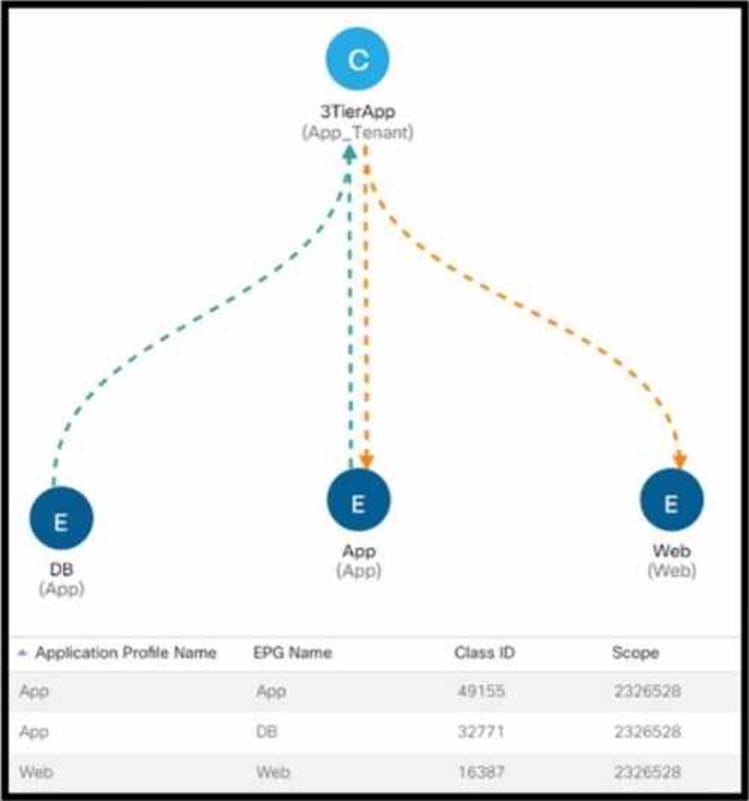
New e-commerce software is deployed on Cisco ACI fabric.
The environment must meet these requirements;
• The overall number of contracts must be reduced by reusing the existing contracts within a VRF when possible
• The e-commerce software must communicate only with software EPGs that are part of the same ANP.
• The e-commerce software must be prevented from communicating with applications in different AN Ps.
Which scope must be selected to meet these requirements?
- A . Tenant
- B . Global
- C . Endpoint Group
- D . Application Profile
C
Explanation:
The Endpoint Group (EPG) scope is the correct choice to meet the requirements for the e-commerce software in a Cisco ACI fabric. By selecting the EPG scope, contracts can be reused within the same Virtual Routing and Forwarding (VRF) context, reducing the overall number of contracts. Additionally, it ensures that the e-commerce software communicates only with software EPGs that are part of the same Application Network Profile (ANP), while preventing communication with applications in different ANPs.
Reference: = (Implementing Cisco Application Centric Infrastructure Official Cert Guide)
Refer to the exhibit.
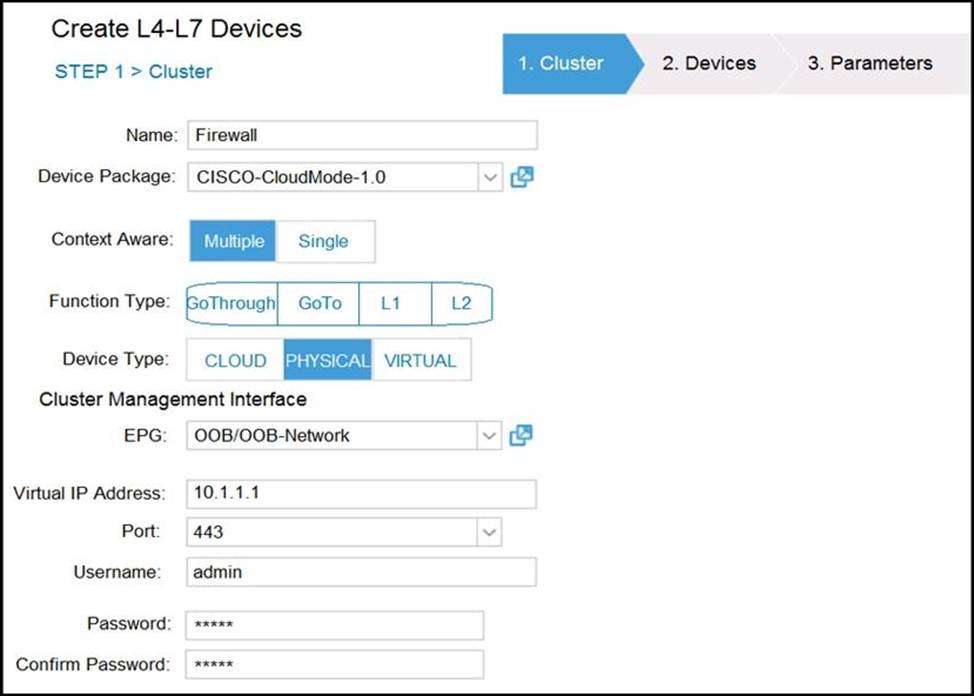
A network engineer configures a Layer 4 to Layer 7 device for an outside routed firewall that is connected to POD-1 inside a Cisco ACI fabric that consists of two pods. All traffic from POD-1 or POD-2 that uses the L3Out should pass through the routed firewall.
Which Function Type must be implemented in the service graph for POD-2 to use L3Out?
- A . GoThrough
- B . L1
- C . GoTo
- D . L2
C
Explanation:
In a Cisco ACI fabric, when configuring a Layer 4 to Layer 7 device for routing traffic through an external firewall connected to the inside of the fabric, the appropriate Function Type in the service graph must be selected to ensure that traffic from both POD-1 and POD-2 passes through the routed firewall when using L3Out. The “GoTo” Function Type is used in scenarios where all traffic destined for L3Out needs to be redirected through a service node like a firewall. This ensures that regardless of the source pod, traffic will traverse the service node before exiting the fabric.
Reference: Implementing Cisco Application Centric Infrastructure Official Cert Guide
Refer to the exhibit.
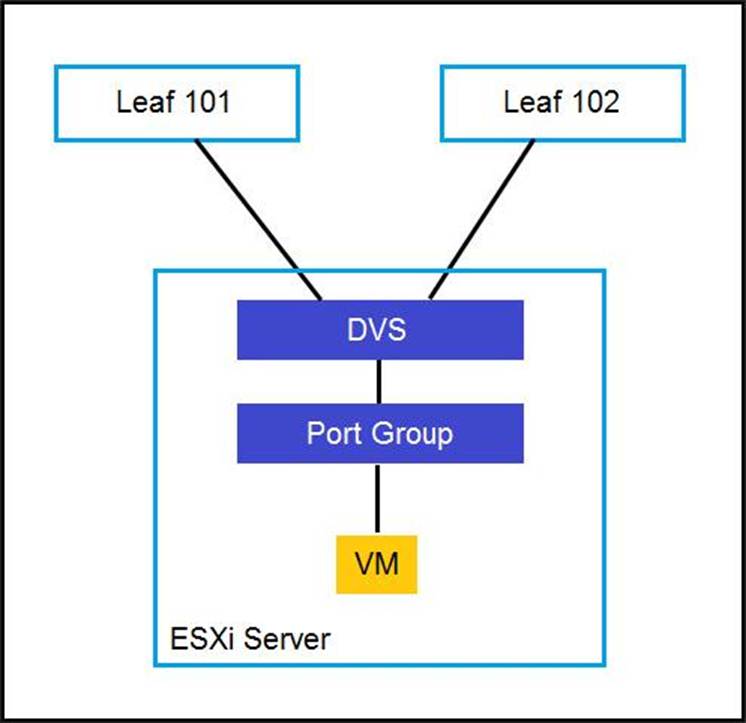
An engineer is configuring a vSwitch policy in the existing Cisco ACI fabric. The requirement is for the Cisco ACI leaf to learn individual MAC addresses from the same physical port.
Which vSwitch policy configuration mode must be enabled to meet this requirement?
- A . MAC pinning
- B . MAC binding
- C . LACP passive
- D . LACP active
A
Explanation:
For the Cisco ACI leaf to learn individual MAC addresses from the same physical port, “MAC pinning” mode must be enabled in the vSwitch policy configuration. This mode allows each ESXi vSwitch port group to pin to a specific uplink or set of uplinks, enabling independent MAC address learning for each pinned uplink, which is essential for distinguishing multiple VMs on an ESXi host by the leaf switch.
Reference: Implementing Cisco Application Centric Infrastructure Official Cert Guide
Refer to the exhibit.
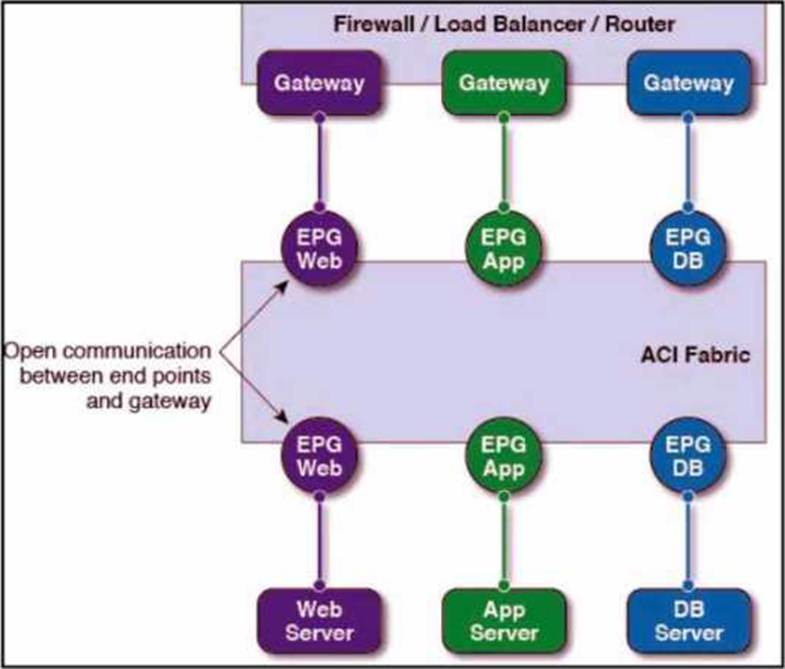
Which type of design approach is shown?
- A . traditional VLAN/subnet model
- B . edge-core-edge model
- C . application-centric
- D . network-centric
C
Explanation:
The design approach shown in the exhibit is application-centric. This model focuses on the application requirements and defines network policies based on the needs of the application rather than traditional network constructs. It allows for a more dynamic and flexible network configuration that aligns with the application’s behavior and interactions.
An organization expands a Cisco ACI Multi-Pod from two to six pods and must ensure that the control plane scales.
What should be configured in the IPN to ensure that BUM traffic is forwarded efficiently across the IPN?
- A . spine headend replication
- B . BIDIR-PIM
- C . MP-BGP
- D . MSDP
A
Explanation:
In a Cisco ACI Multi-Pod environment that is expanding, spine headend replication should be configured to ensure efficient forwarding of BUM (Broadcast, Unknown unicast, Multicast) traffic across the IPN (Inter-Pod Network). This configuration optimizes the control plane scaling and ensures that BUM traffic is handled effectively, maintaining network performance and stability.
Reference: Implementing Cisco Application Centric Infrastructure Official Cert Guide
In a Cisco ACI Multi-Site fabric, the Inter-Site BUM Traffic Allow option is enabled in a specific stretched bridge domain.
What is used to forward BUM traffic to all endpoints in the same broadcast domain?
- A . ingress replication on the spines in the source site
- B . egress replication on the source leaf switches
- C . egress replication on the destination leaf switches
- D . ingress replication on the spines in the destination site
A
Explanation:
In a Cisco ACI Multi-Site fabric, when the Inter-Site BUM Traffic Allow option is enabled in a specific stretched bridge domain, ingress replication on the spines in the source site is used to forward Broadcast, Unknown unicast, and Multicast (BUM) traffic to all endpoints in the same broadcast domain. This method ensures that BUM traffic is efficiently replicated across the fabric, reaching all relevant endpoints without overwhelming the network with unnecessary traffic4.
Reference: = Solved: Cisco ACI Multipod – BUM traffic – Cisco Community.
Refer to the exhibit.
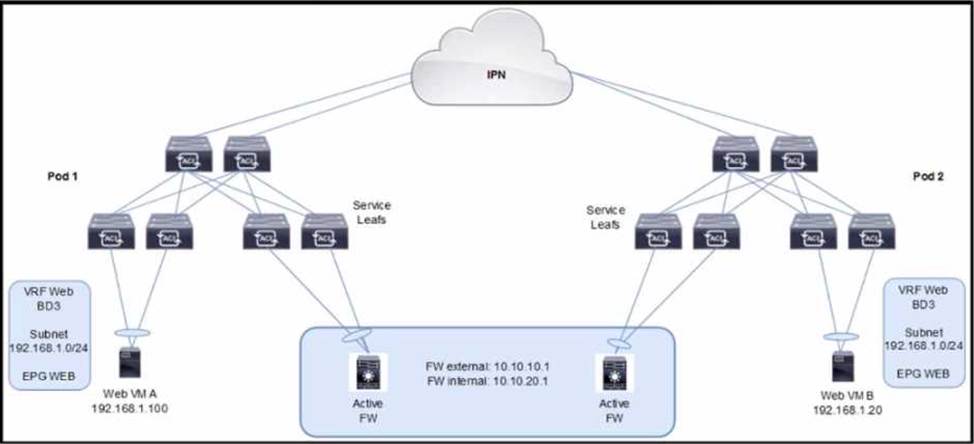
An engineer is deploying a Cisco ACI Multi-Pod with an independent active/active Layer 3 firewall cluster across the pods.
Which task must the engineer perform to prevent the creation of duplicate IP/MAC entries across the pods?
- A . Configure anycast service.
- B . Disable Limit IP Learning to Subnet.
- C . Configure the subnet as shared.
- D . Enable Host Route Advertisement.
C
Explanation:
In a Cisco ACI Multi-Pod deployment, configuring the subnet as shared is crucial to prevent duplicate IP/MAC entries across pods. This allows endpoints in different pods to be part of the same subnet without causing IP/MAC duplication issues, ensuring policy enforcement by the firewall
cluster.
Reference: = (Implementing Cisco Application Centric Infrastructure Official Cert Guide)
What are two P8R characteristics of the Cisco ACI Active-Active Across Pods deployment mode in Cisco ACI Multi-Pod design? (Choose two.)
- A . Traffic is dynamically redirected to the firewall that owns the connection.
- B . This mode causes the traffic to flow asymmetrically.
- C . Deployment occurs in go-to mode only.
- D . Deployment occurs in transparent mode.
- E . The connection state is unsynchronized.
A, E
Explanation:
In an Active-Active Across Pods deployment mode, traffic is intelligently redirected to the firewall that currently owns the connection state, allowing for efficient use of network resources. Additionally, the connection state being unsynchronized means that each pod can independently manage its connections without relying on a centralized state, enhancing the resilience and scalability of the network1.
Reference: = (Implementing Cisco Application Centric Infrastructure Official Cert Guide)
Which two actions should be taken to ensure a scalable solution when multiple EPGs in a VRF require unrestricted communication? (Choose two.)
- A . Configure a taboo contract between the EPGs that require unrestricted communication between each other.
- B . Enable Preferred Group Member under the EPG Collection for VRF section.
- C . Set the VRF policy control enforcement preference to Unenforced.
- D . Set the EPGs that require unrestricted communication between each other as preferred group members.
- E . Set the EPGs that require policy enforcement between each other as preferred group members.
B, D
Explanation:
For unrestricted communication between multiple EPGs within a VRF, setting them as preferred group members is essential for scalability.
Option B, “Enable Preferred Group Member under the EPG Collection for VRF section,” allows all EPGs within this collection to communicate without restrictions by default.
Option D, “Set the EPGs that require unrestricted communication between each other as preferred group members,” designates these groups for unrestricted
intercommunication.
Reference: = Implementing Cisco Application Centric Infrastructure Official Cert Guide