
Cisco 300-630 Practice Exams
Last updated on Oct 22,2026- Exam Code: 300-630
- Exam Name: Implementing Cisco Application Centric Infrastructure - Advanced (DCACIA)
- Certification Provider: Cisco
- Latest update: Oct 22,2026
An existing Cisco ACI Multi-Site setup with default fabric settings contains endpoints that communicate with an MTU of 1500.
What is the minimum MTU value that must be supported by the ISN to allow control plane endpoint information exchange between sites?
- A . 9000
- B . 1554
- C . 9100
- D . 1600
B
Explanation:
The minimum MTU value that must be supported by the ISN to allow control plane endpoint information exchange between sites in a Cisco ACI Multi-Site setup with default settings is 1554 bytes (B). This accounts for the standard MTU of 1500 bytes plus additional overhead for VXLAN encapsulation. An MTU of 9000 (A) or 9100 © is not the minimum required, and 1600 (D) is not related to the default fabric settings5.
Reference: = (Multi-site /Multi-Pod MTU Jumbo Frames5)
A packet is routed between two endpoints on different Cisco ACI leaf switches.
Which VXLAN VNID is applied to the packet?
- A . VRF
- B . EPG
- C . BD
- D . FD
A
Explanation:
When a packet is routed between two endpoints on different Cisco ACI leaf switches, the VXLAN VNID applied to the packet is the VRF (Virtual Routing and Forwarding) VNID. This VNID enables forwarding of the packet through tenant virtual routing and forwarding domains within the fabric34.
Reference: = Cisco APIC Layer 3 Networking Configuration Guide, Release 3.x and later
Refer to the exhibit.
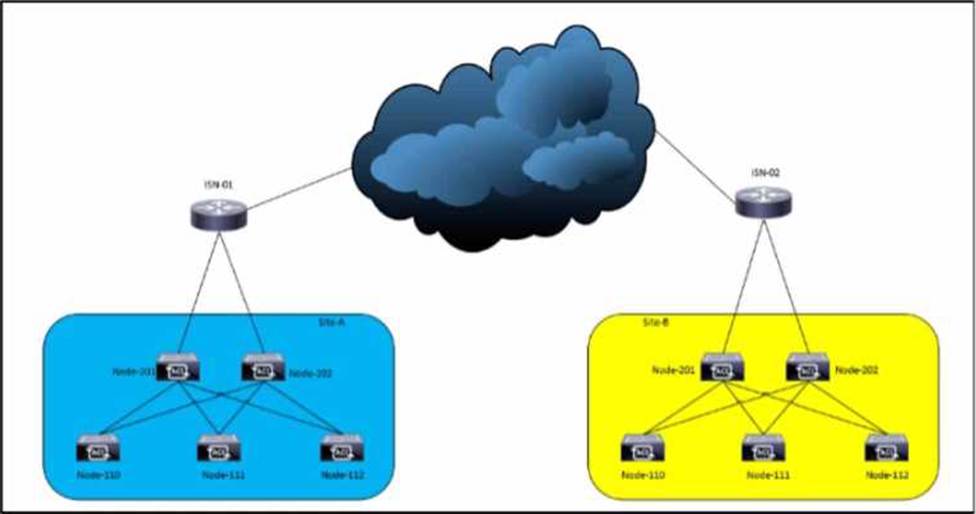
In a Cisco ACI Multi-Site deployment, traffic fails to pass between Site-A and Site-B. and an engineer troubleshoots the link between ISN-01 and Node-201.
Which set of actions establishes connectivity?
- A . • Configure the MTU on the link to be at least 1000 bytes larger than the MTU of the ACI fabrics.
• Configure the link as a routed subinteriace by using VLAN-4. - B . • Configure the MTU on the link to be at least 100 bytes larger than the MTU of the ACI fabrics.
• Configure the link as an access interface by using VLAN-4. - C . • Configure the MTU on the link to be at least 100 bytes larger than the MTU of the ACI fabrics.
• Configure the link as a routed subinterface by using VLAN-4. - D . • Configure the MTU on the link to be at least 1000 bytes larger than the MTU of the ACI fabrics.
• Configure the link as an access interface by using VLAN-4.
C
Explanation:
In a Cisco ACI Multi-Site deployment, proper configuration of the inter-site link is crucial for traffic to pass between different sites. The MTU size is particularly important; if it’s not set correctly, packets may be dropped or fragmented, leading to connectivity issues. By configuring the MTU on the link to be at least 100 bytes larger than that of the ACI fabrics, you allow for encapsulation overhead without packet drops due to exceeding MTU limits. Additionally, configuring the link as a routed subinterface using VLAN-4 is necessary for routing across different broadcast domains, which is essential for inter-site communication in an ACI fabric.
Reference: Implementing Cisco Application Centric Infrastructure Official Cert Guide
How is broadcast forwarded in Cisco ACI Multi-Pod after ARP flooding is enabled?
- A . For the specific bridge domain, all spines forward the broadcast frames to IPN routers
- B . Broadcast frames are forwarded inside the pod and across the IPN using the multicast address that is associated to the bridge domain
- C . Within a pod, the ingress leaf switch floods the broadcast frame on all fabric ports
- D . Ingress replication is used on the spines to forward broadcast frames in the IPN infrastructure
B
Explanation:
In Cisco ACI Multi-Pod, when ARP flooding is enabled, broadcast traffic within a bridge domain is managed by associating a multicast address to the bridge domain. The broadcast frames are then forwarded within the pod and across the Inter-Pod Network (IPN) using this multicast address.
Reference: = Implementing Cisco Application Centric Infrastructure Official Cert Guide
A customer plans to deploy a Cisco ACI Multi-Pod deployment.
Which two features must be implemented on the IPN switches?
- A . • Enable BIDIR-PIM.
• Configure a minimum multicast range of/15. - B . • Enable BIDIR-PIM.
• Configure a maximum multicast range of/23. - C . • Configure PIM anycast RP.
• Configure a minimum multicast range of 123. - D . • Configure PIM anycast RP.
• Configure a maximum multicast range of /15.
C
Explanation:
Configuring Protocol Independent Multicast (PIM) anycast RP allows for efficient multicast traffic routing between pods by having multiple Rendezvous Points (RPs) share the same IP address. A maximum multicast range of /15 provides sufficient address space to support the scale of multicast traffic typically required in such deployments.
Reference: = (Implementing Cisco Application Centric Infrastructure Official Cert Guide)
An engineer created a Cisco ACI environment in which multiple tenants reuse the same contract. The requirement is to prevent inter-tenant communication.
Which action meets this requirement?
- A . Create the contract in the user tenant with the scope set to VRF and exported to other tenants
- B . Create the contract in the common tenant with the scope set to Tenant
- C . Create the contract in the user tenant with the scope set to Global and exported to other tenants
- D . Create the contract in the common tenant with the scope set to Global
A
Explanation:
To prevent inter-tenant communication while reusing the same contract, the contract should be
created in the user tenant with the scope set to VRF and then exported to other tenants. This approach allows the contract to be shared across tenants while maintaining the isolation of each tenant’s VRF. By setting the scope to VRF, the contract’s policies apply only within the context of the specified VRF, thus preventing communication between tenants5678.
Reference: = Implementing Cisco Application Centric Infrastructure Official Cert Guide
Refer to the exhibit.
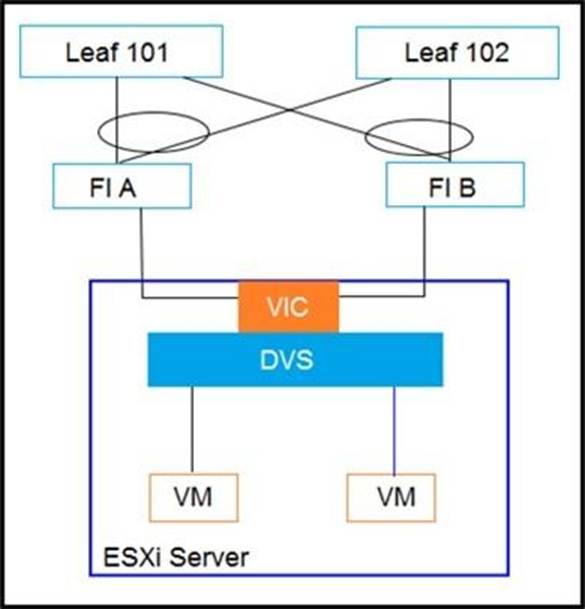
Between Cisco UCS Fls and Cisco ACI leaf switches, CDP is disabled, the LLDP is enabled, and LACP is in Active mode.
Which two discovery protocols and load-balancing mechanism combinations can be implemented for the DVS? (Choose two.)
- A . CDP enabled, LLDP disabled, and LACP Active
- B . CDP disabled, LLDP enabled, and MAC Pinning
- C . CDP enabled, LLDP disabled, and MAC Pinning
- D . CDP enabled, LLDP enabled, and LACP Active
- E . CDP enabled, LLDP disabled, and LACP Passive
- F . CDP disabled, LLDP enabled, and LACP Passive
B, F
Explanation:
In the given scenario where CDP is disabled, LLDP is enabled, and LACP is in Active mode between Cisco UCS FIs and Cisco ACI leaf switches for the DVS setup, the compatible discovery protocol would be LLDP since it’s already enabled. As for load-balancing mechanisms with this setup: MAC Pinning can be used without relying on any link discovery protocol like CDP or LACP; hence option B is valid.
Option F suggests using LACP in Passive mode, which could complement the existing Active mode on other devices to establish an LACP negotiation successfully.
Reference: = Implementing Cisco Application Centric Infrastructure Official Cert Guide
Cisco ACI fabric is migrated from network-centric mode to application-centric mode.
What is possible in an application-centric design?
- A . remapping of VLAN pools
- B . migration of bare metal servers to virtual machines
- C . creation of additional EPGs under one bridge domain
- D . Cisco ACI VMM integration with hypervisors
C
Explanation:
In an application-centric design, the creation of additional EPGs under one bridge domain is possible. This allows for greater flexibility in managing and segmenting network traffic for different applications or services within the same bridge domain.
Reference: = Network Centric to ACI Centric Migration – Cisco
DRAG DROP
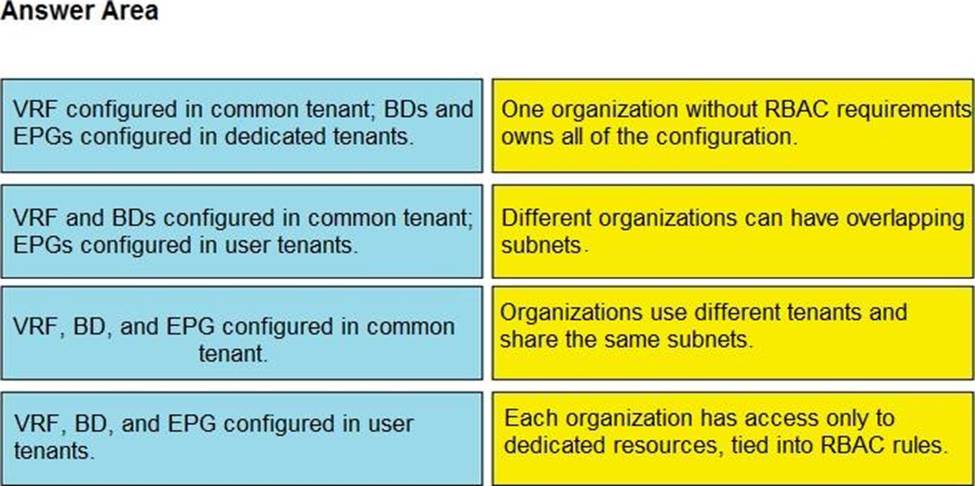
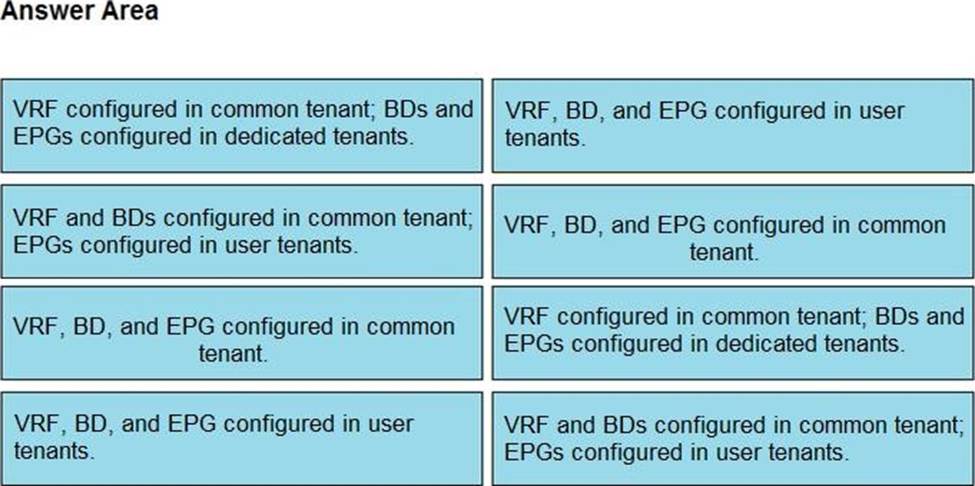
Drag and drop the tenant implementation designs from the left onto the outcomes of the design when a greenfield Cisco ACI fabric is deployed on the right.
Refer to the exhibit.
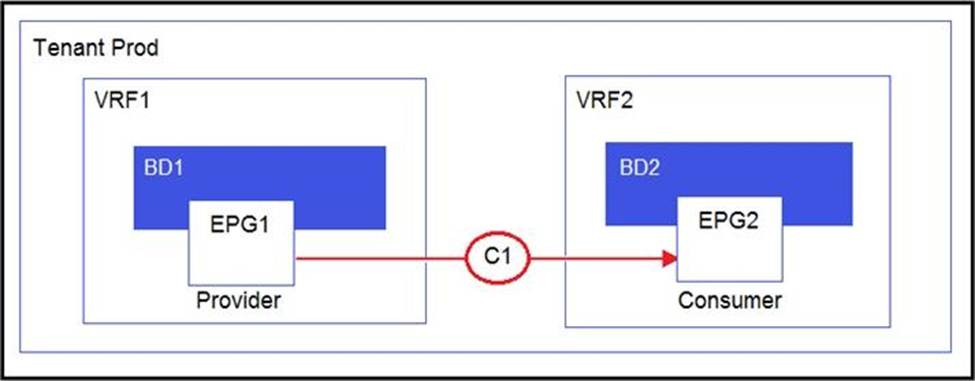
Which two configurations enable inter-VRF communication? (Choose two.)
- A . Set the subnet scope to Shared Between VRFs
- B . Enable Advertise Externally under the subnet scope
- C . Change the contract scope to Tenant
- D . Change the subject scope to VRF
- E . Export the contract and import as a contract interface
B, E
Explanation:
To enable inter-VRF communication, one must configure settings that allow subnets to be advertised externally and establish contract interfaces between VRFs.
Option B, “Enable Advertise Externally under the subnet scope,” allows subnets to be advertised outside their home VRFs.
Option E, “Export the contract and import as a contract interface,” enables communication between different VRFs by creating an exported contract from one VRF that can be imported into another as an interface contract.
Reference: = Implementing Cisco Application Centric Infrastructure Official Cert Guide