
Cisco 300-630 Practice Exams
Last updated on Oct 22,2026- Exam Code: 300-630
- Exam Name: Implementing Cisco Application Centric Infrastructure - Advanced (DCACIA)
- Certification Provider: Cisco
- Latest update: Oct 22,2026
An engineer is implementing the Cisco ACI fabric but is experiencing loops detected from endpoints. When the issue was investigated, it was discovered that the packets are received with the same source IP address but from different leaf switch ports. The engineer must prevent the issue from happening in the future and make sure that the port is brought back up if it was disabled due to the
loop discovered.
Which set of actions must be taken to meet these requirements?
- A . Enable the enforce endpoint check and set the Rouge EP detection interval
- B . Enable the rogue endpoint and set the Error Disabled Recovery Policy
- C . Enable the remote endpoint limit and set the Interface override
- D . Enable reverse path forwarding and set the Hold Interval
B
Explanation:
To address loops detected from endpoints in a Cisco ACI fabric, the engineer should enable the rogue endpoint feature and set the Error Disabled Recovery Policy. This will allow the system to detect rogue endpoints causing loops and automatically recover the port if it was disabled due to the loop detection2.
Reference: = (Implementing Cisco Application Centric Infrastructure Official Cert Guide)
Refer to the exhibit.
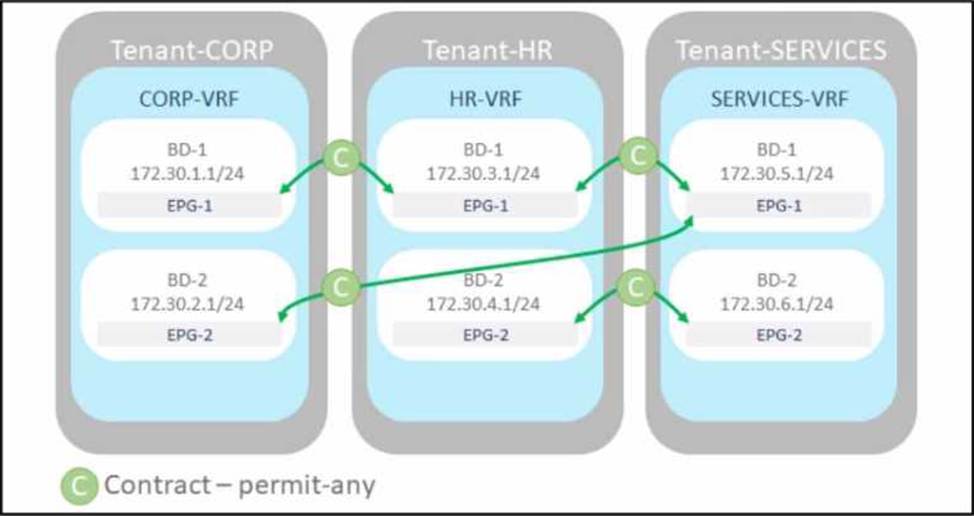
A company merges three of its departments: CORP. HR. and SERVICES. Currently, the connectivity between departments is achieved by using VRF route leaking. The requirement is to redesign the Cisco ACI networking architecture to communicate between EPGs and BDs from any tenant without configuring contracts or VRF route leaking.
Which configuration meets these criteria?
- A . Implement an enforced VRF in the common tenant and map all required BDs to it.
- B . Configure an enforced VRF in the user tenant and map all required EPGs to it.
- C . Implement an unenforced VRF in the common tenant and map all required BDs to it.
- D . Configure an unenforced VRF in the user tenant and map all required EPGs to it.
C
Explanation:
In Cisco ACI, Virtual Routing and Forwarding (VRF) instances are used to create separate routing tables for network traffic management. An unenforced VRF does not apply policies or contracts for communication between endpoints, allowing free communication without the need for explicit permissions. By implementing an unenforced VRF in the common tenant and mapping all required Bridge Domains (BDs) to it, each department’s BDs can communicate with one another without configuring contracts or VRF route leaking, thus meeting the company’s requirement for redesigning their networking architecture.
Reference: Implementing Cisco Application Centric Infrastructure Official Cert Guide
Refer to the exhibit.
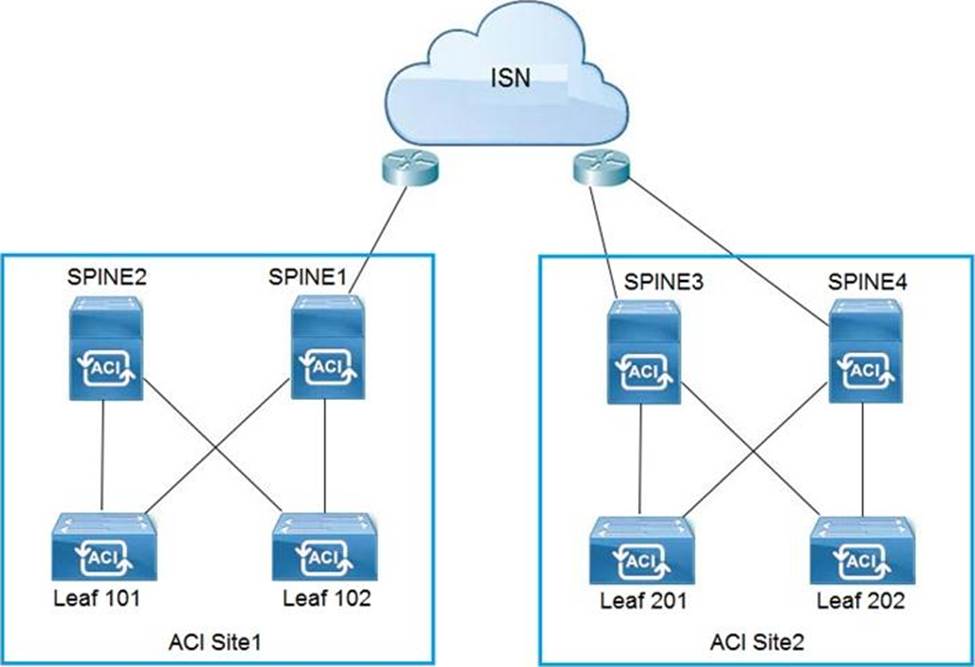
Which two configuration steps are required in ISN for Cisco ACI Multi-Site setup? (Choose two.)
- A . Connect Spine2 to ISN routers.
- B . Configure BIDIR-PIM throughout the ISN
- C . Increase ISN MTU to support the maximum MTU that is sent by endpoints
- D . Configure OSPF between spines and ISN routers
- E . Enable IGMPv3 on ISN routers
B, C
Explanation:
In a Cisco ACI Multi-Site setup, the ISN (Inter-Site Network) connects different ACI sites. For efficient multicast traffic routing, BIDIR-PIM (Bidirectional Protocol Independent Multicast) is configured throughout the ISN, which is why option B is correct. Increasing the ISN MTU (Maximum Transmission Unit) to support the maximum MTU sent by endpoints is crucial to prevent packet fragmentation or loss, making option C correct.
Options A, D, and E are not typically required for an ACI Multi-Site setup. Direct connectivity between Spine switches and ISN routers, as mentioned in options A and D, is usually established through leaf switches.
Option E, enabling IGMPv3 on ISN routers, is more relevant for managing multicast subscriptions within a single site.
Reference: = Implementing Cisco Application Centric Infrastructure Official Cert Guide
What are two characteristics of Cisco ACI and Spanning Tree Protocol interaction? (Choose two.)
- A . When a TCN BPDU is received in a VLAN, Cisco ACI flushes the endpoints for the associated encapsulation.
- B . STP BPDUs are dropped due to MCP.
- C . MST BPDUs are flooded correctly in Cisco ACI fabric without additional configuration.
- D . BPDU filter and BPDU guard can be configured on Cisco ACI leaf edge ports.
- E . Cisco ACI must be configured as the STP root for all VLANs.
A, D
Explanation:
Within Cisco ACI, when a Topology Change Notification (TCN) BPDU is received in a VLAN, the system flushes the endpoints for the associated encapsulation to ensure network stability. Additionally, BPDU filter and BPDU guard can be configured on Cisco ACI leaf edge ports to protect against potential STP issues2.
Reference: https://www.cisco.com/c/en/us/td/docs/switches/datacenter/aci/aci_virtual_edge/configuration/1-x/b_Virtual_Edge_Config_Guide_1_2_2/b_Virtual_Edge_Config_Guide_1_2_2_chapter_0101.html
A Cisco ACI fabric Is configured with these settings:
• A single VRF exists that contains 100 EPGs.
• EPGs 1 to 50 must be permitted to communicate.
• EPGs 51 to 100 must NOT be allowed to communicate with EPGs 1 to 50.
• EPG 51 must be allowed to communicate with EPG 10.
Which two actions must be taken to accomplish these requirements? (Choose two.)
- A . Create a vzAny contract.
- B . Create a standard contract between EPG 51 and EPG 10.
- C . Select the Intra-EPG Isolation checkbox.
- D . Set policy control enforcement to Unenforced.
- E . Enable the Preferred Group option on EPGs 1 to 50
B, E
Explanation:
To meet the requirements specified, two actions must be taken:
B. Create a standard contract between EPG 51 and EPG 10 to explicitly allow communication between these two EPGs. A contract in Cisco ACI defines the communication policy between EPGs, and by creating a standard contract, specific communication can be permitted.
E. Enable the Preferred Group option on EPGs 1 to 50 to allow communication within this group of EPGs. The Preferred Group feature in ACI allows all EPGs within the group to communicate with each other without the need for explicit contracts, while still enforcing contracts for communication with EPGs outside the group.
Reference: = Implementing Cisco Application Centric Infrastructure Official Cert Guide
Refer to the exhibit.
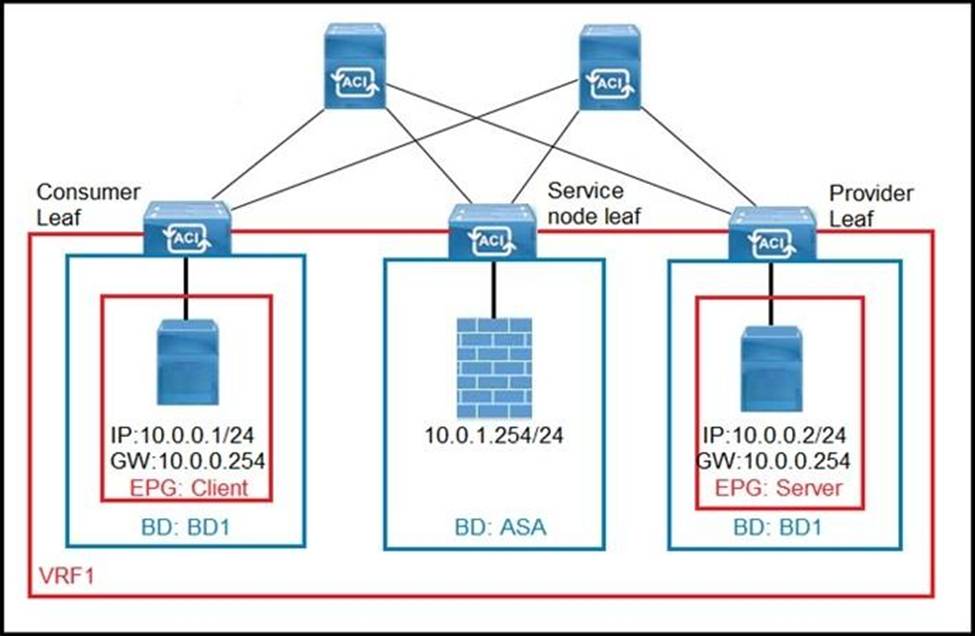
What must be configured in the service graph to redirect HTTP traffic between the EPG client and EPG server to go through the Cisco ASA firewall?
- A . contract filter to allow ARP and HTTP
- B . precise filter to allow only HTTP traffic
- C . contract with no filter
- D . permit-all contract filter
A
Explanation:
To redirect HTTP traffic between an EPG client and EPG server through a Cisco ASA firewall in a Cisco ACI environment, a contract filter must be configured to allow both ARP and HTTP. ARP is essential for IP to MAC address resolution, which is necessary for layer 2 communications within the same subnet or across subnets when routing is involved. The HTTP filter ensures that only HTTP traffic is redirected to the firewall for inspection or policy enforcement.
Reference: Implementing Cisco Application Centric Infrastructure Official Cert Guide
Which action must be taken to connect two nonsilient servers in active/standby mode to two ACI leaves?
- A . Implement a virtual PortChannel on ACI leaves
- B . Enable ARP flooding for the bridge domain if the MAC address of the active interface changes after NIC failover
- C . Configure ARP flooding for the bridge domain if the MAC address of the active interface stays identical after a NIC failover
- D . Disable dataplane learning to avoid endpoint flapping
A
Explanation:
To connect two nonsilient servers in active/standby mode to two ACI leaves, you should implement a virtual PortChannel (vPC) on the ACI leaves. vPC provides high availability and load balancing for server connections.
Reference: = Cisco APIC Layer 2 Networking Configuration Guide, Release 5.2(x)
What two actions should be taken to deploy a new Cisco ACI Multi-Pod setup? (Choose two.)
- A . Configure anycast RP for the underlying multicast protocol
- B . Configure the TEP pool of the new pod to be routable across the IPN
- C . Configure MP-BGP on IPN routers that face the Cisco ACI spines
- D . Increase interface MTU for all IPN routers to support VXLAN traffic
- E . Connect all spines to the IPN
B, D
Explanation:
Deploying a new Cisco ACI Multi-Pod setup involves configuring the TEP pool of the new pod to be routable across the IPN (B) and increasing the interface MTU on all IPN routers to support VXLAN traffic (D). Configuring anycast RP (A) and MP-BGP on IPN routers © are not specific actions for deploying a Multi-Pod setup. Connecting all spines to the IPN (E) is not a required action for deployment3.
Reference: = (ACI Multi-Pod White Paper
A company must connect three Cisco ACI data centers by using Cisco ACI Multi-Site. An engineer must configure the Inter-Site Network (ISN) between the existing sites.
Which two configuration steps must be taken to implement the ISN? (Choose two.)
- A . Configure encapsulation VLAN-4 between the routers and spine nodes.
- B . Configure OSPF on subinterfaces on routers that are directly connected with spine nodes
- C . Configure ISN site extension on Cisco routers in the network
- D . Configure OSPF on all ISN routers.
- E . Configure BIDIR-PIM on all ISN routers.
B, E
Explanation:
For the ISN implementation between Cisco ACI data centers using Multi-Site, OSPF must be configured on subinterfaces for dynamic routing, and BIDIR-PIM must be set up on all ISN routers for efficient bidirectional multicast traffic routing.
Reference: = (Implementing Cisco Application Centric Infrastructure Official Cert Guide)
What are two characteristics of network-centric design in Cisco ACI? (Choose two.)
- A . There is open communication between EPGs
- B . EPGs are used for micro segmentation
- C . EPGs are different security zones
- D . Applications define the network requirements
- E . A bridge domain has one subnet and one EPG
A, E
Explanation:
In a network-centric design within Cisco ACI, there is open communication between EPGs, and a bridge domain typically has one subnet and one EPG. This design is often used for initial migrations and is based on traditional networking concepts.
Reference: = Network Centric to ACI Centric Migration – Cisco