
Cisco 300-630 Practice Exams
Last updated on Oct 22,2026- Exam Code: 300-630
- Exam Name: Implementing Cisco Application Centric Infrastructure - Advanced (DCACIA)
- Certification Provider: Cisco
- Latest update: Oct 22,2026
An engineer must limit local and remote endpoint learning to the bridge domain subnet.
Which action should be taken inside the Cisco APIC?
- A . Disable Remote EP Learn
- B . Enable Enforce Subnet Check
- C . Disable Endpoint Dataplane Learning
- D . Enable Limit IP Learning to Subnet
B
Explanation:
To limit both local and remote endpoint learning to instances where the source IP address belongs to a bridge-domain subnet in the VRF instance, the action that should be taken inside the Cisco APIC is to enable the “Enforce Subnet Check” feature. This configuration ensures that IP addresses outside the configured subnets for the bridge domain are not learned, preventing mis-learning of IP addresses that do not belong to the fabric12.
DRAG DROP
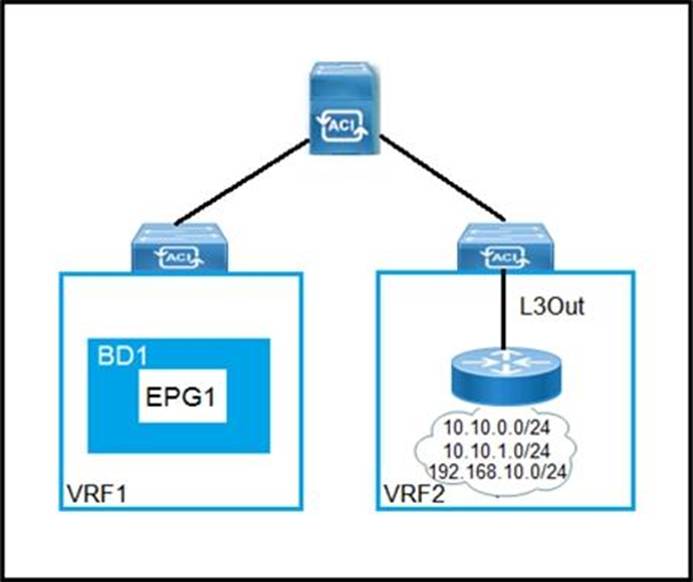
Refer to the exhibit.
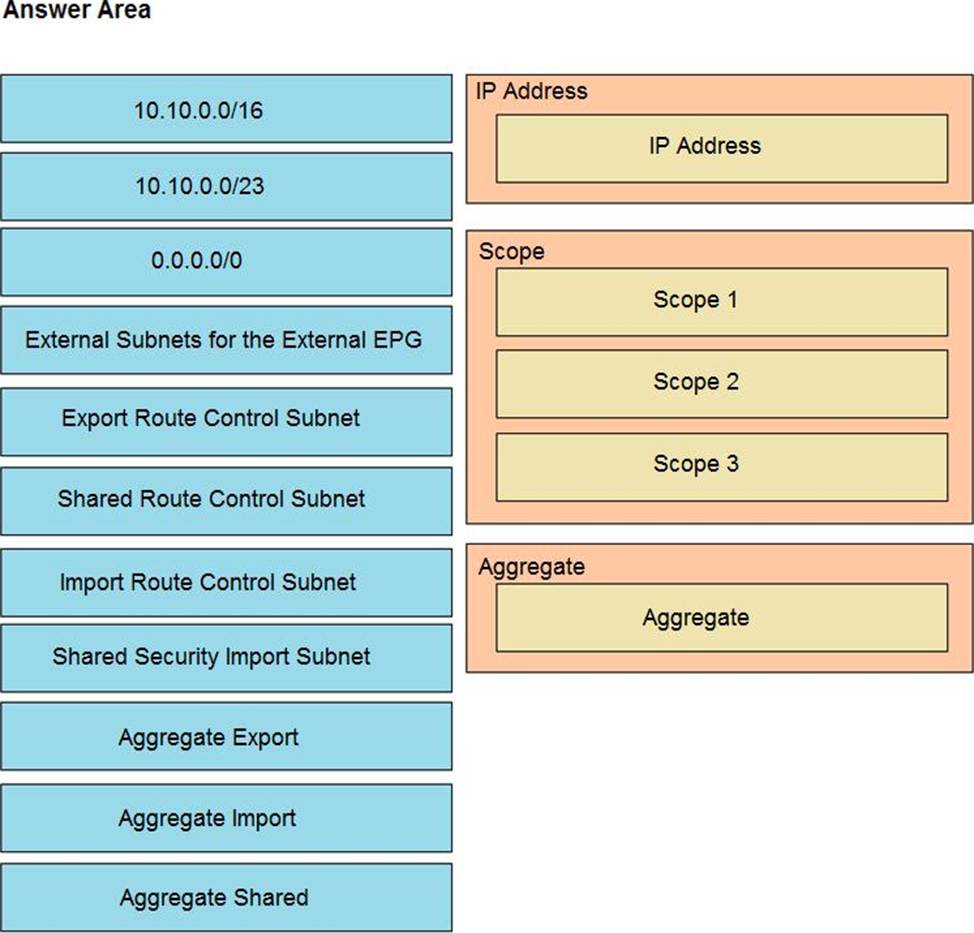
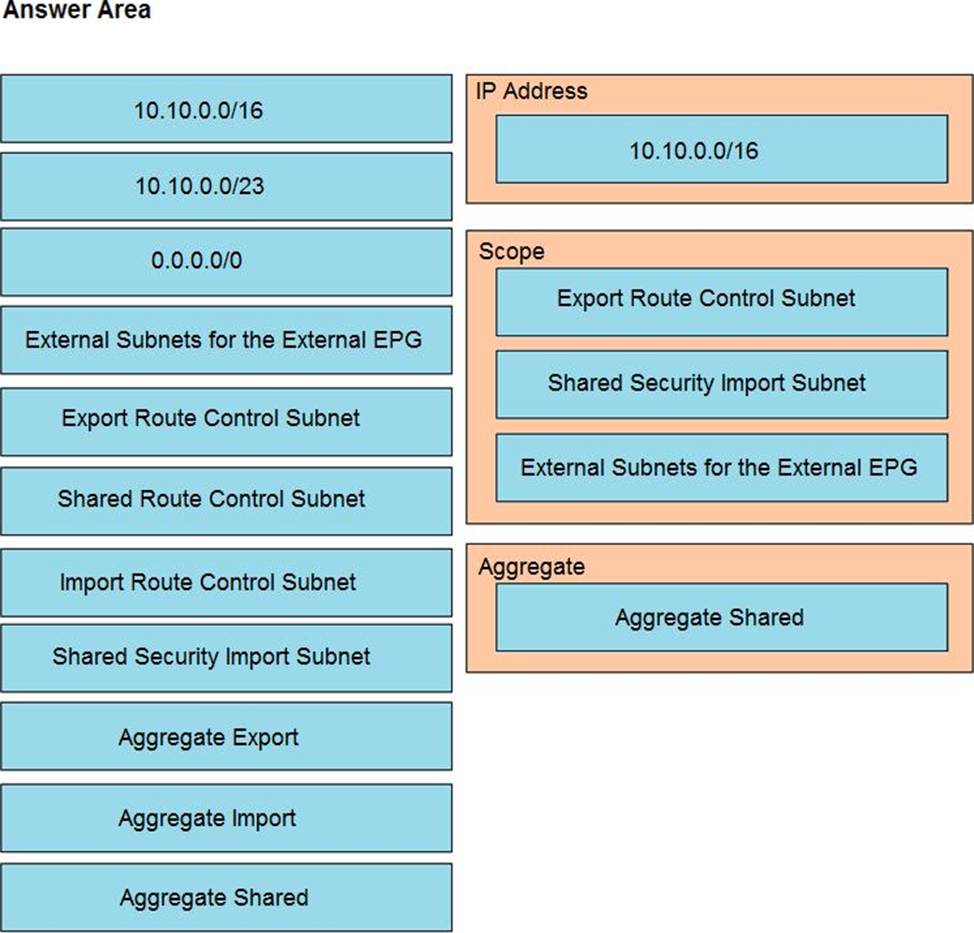
Drag and drop the subnets and flags from the left into the External Network Instance Profile policies on the right to create a setup that advertises only 10.10.0.0/24 and 10.10.1.0/24 prefixes in VRF1 and establishes connectivity between VRFs. Not all options are used.
Which mechanism is used by ACI spine switches to maintain a consistent copy of the endpoint address and location information?
- A . COOP
- B . ISIS
- C . BD
- D . OSPF
A
Explanation:
ACI spine switches use the Council Of Oracles Protocol (COOP) mechanism to maintain a consistent copy of endpoint address and location information. COOP is responsible for distributing this critical data among spines so that each has an accurate view of network endpoints, which is essential for efficient packet forwarding within an ACI fabric.
Reference: = (Implementing Cisco Application Centric Infrastructure Official Cert Guide)
Refer to the exhibit.
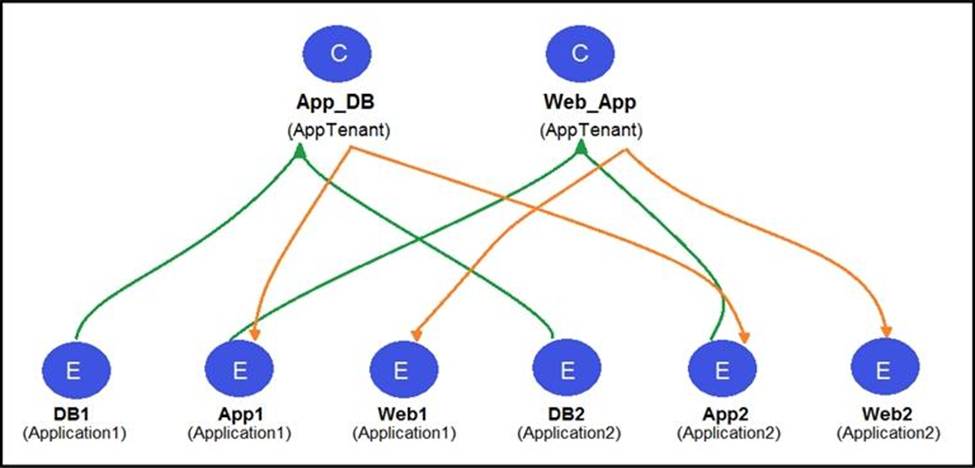
Two application profiles are configured in the same tenant and different VRFs.
Which contract scope is configured to allow communication between the two application profiles?
- A . global
- B . VRF
- C . application
- D . tenant
D
Explanation:
To allow communication between two application profiles that are configured in the same tenant but different VRFs, the contract scope must be set to ‘tenant.’ This is because the contract scope defines the level at which the contract is enforced. A ‘tenant’ scope means the contract applies to all application profiles within the same tenant, regardless of the VRFs they are in. This allows for the necessary route-leaking between the provider and consumer VRFs to enable communication between the application profiles.
Which two actions are the Cisco best practices to configure NIC teaming load balancing for Cisco UCS B- Series blades that are connected to the Cisco ACI leaf switches? (Choose two.)
- A . Create vPC+
- B . Enable LACP active mode
- C . Create PAgP
- D . Create vPC
- E . Enable MAC pinning
B, E
Explanation:
The best practices for configuring NIC teaming load balancing for Cisco UCS B-Series blades connected to Cisco ACI leaf switches involve enabling LACP (Link Aggregation Control Protocol) in active mode and enabling MAC pinning.
LACP active mode (option B) allows for the automatic bundling of several physical links into a single logical link, providing redundancy and increased bandwidth. This mode actively tests the link to
ensure its functionality, which is essential for maintaining a stable connection.
MAC pinning (option E) is a method that assigns a virtual machine’s MAC address to a specific uplink. This ensures consistent forwarding paths for traffic within the same session, which is crucial for avoiding potential traffic distribution issues that could arise from dynamic changes in the network topology.
Creating vPC+ (option A) and vPC (option D) are not recommended as they are related to virtual port channels, which are not applicable in this scenario. PAgP (Port Aggregation Protocol) (option C) is Cisco’s proprietary protocol similar to LACP, but it is not the recommended practice in this context.
Reference: =
Implementing Cisco Application Centric Infrastructure Official Cert Guide
Cisco’s documentation on UCS B-Series Teaming Bonding Options
An engineer designs a Cisco ACI Multi-Pod solution that requires a pair of active-standby firewalls in different pods for external connectivity.
How should the firewalls be implemented?
- A . PBR for routed firewalls
- B . separate L3Out peerings for routed firewalls
- C . routed firewall for the default gateway
- D . transparent firewalls
B
Explanation:
In a Cisco ACI Multi-Pod design, having separate Layer 3 Out (L3Out) connections for each pod is recommended when implementing active-standby firewalls in different pods. This setup allows for independent routing and failover mechanisms, ensuring that each pod can maintain external connectivity even if one firewall fails.
Reference: = Implementing Cisco Application Centric Infrastructure Official Cert Guide
Reference: https://www.cisco.com/c/en/us/solutions/collateral/data-center-virtualization/application-centric-infrastructure/white-paper-c11-739571.html
A host that is connected to a Cisco ACI fabric leaf switch sends an ARP request.
Which transmission method does the ingress switch use to send the ARP requests?
- A . anycast
- B . broadcast
- C . multicast
- D . unicast
B
Explanation:
When a host connected to a Cisco ACI fabric leaf switch sends an ARP request, the ingress leaf switch uses a broadcast transmission method to send the ARP requests. This is because ARP requests are meant to discover the MAC address associated with a specific IP address within the same network broadcast domain. The ingress leaf switch does not know the destination MAC address, so it broadcasts the ARP request to all devices within the broadcast domain1.
Reference: = (Implementing Cisco Application Centric Infrastructure Official Cert Guide)
Refer to the exhibit.
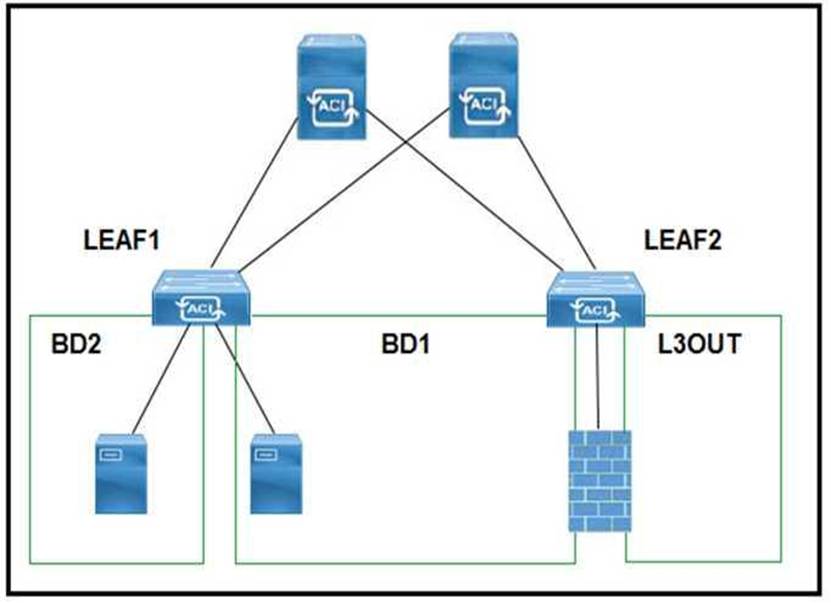
A customer experiences resource overconsumption on one of its border leaf switches.
Which action should be taken to reduce the consumption on this switch?
- A . Disable VRF Policy Control Enforcement
- B . Disable IP Data Plane Learning
- C . Migrate L3Outs to another switch
- D . Disable Remote EP Learning
C
Explanation:
To address resource overconsumption on a border leaf switch, migrating L3Outs to another switch can help distribute the load and reduce strain on the affected switch.
Reference: = Implementing Cisco Application Centric Infrastructure Official Cert Guide
An engineer configures a Cisco ACI Multi-Pod for disaster recovery.
Which action should be taken for the new nodes to be discoverable by the existing Cisco APICs?
- A . Enable subinterfaces with dot1q tagging on all links between the IPN routers.
- B . Configure IGMPv3 on the interfaces of IPN routers that face the Cisco ACI spine.
- C . Enable DHCP relay on all links that are connected to Cisco ACI spines on IPN devices.
- D . Configure BGP as the underlay protocol in IPN.
C
Explanation:
For new nodes in a Cisco ACI Multi-Pod environment to be discoverable by existing APICs, DHCP relay needs to be enabled on the IPN devices’ links connected to the ACI spines. This allows the new nodes to obtain an IP address and be recognized by the APICs for integration into the fabric.
Reference: = Implementing Cisco Application Centric Infrastructure Official Cert Guide