
Cisco 300-630 Practice Exams
Last updated on Oct 22,2026- Exam Code: 300-630
- Exam Name: Implementing Cisco Application Centric Infrastructure - Advanced (DCACIA)
- Certification Provider: Cisco
- Latest update: Oct 22,2026
Refer to the exhibit.
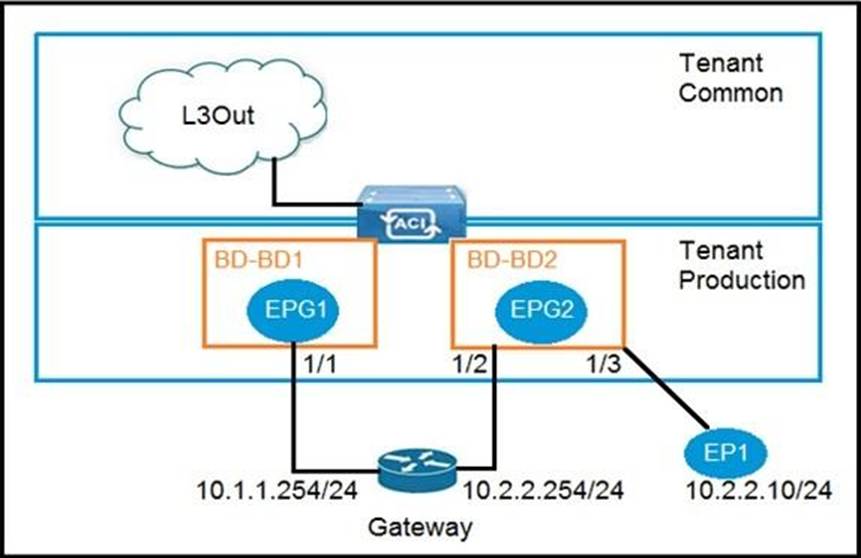
An engineer wants to avoid connectivity problems for the endpoint EP1 when it reaches an external L3Out network through the gateway 10.2.2.254/24.
Which two configurations must be implemented in BD-BD2? (Choose two.)
- A . Disable unicast routing
- B . Enable IP data plane learning for the VRF
- C . Disable ARP flooding
- D . Enable ARP flooding
- E . Enable unicast routing
B, E
Explanation:
To prevent connectivity issues for EP1 when accessing an external L3Out network, it’s essential to enable IP data plane learning for the VRF and unicast routing in BD-BD2. IP data plane learning allows dynamic endpoint learning within a VRF, ensuring accurate forwarding information for EP1. Unicast routing enables packet routing based on destination IP, facilitating proper traffic routing through the gateway.
Reference: = Implementing Cisco Application Centric Infrastructure Official Cert Guide
What does the VXLAN source port add to the overlay packet forwarding when it uses the hash of Layer 2, Layer 3, and Layer 4 headers of the inner packet?
- A . ECMP
- B . TCP optimization
- C . disabled fragmentation
- D . jumbo frames
A
Explanation:
The VXLAN source port adds entropy to the overlay packet forwarding by using a hash of the inner packet’s Layer 2, Layer 3, and Layer 4 headers. This entropy enables Equal-Cost Multi-Path (ECMP) routing, allowing for multiple parallel paths in the network, which increases bandwidth and redundancy2.
Reference: = VXLAN Traffic Forwarding | VXLAN Packet Flow
How is multicast traffic managed in a Cisco ACI fabric?
- A . FTag trees are rooted at the spine nodes. Cisco APIC determines the roots.
- B . FTag trees are rooted at the leaf nodes. Cisco APIC determines the roots.
- C . FTag trees are rooted at the leaf nodes. The roots must be configured manually.
- D . FTag trees are rooted at the spine nodes. The roots must be configured manually.
A
Explanation:
In a Cisco ACI fabric, multicast traffic is managed using FTag trees that are rooted at the spine nodes. The Cisco APIC automatically determines the roots of these trees. This method optimizes the distribution of multicast traffic across the fabric by leveraging the spine nodes as centralized points for multicast routing and replication456.
Reference: = Implementing Cisco Application Centric Infrastructure Official Cert Guide
Which action should be taken in Cisco ACI to reassign a unique globally scoped pcTag to an EPG that provides a global contract?
- A . Configure subnets that are treated as virtual IP
- B . Configure subnets that advertise externally
- C . Configure subnets that are shared between VRFs
- D . Configure subnets that are private to VRF
C
Explanation:
In Cisco ACI, to reassign a unique globally scoped pcTag to an Endpoint Group (EPG) that provides a global contract, one should configure subnets that are shared between VRFs (Virtual Routing and Forwarding instances) (Option C). This action allows subnets associated with an EPG to be shared across different VRFs while maintaining unique identifiers for application endpoint groups within the global scope of the fabric.
Reference: = (Implementing Cisco Application Centric Infrastructure Official Cert Guide)
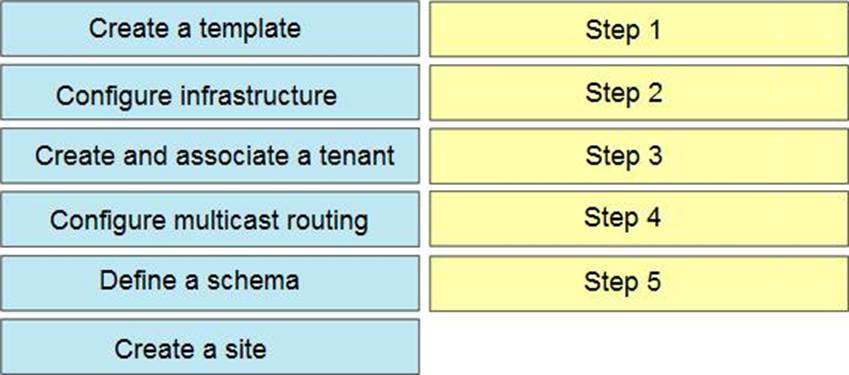
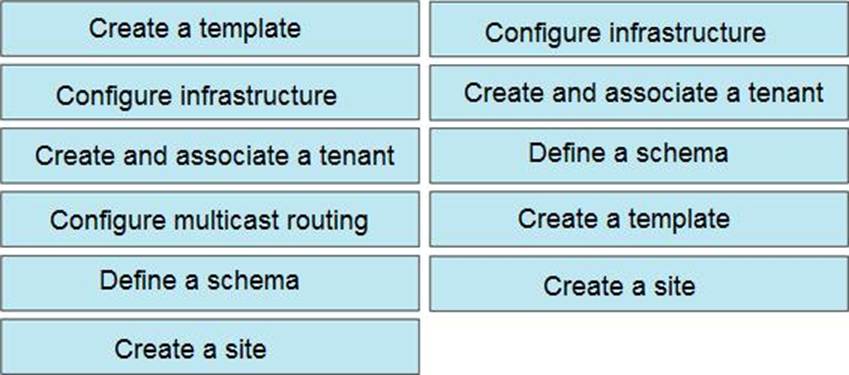
DRAG DROP
An engineer deploys a Cisco ACI Multi-Site Orchestrator for the first time.
Drag and drop the actions from the left into the steps on the right to add a site and deploy new Cisco ACI objects to the fabric. Not all actions are used.
Refer to the exhibit.
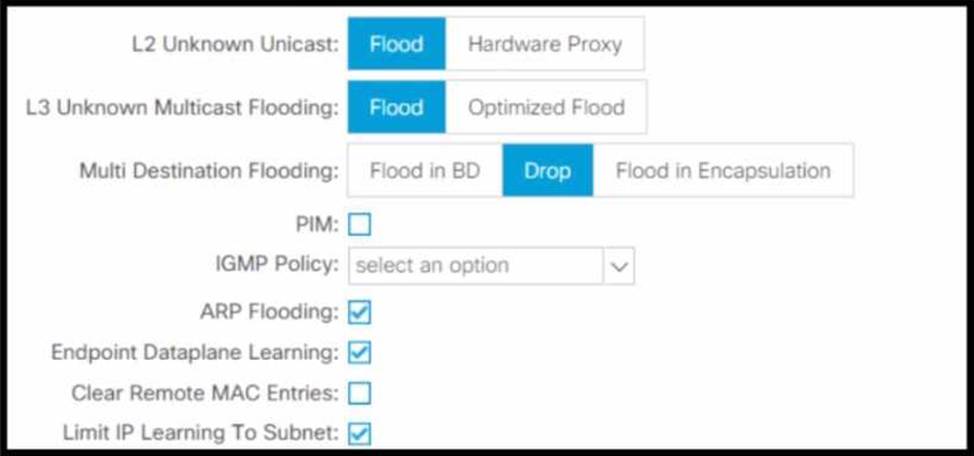
Which method does Cisco ACI fabric use to forward L2 Unknown Unicast packets?
- A . The source leaf sends the traffic to all ports in BD.
- B . Packets are dropped if dMAC is absent in COOP.
- C . The traffic is flooded using VRF Outer Multicast Group ID.
- D . Traffic is flooded to all Layer 2 ports of ACI fabric.
C
Explanation:
In Cisco ACI fabric, when a Layer 2 unknown unicast packet is encountered, the fabric does not drop the packet. Instead, it uses a flooding mechanism to ensure that the packet reaches its potential destination. This is achieved by utilizing the VRF (Virtual Routing and Forwarding) Outer Multicast Group ID associated with the Bridge Domain (BD) to which the unknown destination MAC address belongs. By doing so, Cisco ACI ensures that all endpoints within the BD have an opportunity to receive and process the packet if they are indeed the intended recipient.
Reference: Implementing Cisco Application Centric Infrastructure Official Cert Guide
Which firewall connection allows for the integration of service nodes in transparent mode with a Cisco ACI Multi-Pod setup?
- A . active-standby mode across pods
- B . active-active mode per pods for communication between internal endpoints
- C . active-standby mode per pods for communication between endpoints and external networks
- D . active-active mode across pods
A
Explanation:
The integration of service nodes in transparent mode with a Cisco ACI Multi-Pod setup is achieved by using an active-standby firewall mode stretched across pods. This configuration ensures that the standby node takes over if the active node fails, providing high availability and seamless operation.
Reference: = Cisco ACI Multi-Pod and Service Node Integration White Paper
Refer to the exhibits.
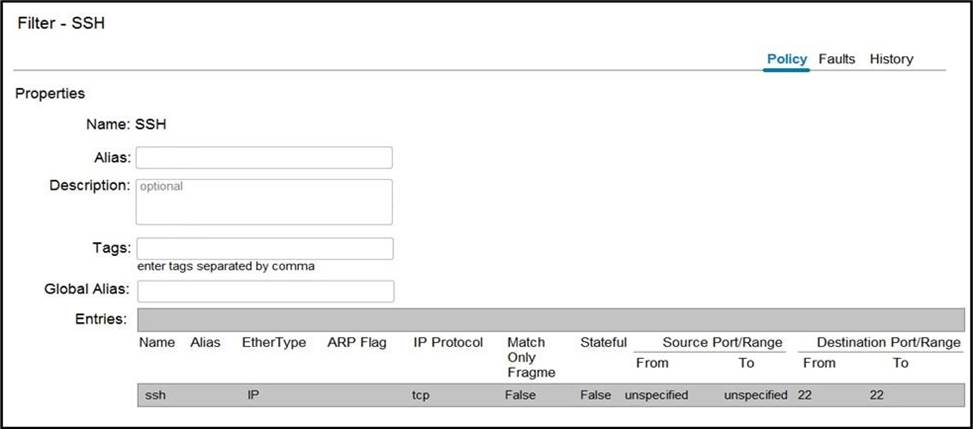
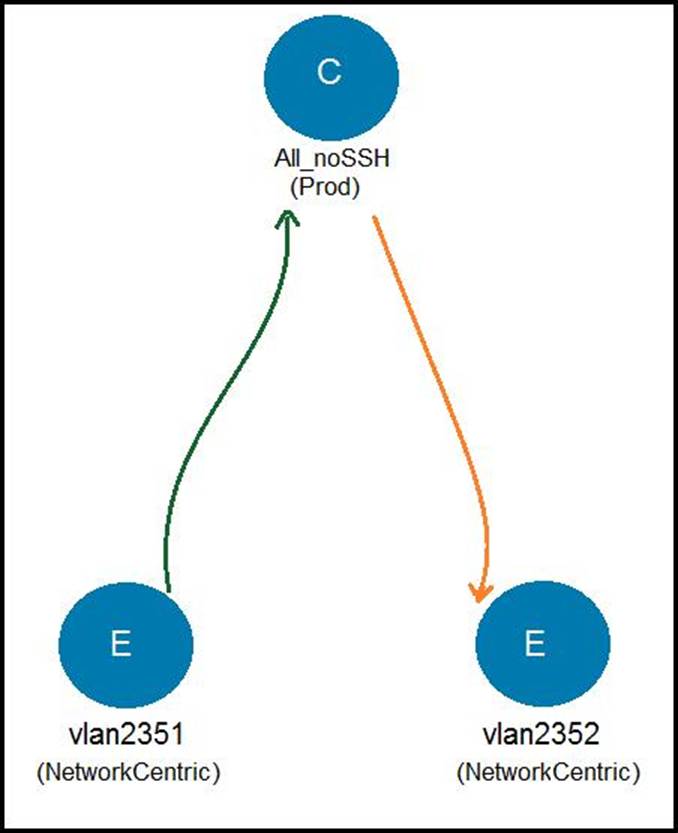
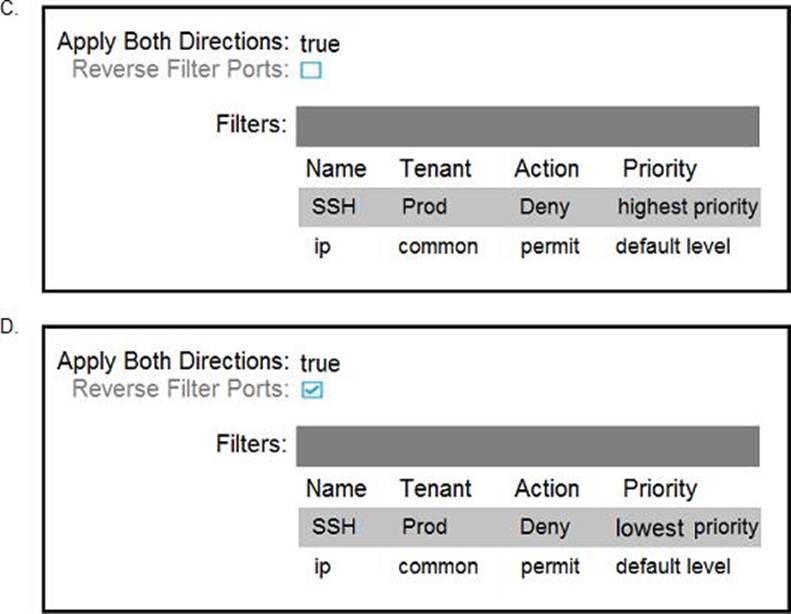
Which subject must be configured for the All_noSSH contract to allow all IP traffic except SSH between the two EPGs?
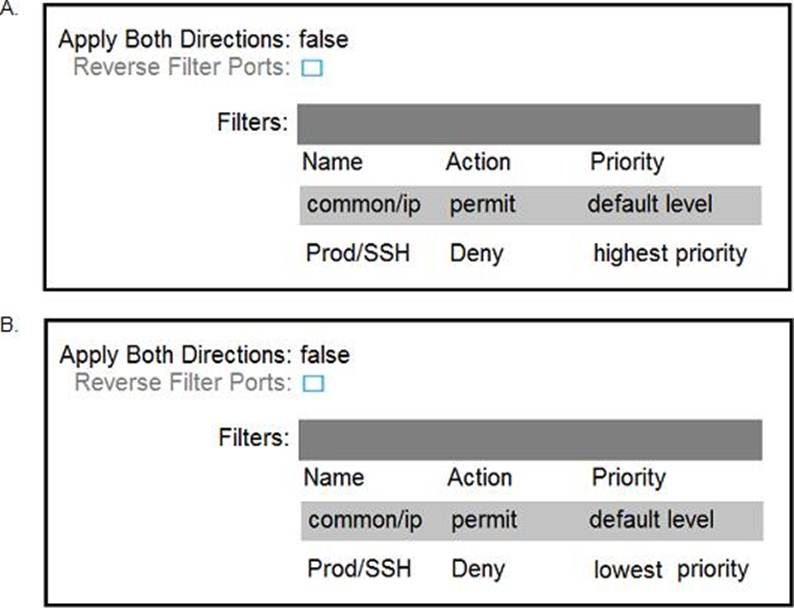
- A . Option A
- B . Option B
- C . Option C
- D . Option D
D
Explanation:
In Cisco ACI, contracts are used to define the policies that govern communication between End Point Groups (EPGs). A contract specifies which types of traffic are permitted or denied between EPGs. To allow all IP traffic except SSH, you would configure the contract to permit all IP traffic and then deny SSH specifically. This is typically done by defining filters within the contract that match on the SSH protocol and setting the action to deny.
Reference: Implementing Cisco Application Centric Infrastructure – Advanced (DCACIA) course materials and official certification guide can provide more detailed information on this topic12.
Cisco’s official documentation and training materials are also a good resource for understanding the configuration and management of contracts in ACI
Refer to the exhibit.
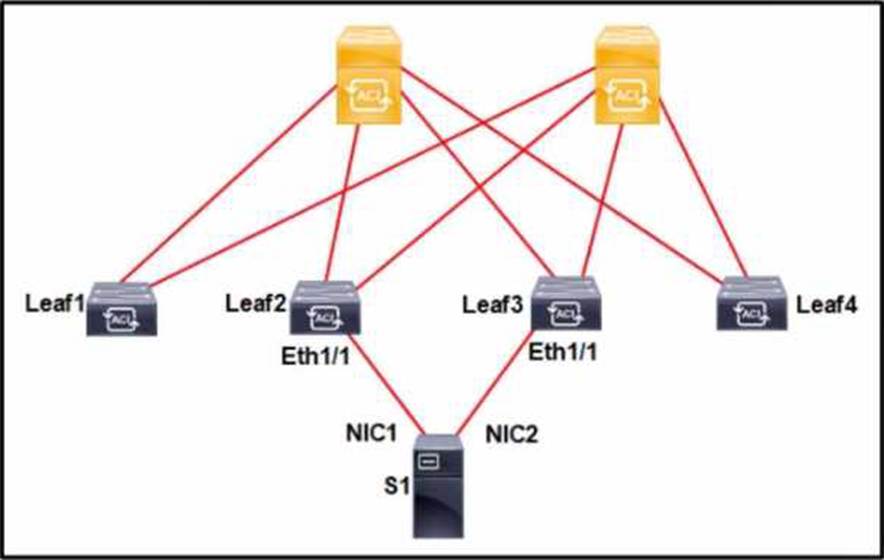
Server S1 is connected to Cisco ACI using two NIC interfaces. NIC1 is an active interface and NIC2 is a standby interface. NIC2 uses its MAC address to send traffic to the Cisco ACI fabric when NIC1 is offline. The requirement is to update the IP address to use the MAC address of NIC2.
Which action accomplishes this goal?
- A . Clear remote MAC entries.
- B . Set L2 Unknown Unicat to Proxy.
- C . Activate IP Data Plane Learning.
- D . Enable GARP EP Move Detection
D
Explanation:
Enabling GARP EP Move Detection allows the Cisco ACI fabric to dynamically update the IP address to use the MAC address of NIC2 when NIC1 goes offline. This feature is crucial for maintaining network connectivity and ensuring that traffic continues to flow seamlessly through the standby interface1.
Refer to the exhibit.
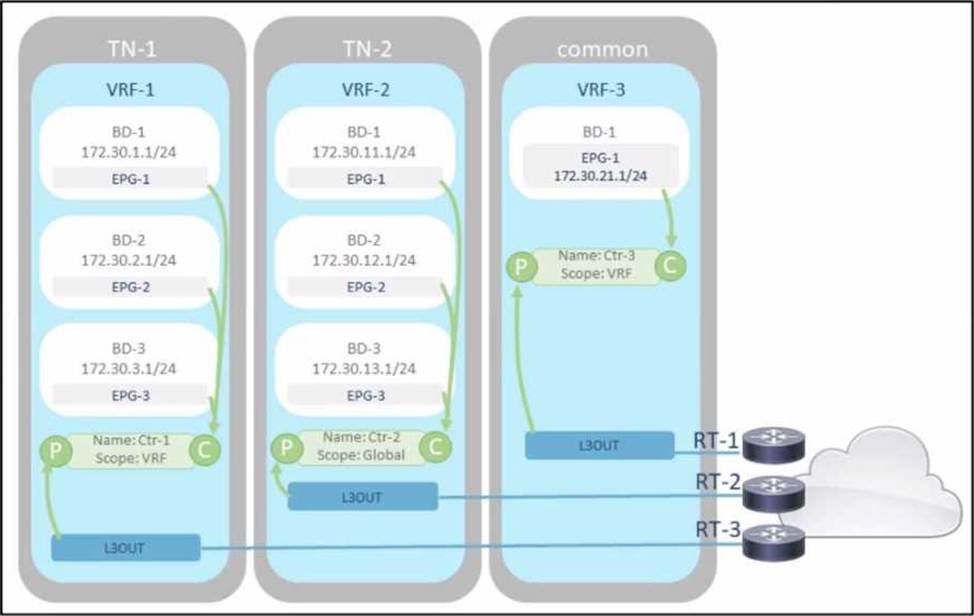
A company decided to decrease its routing footprint and remove RT-2 and RT-3 devices from its data center. Because of that, the exit point must be created from all the tenants by using the common tenant.
Which two configuration tasks must be completed to meet these requirements? {Choose two.)
- A . Move subnets from all the bridge domains to the EPG level and mark them with flag Shared between VRFs.
- B . Change contract Ctr-3 scope to Global, consume it by all EPGs. and flag all subnets with flag Shared between VRFs.
- C . Update the L3Qut ExtEPG subnet in the common tenant with flag Shared Route Control Subnet and Aggregate Shared Routes.
- D . Mark all subnets with flag Shared between VRFs and attach contract Ctr-3 as a provider to all the EPGs.
- E . Export contract Clr-2 into (he tenant TN-1 and attach it as a consumer to all the EPGs in the tenant TN-1.
C, D
Explanation:
To create an exit point from all the tenants using the common tenant after removing RT-2 and RT-3 devices, the following two configuration tasks must be completed:
Update L3Out ExtEPG Subnet: The L3Out ExtEPG subnet in the common tenant should be updated with the flag “Shared Route Control Subnet” and “Aggregate Shared Routes” (Option C). This configuration allows for the sharing of routes between different tenants through a common exit point.
Mark Subnets and Attach Contract: All subnets should be marked with the flag “Shared between VRFs,” and contract Ctr-3 should be attached as a provider to all the EPGs (Option D). This ensures that all EPGs can provide services under contract Ctr-3 across different VRFs, facilitating inter-tenant communication via shared routes.
Reference: = (Implementing Cisco Application Centric Infrastructure Official Cert Guide)