
Cisco 300-630 Practice Exams
Last updated on Oct 21,2026- Exam Code: 300-630
- Exam Name: Implementing Cisco Application Centric Infrastructure - Advanced (DCACIA)
- Certification Provider: Cisco
- Latest update: Oct 21,2026
Refer to the exhibit.
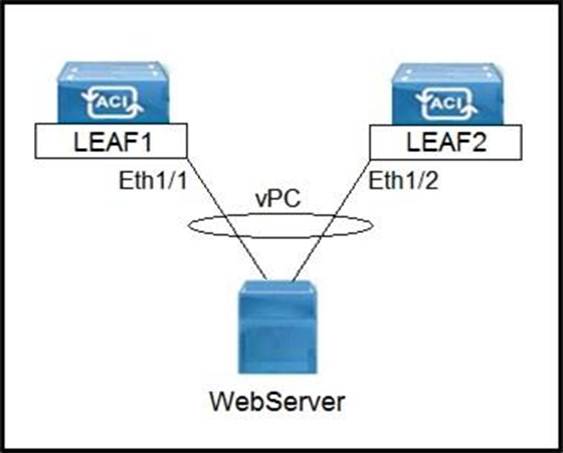
Which three actions should be taken to implement the vPC in the Cisco ACI fabric? (Choose three.)
- A . Select a common vPC interface policy group
- B . Select individual interface profiles
- C . Select common interface profiles
- D . Select individual switch profiles
- E . Select common switch profiles
A, C, E
Explanation:
To implement the vPC (Virtual Port Channel) in the Cisco ACI fabric, one should select a common vPC interface policy group (Option A), select common interface profiles (Option C), and select common switch profiles (Option E). These steps ensure that both switches in a vPC domain are configured with consistent policies and profiles for interfaces and switches. This consistency is crucial for the proper functioning of a vPC setup where two or more links that are physically connected to two different Cisco ACI leaf switches appear as a single “logical” port channel to a third device, like the depicted WebServer.
An engineer troubleshoots a Cisco ACI fabric and receives this output.
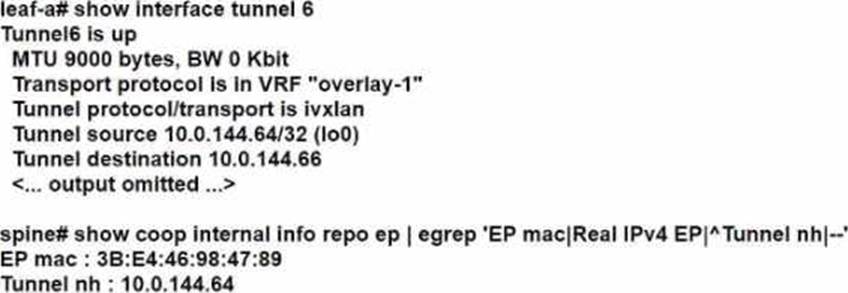
What does tunnel 6 use?
- A . default VRF
- B . GRE protocol
- C . jumbo frames
- D . public IP address
B
Explanation:
The output shows details of tunnel 6 within a Cisco ACI fabric. The transport protocol is listed as “isvlan,” which is typically associated with the GRE protocol in Cisco ACI terminology. GRE, a tunneling protocol developed by Cisco, encapsulates various network layer protocols inside virtual point-to-point links over an IP internetwork.
Reference: Implementing Cisco Application Centric Infrastructure Official Cert Guide
Which requirement applies to migration from Cisco NX-OS mode to Cisco ACI mode with Cisco Nexus 9000 Series Switches?
- A . Pre-existing vPC topology must be removed before the migration is started.
- B . A permit-all contract must be used for traffic that flows inside the data center.
- C . Pre-existing FCoE must be removed from the Nexus devices.
- D . A minimum of five Cisco APIC appliances must be used in the data center network.
C
Explanation:
Removing pre-existing Fibre Channel over Ethernet (FCoE) configurations from Nexus devices is necessary to ensure compatibility with Cisco ACI mode. FCoE configurations are not supported in ACI mode, and their presence can hinder the migration process2.
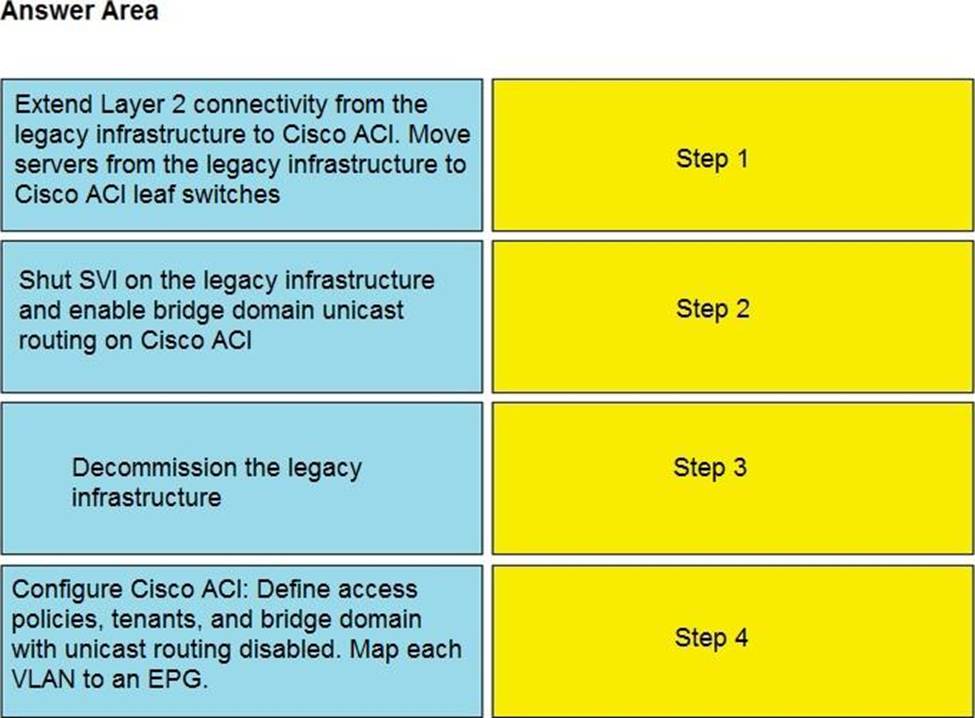
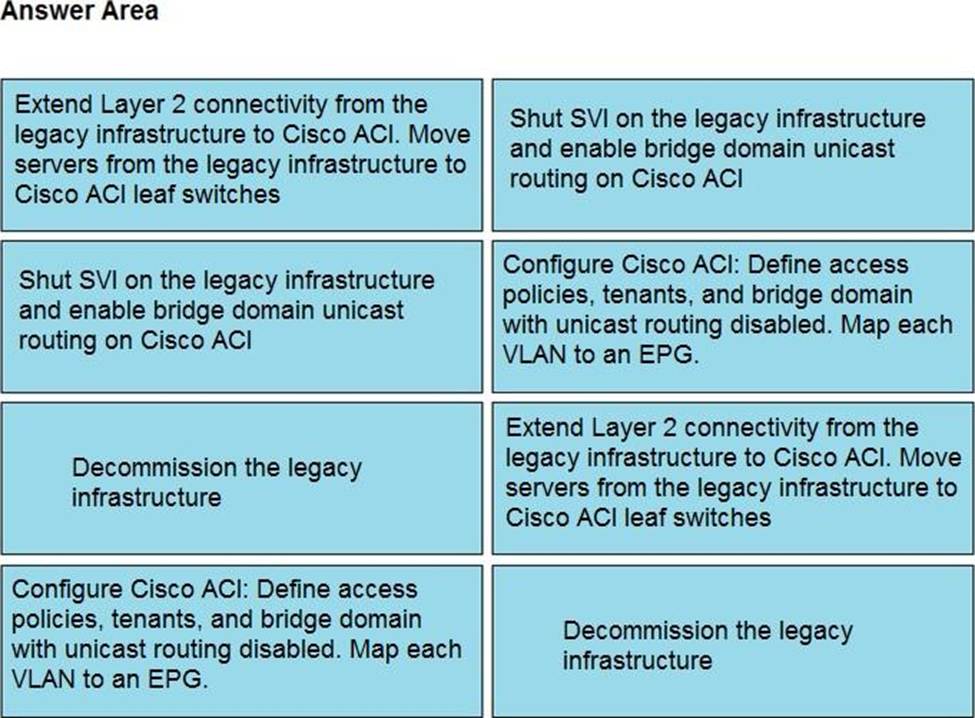
DRAG DROP
An engineer must migrate servers from a legacy data center infrastructure to a Cisco ACI fabric.
Drag and drop the steps from the left into the order that they must be completed on the right to ensure the least amount of downtime.
How is the traffic directed to the firewall pair in a two-site Multi-Pod deployment with an active/standby firewall pair stretched across pods?
- A . to the pod with the active service node
- B . to a collector in the Inter-Pod Network
- C . to the pod designated as the primary pod
- D . to the local service node for processing
A
Explanation:
In a two-site Multi-Pod deployment with an active/standby firewall pair stretched across pods, traffic is directed to the pod with the active service node. This approach ensures that all traffic goes through the firewall that is currently handling traffic, maintaining security policies consistently across both sites while also providing high availability by automatically failing over to the standby firewall in case of any issues with the active one.
Reference: = (Implementing Cisco Application Centric Infrastructure Official Cert Guide)
What is the purpose of the Forwarding Tag (FTAG) in Cisco ACI?
- A . FTAG is used in Cisco ACI to add a label to the iVXLAN traffic in the fabric to apply the correct policy.
- B . FTAG is used in Cisco ACI to add a label to the VXLAN traffic in the fabric to apply the correct policy.
- C . FTAG trees in Cisco ACI are used to load balance unicast traffic.
- D . FTAG trees in Cisco ACI are used to load balance mutli-destination traffic.
D
Explanation:
The Forwarding Tag (FTAG) in Cisco ACI is used to load balance multi-destination traffic. FTAG trees facilitate efficient forwarding of multicast traffic within the fabric, ensuring optimal distribution and load balancing across multiple paths. All multi-destination traffic is encapsulated within VXLAN, and FTAG trees play a crucial role in achieving efficient traffic flow345.
Reference: Implementing Cisco Application Centric Infrastructure Official Cert Guide
Which protocol must be applied between the inter-pod network and spines within each pod to allow broadcast traffic replication between Cisco ACI pods?
- A . MSDP Peering
- B . Multicast BGP
- C . Bidirectional PIM
- D . IGMP Registration
C
Explanation:
Bidirectional Protocol Independent Multicast (Bidirectional PIM) is used between the inter-pod network (IPN) and spines within each pod in a Cisco ACI environment to allow broadcast traffic replication between pods. This protocol is designed to efficiently route multicast traffic in scenarios where the same data is being sent to multiple receivers, which aligns with the need for broadcast traffic replication in an interconnected multi-pod ACI architecture.
Reference: = (Implementing Cisco Application Centric Infrastructure Official Cert Guide)
Refer to the exhibit.
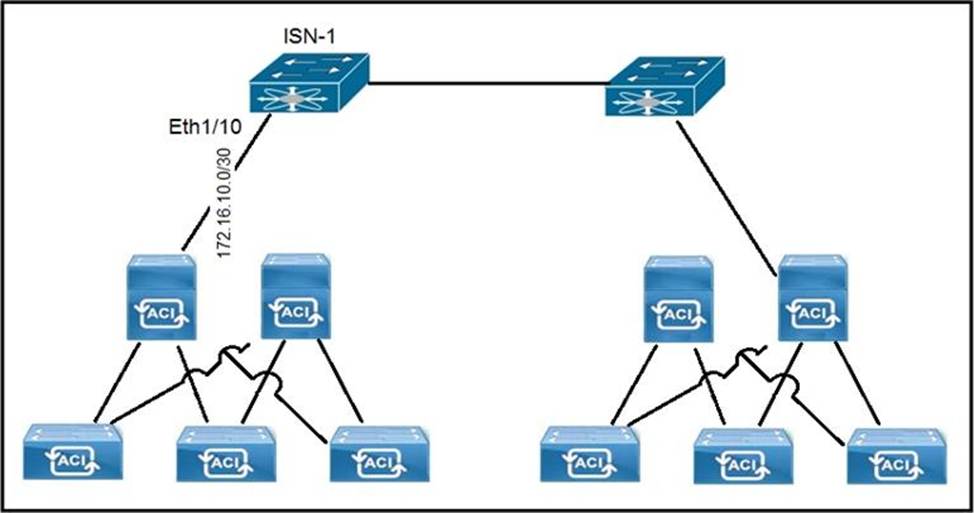
A customer implements Cisco ACI Multi-Site with default MTU settings between two sites.
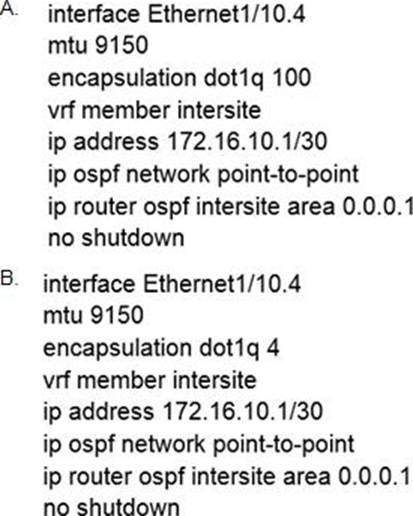
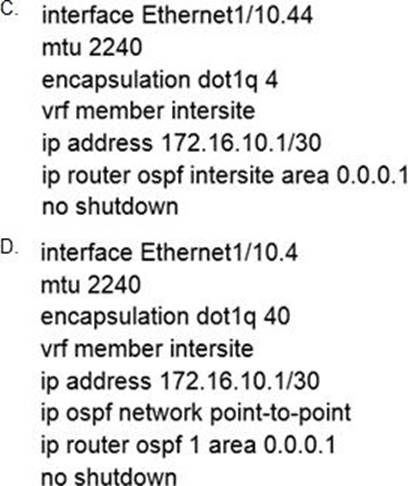
Which configuration should be applied on the interface Eth1/10 on the ISN-1 device?
- A . Option A
- B . Option B
- C . Option C
- D . Option D
C
Explanation:
In a Cisco ACI Multi-Site setup, it’s important to configure the ISN interfaces to handle the encapsulation overhead introduced by the multi-site architecture.
Option C is typically the correct choice because it includes:
A subinterface with a specific VLAN ID for traffic segregation.
An increased MTU size to accommodate the extra bytes added by encapsulation.
The correct VRF for inter-site communication.
OSPF configuration for dynamic routing between sites.
Reference: = Implementing Cisco Application Centric Infrastructure Official Cert Guide
An engineer deployed a Cisco ACI fabric and noticed that the fabric learns endpoints from subnets that are not configured on a bridge domain. To meet strict security requirements, the engineer must prevent this behavior.
Which action must be taken to prevent this behavior?
- A . Activate Enable Data Plane Endpoint Learning
- B . Implement Pervasive Gateway
- C . Configure Static Binding
- D . Enable Enforce Subnet Check
D
Explanation:
To ensure the Cisco ACI fabric adheres to strict security protocols and only learns endpoints from configured subnets on a bridge domain, the “Enforce Subnet Check” feature must be enabled. This feature restricts endpoint learning to IP addresses belonging to the subnets defined in the bridge domain associated with the endpoint’s VLAN, enhancing security by preventing learning of endpoints from unconfigured subnets.
Reference: Implementing Cisco Application Centric Infrastructure Official Cert Guide
An engineer Is configuring a Cisco ACI fabric and requires a shared L30ut network connectivity to external networks. The connectivity must be shared between different tenants.
Which tenant type must be created to meet this requirement?
- A . common tenant
- B . infra tenant
- C . management tenant
- D . user tenant
A
Explanation:
For shared L3Out network connectivity among different tenants in a Cisco ACI fabric, a common tenant is necessary. It provides a global space for defining resources like L3Outs once, which can then be utilized by multiple tenants, simplifying management and ensuring consistent policy application.
Reference: = (Implementing Cisco Application Centric Infrastructure Official Cert Guide)