
Cisco 300-630 Practice Exams
Last updated on Oct 21,2026- Exam Code: 300-630
- Exam Name: Implementing Cisco Application Centric Infrastructure - Advanced (DCACIA)
- Certification Provider: Cisco
- Latest update: Oct 21,2026
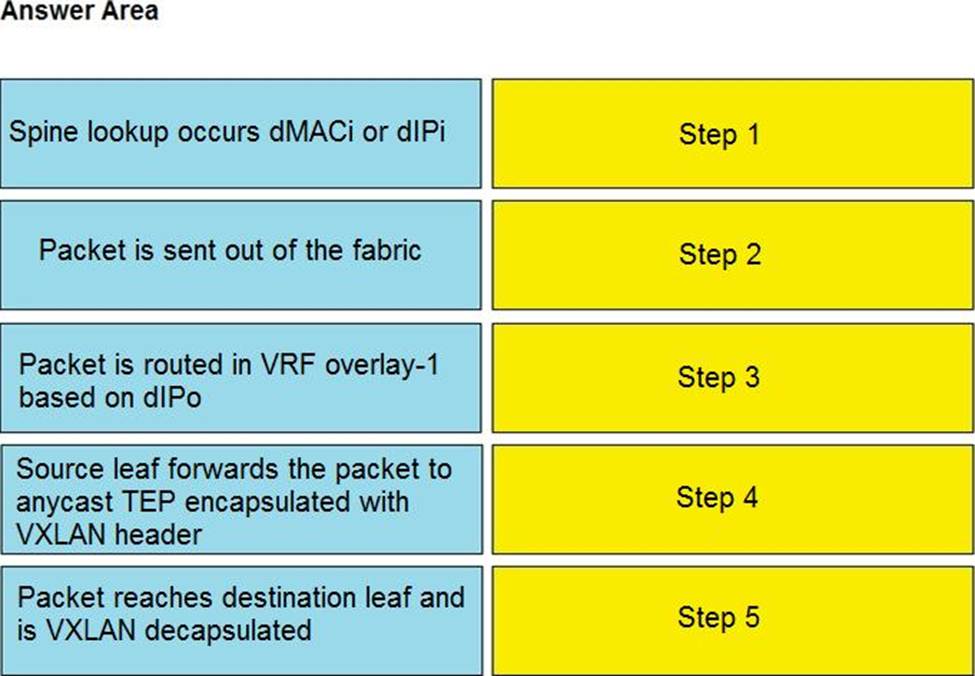
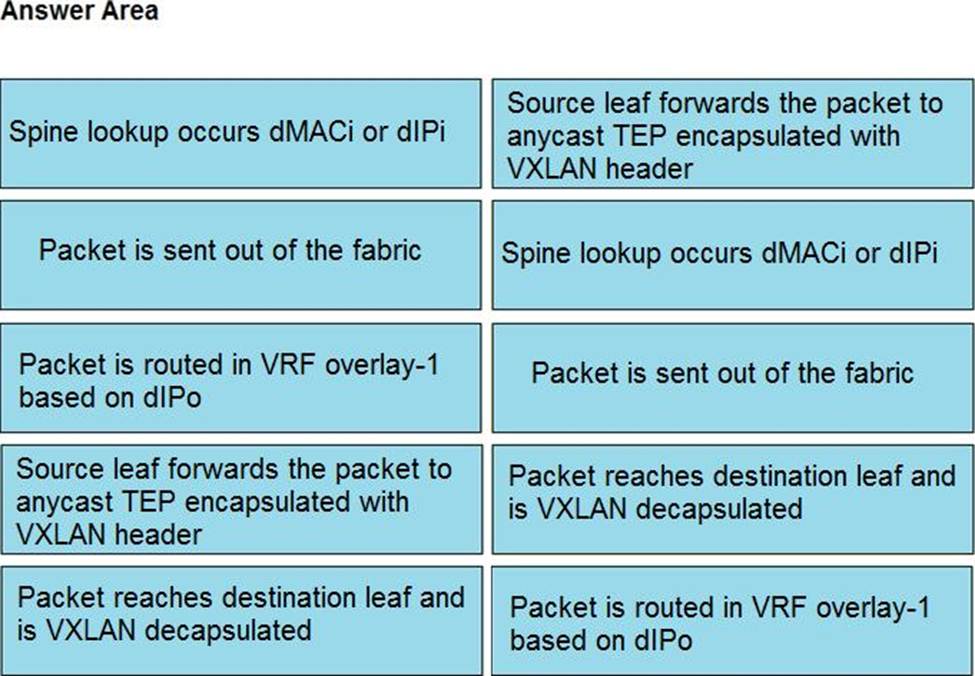
DRAG DROP
A leaf receives unicast traffic that is destined to an unknown source, and spine proxy is enabled in the corresponding bridge domain.
Drag and drop the Cisco ACI forwarding operations from the left into the order the operation occurs on the right.
A customer is deploying a new application across two ACI pods that is sensitive to latency and jitter. The application sets the DSCP values of packets to AF31 and CS6, respectively.
Which configuration changes must be made on the APIC to support the new application and prevent packets from being delayed or dropped between pods?
- A . disable DSCP translation policy
- B . align the ACI QoS levels and IPN QoS policies
- C . disable DSCP mapping on the IPN devices
- D . align the custom QoS policy on the EPG site in the customer tenant
B
Explanation:
To support an application that is sensitive to latency and jitter, it is crucial to ensure that the Quality of Service (QoS) levels within the ACI fabric and the Inter-Pod Network (IPN) QoS policies are aligned. This alignment will help in maintaining consistent handling of the DSCP values set by the application (AF31 and CS6) as the packets traverse across the two ACI pods. By aligning the QoS levels and policies, the application’s packets are less likely to experience delays or drops, thus preserving the required performance levels for the application’s optimal functionality.
Refer to the exhibit.
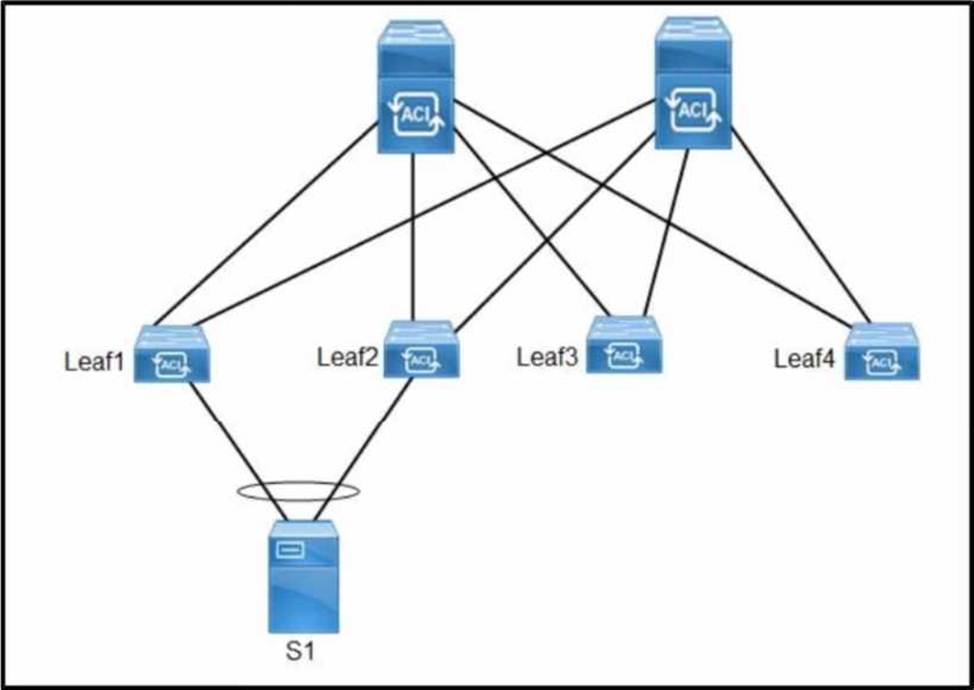
A Cisco ACI fabric must be integrated with VMware. Leaf1 and Leaf2 are connected to S1 using a VPC. The object VMware Virtual Distributed switch VPC Policy group type has been created in the fabric.
Which mode must be set for the port-channel policy to allow the failover and the full use of the bandwidth in both directions?
- A . Link Aggregation Control Protocol
- B . MAC Pinning
- C . Static channel – Mode On
- D . Explicit failover order
A
Explanation:
LACP is the correct mode for the port-channel policy to ensure failover and full bandwidth utilization in both directions when integrating a Cisco ACI fabric with VMware using a VPC connected to Leaf1 and Leaf2. It allows multiple physical ports to be bundled into a single logical channel, providing redundancy and increased bandwidth.
Reference: = (Implementing Cisco Application Centric Infrastructure Official Cert Guide)
Refer to the exhibit.
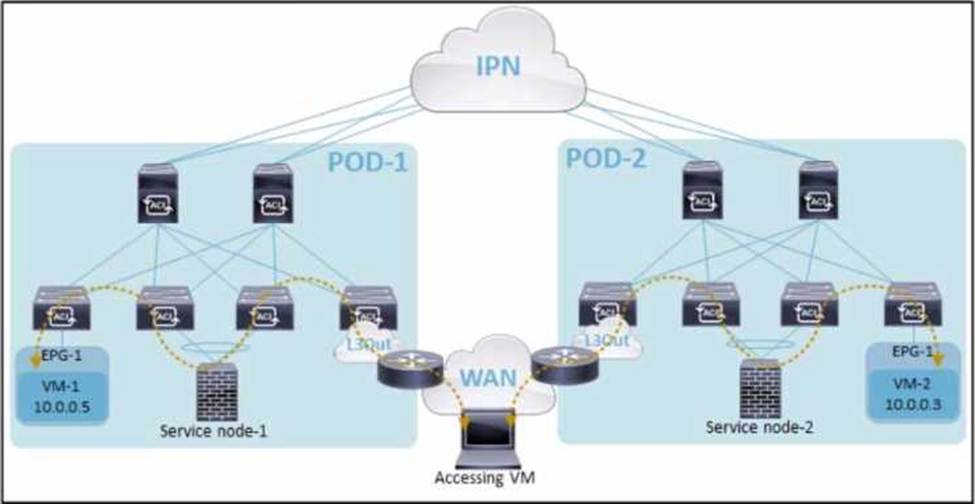
The requirement Is to prefer the local PBR node and redirect the traffic to the remote pod PBR node in the case of catastrophic node failure.
Which configuration meets these requirements?
- A . • location-based PBR
• host route advertisement
• resilient hashing - B . • symmetric PBR
• location-based PBR
• resilient hashing - C . • symmetric PBR
• unidirectional PBR
• resilient hashing - D . • location-based PBR
• host route advertisement
• node tracking
D
Explanation:
The correct configuration to prefer the local Policy-Based Routing (PBR) node and redirect traffic to the remote pod PBR node in case of catastrophic failure is option D: location-based PBR, host route advertisement, and node tracking. Location-based PBR allows for the selection of a preferred path based on the location of the traffic source or destination. Host route advertisement enables specific routing information to be propagated throughout the network, which can be used to influence traffic flow. Node tracking provides a mechanism to monitor node status and reroute traffic if a node becomes unavailable due to failure.
Reference: = (Implementing Cisco Application Centric Infrastructure Official Cert Guide)
An engineer must implement an L30ut within a tenant to allow the reachability to services outside of the Cisco ACI fabric. The requirement is to allow communication from the EPGs in the same VRF to the external services and save TCAM resource utilization.
Which contract insertion method must be used to meet these requirements?
- A . Provider: each service EPGs Consumer: vzAny inside the VRF
- B . Provider: each service EPGs Consumer: L30ut external EPGs
- C . Provider: L30ut external EPGs Consumer: each service EPGs
- D . Provider: L30ut external EPGs Consumer: vzAny inside VRF
D
Explanation:
To allow reachability to services outside of the Cisco ACI fabric while conserving TCAM resources, an engineer should use a contract insertion method where L30ut external EPGs act as providers and vzAny inside VRF acts as consumers. This configuration allows for communication from all EPGs within a VRF (represented by vzAny) to access external services through L30ut without having to create individual contracts for each service EPG, thus saving TCAM resources.
Reference: Implementing Cisco Application Centric Infrastructure Official Cert Guide
Which PIM version must be configured in the Inter-Pod Network to allow broadcast, unknown unicast. and multicast flooding between Cisco ACI pods?
- A . Bidirectional PIM
- B . PIM dense mode
- C . PIM sparse mode
- D . Source Specific Multicast
C
Explanation:
Protocol Independent Multicast sparse mode (PIM-SM) is designed for efficient routing to multiple receivers in a multicast group across an inter-pod network (IPN). PIM sparse mode is best suited for environments where receivers are dispersed because it allows for explicit join messages to control the flow of traffic. This makes it ideal for scenarios where broadcast, unknown unicast, and multicast flooding between Cisco ACI pods is required.
Reference: = (Implementing Cisco Application Centric Infrastructure Official Cert Guide)
What is a design implication for Cisco ACI using an application-centric approach?
- A . Multiple VLANs and/or multiple EPGs are under one bridge domain
- B . VLAN numbers are in the names of the bridge domain and EPG objects
- C . One EPG is mapped to multiple bridge domains
- D . One VLAN equals one EPG equals one bridge domain
A
Explanation:
Using an application-centric approach in Cisco ACI means that multiple VLANs and/or multiple EPGs can be grouped under one bridge domain. This approach aligns network constructs with application requirements, enabling more efficient and flexible network configurations.
Reference: = Network Centric to ACI Centric Migration – Cisco
Which protocol is used to exchange the MAC/IP address information for endpoints between spine switches in different pods in a Cisco Multi-Pod solution?
- A . BGPVPNv4
- B . MP-BGPEVPN
- C . IS-IS
- D . GRE
B
Explanation:
The protocol used for exchanging MAC/IP address information for endpoints between spine switches in different pods within a Cisco Multi-Pod solution is MP-BGPEVPN (Multiprotocol BGP Ethernet VPN). This protocol facilitates scalable communication between separate locations by allowing MAC/IP address information sharing across pods.
Reference: = (Implementing Cisco Application Centric Infrastructure Official Cert Guide)
Which approach does Cisco ACI use to achieve multidestination packet forwarding between leaf switches in the same fabric?
- A . Map VXLAN VTEP to the multicast group
- B . Map VXLAN to PIM-SM protocol
- C . Map VXLAN VNI to the multicast group
- D . Map VXLAN to PIM-DM protocol
C
Explanation:
Cisco ACI uses a mapping of VXLAN Virtual Network Identifier (VNI) to multicast groups to facilitate multidestination packet forwarding between leaf switches within the same fabric. This approach allows for efficient communication and data packet distribution to multiple destinations simultaneously1.
Reference: = Cisco ACI Multidestination Packet Forwarding Approach
Which device replicates Broadcast. Unicast. and Multicast (BUM) frames to all remote sites in a Cisco ACI Multi-Site with multiple stretched bridge domains?
- A . remote spine node that translates the VNID to the locally significant value
- B . receiving leaf that learns the location for the sourced BUM traffic
- C . source leaf that floods the traffic to the specific multicast group or GlPo
- D . local spine that is elected the designated forwarder for each bridge domain
C
Explanation:
In a Cisco ACI Multi-Site setup, the source leaf is responsible for flooding BUM (Broadcast, Unicast, and Multicast) traffic to the specific multicast group or GIPo (Group IP Overlay). This process involves the ingress replication function on the spine nodes of the source site to replicate BUM traffic to all remote sites where the bridge domain is stretched12.
Reference: = Cisco ACI Multi-Site Architecture White Paper, ACI Multi-Site Data Plane Communication – DCLessons