
Cisco 300-630 Practice Exams
Last updated on Oct 21,2026- Exam Code: 300-630
- Exam Name: Implementing Cisco Application Centric Infrastructure - Advanced (DCACIA)
- Certification Provider: Cisco
- Latest update: Oct 21,2026
Refer to the exhibit.
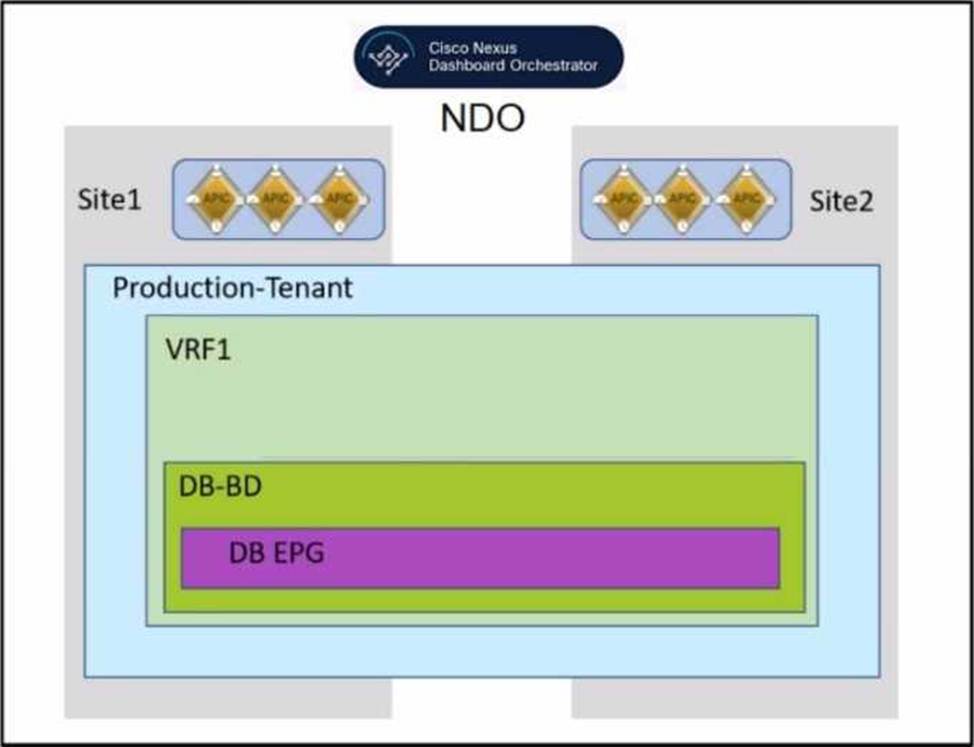
An engineer must allow IP mobility between Site1 and Site2 in a Cisco Nexus Dashboard Orchestrator.
The design must meet these requirements:
• A disaster recovery (DR) solution must exist between the sites that do not require vMotion support
• The application must be started at a DR site without having to re-IP the application servers
• The solution must avoid any broadcast storms between the sites.
Which two actions meet these criteria? (Choose two.)
- A . Deploy a local EPG for Site1 and Site2.
- B . Define a unique bridge domain subnet per site.
- C . Configure STP between Cisco ACI fabrics.
- D . Apply the L2 Stretch feature.
- E . Disable inter-site BUM Traffic.
D, E
Explanation:
The L2 Stretch feature allows for the extension of a Layer 2 network across multiple sites without changing the IP addressing scheme, which satisfies the requirement for starting an application at a DR site without re-IPing servers. Disabling inter-site BUM (Broadcast, Unknown unicast, and Multicast) traffic prevents broadcast storms between sites while still allowing IP mobility, meeting both specified criteria.
Reference: = (Implementing Cisco Application Centric Infrastructure Official Cert Guide)
Leaf 1002 receives a packet from a host attached to Leaf1001. The packet contains the MAC address. IP address, and VRF of the source.
Which information does each node learn?
- A . Leaf 1002 learns the IP address of the source.
Spine2001 learns the VRF of the source. - B . Leaf 1002 learns the VRF of the source.
Leaf1002 learns the IP address of the source. - C . Leaf1001 learns the MAC address of the source.
Leaf1002 learns the IP address of the source. - D . Leaf1001 learns the IP address of the source.
Spine2001 learns the IP address of the source
C
Explanation:
When Leaf 1002 receives a packet from a host attached to Leaf 1001, it learns the MAC address of the source from Leaf 1001. Additionally, Leaf 1002 learns the IP address of the source.
Reference: = Cisco APIC Layer 2 Networking Configuration Guide, Release 5.2(x)
An engineer configures a new Cisco ACI Multi-Pod and must set up the link between the spine and the IPN device.
Which three actions should be taken to accomplish this goal? (Choose three.)
- A . Enable MP-BGP routing
- B . Enable BIDIR-PIM protocol
- C . Enable PIM-SM protocol
- D . Enable OSPF routing
- E . Enable IS-IS routing
- F . Enable DHCP relay
A, B, D
Explanation:
To set up the link between the spine and the IPN device in a Cisco ACI Multi-Pod, the following actions should be taken:
An engineer configures a new Cisco ACI Multi-Pod setup.
Which action should be taken for fabric discovery to be successful for the nodes in Pod 2?
- A . Select the Route Reflector field in Pod Peering
- B . Enable the DSCP class-cos translation policy for Layer 3 traffic
- C . Configure POD 2 Data Plane TEP under the Pod Connection Profile
- D . Add the IPN subnet under the Fabric External Routing Profile
C
Explanation:
For fabric discovery to be successful for the nodes in Pod 2, the engineer should configure POD 2 Data Plane TEP under the Pod Connection Profile. This action establishes the necessary data plane tunnel endpoint for communication between the pods.
Reference: = Troubleshoot ACI Fabric Discovery – Multi-Pod Discovery – Cisco, Which action should be taken for fabric discovery to be successful for…
An engineer must allow routes learned from one L3Out to be advertised out another L3Out. The engineer does not have an explicit list of all the routes that must be advertised out, however, they know that they are all part of the 10.16.0.0/16 CIDR block.
Which attributes must be selected under Ext-EPG to allow the necessary routes to be advertised out?
- A . Enable Export Route Control Subnet and enable Aggregate Export
- B . Disable Shared Route Control Subnet and enable Aggregate Shared Routes
- C . Enable Export Route Control Subnet and disable Aggregate Shared Routes
- D . Enable Export Route Control Subnet and enable Shared Route Control Subnet
A
Explanation:
When allowing routes learned from one L3Out to be advertised out another L3Out, the Export Route Control Subnet should be enabled, and Aggregate Export should also be enabled. This configuration allows the necessary routes within the specified CIDR block to be aggregated and advertised out, facilitating efficient route advertisement without the need for an explicit list of all routes.
Reference: Implementing Cisco Application Centric Infrastructure Official Cert Guide
Which action reduces the impact on workload when migrating from the existing Cisco NX-OS VXLAN network infrastructure to the Cisco ACI fabric?
- A . Disable bridge domain unicast routing while a default gateway is in VXLAN infrastructure
- B . Set the default gateway in the Cisco ACI and VXLAN fabrics
- C . Use ACI spines for the Cisco ACI and VXLAN fabrics
- D . Configure vPC between the standalone Nexus and the Cisco ACI leaf
A
Explanation:
Migrating from Cisco NX-OS VXLAN to Cisco ACI fabric involves several considerations to minimize impact on workloads. Disabling bridge domain unicast routing while the default gateway remains in the VXLAN infrastructure ensures that the migration does not disrupt the existing traffic flow. This approach allows for a smoother transition by maintaining the current routing paths until the migration is complete123.
Reference: = Implementing Cisco Application Centric Infrastructure Official Cert Guide
Refer to the exhibit.
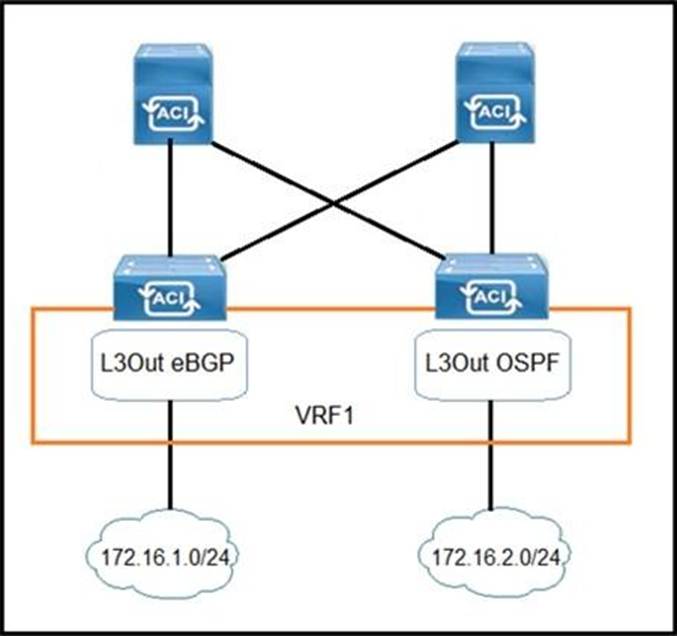
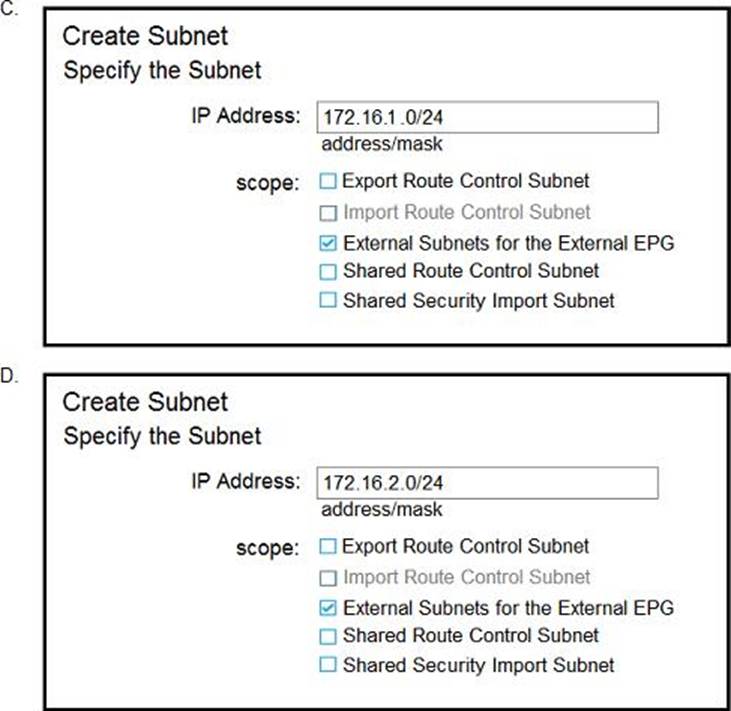
Which configuration must be implemented on L3Out EBGP to advertise out of the fabric 172.16.2.0/24 network that is learned from L3Out OSPF?
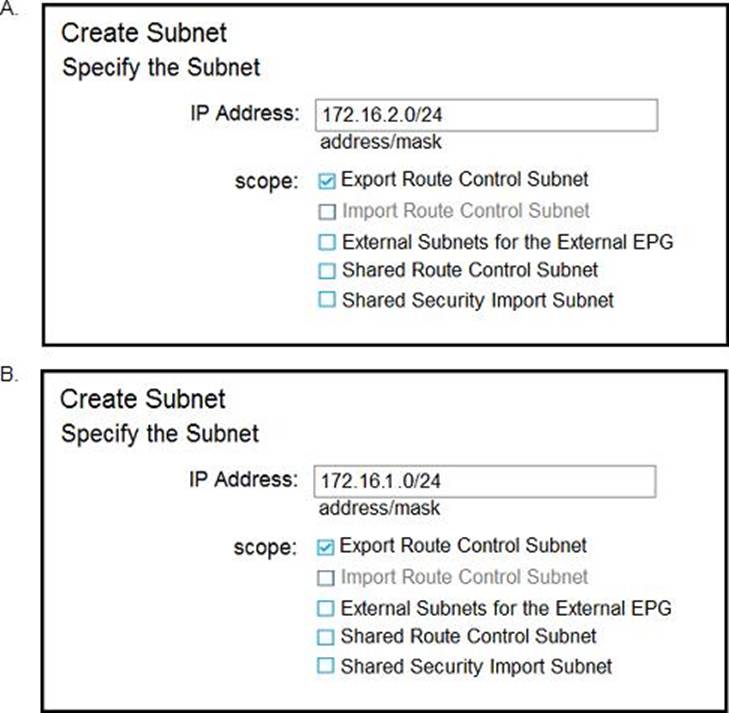
- A . Option A
- B . Option B
- C . Option C
- D . Option D
D
Explanation:
To advertise the 172.16.2.0/24 network learned from L3Out OSPF out of the fabric via EBGP, a subnet must be created within the L3Out’s External EPG and marked as “Shared Route Control Subnet.” This setting allows the route to be advertised to external routers through EBGP.
Reference: = Implementing Cisco Application Centric Infrastructure Official Cert Guide
How does Cisco ACI manage the STP BPDUs between two pods?
- A . Cisco ACI spines perform ingress replication for STP BPDUs
- B . Cisco ACI spines suppress STP BPDUs to be forwarded to other pods
- C . BPDUs are forwarded over IPN using the bridge domain GIPo multicast address
- D . Special multicast group 239.255.255.255 is used to forward STP BPDUs
B
Explanation:
In Cisco ACI, the spines suppress STP BPDUs to prevent them from being forwarded to other pods. This behavior ensures that the ACI fabric operates efficiently without relying on STP for loop prevention.
Reference: = Cisco APIC Layer 2 Networking Configuration Guide, Release 5.2(x)
Refer to the exhibit.
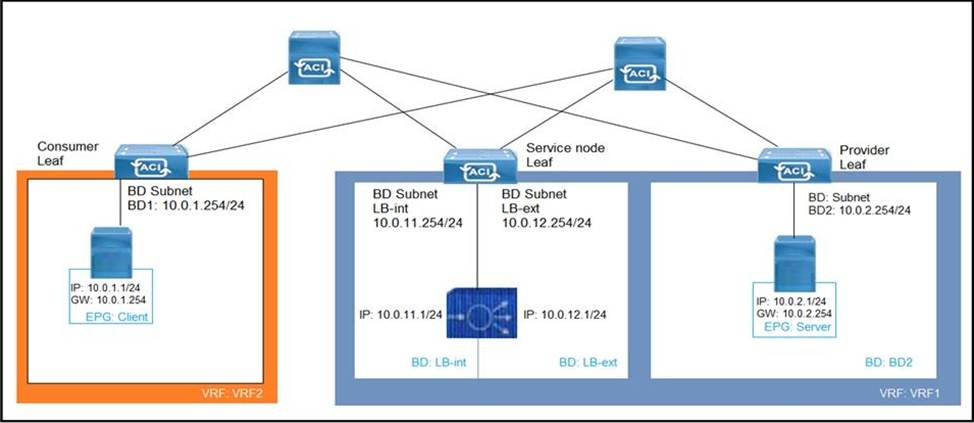
What must be configured to allow the PBR node (LB-int) to monitor the availability of the endpoint that is in the EPG server?
- A . Endpoint Dataplane Learning
- B . Unicast Route disabled for client and server bridge domains
- C . PBR node tracking
- D . Direct Connect in the service graph template
A
Explanation:
PBR Node Tracking:
Purpose: It is used to monitor the health and availability of endpoints within an Endpoint Group (EPG).
Functionality: When configured, it allows for real-time health checks and traffic redirection based on endpoint status and network conditions.
Benefits: Ensures traffic is directed to healthy endpoints, maintaining application performance and availability.
A network engineer configured an active-active firewall cluster that is stretched across separate pods in the Cisco ACI fabric.
Which two implementation setups for anycast services are available? (Choose two.)
- A . Modify the Cisco ACI contract scope
- B . Modify the MAC address on the second firewall
- C . Configure the firewalls behind an EPG subnet
- D . Deselect No Default SVI Gateway under EPG Subnet
- E . Deploy a Layer 4 to Layer 7 service graph with PBR
C, E
Explanation:
Anycast services in a Cisco ACI fabric allow services like firewalls to be stretched across multiple pods, providing high availability and resiliency. The correct setups for implementing anycast services include configuring the firewalls behind an EPG subnet © and deploying a Layer 4 to Layer 7 service graph with Policy-Based Routing (PBR) (E). Modifying the ACI contract scope (A) or the MAC address on the second firewall (B) are not related to anycast service implementation. Deselecting No Default SVI Gateway under EPG Subnet (D) is not a setup for anycast services1.
Reference: = (Cisco APIC Online Help – About Anycast Services2)