
Cisco 300-630 Practice Exams
Last updated on Oct 21,2026- Exam Code: 300-630
- Exam Name: Implementing Cisco Application Centric Infrastructure - Advanced (DCACIA)
- Certification Provider: Cisco
- Latest update: Oct 21,2026
Where are STP BPDUs flooded in Cisco ACI fabric?
- A . in the bridge domain VLAN
- B . in the native VLAN ID
- C . in the access encapsulation VLAN part of different VLAN pools
- D . in the VNID that is assigned to the FD VLAN
A
Explanation:
In Cisco ACI fabric, STP BPDUs are flooded in the bridge domain VLAN. This allows the BPDUs to be propagated throughout the fabric, maintaining the STP topology2.
Reference: = Implementing Cisco Application Centric Infrastructure Official Cert Guide
Refer to the exhibit.
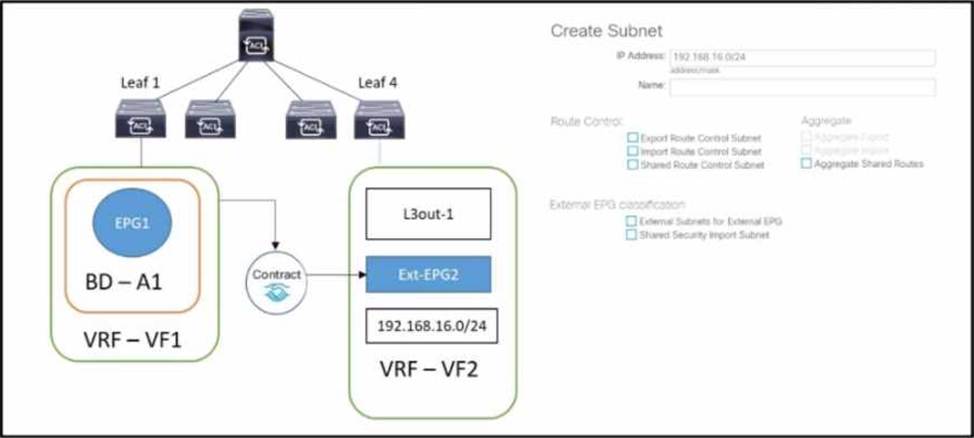
The external subnet and internal EPG1 must communicate with each other, and the L30ut traffic must leak Into the VRF named "VF1".
Which configuration set accomplishes these goals?
- A . External Subnets for External EPG Import Route Control Subnet Shared Route Control Subnet
- B . External Subnets for External EPG Shared Route Control Subnet Shared Security Import Subnet
- C . Export Route Control Subnet Shared Security Import Subnet Aggregate Shared Routes
- D . Export Route Control Subnet Import Route Control Subnet Aggregate Shared Routes
D
Explanation:
The configuration set that accomplishes the goals of allowing communication between the external subnet and internal EPG1, as well as leaking L30ut traffic into VRF named “VF1”, is option D: Export Route Control Subnet Import Route Control Subnet Aggregate Shared Routes. This configuration ensures that routes are properly exported from one entity and imported into another while aggregating shared routes for efficient routing within the VRF “VF1”. It allows for controlled route leaking which is necessary for communication across different entities within a Cisco ACI environment.
Reference: = (Implementing Cisco Application Centric Infrastructure Official Cert Guide)
Refer to the exhibit.
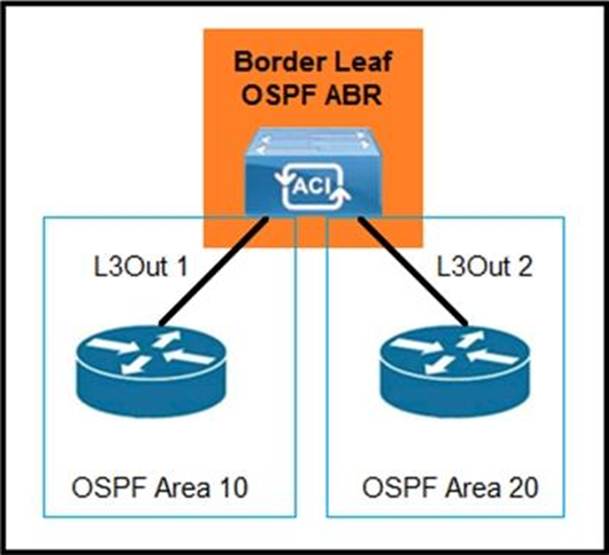
Which configuration must be implemented to allow intra-VRF transit routing between the two external routers?
- A . Deploy both areas under the same L3Out policy
- B . Change one of the areas to area 0
- C . Configure OSPF virtual links
- D . Modify L3Out 1 to use the same OSPF area as L3Out 2
C
Explanation:
For intra-VRF transit routing between two external routers in different OSPF areas, OSPF virtual links are required. They connect non-contiguous areas to the backbone area, ensuring all areas can communicate even if not directly connected.
Reference: = Implementing Cisco Application Centric Infrastructure Official Cert Guide
An engineer configures a new Cisco ACI Multi-Site Orchestrator node to join an MSO cluster.
Which two components are necessary to ensure that the new node has IP connectivity in this configuration? (Choose two.)
- A . Cisco ACI spine interfaces that are connected to ISN
- B . Cisco APICs over the OOB management network
- C . existing Cisco ACI Multi-Site Orchestrator node
- D . management IP of ESXi hosts where the controllers are deployed
- E . OOB interface of ISN
B, D
Explanation:
For a new Cisco ACI Multi-Site Orchestrator (MSO) node to join an MSO cluster and ensure IP connectivity, it requires connectivity to the Cisco Application Policy Infrastructure Controllers (APICs) over the Out-of-Band (OOB) management network and the management IP of ESXi hosts where the controllers are deployed. The OOB management network allows the MSO node to communicate with the APICs for centralized management and policy control, while the management IP of the ESXi hosts provides the necessary connectivity for the virtual machine infrastructure where the MSO node is deployed123.
Reference: = Cisco ACI Multi-Site Architecture White Paper, Cisco Multi-Site Deployment Guide for ACI Fabrics, ACI Multi-Site Architecture and Deployment – Cisco.
What are two characteristics of Cisco ACI interaction with MSTP? (Choose two.)
- A . A Cisco ACI leaf flushes all local endpoints in the received EPG when an MSTP TCN frame is received.
- B . A static path binding is required for native VLAN to carry the MST BPDUs in existing EPGs.
- C . Mis-cabling protocol is used to snoop the MSTP TCN packets.
- D . A dedicated EPG must be created for the native VLAN ID with static bindings toward the MSTP-enabled switches.
- E . The PVST simulation must be configured on external network switches to support MSTP.
A, D
Explanation:
Cisco ACI handles MSTP TCN frames by flushing local endpoints in the affected EPG to prevent stale entries. For MST BPDUs to traverse the ACI fabric, a dedicated EPG for the native VLAN with static bindings is required for MSTP-enabled external switches.
Reference: = (Implementing Cisco Application Centric Infrastructure Official Cert Guide)
An engineer configures Cisco ACI Multi-Site and must specify the control plane TEP IP for spines.
Which statement describes control plane TEP IP in this situation?
- A . The unique IP address is defined on each spine node that belongs to a fabric and is used to establish MP-BGP EVPN and VPNv4 adjacencies with the spine nodes in remote sites.
- B . The unique IP address is defined on each spine node that belongs to a fabric and is used to establish VXLAN adjacencies with the spine nodes in remote sites.
- C . The common anycast address is shared by all the spine nodes in the same site and is used to perform headend replication for BUM traffic.
- D . The common anycast address is shared by all the spine nodes at the same site and is used lo source and receive unicast VXLAN data plane traffic.
A
Explanation:
The control plane TEP (Tunnel Endpoint) IP address is a unique IP address assigned to each spine node within a Cisco ACI fabric. This IP address is used to establish MP-BGP EVPN (Multiprotocol Border Gateway Protocol Ethernet VPN) and VPNv4 (VPN version 4) adjacencies with the spine nodes in remote sites when configuring Cisco ACI Multi-Site. The control plane TEP IP enables the spine nodes to exchange routing information and network reachability for seamless integration of multiple sites into a single ACI fabric.
Reference: = Implementing Cisco Application Centric Infrastructure Official Cert Guide
Refer to the exhibit.
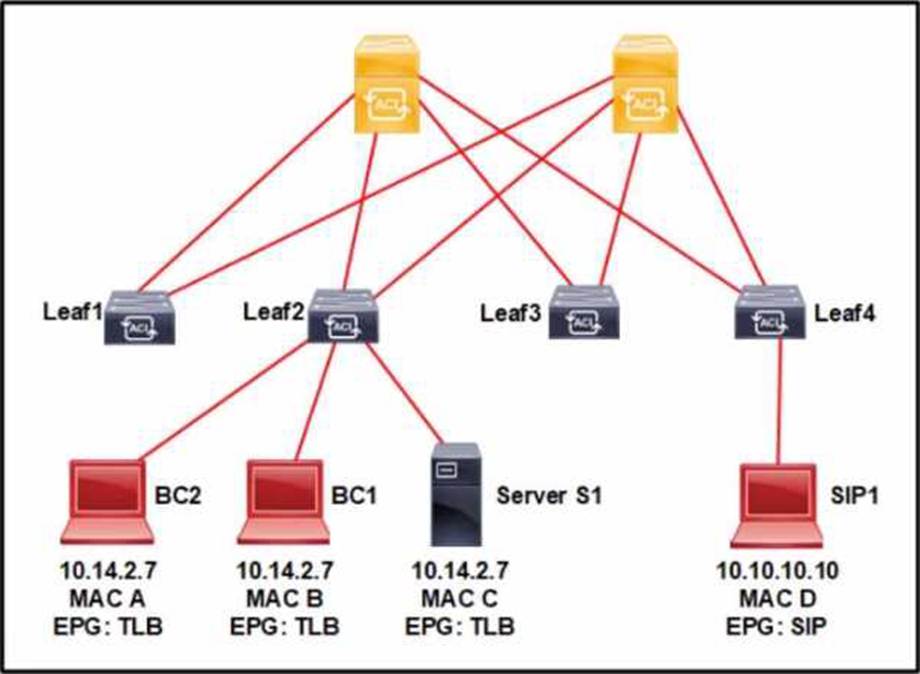
Server S1 is load balancing traffic received from SIP1 to BC1 and BC2. The Cisco ACI fabric must learn the IP address of S1 and unlearn the BC1 and BC2 IP addresses.
Which two actions must be taken to meet these requirements? (Choose two.)
- A . Check the Limit IP learning to subnet box.
- B . Disable IP data plane learning on EPG TLB
- C . Enforce subnet check globally.
- D . Suppress ARP response on BC1 and BC2.
- E . Create L4-L7 virtual IP of 10.14.2.7.
A, D
Explanation:
In the Cisco ACI fabric, to ensure that the IP address of Server S1 is learned and the IP addresses of BC1 and BC2 are not learned, one must limit IP learning to a specific subnet and suppress ARP responses from BC1 and BC2. By checking the “Limit IP learning to subnet” box (Option A), it ensures that only IPs within a defined subnet are learned, which would include Server S1’s IP but exclude BC1 and BC2 if they are outside of this subnet. Suppressing ARP response on BC1 and BC2 (Option D) prevents these devices from responding to ARP requests, which in turn prevents their IPs from being learned by other devices in the network.
Reference: = (Implementing Cisco Application Centric
Infrastructure Official Cert Guide)
Refer to the exhibit.
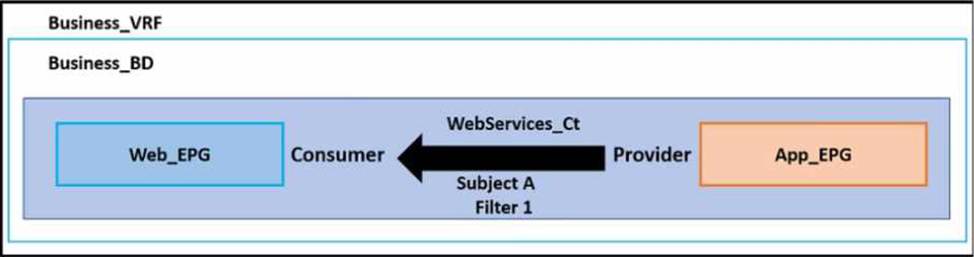
Which configuration set must be applied to filter 1 to enable SSH communication between Web_EPG to App_EPG?
- A . Apply Both Directions: Disabled Reverse Filter Ports: Enabled
- B . Apply Both Directions: Enabled Reverse Filter Ports: Enabled
- C . Apply Both Directions: Disabled Reverse Filter Ports: Disabled
- D . Apply Both Directions: Enabled Reverse Filter Ports: Disabled
D
Explanation:
To enable SSH communication between Web_EPG (Web Endpoint Group) and App_EPG (Application Endpoint Group), it’s necessary to apply a configuration that allows bidirectional communication while not restricting ports based on their directionality. By enabling “Apply Both Directions” and disabling “Reverse Filter Ports,” this ensures that the filter allows SSH packets to flow from Web_EPG to App_EPG and vice versa without any restrictions based on the port’s direction, which is essential for establishing an SSH session.
Reference: = (Implementing Cisco Application Centric Infrastructure Official Cert Guide)
Which feature should be disabled on a bridge domain when a default gateway for endpoints is on an external device instead of a Cisco ACI bridge domain SVI?
- A . unicast routing
- B . ARP flooding
- C . unknown unicast flooding
- D . proxy ARP
B
Explanation:
ARP flooding should be disabled on a bridge domain when the default gateway for endpoints is on an external device instead of a Cisco ACI bridge domain SVI. This is because ARP flooding allows for the resolution of IP addresses to MAC addresses within the bridge domain. When the default gateway is external, enabling ARP flooding can lead to unnecessary broadcast traffic on the network, as the ARP requests will not be contained within the ACI fabric. Disabling ARP flooding ensures that ARP requests are handled by the external device serving as the default gateway1234.
Reference: = Implementing Cisco Application Centric Infrastructure Official Cert Guide
An engineer creates the objects that must be deployed at each site in Cisco ACI Multi-Site Orchestrator.
Which action should be taken before the schema can be associated with the newly configured site?
- A . Attach the templates to the newly configured site
- B . Configure a provider for the Cisco ACI Multi-Site Orchestrator
- C . Import existing policies from an existing tenant to Cisco ACI Multi-Site Orchestrator
- D . Configure the Infra Site-Specific Settings
B
Explanation:
Before associating a schema with a newly configured site in Cisco ACI Multi-Site Orchestrator, it’s essential to configure a provider. This establishes a communication link between the orchestrator and the sites, enabling proper deployment and management of objects across multiple sites.