
Cisco 300-630 Practice Exams
Last updated on Oct 21,2026- Exam Code: 300-630
- Exam Name: Implementing Cisco Application Centric Infrastructure - Advanced (DCACIA)
- Certification Provider: Cisco
- Latest update: Oct 21,2026
An engineer must implement a full mesh Cisco ACI Multi-Site architecture.
Which action must be taken on each spine to accomplish this goal?
- A . Configure BGP-EVPN Router-ID
- B . Configure Multi-Pod Data-Plane TEP
- C . Configure Overlay Unicast TEP
- D . Configure Overlay Multicast TEP
A
Explanation:
For a full mesh Cisco ACI Multi-Site architecture, configuring the BGP-EVPN Router-ID on each spine is essential. This configuration ensures unique identification and proper routing of traffic within the overlay network1
Reference: https://www.cisco.com/c/en/us/solutions/collateral/data-center-virtualization/application-centric-infrastructure/white-paper-c11-739609.html
An engineer implements the Cisco ACI solution and needs to confirm that the leaf switch correctly learns the remote endpoint MAC.
Which information must be included in the VXLAN packet that is received from the Cisco ACI spine for the Cisco ACI leaf to learn MAC as a remote endpoint?
- A . VRF
- B . application profile
- C . bridge domain
- D . EPG
C
Explanation:
For a Cisco ACI leaf switch to correctly learn the remote endpoint MAC, the VXLAN packet received from the Cisco ACI spine must include bridge domain information. The bridge domain contains the Layer 2 forwarding context, which allows the leaf switch to learn and associate the MAC address with the correct bridge domain3.
Reference: = (Implementing Cisco Application Centric Infrastructure Official Cert Guide)
What is a use of the Overlay Multicast TEP in Cisco ACI Multi-Site communication?
- A . to perform headend replication
- B . to act as the source IP for BUM traffic
- C . to establish MP-BGP adjacencies with remote spines
- D . to send and receive unicast VXLAN data plane traffic
B
Explanation:
The Overlay Multicast TEP in Cisco ACI Multi-Site communication serves as the source IP for BUM traffic, which includes Broadcast, Unknown unicast, and Multicast traffic. This is crucial for efficient replication of BUM traffic across different sites.
Reference: https://www.cisco.com/c/en/us/solutions/collateral/data-center-virtualization/application-centric-infrastructure/white-paper-c11-739609.html#CiscoACIMultiSiteoverlaydataplane
As part of a newly deployed ACI fabric, a pair of border leaf switches have been deployed to provide shared services for all tenants. The configured L3Out runs OSPF as the routing protocol. The requirement is to advertise the routes from the border leaf switches to the compute leaf switches.
Which configuration must be implemented to meet these requirements?
- A . Configure a BGP route reflector policy for the Cisco ACI pod
- B . Define the shared L3Out in the common tenant
- C . Enable Import Route Control Enforcement in the L3Out policy
- D . Define the consumer subnet under the consumer EPG
B
Explanation:
To advertise routes from border leaf switches to compute leaf switches in a shared services scenario, the shared L3Out should be defined in the common tenant. This allows all tenants to access the shared services provided by the L3Out. By configuring the L3Out in the common tenant, routes can be advertised to the compute leaf switches, ensuring that the services are available across the ACI fabric.
Reference: Implementing Cisco Application Centric Infrastructure Official Cert Guide
A cloud provider must make a pair of firewalls available to all tenants. Each tenant defines its own service graph.
Where should the Layer 4 to Layer 7 service be configured to accomplish this goal?
- A . management tenant
- B . infrastructure tenant
- C . user tenant
- D . common tenant
D
Explanation:
In Cisco ACI, shared services like firewalls should be configured in the common tenant. This allows all tenants to access the services without duplicating them in each tenant.
Refer to the exhibit.
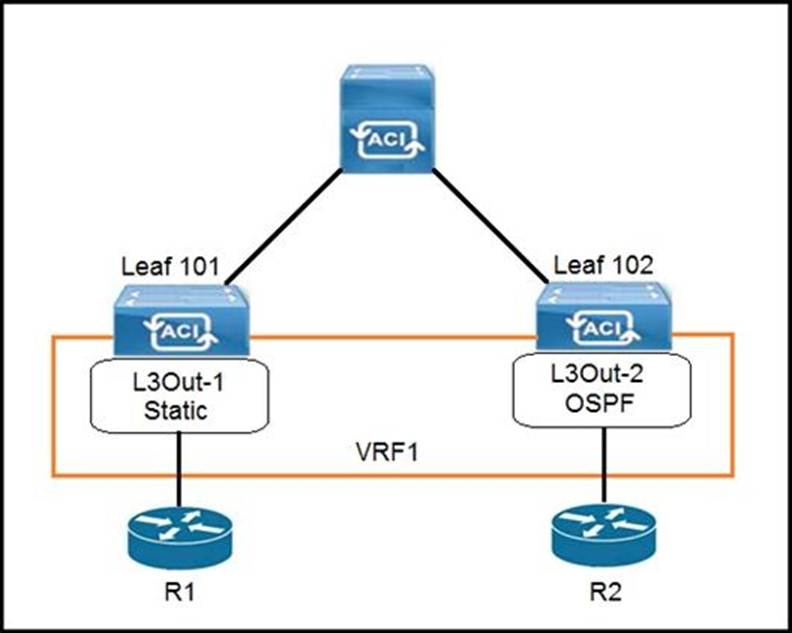
The 0.0.0.0/0 is configured as a default static route on L3Out-1.
Which action should be taken for the 0.0.0.0/0 prefix to advertise out on L3Out-2 OSPF?
- A . Enable Shared Security Import Subnet
- B . Enable Aggregate Export Subnet
- C . Enable Shared Route Control Subnet
- D . Enable Export Route Control Subnet
B
Explanation:
In an ACI setup, to advertise a default static route from L3Out-1 to another L3Out using OSPF, the Aggregate Export Subnet feature must be enabled. This allows for the summarization and advertisement of routes, including the default route, to external networks via OSPF.
Reference: = Implementing Cisco Application Centric Infrastructure Official Cert Guide
Refer to the exhibit.
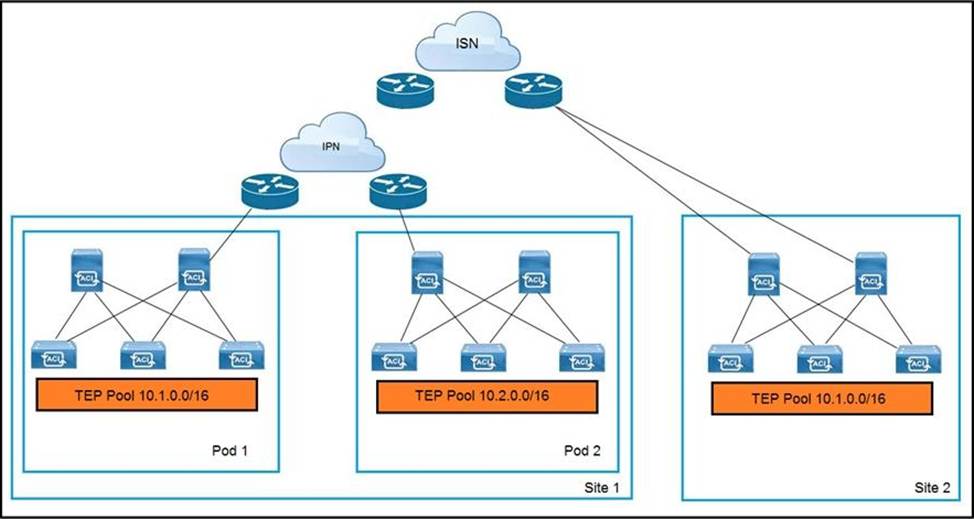
An engineer extends a Cisco ACI Multi-Pod setup to a Cisco ACI Multi-Site implementation.
Which action allows the interconnection?
- A . Configure BIDIR-PIM in the IPN and ISN
- B . Use dedicated uplinks on Site 1 spines for ISN connections
- C . Connect all spines to the IPN and ISN
- D . Filter the advertisement of the Site 2 TEP pool into the IPN
A
Explanation:
When extending a Cisco ACI Multi-Pod setup to a Multi-Site implementation, configuring BIDIR-PIM in both the IPN (Inter-Pod Network) and ISN (Inter-Site Network) is necessary. This allows for efficient multicast traffic routing between multiple pods and sites.
Reference: = Implementing Cisco Application Centric Infrastructure Official Cert Guide
What is a characteristic of a stretched bridge domain solution between Cisco ACI sites with Layer 2 flood disabled?
- A . The application profile that is associated to the bridge domain have local significance in each site.
- B . The tenant and VRF that associated to the bridge domain have local significance in each site.
- C . Headend replication is used for BUM traffic between sites.
- D . IP mobility is ensured between sites for disaster recovery.
C
Explanation:
In a stretched bridge domain solution between Cisco ACI sites with Layer 2 flood disabled, headend replication is used for broadcast, unknown unicast, and multicast (BUM) traffic between sites. This approach optimizes traffic flow and reduces unnecessary flooding across the network1.
Reference: = Implementing Cisco Application Centric Infrastructure Official Cert Guide
Refer to the exhibit.
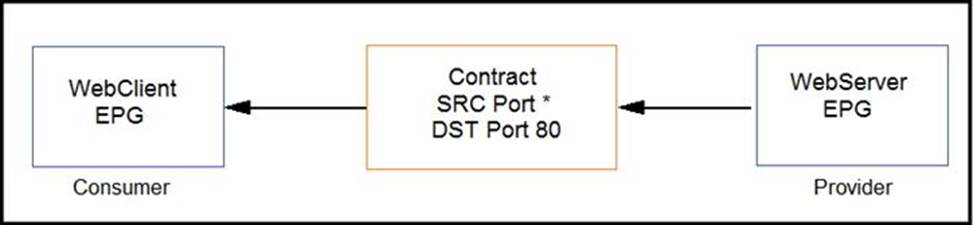
Which combination of flags in the Cisco ACI contract allows a client in WebClient EPG to establish an HTTP connection toward a server in WebServer EPG?
- A . Apply Both Direction ENABLED and Reverse Port Filter ENABLED
- B . Apply Both Direction DISABLED and Reverse Port Filter DISABLED
- C . Apply Both Direction DISABLED and Reverse Port Filter ENABLED
- D . Apply Both Direction ENABLED and Reverse Port Filter DISABLED
C
Explanation:
In Cisco ACI, contracts define the policies for communication between EPGs (Endpoint Groups). For a client in WebClient EPG to establish an HTTP connection toward a server in WebServer EPG, the contract must allow the initiation of communication from WebClient to WebServer. Since HTTP uses port 80, the destination port (DST Port) should be set to 80 as per standard HTTP communications. The option “Apply Both Direction DISABLED” means that only the initiator of the connection (in this case, WebClient EPG) can send traffic unless specified otherwise by another contract or filter. The “Reverse Port Filter ENABLED” allows return traffic from WebServer EPG back to WebClient EPG on dynamically allocated source ports used by WebClient when initiating the connection. This combination ensures that clients can initiate an HTTP request and receive responses from servers.
Reference: = Implementing Cisco Application Centric Infrastructure Official Cert Guide
A Cisco ACI fabric is connected to a switched network that runs Spanning Tree Protocol on VLAN 101. VLANs 101. 102. and 103 are mapped to bridge domain BD10123. The leaf node that is attached to this switched network receives a spanning-tree topology change notification.
Which endpoints does AC I flush?
- A . all endpoints associated with VLAN 102 or 103 in BD10123 on the spine node
- B . all endpoints associated with VLAN 101 in BD10123 on the leaf node
- C . all endpoints associated with VLAN 101. 102, and 103 in BD10123
- D . all endpoints associated with VLAN 101 in BD10123
B
Explanation:
The topology change notification (TCN) in Spanning Tree Protocol (STP) triggers a flush of the MAC address table. When a leaf node receives a TCN, it flushes the MAC address entries associated with the VLANs affected by the topology change. In this case, since the TCN is related to VLAN 101, the ACI fabric will flush all endpoints associated with VLAN 101 in bridge domain BD10123 on the leaf node.