
Cisco 300-620 Practice Exams
Last updated on Nov 16,2026- Exam Code: 300-620
- Exam Name: Implementing Cisco Application Centric Infrastructure (DCACI)
- Certification Provider: Cisco
- Latest update: Nov 16,2026
Regarding the MTU value of MP-BGP EVPN control plane packets in Cisco ACI, which statement about communication between spine nodes in different sites is true?
- A . By default, spine nodes generate 9000-bytes packets to exchange endpoints routing information.
As a result, the Inter-Site network should be able to carry 9000-bytes packets. - B . By default, spine nodes generate 1500-bytes packets to exchange endpoints routing information.
As a result, the Inter-Site network should be able to carry 1800-bytes packets. - C . By default, spine nodes generate 1500-bytes packets to exchange endpoints routing information.
As a result, the Inter-Site network should be able to carry 1500-bytes packets. - D . By default, spine nodes generate 9000-bytes packets to exchange endpoints routing information.
As a result, the Inter-Site network should be able to carry 9100-bytes packets.
A
Explanation:
The statement about the MTU value of MP-BGP EVPN control plane packets in Cisco ACI that is true for communication between spine nodes in different sites is that by default, spine nodes generate 9000-bytes packets to exchange endpoints routing information. As a result, the Inter-Site network should be able to carry 9000-bytes packets2. This ensures that the control plane traffic, which is not VXLAN encapsulated, can be properly handled across the sites2.
Refer to the exhibit.
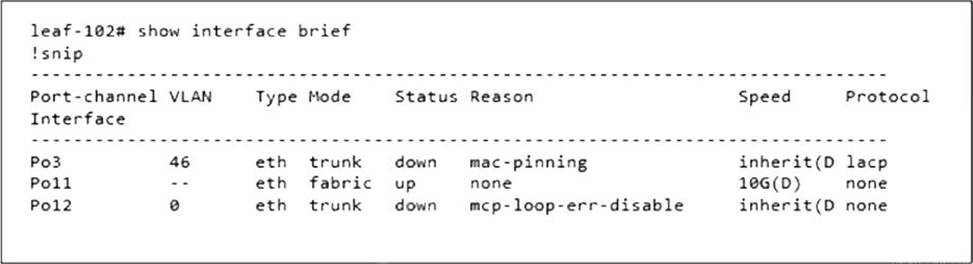
Which two configuration steps are completed before this output is generated? (Choose two.)
- A . MCP policy for the interface policy group for Port-channel 12 is enabled.
- B . MCP Instance Policy default in the global access policies is enabled.
- C . Error Disabled Recovery Policy for Loop Indication by MCP is set to True.
- D . BPDU Guard is enabled for the interface policy group for Port-channel 12.
- E . Spanning Tree Policy Region STP_4CAF232E48FF20 is added to the spanning-tree policy of the switch.
Refer to the exhibit.
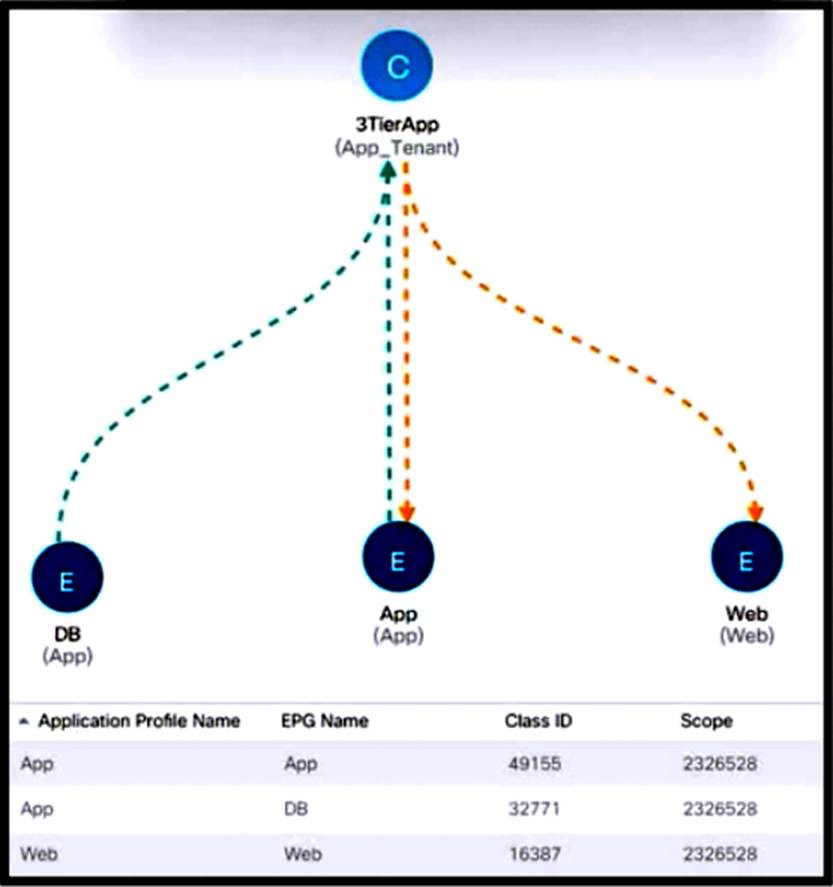
New e-commerce software is deployed on Cisco ACI fabric.
The environment must meet these requirements:
• The overall number of contracts must be reduced by reusing the existing contracts within a VRF when possible.
• The e-commerce software must communicate only with software EPGs that are part of the same ANP.
• The e-commerce software must be prevented from communicating with applications in different ANPs.
Which scope must be selected to meet these requirements?
- A . Application Profile
- B . Endpoint Group
- C . Tenant
- D . Global
A
Explanation:
To meet the requirements for the new e-commerce software deployed on the Cisco ACI fabric, the scope of the contracts should be set to “Application Profile”. This scope ensures that the contracts are applied within the same Application Network Profile (ANP), allowing the e-commerce software to communicate only with software Endpoint Groups (EPGs) that are part of the same ANP. It also prevents communication with applications in different ANPs, thus maintaining the necessary isolation and reducing the overall number of contracts by reusing existing ones within a VRF.
Reference: Cisco ACI Contracts and Scopes Documentation
Cisco ACI Best Practices Guide
What happens to the traffic flow when the Cisco ACI fabric has a stale endpoint entry for the destination endpoint?
- A . The leaf switch does not learn the source endpoint through data plane learning.
- B . The leaf switch drops the traffic that is destined to the endpoint.
- C . The leaf switch floods the traffic to the endpoint throughout the fabric.
- D . The leaf switch sends the traffic to the wrong destination leaf.
C
Explanation:
When the Cisco ACI fabric has a stale endpoint entry for the destination endpoint, the traffic flow is affected in that the leaf switch floods the traffic to the endpoint throughout the fabric (Option C).
This flooding occurs because the leaf switch does not have the correct location of the endpoint in its endpoint table, leading it to flood the traffic in an attempt to reach the destination.
Reference: https://www.ciscolive.com/c/dam/r/ciscolive/us/docs/2019/pdf/BRKACI-2641.pdf
An engineer needs to deploy a leaf access port policy group in ACI Fabric to support the following requirements:
• Control the amount of application data flowing into the system
• Allow the newly connected device to auto-negotiate link speed with the leaf switch
Which two ACI policies must be configured to achieve these requirements? (Choose two.)
- A . L2 interface policy
- B . link level policy
- C . slow drain policy
- D . ingress control plane policing policy
- E . ingress data plane policing policy
B, E
Explanation:
To deploy a leaf access port policy group in ACI Fabric that controls the amount of application data flowing into the system and allows auto-negotiation of link speed, the two ACI policies that must be configured are:
Link level policy2.
Ingress data plane policing policy2.
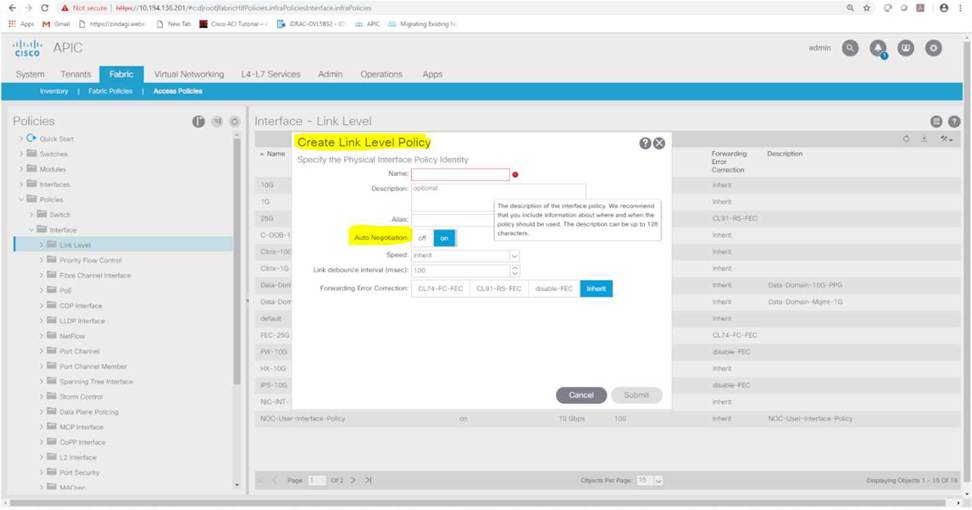
Slow Drain handles FCoE packets that are causing traffic congestion on ACI fabric. So, it is wrong.
Ingress control plane is wrong, because the request is for “application data flowing”.
L2 interface policy is concerned about QinQ and VLAN scope.
Refer to the exhibit.
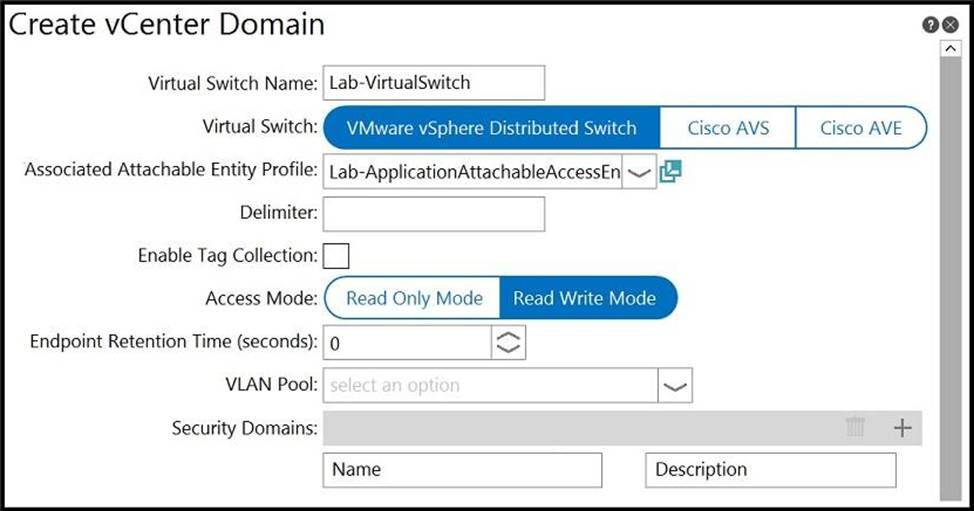
An engineer is integrating a VMware vCenter with Cisco ACI VMM domain configuration. ACI creates port-group names with the format of “Tenant | Application | EPG”.
Which configuration option is used to generate port groups with names formatted as “Tenant=Application=EPG”?
- A . enable tag collection
- B . security domains
- C . delimiter
- D . virtual switch name
C
Explanation:
In the Cisco ACI VMM domain configuration, to generate port groups with names formatted as “Tenant=Application=EPG”, the configuration option used is delimiter. The delimiter is a character that separates the elements of the port-group name. By changing the delimiter setting to “=”, the port-group names will be generated with the desired format.
Refer to the exhibit.
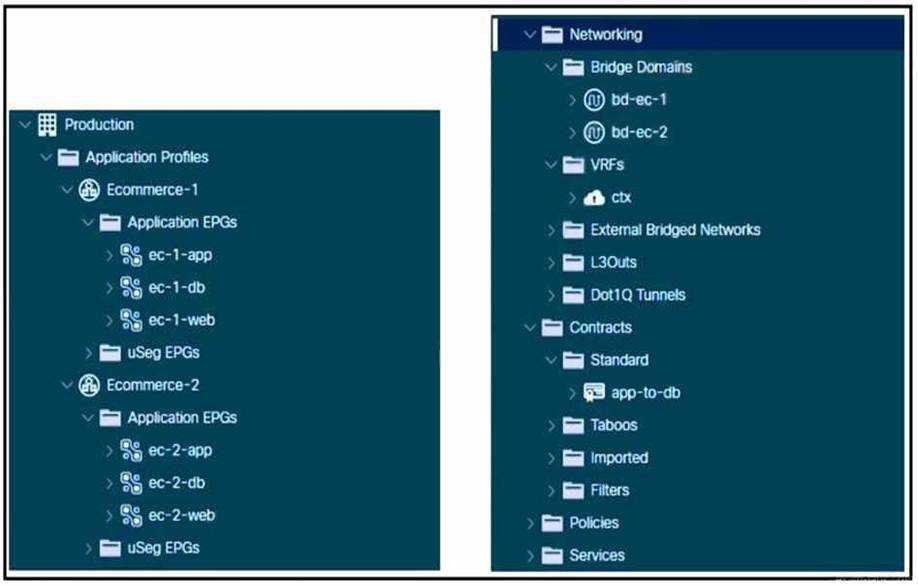
Refer to the exhibit. A Cisco ACI environment hosts two e-commerce applications. The default contract from a common tenant between different application tiers is used, and the applications work as expected. The customer wants to move to more specific contracts to prevent unwanted traffic between EPGs. A network administrator creates the app-to-db contract to meet this objective for the application and database tiers. The application EPGs must communicate only with their respective database EPGs.
How should this contract be configured to meet this requirement?
- A . Set the app-to-db scope to Global.
- B . Set the app-to-db scope to Application Profile.
- C . Implement the app-to-db scope as VRF.
- D . Implement the app-to-db as a Taboo contract.
B
Explanation:
To ensure that application EPGs communicate only with their respective database EPGs, the app-to-db contract should be configured with a scope set to the Application Profile. This scope ensures that the contract is applied only within the specific application profile, allowing for granular control over the communication between the application and database tiers. By setting the scope to Application Profile, the contract will not apply to other application profiles, thus preventing unwanted traffic between EPGs of different applications1.
Reference: Cisco ACI Contract Guide White Paper1
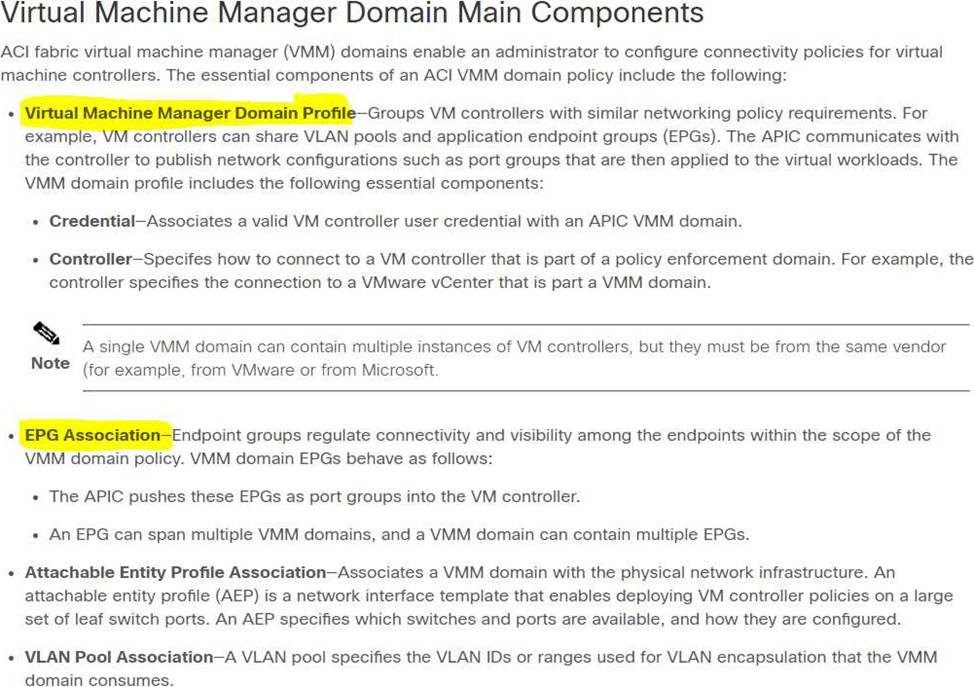
Which two components are essential parts of a Cisco ACI Virtual Machine Manager (VMM) domain policy configuration? (Choose two.)
- A . VMM domain profile
- B . EPG static port binding
- C . Layer 3 outside interface association
- D . IP address pool association
- E . EPG association
A, E
Explanation:
The two essential components of a Cisco ACI Virtual Machine Manager (VMM) domain policy configuration are:
VMM domain profile1.
EPG association1.
https://www.cisco.com/c/en/us/td/docs/switches/datacenter/aci/apic/sw/1-x/aci-fundamentals/b_ACI-Fundamentals/b_ACI-Fundamentals_chapter_01011.html#concept_74EFC437C0AA44A391676F70ACE59DF3
A customer creates Layer 3 connectivity to the outside network. However, only border leaf switches start receiving destination updates to other networks from the newly created L3Out. The updates must also be propagated to other Cisco ACI leaf switches. The L3Out is linked with the EPGs via a contract.
Which action must be taken in the pod policy group to accomplish this goal?
- A . Apply a BGP route reflector policy.
- B . Enable a COOP policy.
- C . Configure an IS-IS policy.
- D . Implement an access management policy.
A
Explanation:
To ensure that destination updates from a newly created L3Out are propagated to all Cisco ACI leaf switches, a BGP route reflector policy should be applied. This policy allows the border leaf switches, which act as BGP route reflectors, to redistribute the learned routes to other leaf switches within the fabric1.